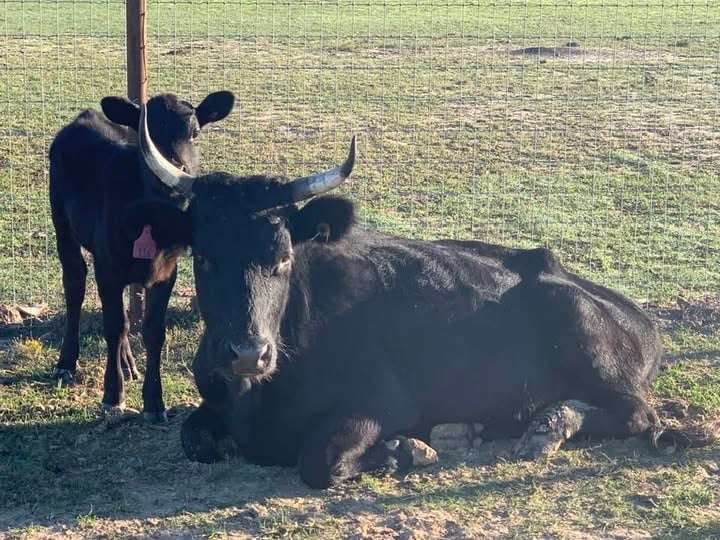
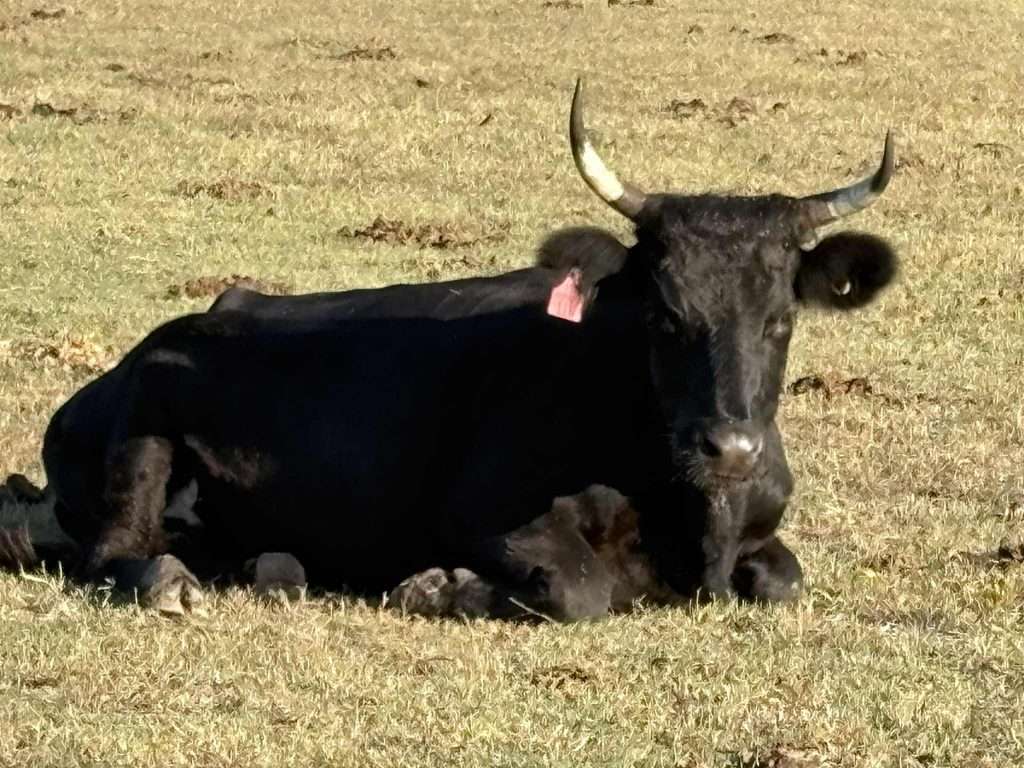
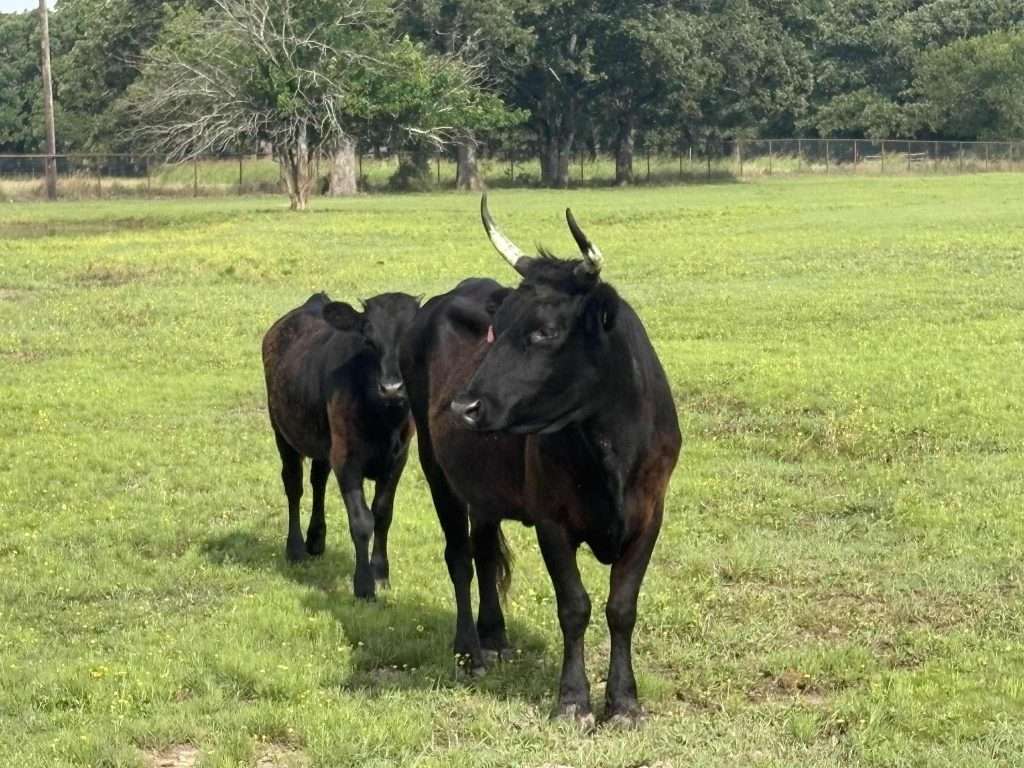
Buy the cattle. How often in life do you just do something that you later think, what the heck did I do? Roll the dice and see what comes up. That wasn’t me. I thought it over. I had a plan. When you have a plan, it always works. At least I try to convince myself of that.
I had the land. 40 acres of woods and pasture. My dream come true. A small turnout attached to the horse stables within spitting distance of a 3 acre pasture. The turnout has 4 rail iron fencing and the pasture has 3 strands of electric wire. The perfect place, in my mind, for my new Dexter cattle.
I had read, multiple times, that Dexter cattle are easy on the land. Smaller, lighter, and easy grazers. A cow per acre, I should be golden. Start small and grow.
Electric fencing, for me, was a nonstarter. I get it. The cattle respect it when trained. It is cheaper than other alternatives and easy to install. One small problem. I don’t like getting shocked. If I don’t like it, my cattle sure as heck won’t.
As a teenager, my cousin, Kevin, and I were raccoon hunting in my Pappy’s woods. Let me amend that. We were chasing our coon dogs through the woods who were chasing deer. The raccoons were very safe.
Kevin announced that he had to take a potty break. It was dark and I pointed my head lamp on anything but Kevin. I heard him yell and fall backwards directly into several thorn bushes. Not knowing what to think I shined my light on him seeing laying down with his pants at his ankles. Kevin was yelling, “I got shocked! I got shocked!”
He peed on an electric fence. Lesson learned. I don’t like electric fences.
But it was November. I won’t put the Dexters on the pasture until the spring anyway. I can buy the cattle and keep in my turnout. I can use the stables in the winter to keep them warm. I can remove the electric fence in the spring and install a new fence. It can’t be much more expensive. That should work. Plan was taking shape. Buy the cattle.
As soon I called, I knew. I found a website of a seller that was relatively close to where I lived. Looked genuinely wholesome, and in this day and age, you never know. I gave them a call. I didn’t know it then, but I say it proudly now, that is when I first spoke to very nice people who I will later call my mentors. If you are new, find one. There are people out there who share the same thoughts, and have experienced it before, who are willing to engage and assist. Take calls from you while you are on your cell phone standing in the pasture, staring at a cow saying what the heck just happened and what do I do now.
I, my wife, and Bear, my beloved dog, were invited to their farm. In fairness to my dog, I don’t know who is more attached, the dog or me. Both of us have a lot of sticky velcro on us. I am happy with either description.
It helps seeing the farm and the environment that the cattle are being raised in. I had decided that the cattle I wanted were cattle that were well taken care of, loved, not horned, and docile. All of those, of course, are a personal preference. After leaving, my wife told me that we just bought some cattle, though the check had not been written. She was correct.
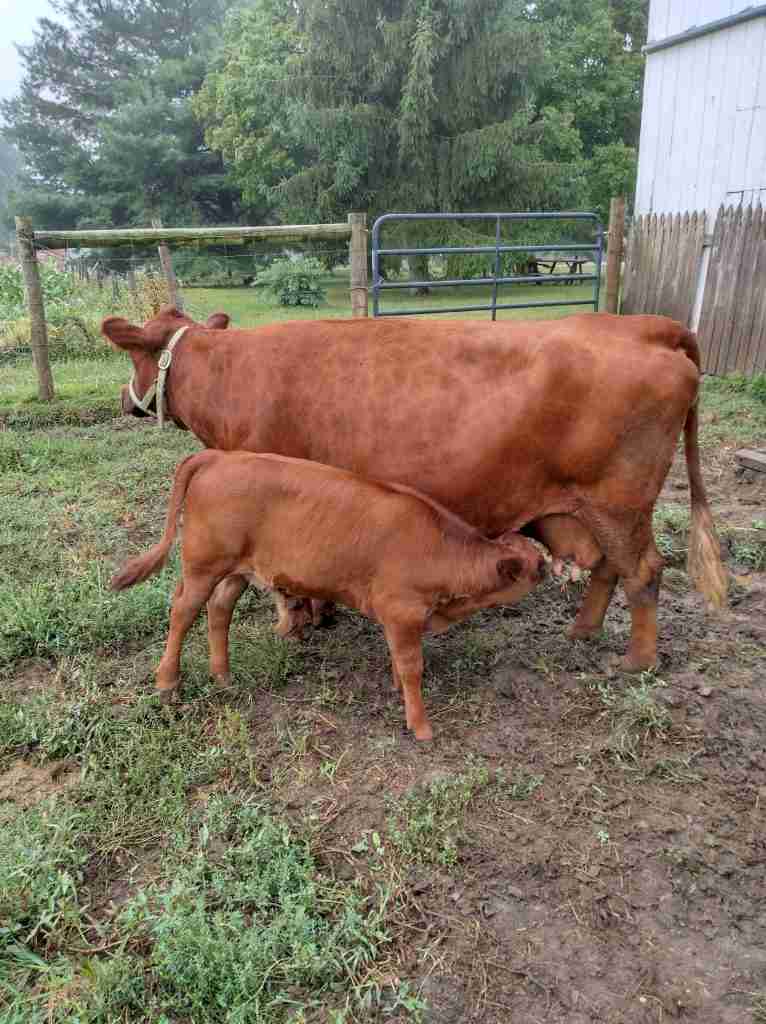
My mentors delivered Bitsie, Willow, Jubilee (in calf), and Liberty just a few days later. Our Yellowstone was in the cattle business.
A little bit about the author. I own and operate a small farm called “Our Yellowstone LLC” in Illinois. I couldn’t do it alone, but will keep my wife’s name out of it to protect her innocence.
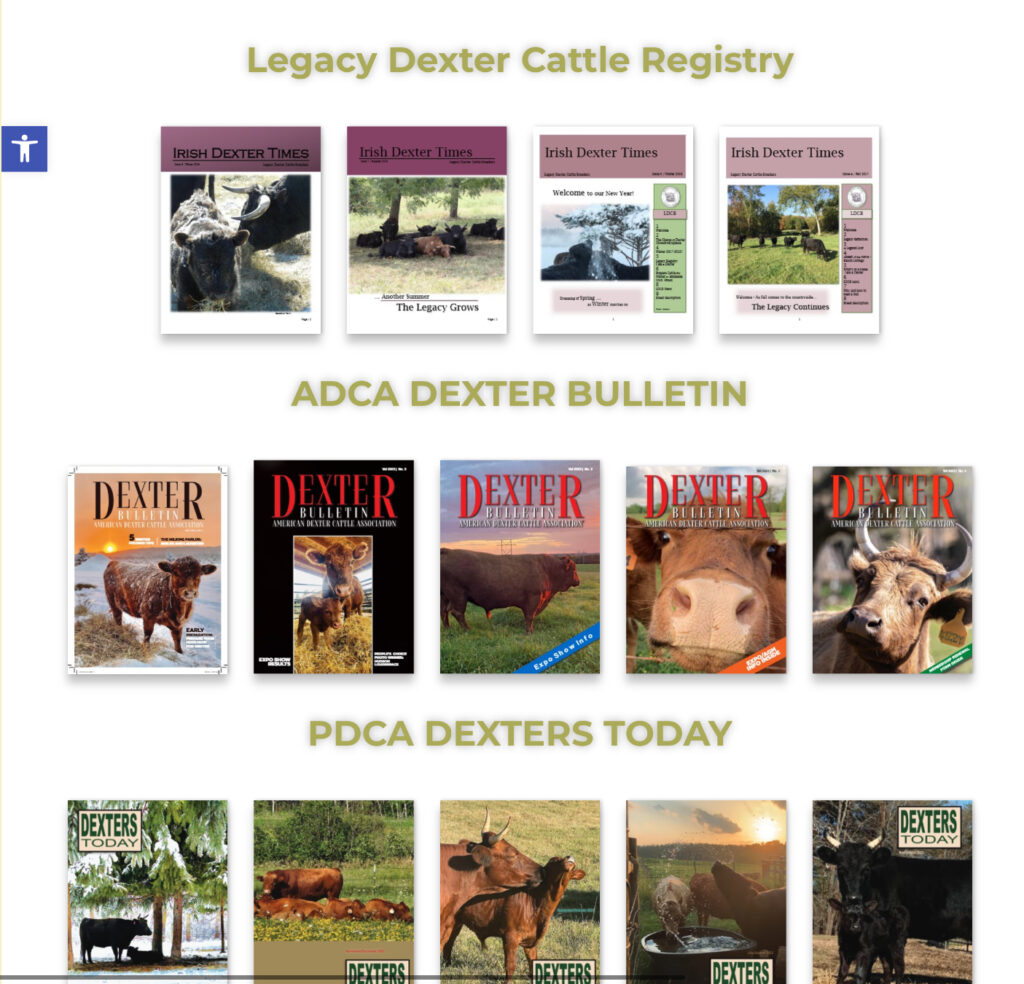
If you looking for more information on our wonderful breed, scroll down past the digital magazines to the flipboard section. There are several of the Dexter Registry Magazines that have been converted into easy to view flipboards. So much history at your fingertips in one place, the IDC Gazette.
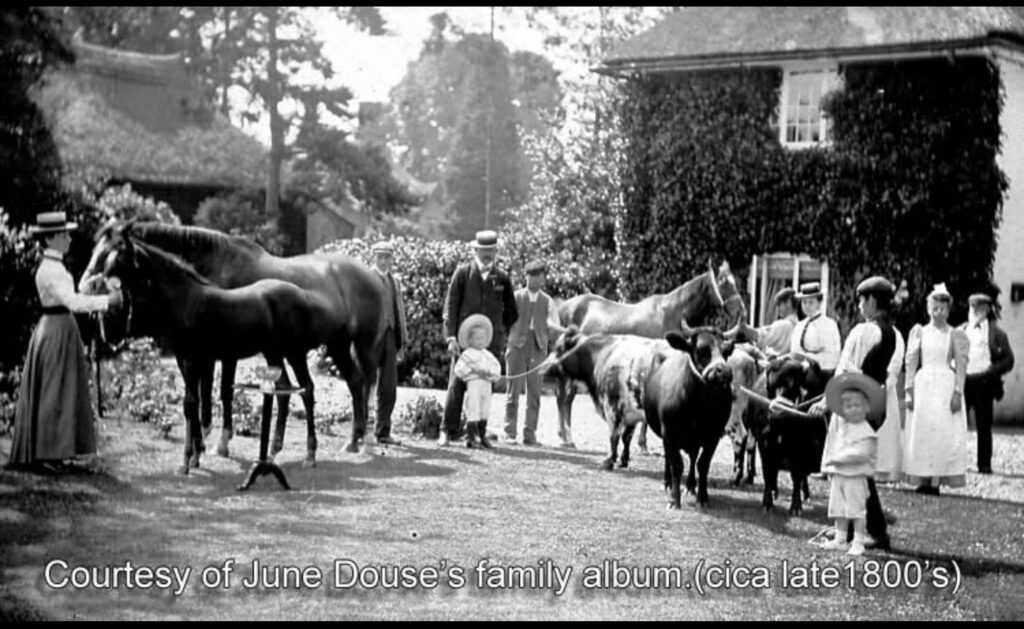
Here is what a Dexter family gathering looked like in the 1800s. Notice that the cottage cow is handled pretty much like the family horse. This photo was taken from the Facebook group DexterCattle Historical with the permission of Judy Spongaule. Judy has a wealth knowledge about our wonderful breed.
Juliette Albrecht is a contributing member of the Irish Dexter Cattlemen, who was born and raised in the dairy industry. She has helped a fellow IDC member save their cow. Look for her articles each month and for past articles in the Gazette.
Juliette also runs two Facebook groups. One is under her name. The other is called The Science of Owning Dairy Cattle.
☆☆ Milk Fever It scares so many dairy cow owners, and for a rightful reason. However I hope that I can shed some light on it and take away a bit of that fear. Hypocalcemia (milk fever) is brought on by the sudden demand for calcium that comes prior to delivery and directly afterwards. This taps her muscles, which carry that, heavily. In a pre calving scenario it will affect labor, since the cow needs muscles to contract. Often in this case she will need assistance. Characterized by lethargic movement, dull, dark eyes, and drop in body temperature, it can also lead to her going “down.”
●● Prevention
First calf heifers are less prone to this, but it CAN happen in them. Commonly it affects 3rd lactation and beyond. From the time she delivers her calf you are either setting her up for a great following lactation, or one doomed to fail. It all start with NUTRITION. Dairy cattle are beautiful, but oh so delicate. She needs fiber, energy, starch, protein, bypass protein and minerals to simply survive. (Keep an eye out for Mariah Gull and her weekly posts regarding this subject!) When a cow calves in she loses body weight rather rapidly. During this time she “milks off” condition. Peak is considered to be day 30 to 90 in milk. If she is being fed correctly, she will not become too thin. Coupled with a good deworming protocol, she will slowly regain weight. At roughly day 80 she ideally will be bred back, and than her body weight will continue to rise. Grain should rise as she peaks to meet her milk volume, than slowly decrease as it falls. If she goes into late stage lactation either too thin or on the alternate, overweight, she is being setup for metabolic problems. During the dry period I either cut grain off completely (during spring and summer grazing, when forage quality is high) or feed a 2 to 3 lb per head feeding rate during the fall and winter.
Transition refers to the time before estimated due date. This commonly starts at 3 weeks out from calving, and technically extends to 30 days in milk. This is my protocol.
1) stop salt access, as it increases the chance of edema.
2) feed either a high fiber, grassy hay or have her graze similar.
3) feed 3 lbs a day of our parlor grain (18 percent protein)
4) top dress with the negative DCAD Soy Chlor
Five to seven days prior to delivery her appetite will drop. If it is significant I give B Complex.
On this protocol I see very little metabolic problems. However I always give Bovikalc to…
A) an assisted birth
B) twins
C) a cow with a known history for metabolic problems (milk fever, metritis, ketosis)
Should she go down, IV calcium is the only way to get her back up.
A cow that has had milk fever typically never reaches her full potential in milk volume for that lactation.
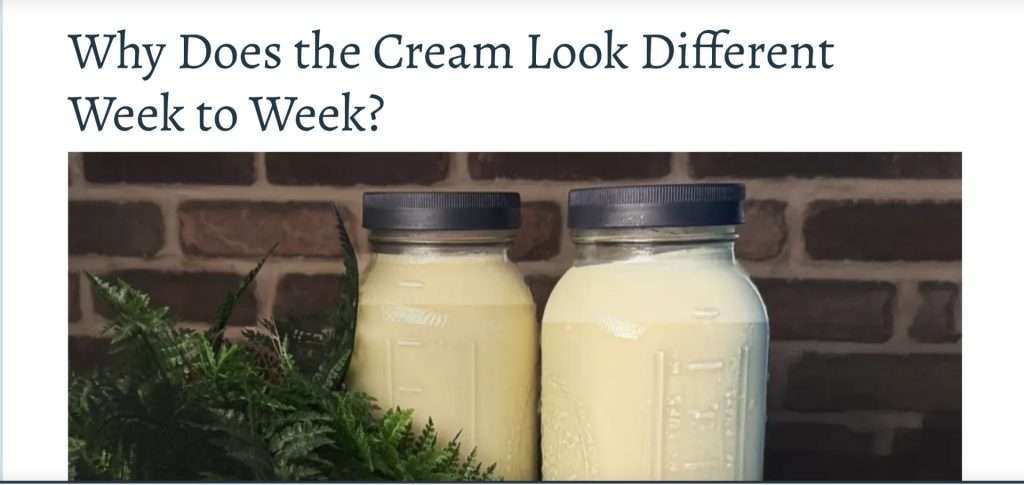
Here is an interesting article from a fellow Dexter milker, Michele Parsley. Real facts about how it varies and why. Don’t forget, some of our cream stays behind and never completely separates, making two incredible products, cream and still some pretty creamy milk for drinking or making something else. Celebrate your Dexter milk and cream!
COVID. It sucked. No matter what aisle of the plane that you sit in, even if you just want to stand in the middle, it sucked. There was tragedy, heart ache and despair. Some are still recovering. Some never will. All that said, it was eye opening for me. An introvert by nature (though very few of those that meet me will agree with that description), COVID was somewhat of a respite. It forced, for better or worse, solitude. For me, it brought peace. It got me thinking about our world and my place in it. It was time to start questioning old habits and accepting the norm. It was time to start doing.
Where do I start? As my late Dad would say, at the beginning. I started to look for property in a rural area. That was my first mistake. I didn’t have a solid foundation as to what I wanted to do. I looked at field, woods, and pastures. Some had homes, and others did not. About all of the properties were a good distance from where I lived and some were located in other States. After becoming exhausted and frustrated, I realized that my search was futile. I needed to establish what I wanted to do and with what animals.
My initial thought was horses. My thought is I could breed horses, and/or run a boarding business. It was my wife, ever the cynic, who asked the first pointed question. “Do you know how to ride a horse?”
Contrary to popular opinion in my household, I was a seasoned equestrian and rodeo champion. At least in my mind I dreamed I could be. That said, I scheduled horse back riding lessons. While I enjoyed the lessons, and riding, I started to think it was going to take a lot of time and experience to take other people’s horses in and provide appropriate care. But alas, fate had other plans. My wife quit asking about trivial things such as my ability to take care of horses and we sold our home and bought a home with horse stables and acreage. For me, it was heaven.
Then reality set in. I remembered what the goal was. The goal was to raise our own food. Horses would be welcome, but horse meat will never be in our diet.
The internet, love it or lump it, is a source of a great deal of information. I play the game. In that, I mean, I disregard all the “great” comments, and all the “terrible” comments and seek the middle, I tried to not seek articles that I favored but cast a wide net looking for neutrality. Just the facts, ma’am. What I found intrigued me. Dexter cattle. Ideal for beef, milk, and smaller areas of land. Hearty animals and docile in nature. Not miniature, but smaller in stature. Less intimidating for the new and not an animal that has to be considered a pet.
I compared to different breeds. I was intrigued by grass fed and milk that many argue is better suited to sensitive stomachs. Not only for feeding my family, but the potential of feeding others. I was not looking for marketing gimmicks but trying to fit a niche. My niche. I was told finding the acreage was the hardest part of raising cattle. I can say with 100% certainty, that is a lie. But I am having so much fun living my dreams with our Dexter cattle.
A little bit about the author for those who have read this article or maybe even the first article and scrolled to the bottom of this article just to see if someone had the guts to admit writing this. I own and operate a small farm called “Our Yellowstone LLC” in Illinois. I couldn’t do it alone, but will keep my wife’s name out of it to protect her innocence.
The old saying “No feet, no cow” is a phrase that denotes the importance of a cow’s ability to walk. Without good feet there can be no cow to stand on them, thus causing peril to the health of the cow. No Udder, no cow could be a similar maximum, denoting the importance of the cow’s udder. Without a good functioning udder, a cow cannot fulfill her role to nourish a calf or humans thus degrading her value as a cow. Not every Dexter needs an udder like Atlantic Alison, but the quality of a Dexter cow is tied up in the function and quality of her udder.
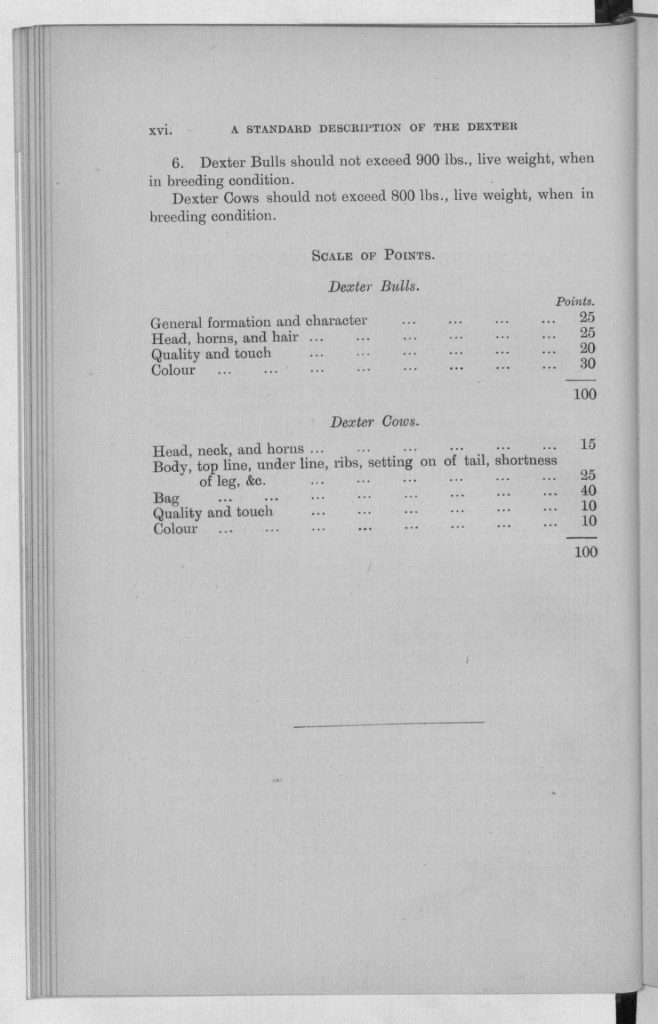
Scale of Points taken from the 1900 English Standard
This scale of points as seen above, is the first scale of points written for Dexter cattle and the most authoritative in breed history. It makes it clear what values can be attributed to a Dexter cow. As you can see udder traits are very important to the Dexter breed. There is no room in the Dexter breed for cows with truly bad udders, as it’s not agreeable to the standard scale of points. So, you see, 40% of a Dexter cows value of points is wrapped up in the quality of her udder, where only 25% goes for her body. That 25% is not just shortness or depth alone but “body, top line, under line, ribs, setting of tail, shortness of leg &c.” The point is cows with good udders are very important to the breed. A cow that lacks valuable udder points would scale very low as a Dexter in general. A cow that is not perfectly short could still score quite high as a Dexter if all other traits were ideal. A short Dexter with a bad udder would easily be beat by a taller Dexter with good conformation and an excellent udder.
Come check out our growing TikTok account and join the fun! Our content is a great mix of cute, fun, informative, and everything in between—there’s something for everyone. Be sure to follow us so you don’t miss out.
Want to see your Dexters or your farm featured? We’d love that! Feel free to send photos and/or videos to 📧 ti****@******************en.com
We’ll also be posting new ads on TikTok. I’m currently catching up on existing ads, and once we’re up to date, your ad will be posted as soon as it goes live on the website.
Have content ideas or interesting Dexter facts to share? Photos, videos, and suggestions are always welcome, just send them to the email above.
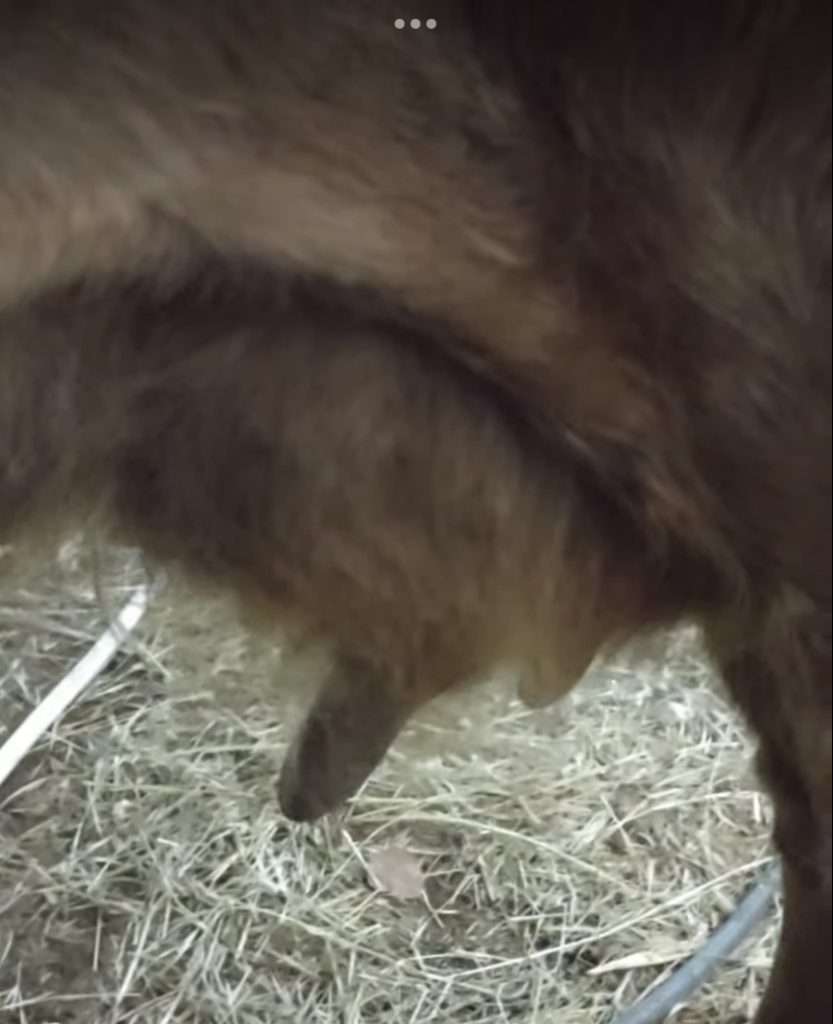
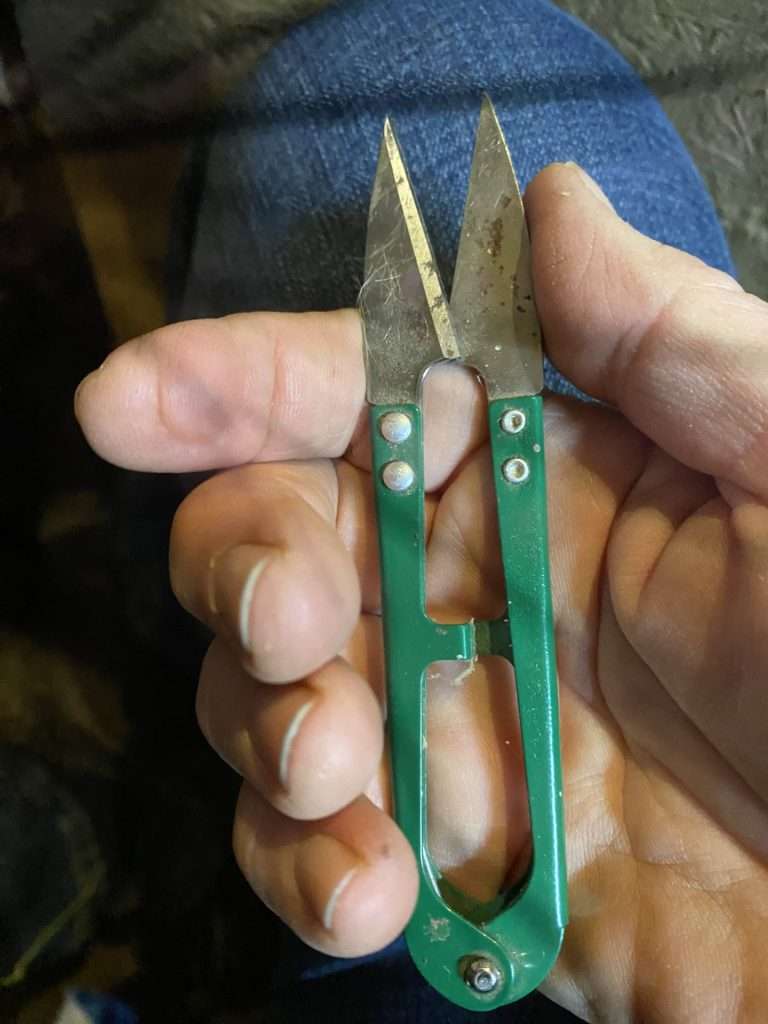
Let’s face facts. Some of our Dexter gals have some pretty hairy udders. All that hair is not something we want if we are trying to milk them and provide a clean product. I use these handy dandy scissors pictured below, but some folks also use electric clippers, as in the short video below.
What ever method you choose, make sure you do it, it makes cleaning the udder sooo much easier!
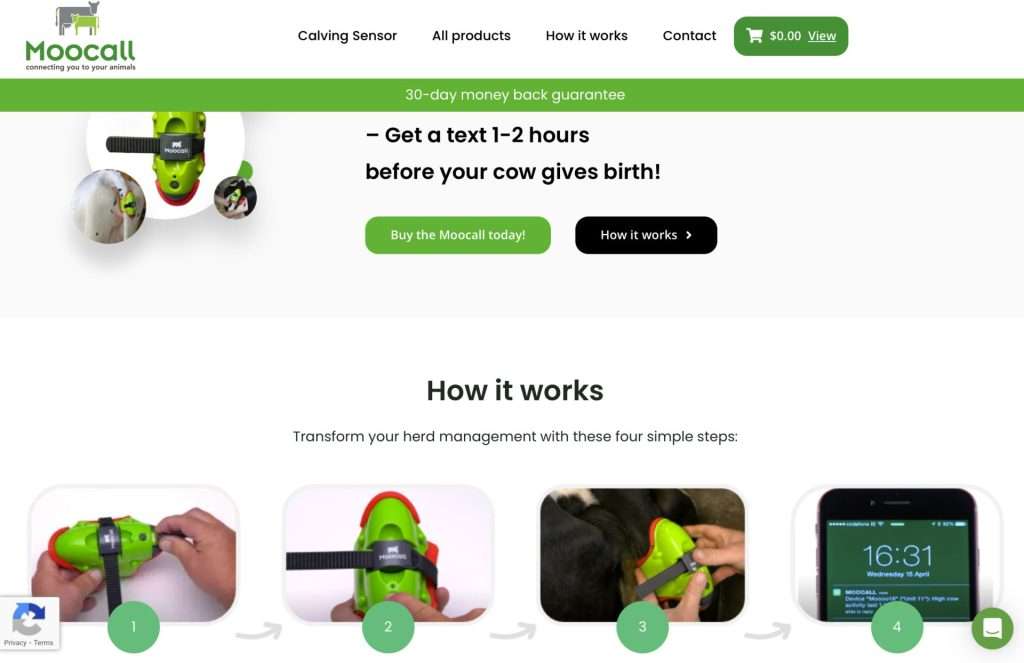
After many nights of interrupted sleep, due to monitoring a heifer and her first calving, I decided to let technology given it a try. I purchased a Moo Call device. Of course it arrived and she went into labor, but I decided to given it a try on my Dexter due.
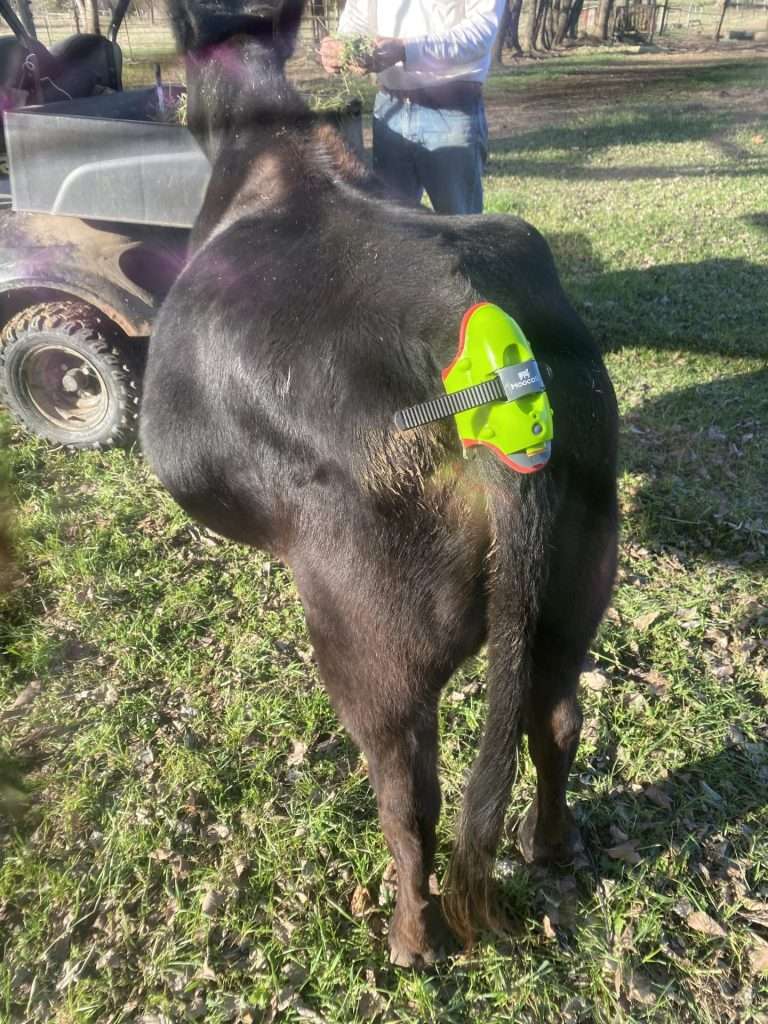
It was pretty simple. I followed the instructions and had to cut off to sections on the red rubber grip to get a proper fit. After that I attached it to her tail and monitored during the day, like I always have. I figured she was a few days out and mostly used it at night, so I could sleep.
After a brief phone call with them, to make sure it was working properly, I relaxed and decided to give it a chance. He due date came and went, but all of my experience told me she was not ready and I slept like a baby.
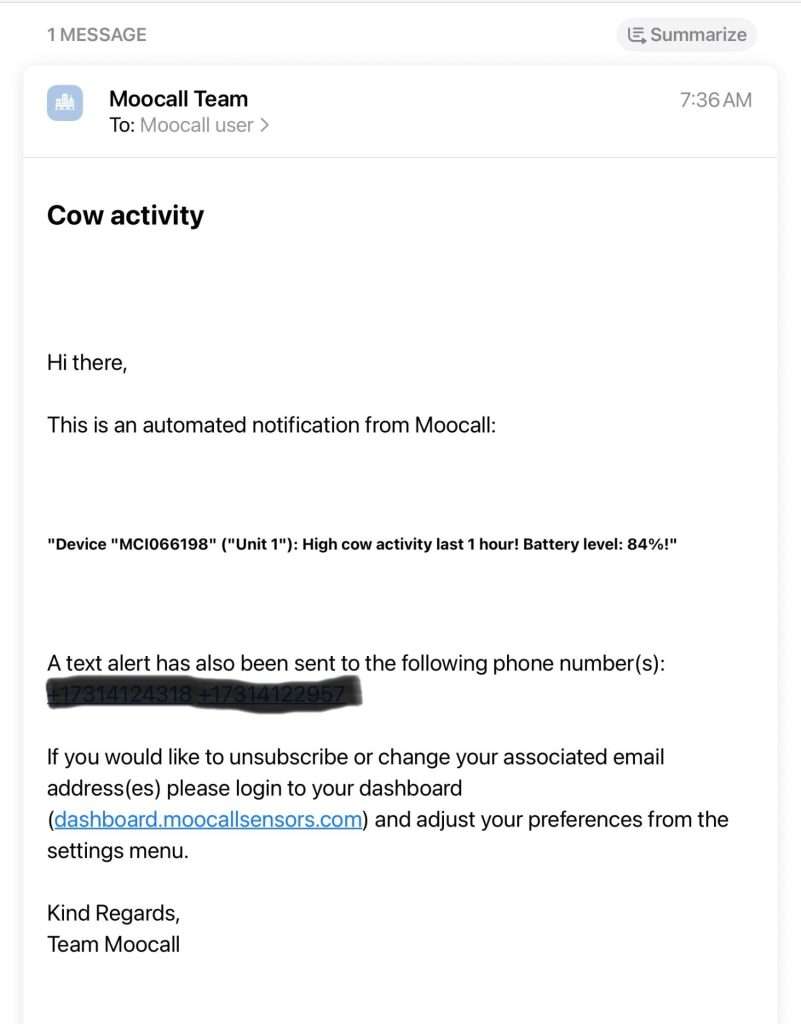
The next morning while finishing up miking, my husband said…Did you just get an email like this? I grabbed my phone only to have it MOOO at me! I had received the email and text…but now it was mooing at me from the APP I had downloaded.
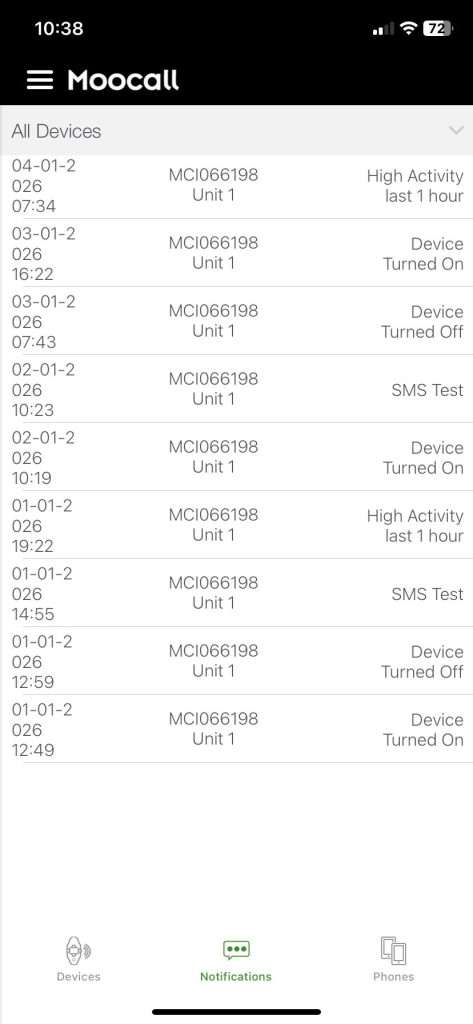
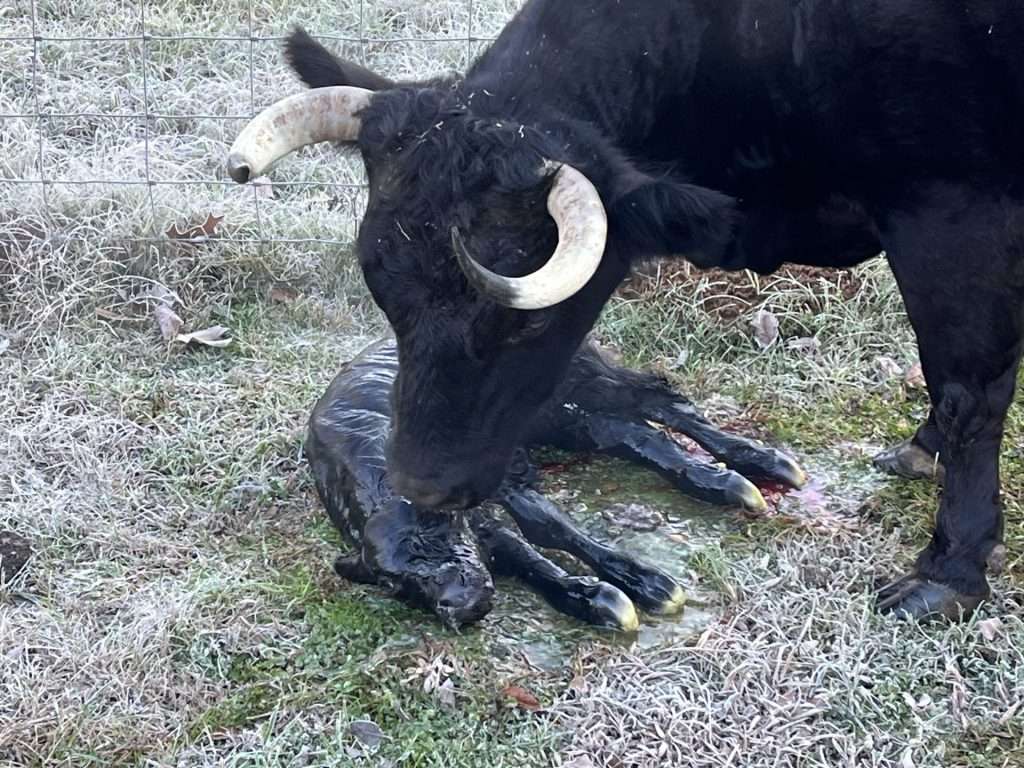
We quickly finished up and went to check on her…and yes she was in the beginning stages of labor. The Moo Call said she would calf within the hour…and she did! The alerts started at 7:34 and the calf arrived at 8:18. Here are some visuals of our experience.
Did you know that we have given everyone a free ad to try out the Irish Dexter Cattlemen Marketplace? That’s right! Give it a try!
I have found it a great place to produce a professional looking ad that can be shared anywhere.
Recently, we have tweaked some of the features to make it easier to use. The pictures are automatically resized to work with the system. No pre approval process. We can tweak it later if we need to. And also a team behind you that can help you make it what you want it to be.
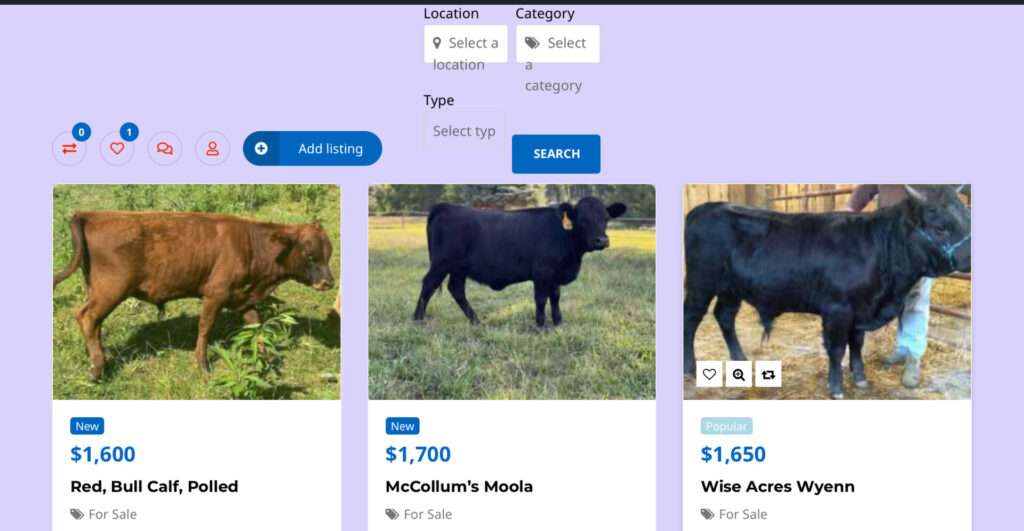
Here are some recently posted ads. Check them out!
Irish Dexter Cattlemen is about farmers & Ranchers. A critical design feature of the website was to connect farmers & ranchers with each other using the latest technology. For example, whenever you list an item for sale in the MarketPlace, you instantly become connected to the buyers interested in your item. Buyers can directly message you and ask questions about the cow you have just listed. As the seller, you begin to collect the names and email addresses of all your potential buyers. This is one way farmers & ranchers become connected to each other..
Announcing the Documents Vault, a new way farmers & ranchers can share information with other farmers & ranchers, plus a unique way to dramatically simplify the sale and transfer of your Irish Dexter. In fact, you can use the Documents Vault to sell and transfer any item you have on the farm. The key feature is how it can share.
How Do I Access It?
Casual users browsing the Irish Dexter Cattlemen website, users who have registered for free on the website, and members who have registered and then have become members, all have access to the Documents Vault in increasingly feature rich ways depending on their chosen level.
To access the Documents Vault, mouse over Dashboards on the main menubar, then select My Documents Vault. If you are a casual user, this will open the Public Documents Vault containing folders and documents relevant for public viewing. If you are a registered user, this will open your Private Documents Vault where you can create you own personal folders where you can upload files and documents plus you will have acess to folders and files shared with you by other farmers & ranchers. If you are a member, you will have access to the same files and folders as do registered users plus you gain access to significantly more valuable documents that enhance your farming operation.
What is it? How can I use it?
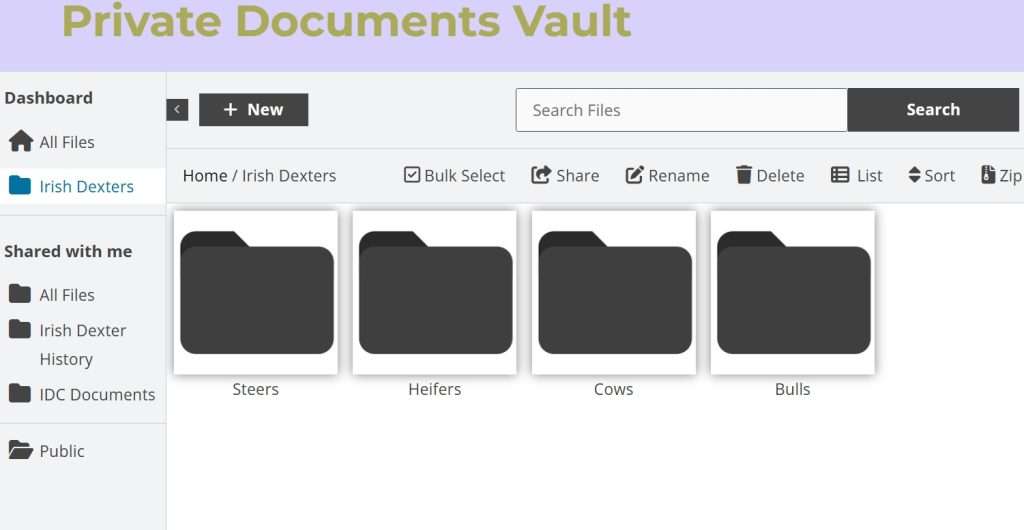
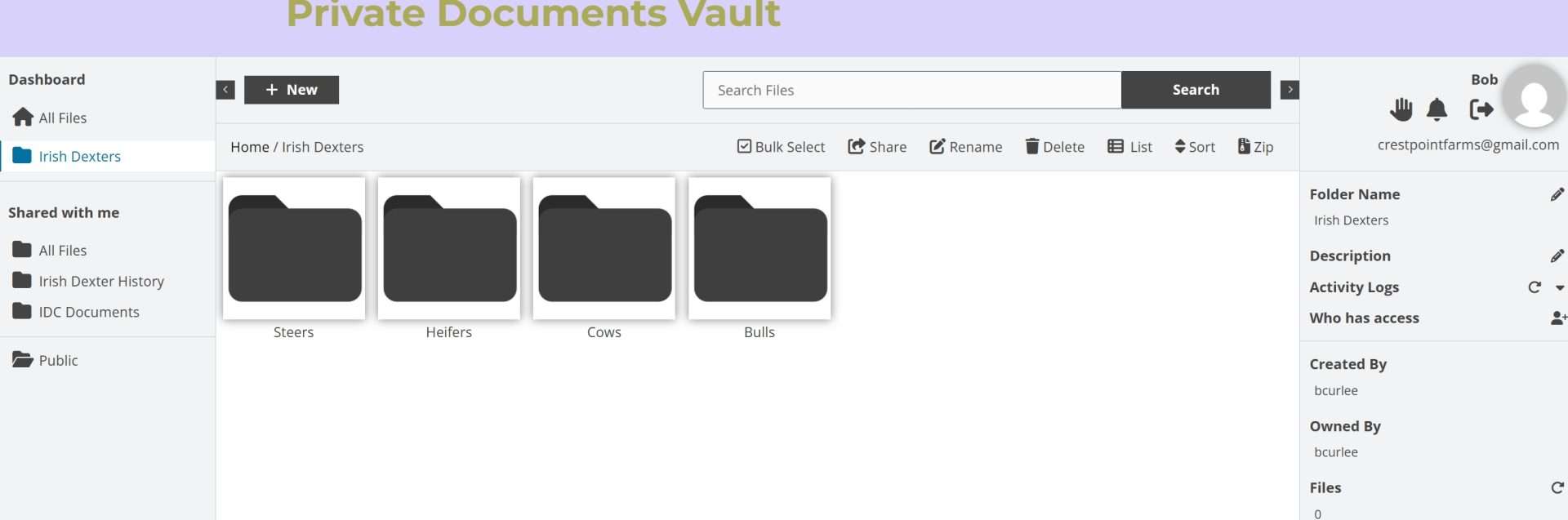
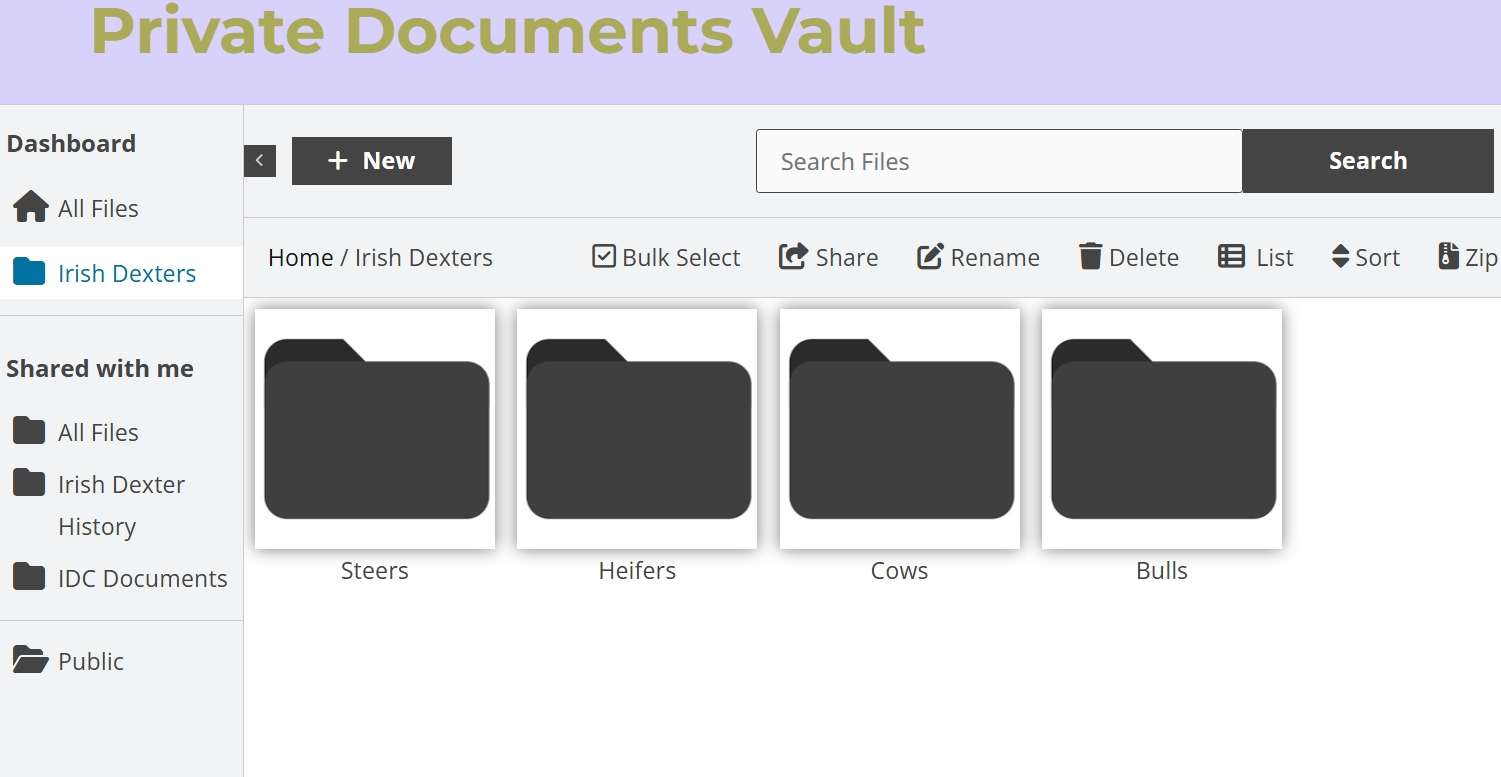
The Documents Vault is no different than an ordinary file system except in one important way. It provides you with file and documents sharing. To begin, use the New button to create folders or upload files. In this example, a new folder was created and labeled Irish Dexters which you can see on the left under Dashboard. Clicking on this folder allowed for it to be opened and four more folders were created as you see above. Click on the Cows folder and here you can create a separate folder for each of your cows. Click on a specific cow’s folder and you can begin uploading the documents for that cow. What kind of documents? The system accepts Word documents Excel spreadsheets, PowerPoint presentations, text files, pdf documents, images, and photos. This means you can upload a photo of your brucellosis certificate provided to you by your vet. Upload your cow’s registration certificate provided to you by your registrar. Upload the genetic tests provided by your genetics testing lab. Upload your cow’s photos. Collect all the documents as they occur. Use your smartphone to capture your documents. What’s the benefit? When time comes to sell your cow, or heifer, or bull, one simple click of the Share button transfers all your cow’s information to your new buyer. This is how you build value for your farm and your buyer will instantly see that your farm is where they want to buy more cows.
How do I share?
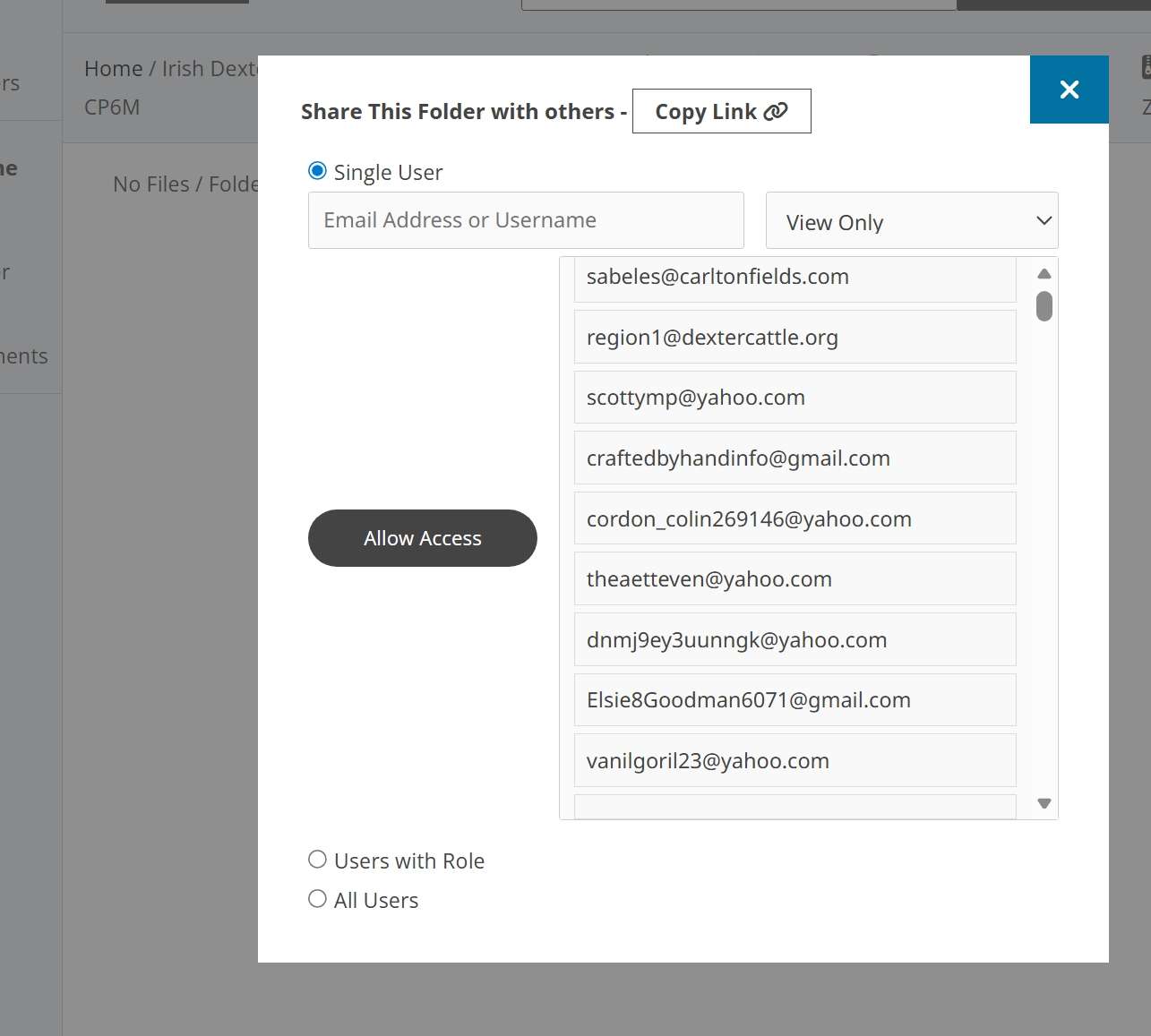
Click on the folder then click on the Share button. It’s as easy as that. In the Share window (shown above) you can enter the buyer’s email address (they must complete a free registration on the website first) and then choose how you want to share your folder. Your choices are View Only, View and Upload, or Full Access. Any folder or for that matter, any single document can be shared. Sharing does not remove the folder or document. You continue to have full access to it, just as before. This new tools makes it even easier to sell and transfer your Irish Dexters and you have a direct record of who bought your cow. They buyer has a direct record of where they bought each animal. They are sure to buy more from you again.
Summary
Your fundamental, underlying goal in the operation of your farm is to build value. The Documents Vault does just that. It keeps you organized and it demonstrates to your buyers a significantly higher degree of trust. They are assured that they get everything they bought. This means that your buyers will be contacting you first for all their future purchases. The example here was for your Irish Dexters, but anything on your farm can be documented and shared in the same way. Also, you can add new information on how you farm and capture information you think is valuable and easily share it with everyone at Irish Dexter Cattlemen by selecting All Users in the Share window. The Documents Vault is how Irish Dexter Cattlemen connects farmers & ranchers.
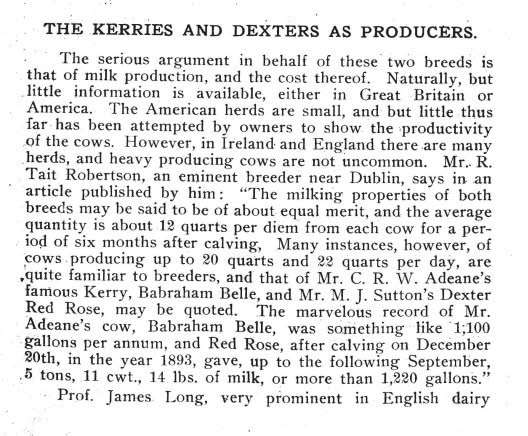
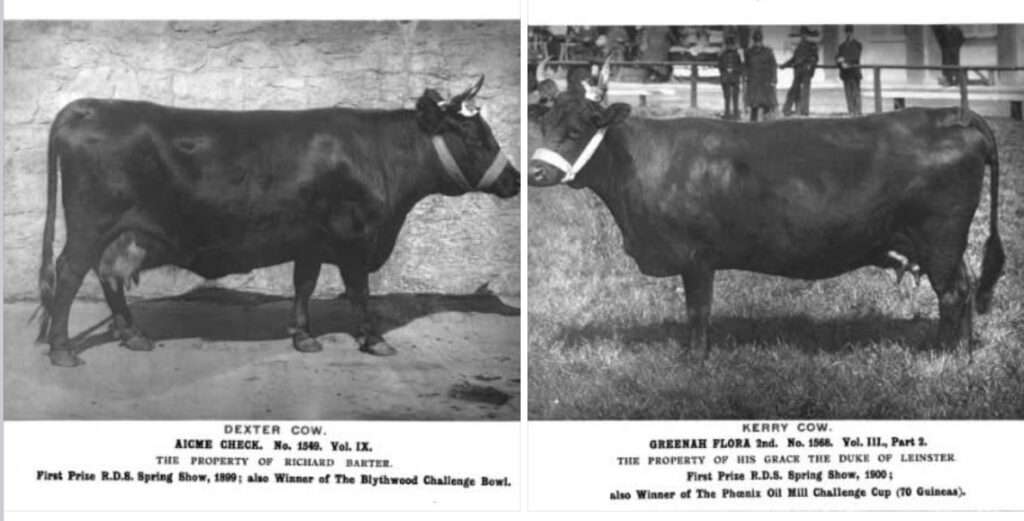
Many may not know that the Dexter at one time was known to have milking properties of equal merit as the Kerry, a known dairy breed, though they are a dual-purpose breed. Mr. R Tait Robertson was to of said ” The milking properties of both breeds may be said to be of about equal merit”. Who is R. Tait Robertson? He is the son of James Robertson, of whom bred or collected a large portion of the foundation Dexters sold to England and other places. He was an influential breeder. For an interesting photo reference of the amazing similarities of Dexter and Kerry cattle see Aicme Check (Dexter cow) and Greenah Florah 2nd (Kerry cow). I did not have to hunt far and wide to find examples that looked closely related. All I had to do is go to the 1901 Herd book and find the only available photos of an example Kerry and Dexter cow. And by the way note the classic white Dexter udder marking on the Kerry cow as this was a common Kerry trait feature too. Nose to nose as you can see in the photo comparison they do look quite alike.
Are you struggling to sell your Irish Dexters? Their Beef? Farm made products?
I think one of the hardest things for the Dexter owner is to sell their products. I have a background in marketing, sales and science, which seems to have helped us find our niche. The Irish Dexter dairy and beef are a niche products and should be marketed with that in mind. We happen to be grass fed, grass finished another niche market. I think if you take a step back and look at your market, you will be able to carve out a niche for your Dexter products. I use the chef Ramsey card all the time….do you know that he prefers Dexter beef and uses them in his restaurants.
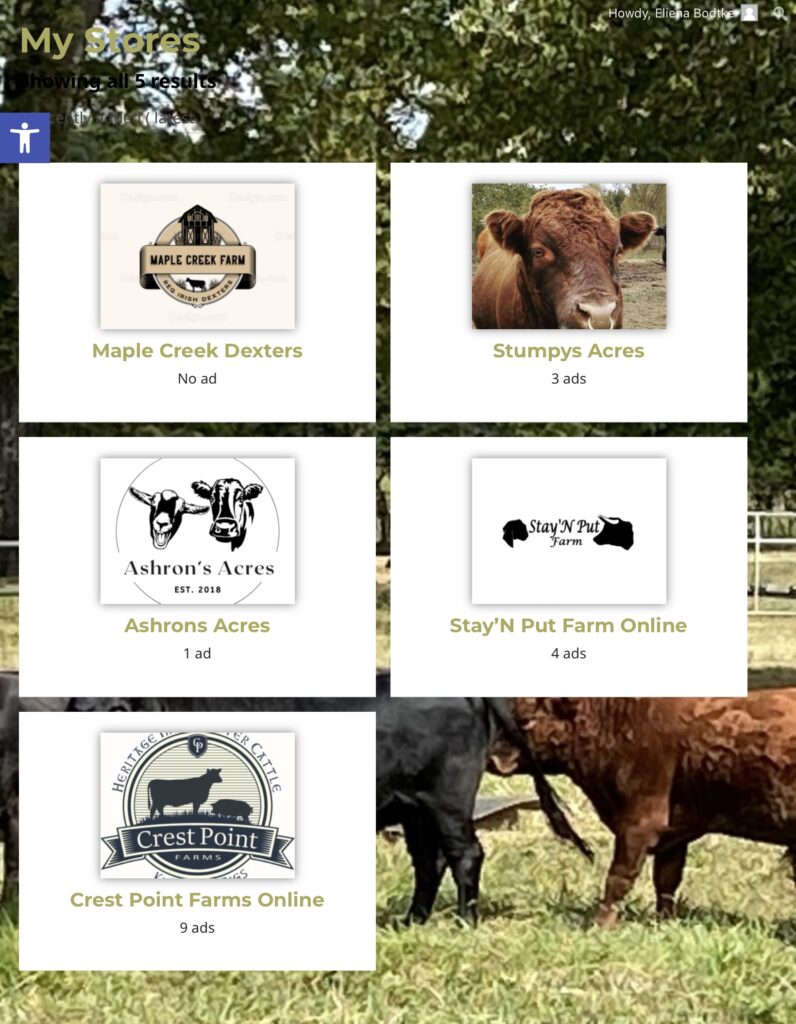
Did you know that Crest Point Farms, also a member of the IDC online stores is a supplier to the restaurant market. Take a look at his marketing on our website and you will see his marketing of both his Irish Dexter beef and Kune Kune pork. Using the systems put in place for you at the Irish Dexter Cattlemen ( IDC) website you should be able to create this niche for you and your products in your area.
Take a look the products available from Stumpys Acres and Ashron Acres? They are selling Dexter beef and handmade farm items. Also take a look at Maple Creek Dexters, they have no ads currently running, but a lovely write about their farm. Lucky them, they have nothing at the moment that they are trying to sell. This happens with repeat customers and word of mouth selling from happy customers.
But if an online store is not right for you at this time in your marketing…then look to the IDC Marketplace. To receive a free ad for the marketplace all you need to do is register first and then fill out the information as it prompts you thru the process. The end result is a beautiful professional looking ad. You can then copy and paste that link anywhere like FB, IG or an email. I have found that by using the ad link I look more professional and now have a wait list for my Nubians, Dexters and my soap business has certainly taken off in a big way, as I am now shipping more and more! It’s no longer just a local sale. One important feature for me is…it lets me know when my inventory is low by item. This is helping me produce what I need for my growing business.
The IDC website is so much more than just a marketplace and free monthly newsletter. With an entry level membership you have access to practically everything in the cattle industry, specific Dexter articles, and access to all three registries….I no longer need to remember other website addresses. The IDC website is a one stop shop for everything I need, and provides access to anything Dexter.
Minerals are a small, but mighty, nutrient requirement for cattle. These elements cannot be made by the body and they are essential for proper function of the skeletal, immune, and muscular systems.
Dexter beef is a breed of cattle that is known for its quality and taste. It is commonly known in foodie circles that Dexter beef is some of the tastiest around and really good to eat.
”With the rise of farm-to-table eating and artisanal meats many diners are seeking out flavorful beef from non-commercial cattle breeds. One such breed gaining popularity is Dexter beef a tender, succulent meat from small, hardy cows native to Ireland.”
The mama is #116 Briarhook Juno Legacy # L03860LH-19HH and bull calf born September 29 with Fitz’s Golden Legacy Dillen. Dillen is our current sire, and he is the progeny of Colorado Chief and Chautauqua Demelza.
About the author… Angie Gaines grew up in the Sandhill Piedmont of North Carolina. As a child she accompanied her grandpa to cattle auctions. They raised feeder stock in the wonderful sandy loam. Her mother and father raised registered Polled Hereford cattle and their favorite standing bull was called Jerry Justin Banner 3rd. Almost twenty years ago Angie decided to be part of the preservation of the Irish Dexter cattle loved in Ireland. When she shared a photo of her beginning herd her mother aged 78 exclaimed; “Wow, look at those horns”. Angie responded with “ Mama, if a cow wants to hurt you they don’t need horns to do it”. Angie now resides in Texas with her wonderful Irish Dexters and Curly Mustangs.
====================
I gaze out my window on a rainy day and see three beautiful Black horned Irish Dexter cows, Juno, Flora and Faye grazing on the lush Spring grass in the Lone Star State. I wonder what it was like when their ancestors grazed just outside a little hamlet known as Argyle about 100 miles Northwest of Dallas, Texas of me. Their ancestors were the foundation for a line of Irish Dexter cattle that 50 years later would be known as the Legacy “Colorado” line and I am intrigued that these wonderful cows have made an interesting journey back to Texas.
“Mark and Marge (Davis) were living in Colorado when they first read about little cows known as Irish Dexters. Mark borrowed a trailer and traveled to Argyle, Texas to purchase his first cow and calf and a 14-month old heifer. ‘The cow was milking, but she was very wild”, he said with a chuckle. “A rancher friend of ours taught me to milk.” The couple later purchased a herd bull from Decorah, Iowa and in 1966, they and 5 cattle moved to Delaware. Mark Davis was a past President of the American Dexter Cattle Association.” He was also the Delaware registered agent for PDCA incorporation until recently.
The oldest Colorado cow owned by Mark and Marge Davis listed in our wonderful resource the Legacy Irish Dexter Registry is Colorado Queen (circa 1967). She goes back to Lady Knight who was bred by Dr. Harvey Goettsche in Dallas, Texas and Edmonde LeRoux, Argyle, Texas. Dr. Goettsche, was a well-known dentist who enjoyed the ranching life as a hobby. His partner Edmond LeRoux, had a beautiful ranch in Argyle, Texas and was a retired American Airline pilot with an impressive history of helping U.S. troops fly to destinations including the Far East, Japan, Australia and more with the Military Airlift Command and American Airlines.
Lady Knight has awesome ancestors who are beloved in our Irish Dexter community including Grinstead and Peerless. She is also the dam of the well-known bull Colorado Chief whose sire was an Irish Dexter bull Mark Davis went to Iowa to and brought back to Colorado. Marge Davis shared this in a phone conversation. She shared the wonderful journey that has become the foundation for the Colorado herd.
Briarhook Juno
Since we have explored how Lady Knight and her heifer left Argyle, Texas and became the foundation of the wonderful Colorado herd, let’s go back and explore how the Irish Dexter cattle came to be found in Texas. Lady Knight was the progeny of a nice bull registered as Captain Fortune and bred by Otto C. Jensen. Captain Fortune’s ancestors were direct registered cattle from the Peerless herd. “The foundation for the Peerless herd at Decorah, Iowa, was obtained by John Logsdon from the Elmendorf Farm, August A. Busch and James J. Hill, in 1919. Later, two bulls were obtained successively from Daniel Guggenheim, owner of Hempstead House herd. In 1944, when the Peerless herd had their first public sale, the herd numbered 150 head of cows and heifers! Peerless herd is the oldest Dexter herd in the United States. “ (Remember the Busch name as we continue this journey through history.)
With the tireless work, Judy Sponaugle has put together a researchers dream, creating the Legacy Irish Dexter Registry. Within a few short strokes on my keyboard and a quality internet connection, I am able to see that Lady Knight’s dam was the beautiful Black Duchess who was born in 1958. Edward Lord bred her with Atlantic Cornelius as her sire and Framfield Roda 7th as her dam. Both of Lady Knight’s parents were registered in the Dexter Cattle Society (DCS) founded in the United Kingdom. Both Atlantic and Framfield’s dams were the well-lovedGrinstead dams and going back till the beginning of the DCS (Dexter Cattle Society) conception circa 1892.
Back to the Lone Star state, we find a handsome Black Bull named Mark Anthony. His parents are Black Duchess and Atlantic Cornelius. His owner and breeder is a well know colorful character in the history of Texas, Clint Murchison. In my search, I have found little documentation about Irish Dexters, but it was well known that Mr. Murchison loved ranching. Ernestine Orrick Van Buren points out in her book Clint: Clinton Williams Murchison: A Biography : “In the late 1930s Murchison began diversifying his investments. He acquired numerous life-insurance companies, banks, bus lines, publishing firms, heavy industrial building materials companies, and an assortment of companies serving such leisure activities as hunting, fishing, travel, and gardening. He was a cattleman throughout his life and acquired extensive ranches in Mexico and East Texas. He experimented in improving cattle strains and in developing superior grazing grasses.”
Yes, millionaires loved our Irish Dexters, too! Speaking of millionaires let’s go back and visit the Anheuser Busch family and their involvement in Irish Dexter cattle and Texas. I ran across a 1916 newspaper article from Waco, Texas where 14 Irish Dexters belonging to Anheuser Busch Dexter Cattle. The cattle was transported via train to show their exhibit known the Bevo during a “tick” quarantine. The event appears to have hugely popular. We do know from well-kept records that , “In 1914, August A. Busch of St. Louis, Missouri purchased Dextersfrom C.D. Gregg of St. Louis and established the Grant’s Farm Herd. Additional animals were purchased by August Busch in 1915 from Elmendorf Farm in Lexington, Kentucky. The Elmendorf Herd was dispersed in 1917.” Perhaps a few of these wonderful cows stayed in Texas.
The Colorado herd of Irish Dexter cattle that Mark and Marge Davis created has an amazing history and enjoyed passage with many friends they encountered along the way. I feel fortunate to be friends with those who continue this line of Irish Dexters including Judy Sponaugle (owner of the Legacy Registry and Preservation Project ), The Mendenhalls, Lori Goldman and several others. I am especially grateful to Pam Baker, for the opportunity to add Juno, Flora and Faye in our herd and welcome them back to the Lone Star state where their ancestors once roamed.
#125 Briarhook Flora Legacy L03859LH-20HH with heifer Fitz’s Golden Finlee, Legacy #L04703TH-23HH. Flora’s sire is Colorado Orpheus Legacy # L01683LH-13HH. Orpheus goes back to Lady Knight and Peerless Perfection II.
A Deep Dive Podcast, brought to you by Irish Dexter Cattlemen, on topics of interest to all farmers and ranchers. Subscribe to the free, monthly Irish Dexter Cattlemen Tips & Tricks Guide to get early access.
Brought to You by These Breeders, Affiliates, & Sponsors
Where ever they roam Dexters are Irish and Proud Of It!
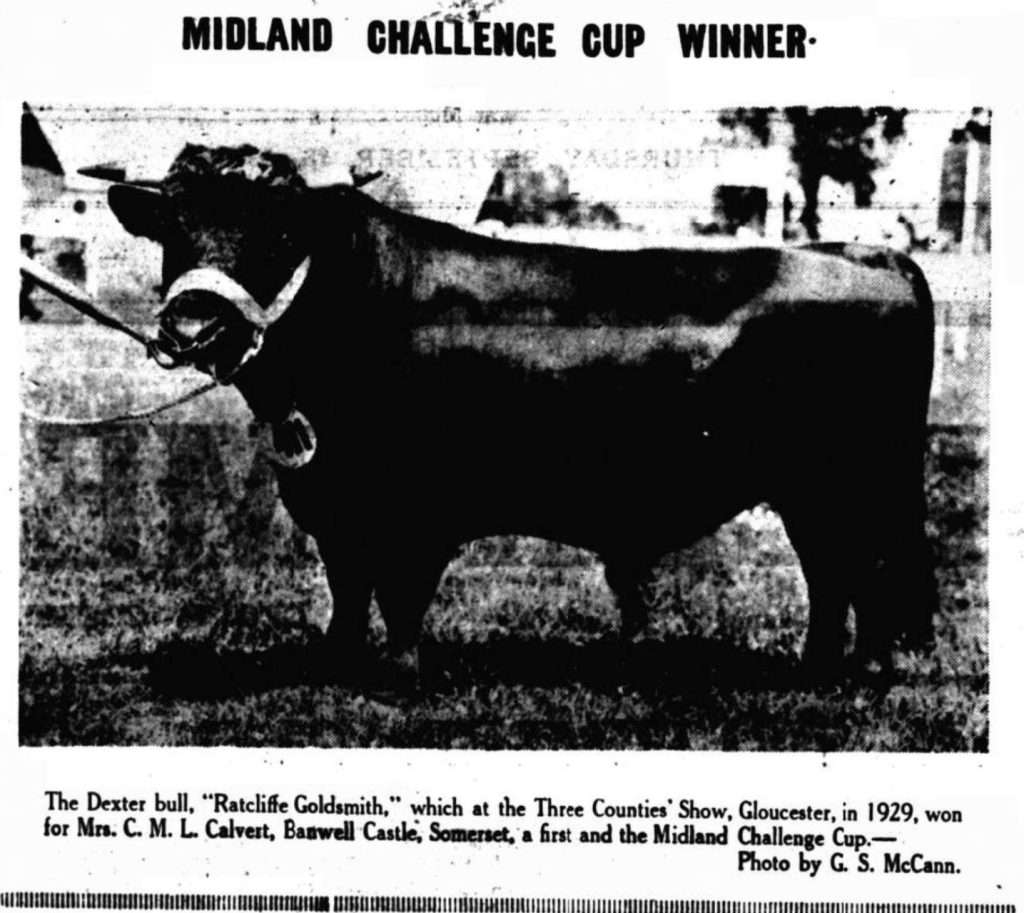
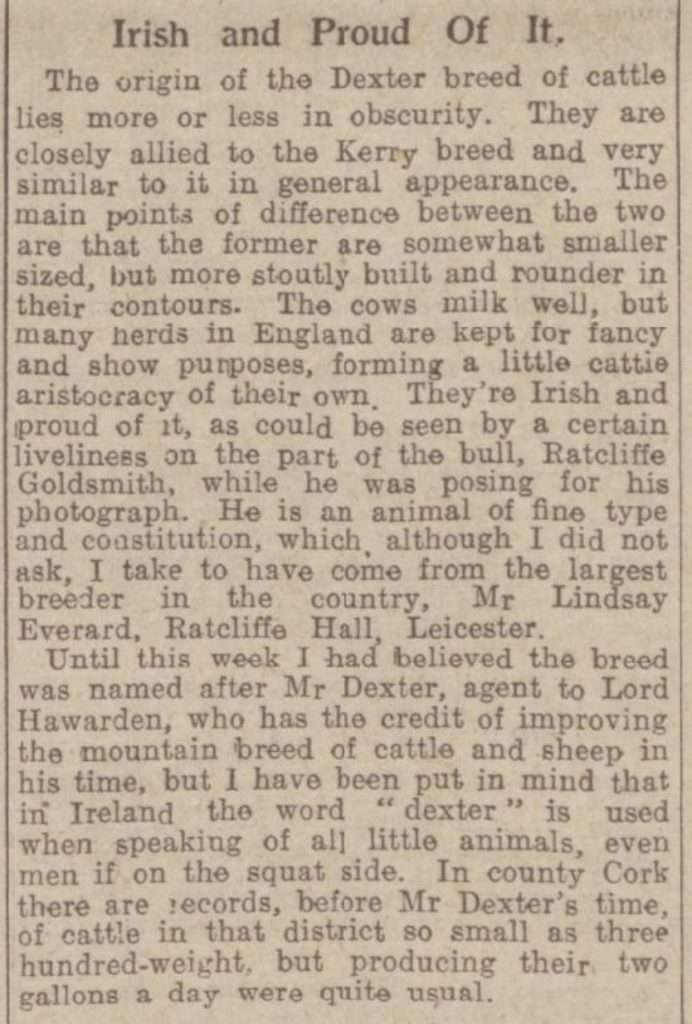
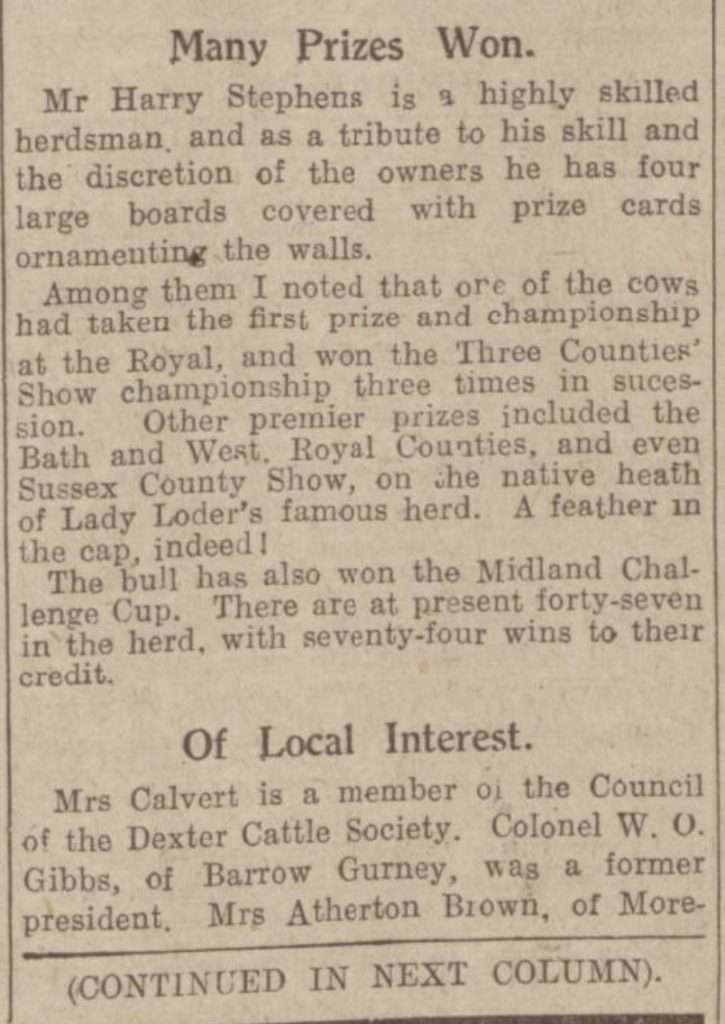
Dexters are well known as Irish Dexters even if many other points about them are debated. The above bull though registered with the Dexter Cattle Society is an Irish Dexter with a “fine type and constitution” as the article states. I checked, he certainly was owned and breed by Mr. W. Lindsay Everard of Ratcliffe. This article holds true to the fact that Dexters are known to be of a small type of cattle. That very small cattle were known to roam Ireland before “Mr. Dexter” was ever penned in History. In Kerry there was known to be some of the smallest type of cattle one can imagine, long before Dexters were ever established or organized into a true breed. So small of an animal that it is mentioned in this paragraph, but yet still producing 2 gallons of milk a day is a marvel indeed. The brown article was written on 14 Nov 1929, it’s from the Western Daily Press Bristol. The picture was taken from a later newspaper published in 1930. Though the Dexter was well known to produce ample milk and was “closely allied to the Kerry breed and very similar to it in general appearance.” The differences being that “Dexters are “more stoutly built and rounder in their contours”.
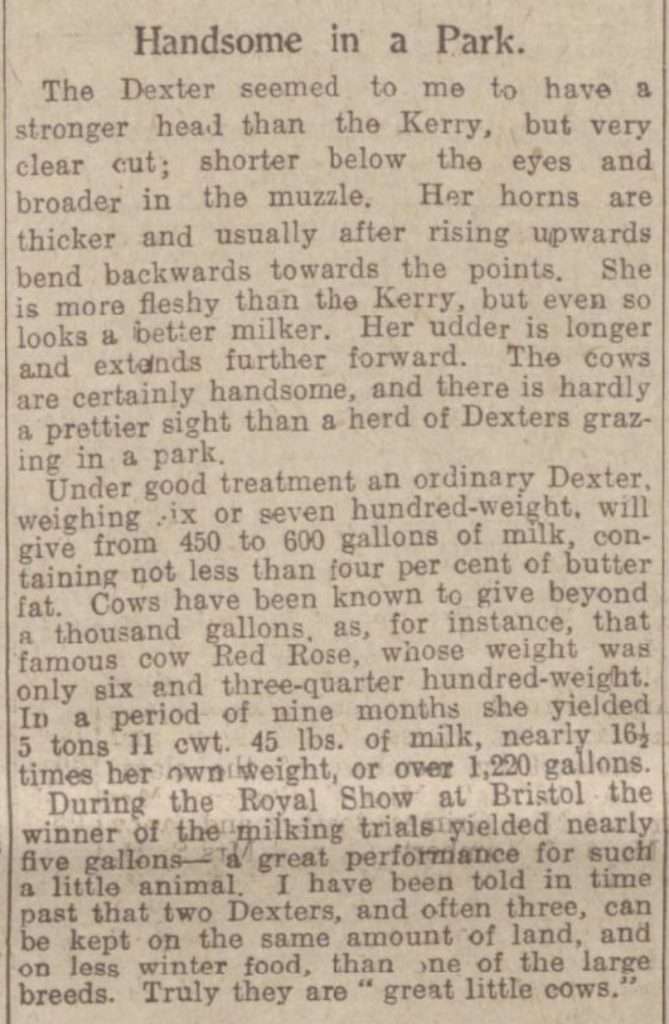
The Dexter has a “stronger head than the Kerry, but very clear cut, shorter below the eyes and broader at the muzzle”. The description of her horns are as follows ” Her horns are thicker and usually after rising upwards bend backwards towards the points”. It is interesting to note that she is even fleshier than the Kerry but was thought to look a better milker than the Kerry. Short cows with large udders seem to showcase the udder in a much more extreme way than a longer legged cow though the udder could be of the same size. The article really goes on to highlight the excellent milking attributes of a Dexter to great lengths. A point worth mentioning is that “there is hardly a prettier sight than a herd of Dexters grazing in a park”. I personally can’t help but look out at my hills and know this rings true to me today, just as much as it must have to the writer of this article in the past! Dexters truly are practical and beautiful when bred for all these amazing Historical traits!
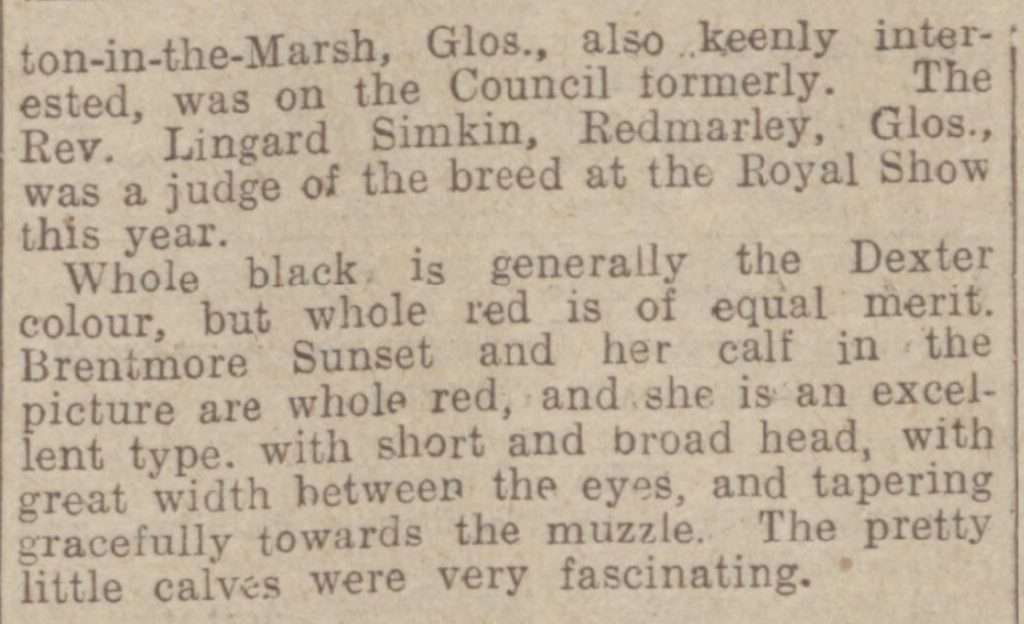
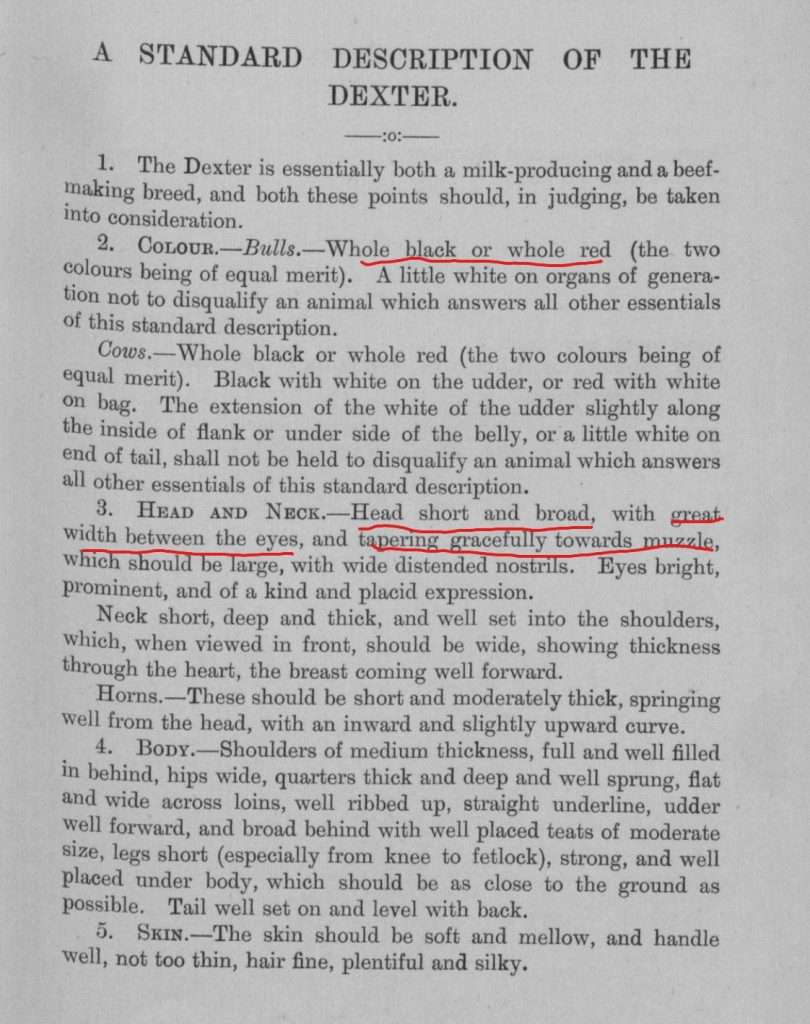
Breeders have long been concerned with breeding to “type” and a few points to mention in this last photo that align with the Standard Description of a Dexter is the color being “Whole black or whole red”. The “Head short and broad” with “great width between the eyes”, and “tapering gracefully twords the muzzle. Dexters definetley impress with their specific beautiful traits and charming ways which took hold of many a wealthy land owner who could aford to buy any exotic cattle they chose. In conclusion Dexters and their “pretty little calves are very fascinating”! They are Irish and Proud of it and those of us who breed them, have been taken by their Irish Charms.
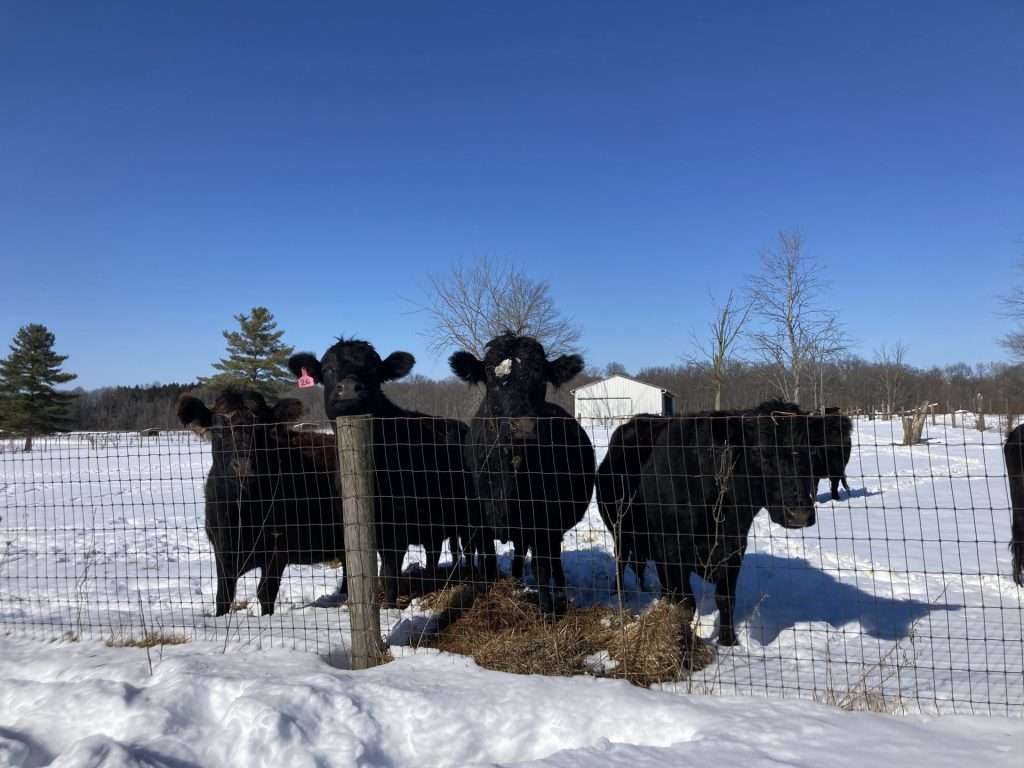
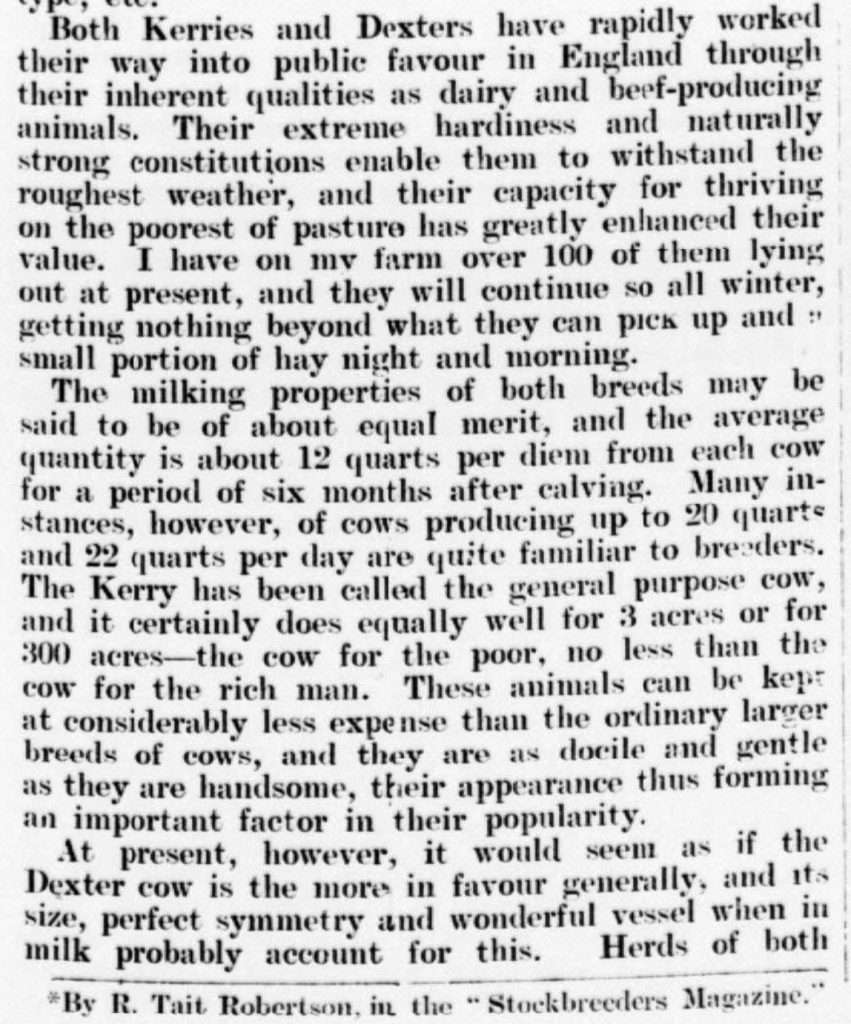
Dexters have long been hailed as hardy and thrifty even adaptable to locations from Africa to snow laden areas. This article I am sharing was written by R. Tait Robertson; he was a famous and most influential Dexter breeder for his day. He was not just any armature Dexter owner, since he was a foundational breeder of Dexter cattle and a generational farmer. He explained that” I have on my farm over 100 of them (Dexters) lying out at present, and they will continue so all winter, getting nothing beyond what they can pick up and a small portion of hay night and morning”. What this means is that Original Dexters could get by on just a little, but of course they could thrive on even more. It was often said that when the Dexters of Ireland went to the manor lands of England they grew greater in size due to the surplus. Dexters can do well on just forage and hay alone with no grain needed. They can excel on the best rations and produce even more, but if times get tough, they can more than get by.
Who was R. Tait Robertson?
Mr. Roberston was a very influential breeder, breeding in Malahide, County Dublin, Ireland. His family later had Church Farm in Babraham, Cambridge. His Dexters were esteemed as quality and were very sought after by the English who wished to keep them. He is the son of James Robertson. They were not just multigenerational farmers but multi-generational Dexter farmers who helped shape Dexters in their early years by breeding and selection. Dexters as we know them then owed a great degree of tribute to this influential family. Mr. R. Tait Robertson was also a judge for Kerry and Dexter cattle. He judged them by the merit that this article speaks to. Someone may say that Dexters are a beef breed that can milk, but Mr. R Tait Robertson said they have “equal merit” to Kerry cattle. They were not transformed in England to a milking breed but rather selected and bred by breeders like the Robertsons for great dual-purpose traits and were heavy in exceptional dairy traits. When R. Tait Robertson speaks to their equal merit remember that he was a judge for both Kerry and Dexter cattle and those judges gave prizes and entered both Kerry and Dexter cattle into the foundation herd books for the Royal Dublin Society. Dexters are not, nor have they ever been a beef breed that can be milked, but rather a dual-purpose breed with equal merit in milking traits to an ancient breed of dairy cattle (Kerry cattle) that can excel at grass-based feeding.
Lamancha Dexter Herd
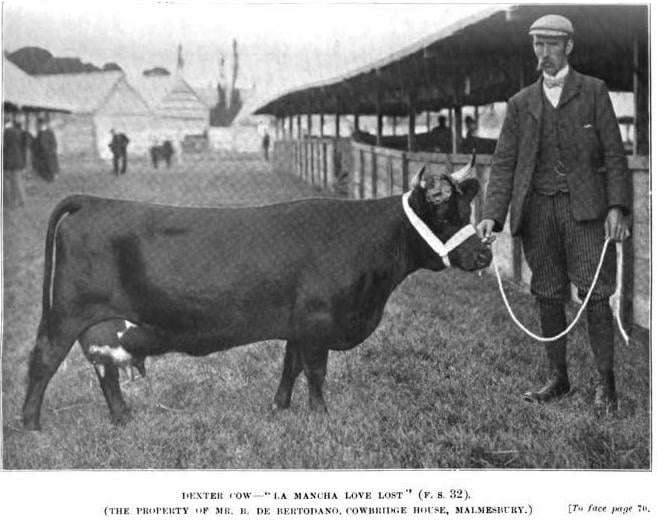
Mr. R. Tait Robertson was the owner and or collector of the cattle in the La Mancha Herd. He or his family may not have bred them all but rather selected some as foundational cattle for the Dexter breed. You will often see La Mancha Dexters registered to him, his father or Robertsons and sons. His Dexters traveled to many countries and those Dexters that could be found “Lying out all winter long, getting nothing more than what they can pick up and a small portion of hay Night and Morning” run in the veins of our Dexters today. This article I shared was written on 16 December 1899 and La Mancha Love Lost was born in 1897. She was qualified by inspection most likely by Mr. R. Tait Robertson and would have spent time in his field while this article was written. It’s nice to think of such a beautiful cow lying out in your pasture all winter long, getting nothing more than what she can pick up and a small portion of hay night and morning then still looking so beautiful! That’s the kind of Dexter I want.