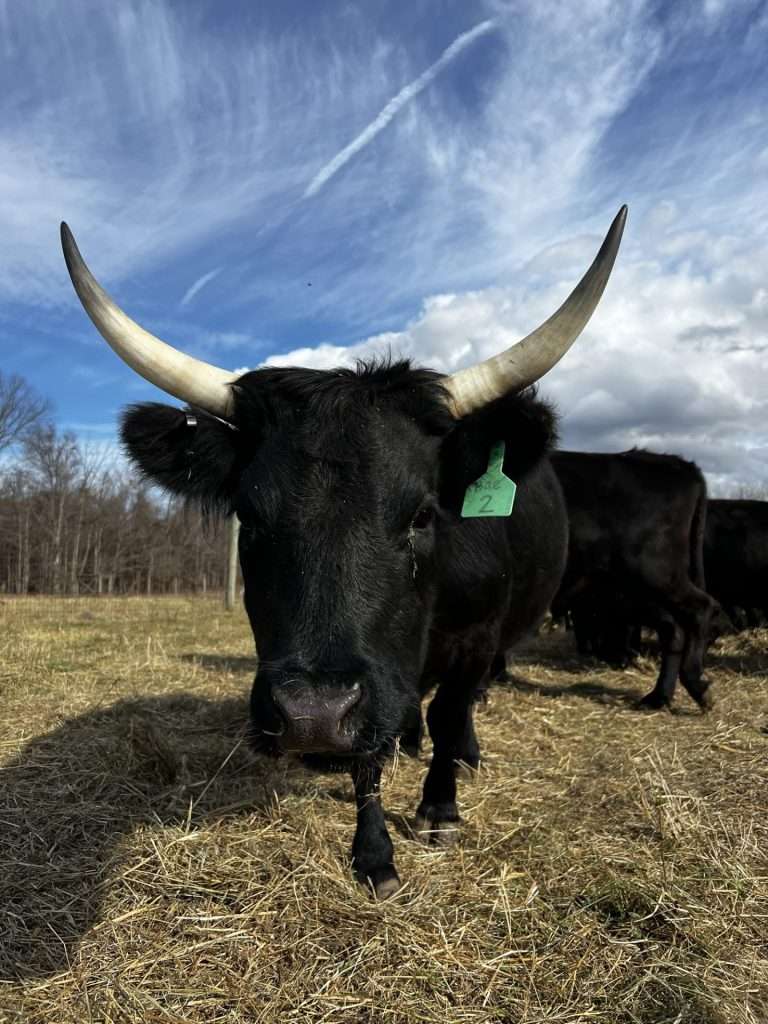
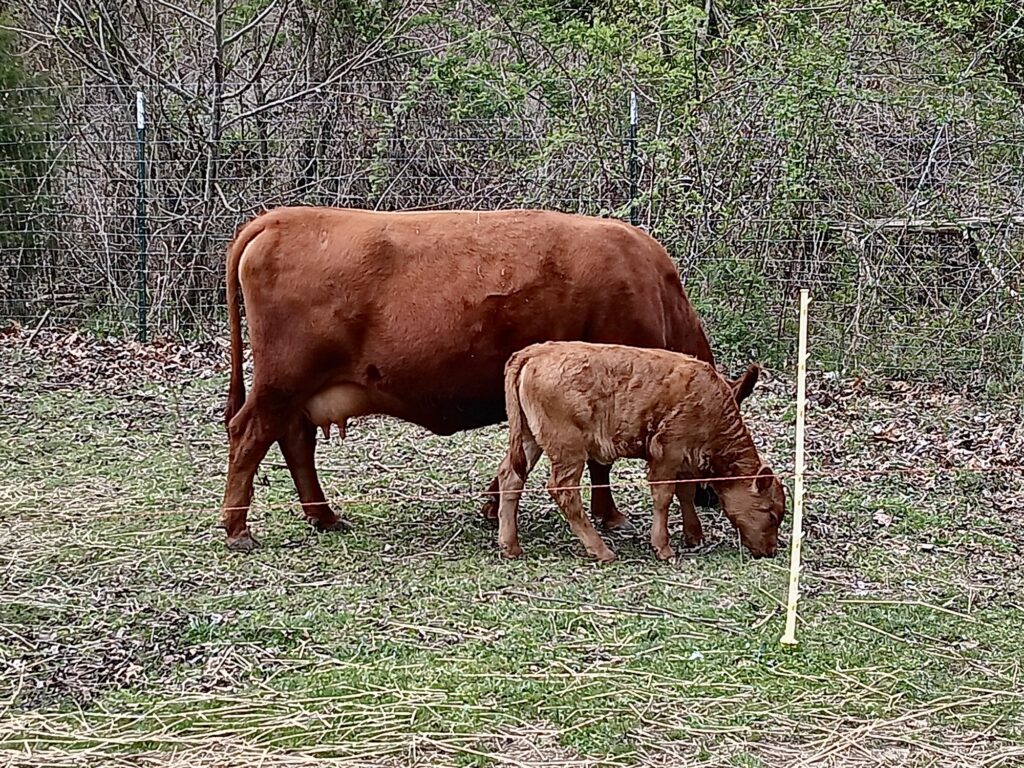
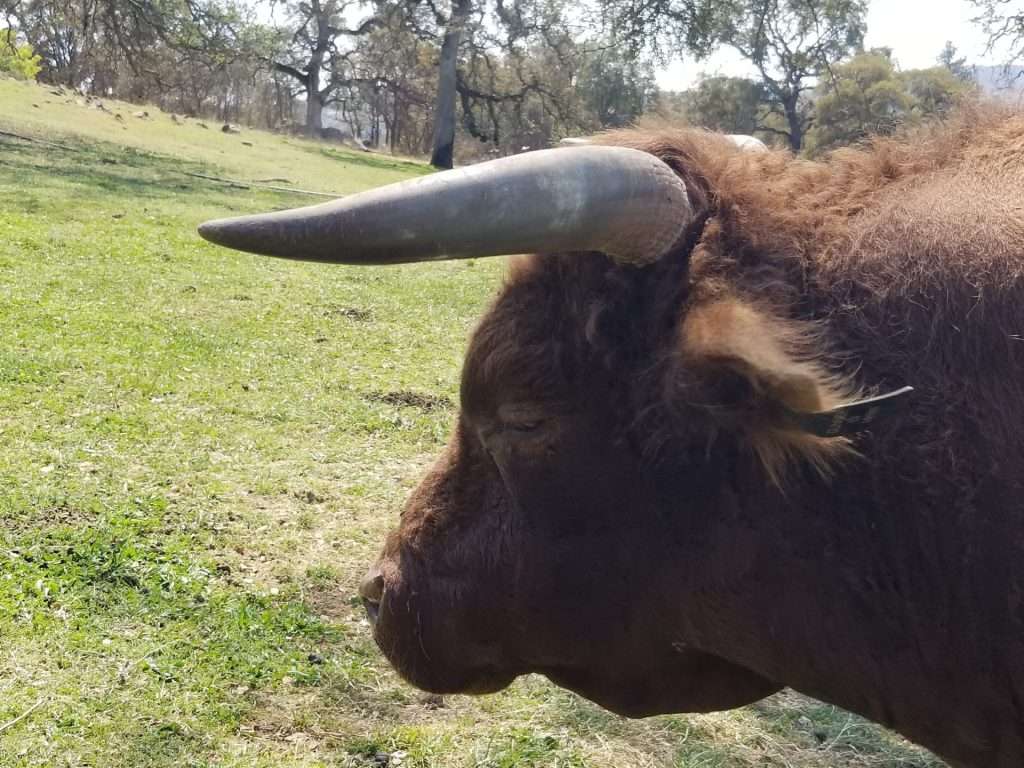
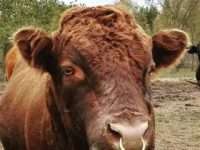
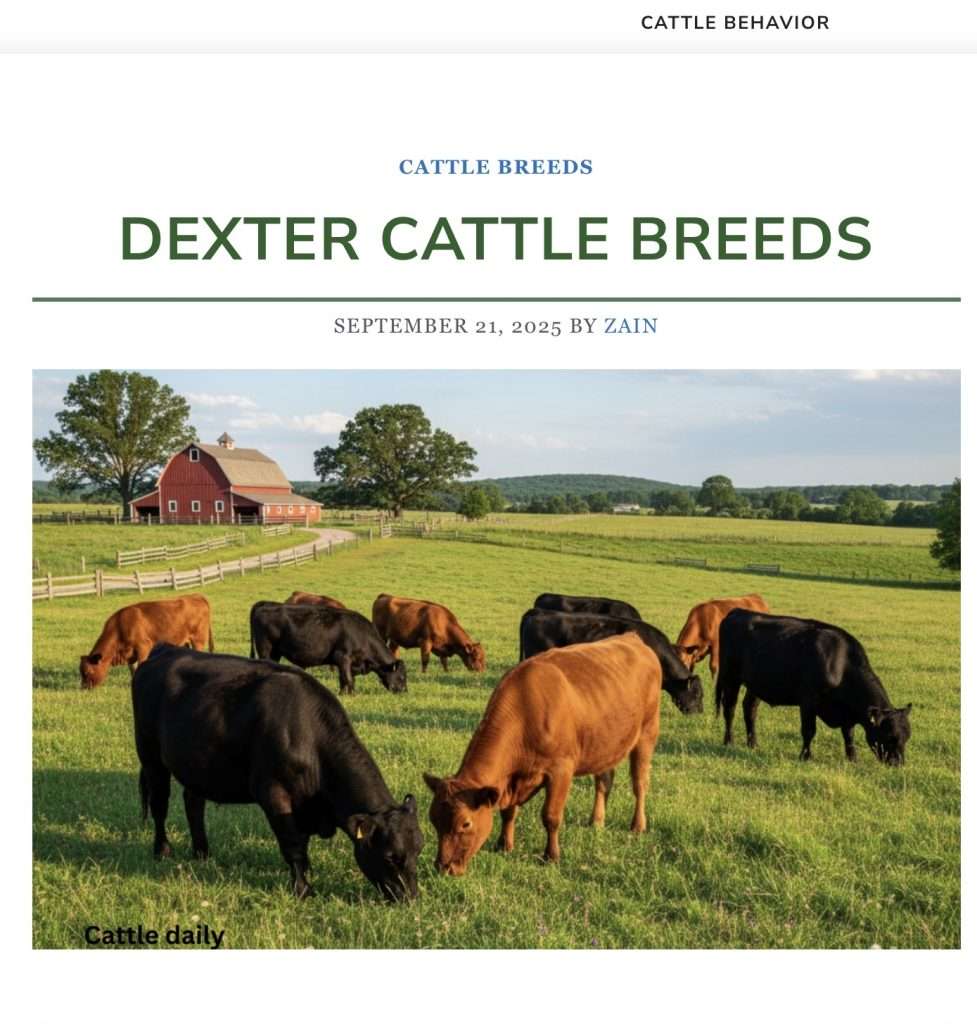
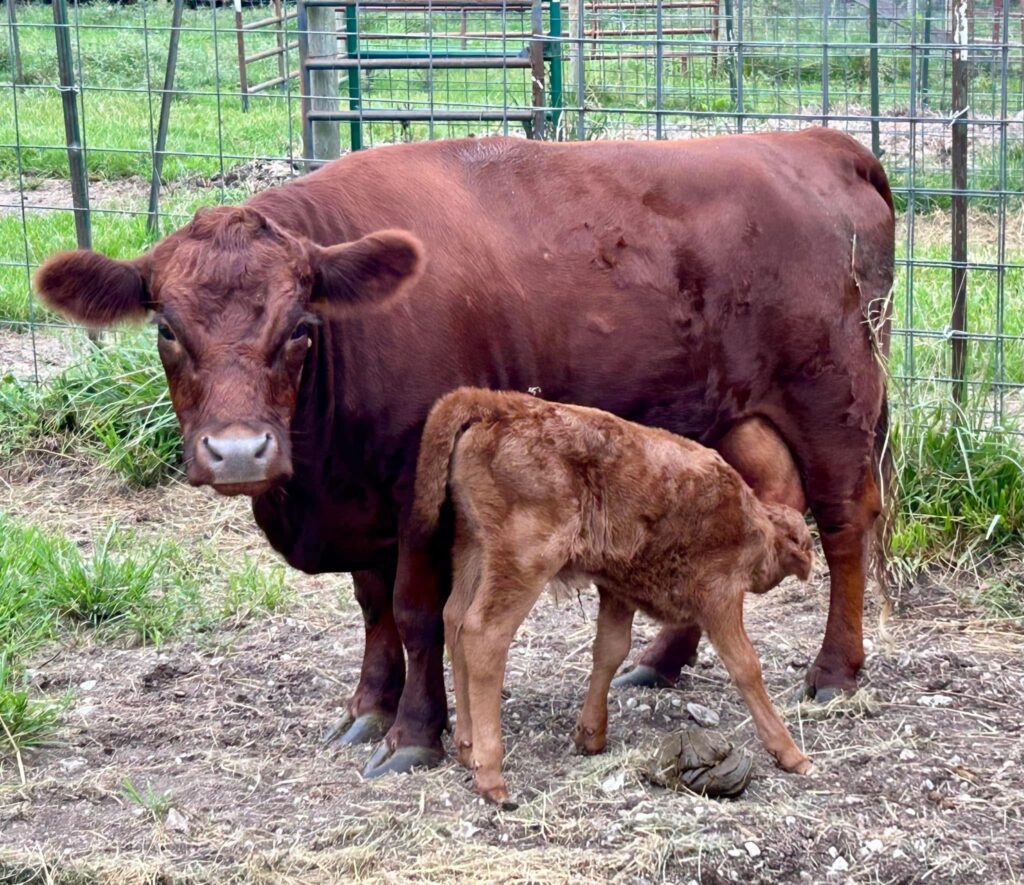
For several years now my family has kept a mixed herd of horned, dehorned and naturally polled Dexter cattle. We rotationally graze, and our cattle have plenty of space to move around. They have gentle personalities, so their horns have not been an issue for us. Horns can also be unique markers with their varying shapes, identifying individual animals in the herd. Whether you are pro horns, against them, or still weighing your options, this is a short article to help shed some light on the pros and cons…
It was Sunday. It was hot. Phillip, the drone operator, Jostan and Blake, the cowboys, and I agreed to meet that afternoon at the last known location of Sweet Caroline.
Phillip and I arrived first and the drone was sent up. Sweet Caroline could not be found. Keeping in mind that the drone searches for heat signatures and does better in the evening, we were not discouraged. That said, I would have loved to have seen her.
Jostan and Blake arrived early afternoon. They weren’t much for small talk. After discussing where she was last seen and the layout of the land, they boarded their 4 wheeler and went looking for her. I saw each of them get off the 4 wheeler more than once and go walking into the woods next to the field. After searching for about an hour, they came back to announce that she is not there. This can’t be happening.
Jostan and Blake agreed to come back in the evening if we found her. Admittedly, I was a little taken aback, but never was I not going to give up hope. Philip and I went to eat. Refreshed we returned to the last sighting.
The drone went up. Nothing. Philip would not stop. He would fly the drone, land it, change the battery, take a small break, and send it back up.
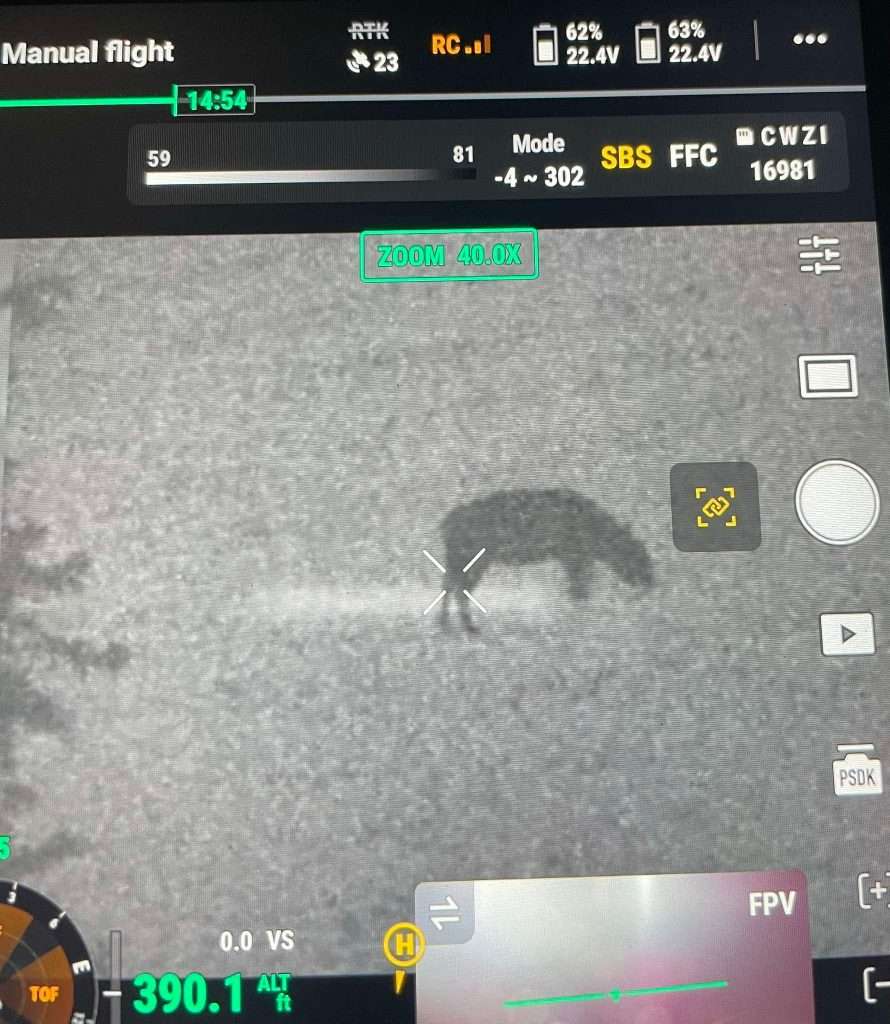
Late into the evening, Phillip said to me that he is going to fly over the pasture where there were other cattle. He flew over and looked at each cow. “Scott, come here. This cow looks black but has what appears to be mud on her legs.”
I walked over to him, and Phillip showed me the screen. There she was. “That is her. I would recognize Sweet Caroline anywhere.”
We had found her. Sweet Caroline had managed on her own to find a way into the pasture to be with other cattle. She most likely crawled under the fence near a small creek. That is the same area where I had tried to walk her in to the gate.
I called the cowboys. We had found her. Jostan and Blake committed to coming the following day.
It was Monday. It was hotter than it was Sunday. From my hotel, I called the landowner. I explained that Sweet Caroline was on his property, with his cattle. The farmer was nice and respectful, but asked for proof. He was hesitant to allow anyone try to get her. I told him the cowboys were coming.
I met Jostan and Blake at the gate of the pasture where Sweet Caroline was seen the night before. It was a large pasture. Jostan wanted to take his 4 wheeler. The farmer would not allow it until we had proof she was there. Jostan and Blake took off on foot. Hot and trudging over small hills, steep embankments and through woods, they found her. They sent me a video. I confirmed to the farmer that it was her. He agreed it was not his cow. She wouldn’t leave the herd.
Jostan and Blake came back to the trailer and indicated that they may have to tranquilize her. They explained the risks. When one of the risks is death, it makes you pause. They hoped it wouldn’t come to that, but wanted my permission.
The farmer had left. Jostan looked at me. I said, “What do you think?” Jostan said, and I will never forget it, “I am going to go get your cow.” He and Blake got the tranquilizer gun, got on the 4 wheeler and left.
Approximately 20 minutes later, I got a phone call. It was Jostan. “She is right in front of me. What do you want to do?”
“What do you mean?”
“You have to give me permission to use the tranquilizer gun. I need you to say it.”
“Is there risks?”
“Yes, but I have done it many times and have never had a problem.”
“Do it.”
I heard the shot. I waited. Nothing. 10 minutes. 15 minutes. 20 minutes. I hear a 4 wheeler. 25 minutes. I got a call.
“Bring the trailer now. Drive to other side of the pasture. She is waking up.”
I drove. I got there and they had her tied but she didn’t want to be. I backed the trailer up and the three of us got her into the trailer. It wasn’t easy, but we got her.
“Now that is some real cowboy crap!” I yelled. I hugged them both. Sweet Caroline was in the trailer.
They drove their 4 wheeler and I drove my truck and trailer back to their truck. I asked what I owed and paid the bill. I thanked then for a job well done.
The farmer came back and asked if we got her. I told her she was in the trailer. He jumped on the trailer and looked in.
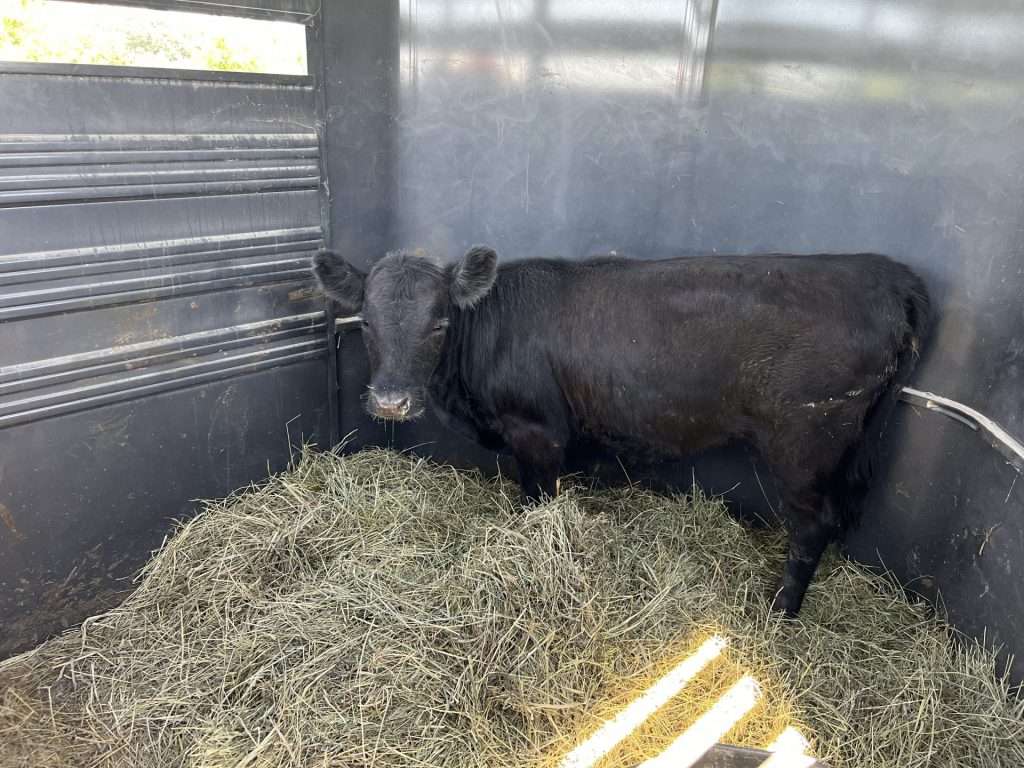
“She looks like an Angus.”
“I want to pay you for your time and trouble.”
“Absolutely not. I don’t want it. I am glad you got her.” He started to walk away. He turned back around and asked, “Can I asked what you paid them?” I told him. He shook his head and then said, “Tell me something. Hotel, drone, cowboys. This has cost you a lot of money. Didn’t it cost you much more than the calf is worth?”
I looked him in the eye, and with a tear falling down my cheek, I said, “Not even close.” The farmer smiled. Nodded once and walked away.
Sweet Caroline was going home.
A little bit about the author. I own and operate a small farm called “Our Yellowstone LLC” in Illinois. I couldn’t do it alone, but will keep my wife’s name out of it to protect her innocence.
Photo of one of our cows at Bryn Mawr just recently taken, but soon to fade into the mist of time, just like all the Dexters before her.
An Outstanding Description of the Dexter
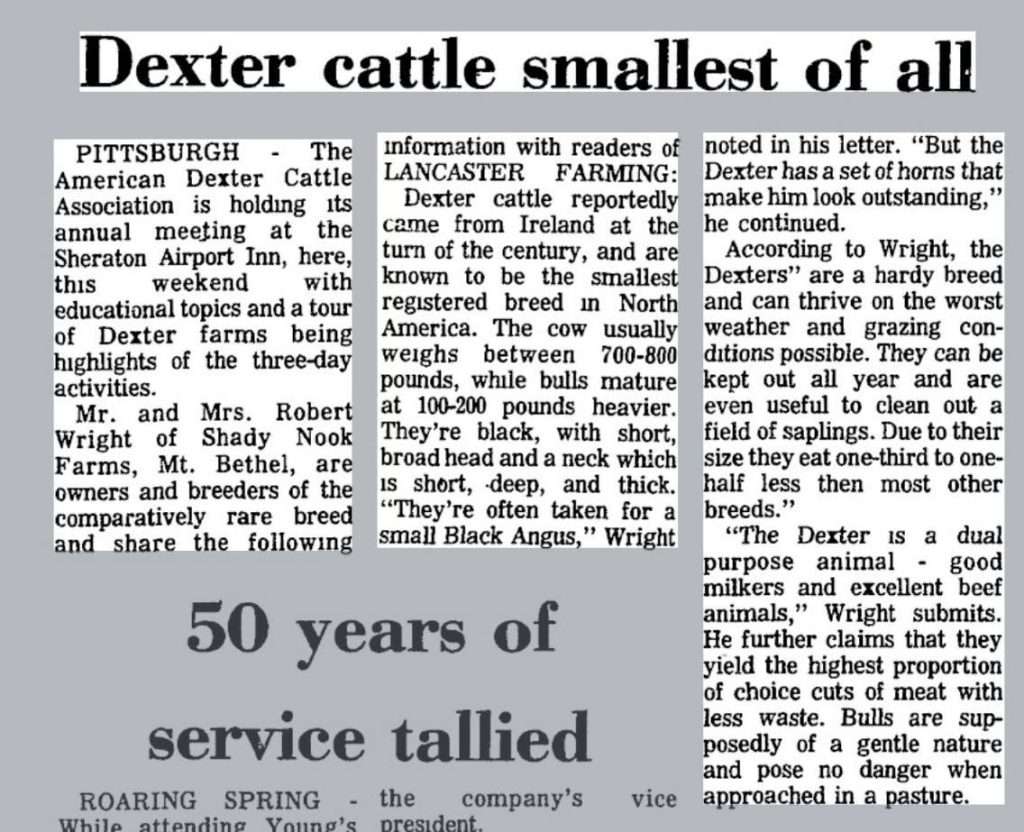
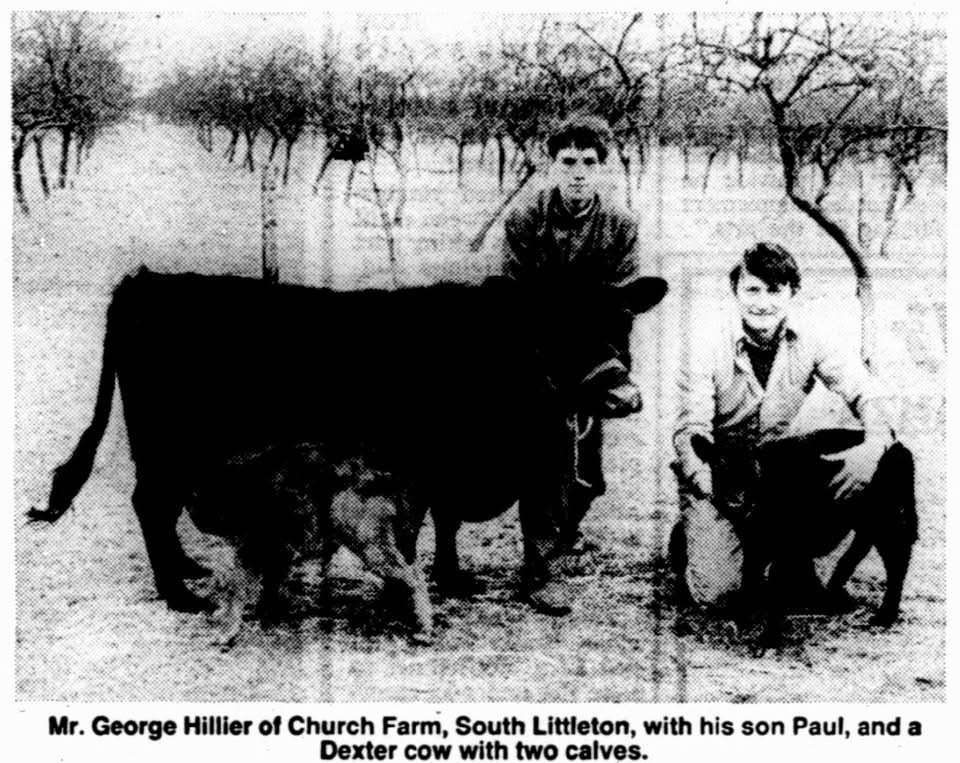
In America and all across the globe, it was much more common for Dexters to be black. So much so, that at one point people even forgot that they were once another color and when asked they may not even have known that the original breed standard allowed for red Dexters to be registered. It was common knowledge that they had horns. This article is 1976 states a fairly common view of what Dexters were before the widespread introduction of polled genetics into the breed. They may have been black like angus and small in size but their horns strikingly set them apart. It was a significant breed identifier that let you know they were not just little angus. As the article states “the Dexter has a set of horns that make them look outstanding”.
Of course, the size of the Dexter is a breed identifier, but it alone has not been the sole identifier. Today as many small breeds and cross breeds are being developed it becomes more common to see “mini” cattle where the cows are between 700-800 pounds and the bulls are up to a thousand. Size alone is not enough to set Dexters apart as a breed regardless of height or weight. Besides just physical attributes there are practical attributes that this article quickly highlights, that showcases Dexters as a unique small breed. They are not just for eye appeal or for cute pasture ornaments, but rather work well for the true purpose of a dual-purpose breed supplying both milk and beef. Another significant and often reported Dexter identifier is that they will survive on low quality pasture, living outdoors year-round and browse well for cattle. They have very docile bulls, and this is one of the very reasons new cattle owners become attracted to the breed. This trait is so important for the future preservation of the breed as it attracts so many people to cattle in general, due to the ease of handling. This is something we should never loose from the Dexter breed by improper breeding by using bulls with bad temperaments or cross breeding in breeds with bad temperaments spoiling the breed. How ruined could the Dexter be, if the breed became synonymous with poorly behaved and mean-spirited bulls?
What a beautiful description Mr. and Mrs. Robert Wright of Shady Nook farms has supplied for us 50 years later long after their Dexters have expired. Strange coincidence that the article mentions 50 years for a different remembrance as I look back and read this article 50 years later. When looking them up I found nothing under their names but I did find some Dexters registered to the Farm name Shady Nook, that had to be theirs due to the time of registration. Five Dexters only ever registered under the name of Shady Nook and only one of which ever went on to have registered offspring. A bull named Shady Nook’s Dubar born in 1976 , who sired two registered calves. This is all too common of a story in Dexters, new breeders, small operation, few cattle registered and then Dexters lost to the history of time. It causes one to consider that not only must we hold onto breed identifying traits, but also the very Dexters that bore those traits by putting them in the hands of people who will keep them breeding. Breed them strong and breed them long. Long live the true Irish Dexter!
Article taken from Lancaster Farming, 17 July 1976.
Thank you for reading and considering, Danielle of Bryn Mawr.
Whit Ashe of Circle A Ranch in Savannah, Tennessee , has been our cowboy, AI tech and friend for over ten years now. Our nick names for him, include Man With The Golden Arm, Mr. One And Done and My Favorite Cowboy to name a few. But, wouldn’t you use those names to describe a perfect heifer record and he only had to come back twice for redos in 10 years. We recommend him for anyone in the area. But after several conversations, it appears that much of our success as team, is not just his technique.
Minerals
For both Circle A Ranch and our little homestead, Stay’N Put Farm, it started with the management program. We both use Vitaferm Concept aid minerals. Whit recommended these right from the beginning, including when we were doing live cover on and off. It is set out free choice for them to utilize at their pleasure. With the success rate like ours, proper nutrients to help them take with one attempt has to be one of the key components . Seeing others succeed when switching to it, seems to us to be part of one of the keys to success. But this is just one of components to this success.
Timing
Timing is very crucial as well. Each Dexter will have its own cycle. Ours are between 18 and 21 days. Signs of coming into heat differ from cow to cow. Some of the signs we look for are loose poops, change in behavior…extra sweet or standoffish behaviors. You will often times see the cows standing close to each other, one appears to be more affectionate than the others. These for us are the start of of the heat cycle and duly noted.
Next we watch for jumping or restless behavior. This could include a nursing calf, jumping on mom or behaving weirdly with mom. If you’re milking, you may see an appreciable drop in milk, we do.
This is when your observation skills are most important. Cows will jump cows. Cows will jump bulls. This behavior is referred to as bulling. If you only have one cow in your herd and no other Dexter or bovine friend, this can be troublesome.
It can help you know that a cow is in heat, but it can’t tell you whether it is in a standing heat.
Telephone conversations and texts happen with Whit Ashe when we see behavior changes, poops getting loose or a milk drop and then we keep in close contact until we are sure that we are in standing heat.
Standing heat
Standing heat is when the cow stands for anyone to mount her. It is at this point you should be ready. We try to AI within the next 12 hours…and close to the 12 hour mark.
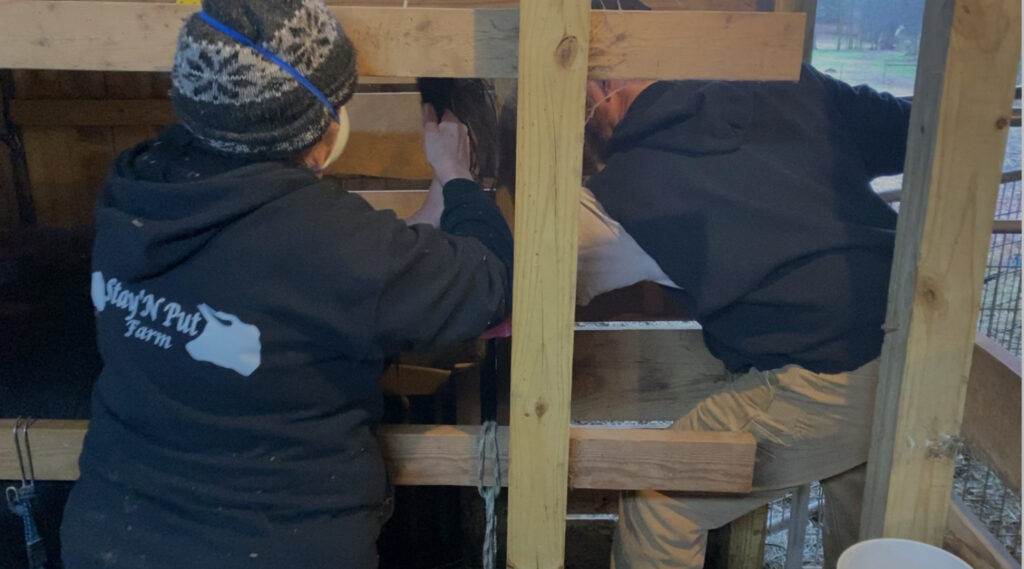
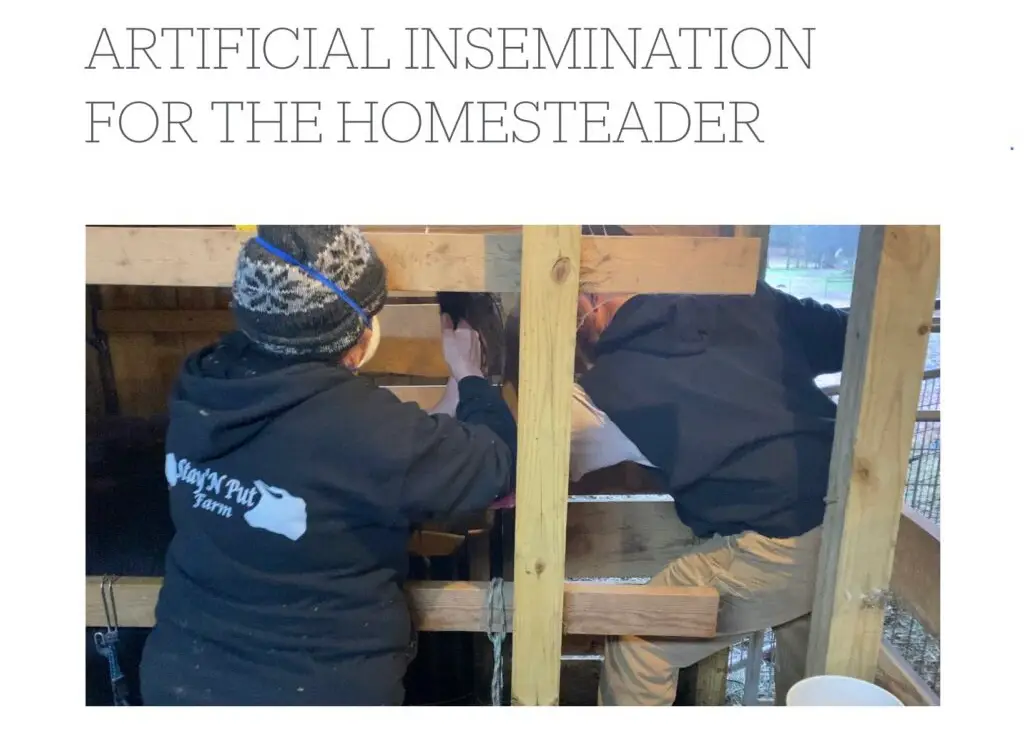
When your tech arrives, you should have your cow either in the barn or in the milking stanchion or shoot. You will need to have your straw selected that you want to use. The tech will warm the insertion device, by placing close to their body…down their shirt. The straw will be warmed in a special straw warmer. Once it is thawed, the device will let you know and the fun begins. The attached video will show you what it typically looks like.
Whit Ashe has only had to make two trips back in 10 years, and I would have to say one was probably the semen , which is rare to have a problem with it and the other was my timing. We chased it…knowing it would probably result in a bull, but we were unsuccessful. As of the time writing this article we have only received two bulls by AI, and that was from another AI tech, Weston Williams. Whit Ashe has a perfect heifer record here, very hard to believe, but true.
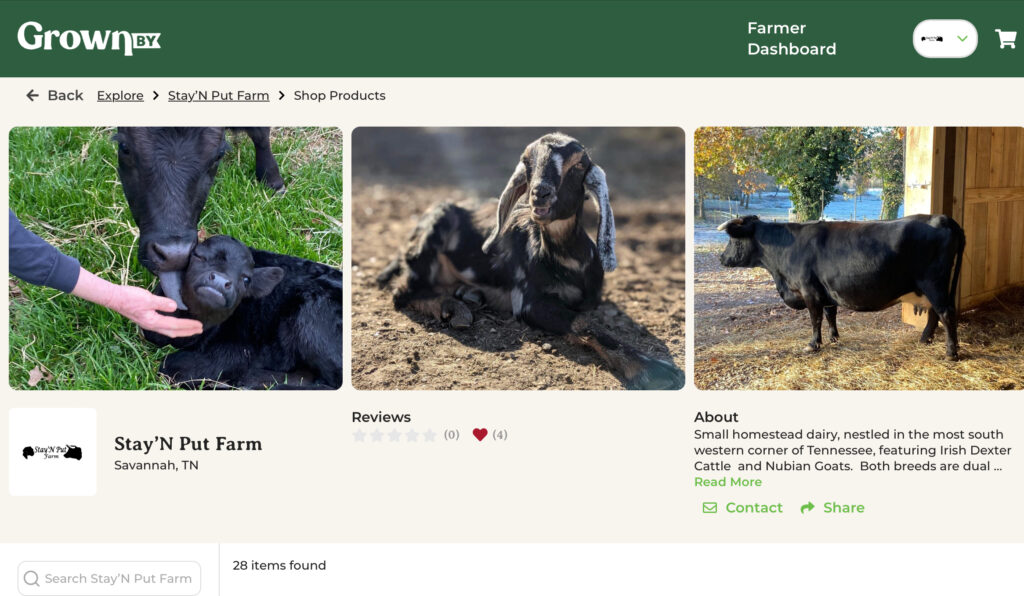
I have had a small soap business for years. It has been a very manual order process. So, when someone was needed to test the GrownBy site for the next phase of the Irish Dexter Cattlemen website, I decided it was time for me to have an easier way to order. It also gave me the added benefits of being able to sell my Irish Dexter cattle and Nubian goats without having to set up my own website. Everything in one place, with no knowledge of set up or having to maintain my own website. Well I have to tell you….this has been a most enjoyable experience. From the ease of using the site, to the help that is available from the GrownBy team at the drop of a hat. I can edit, add or remove things with little effort. But the really exciting thing was having metrics to be able to see if the site was working for me. The first time I checked how many had clicked on my site it said 163…WOW! I started working on my site in May and had yet to check the metrics out. I shared it on my FB page and on the IDC site once, well maybe twice and boom a week later 193 visits. The other notable is that my order size increased. Not by a little, a lot! We are still working on GrownBY handling the shipping component, but the problem is at my end, not theirs, everything has to be weighed and then the zip code has to be taken into consideration. The work around is pick up at farm and handling the shipping afterward…or adding to the price the average shipping…but I’m working on that. The long and short of it is, not only is the site working for me for selling my soaps and shampoos. It provides an easy link for my customers to go to and see what I have available …and helps me with driving what needs to be made and stocked. And maybe they will consider some of the adorable bucks we have currently for sale! I didn’t need to learn another language or program, all I had to do was share it, so people know where to look. Another added benefit is, you can see other farms in your area …that you might want to visit or buy from. It’s farmers! Yup, farmers, you are working with other farmers. So if you have a soap business like me, or just a few animals to sell, or a CSA, you really should check it out. I hope you have the same experience as I have had….now off to make another soap and build that inventory.
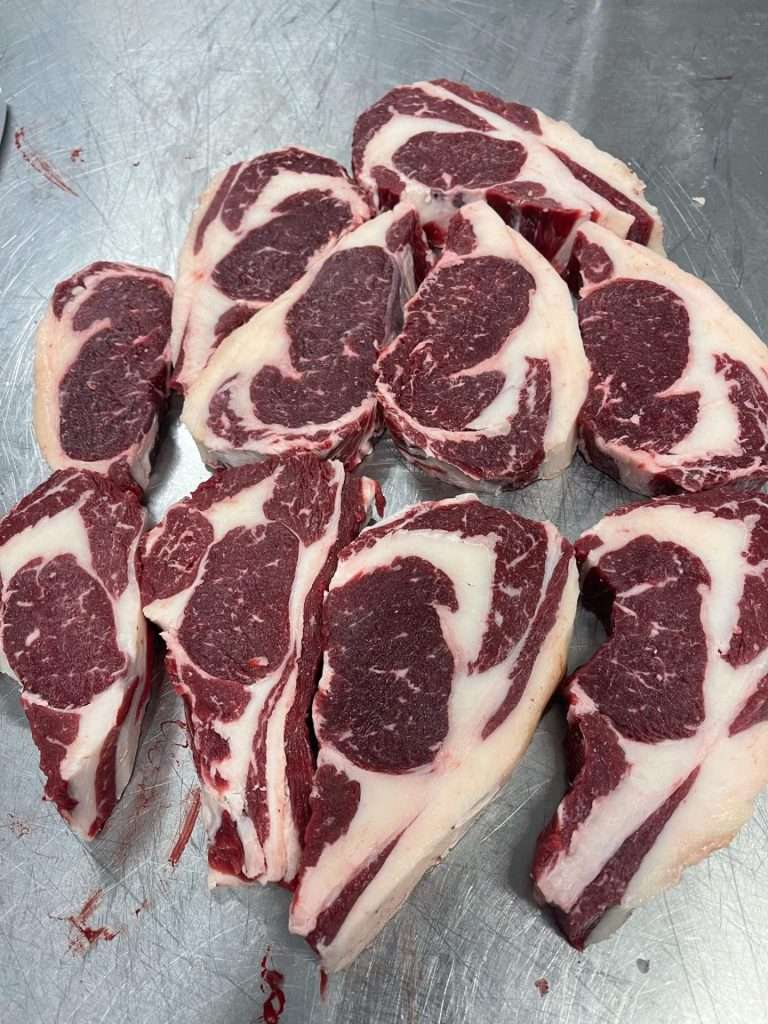
With all the talk about marbling and beef tenderness, here is something to consider…marbling does not equal tenderness…taste yes…tenderness no. And selecting for easy keepers can be a great step selecting the best beef from your herd.
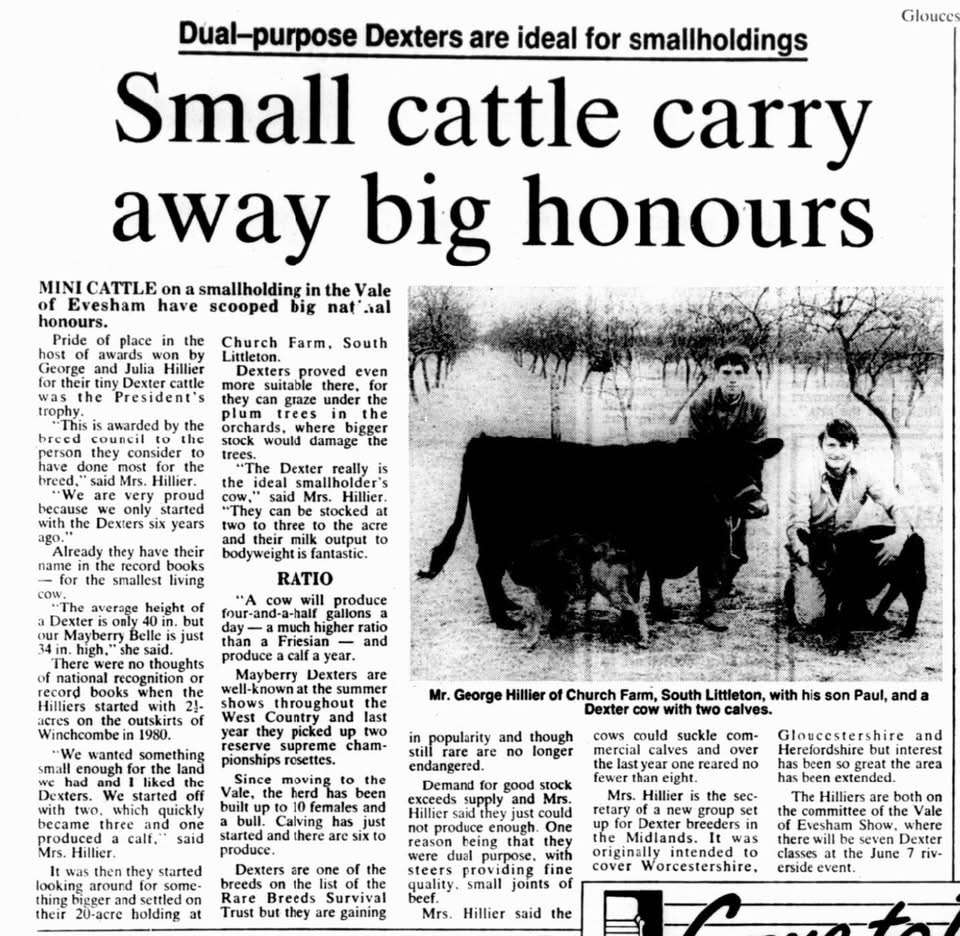
This article written in Gloucestershire on 27th March 1986 represents a long memorable chapter of the pages in History of Dexter cattle. The Dexter in this article is being noted as truly dual purposed, possessing fine quality small joints of beef, all the while being able to suckle two calves at once and raise 8 commercial calves in one year. This all seems an even more amazing feat when you consider one of the cows being spoke of was 34 inches. Thirty-four inches, how many Dexters today meet these amazing statistics? This article when I compared to other historical information sites a higher average milk production than some historical amounts in Dexters that I have seen at 4.5 gallons per day. This figure is not rare by any means but not necessarily a given rate with some Dexters producing a bit less. Dexters are being stated as being small and valuable for grazing under plum trees so as not to damage the trees. At the time of this article, Dexters are listed on the Rare Breed Survival Trust, but are no longer being listed as endangered as they once were prior to the articles printing. When we consider today with so many pedigree Dexters in great numbers it is hard for many to believe that Dexetrs were once so rare. But yet how many rare Jems are left like the Dexters being mentioned from these days, just back in 1986? Perhaps the Dexter of 1986 is rarer than we think.
A Deep Dive Podcast, brought to you by Irish Dexter Cattlemen, on topics of interest to all farmers and ranchers. Subscribe to the free, monthly Irish Dexter Cattlemen Tips & Tricks Guide to get early access.
Brought to You by These Breeders, Affiliates, & Sponsors
I needed help and was unafraid to admit it. I was at home and 6 hours away from Sweet Caroline. Taking the animal shelter’s advice, I called “Eye In The Sky Thermal Drone Pet Rescue”.
Philip answered on the second ring. I explained the situation, and the first words out of his mouth were, “I can go tonight.” I lost it. Fear, anxiety, exhaustion hit me all at once. I couldn’t speak for a good 30 seconds. Philip indicated that this is what he does. He asked that I send him a google pin with Sweet Caroline’s last location. He will contact the Sheriff’s department to let them know that a drone will be in the sky. I was flabbergasted but had hope.
I asked Philip is he thought he would find her. He responded, “I am 100% sure I will find her.”
“How can you be so confident?” I asked.
“It is a black cow! I am used to looking for much smaller animals. She will standout.” He was right.
That night, at approximately 8:30 PM, I received a text. I received a photo of Sweet Caroline standing in a corn field. I couldn’t believe it. I called Philip. He said he found her near the woods where she was last seen. She looked healthy and was eating. I couldn’t have been happier. I made plans to meet Philip the next day in Iowa in hopes of bringing Sweet Caroline home.
The plan was to meet with Philip, fly the drone, see Sweet Caroline and walk her to the trailer and then bring her home. That was the plan. Sweet Caroline had other ideas.
Truck and trailer in tow I was Iowa bound. Through my ever growing list of Iowa contacts, I learned the name of the farmer who’s pasture abutted the woods in which we believed Sweet Caroline had taken residence. I gave him a call while in route. He indicated that he did indeed own the pasture and confirmed that there were several head of cattle in it. The pasture was large, had several acres of woods and water. The farmer told me that there was a spring in the woods where Sweet Caroline was at so she had water. He was going to walk his pasture to see if he could see Sweet Caroline.
About 4 hours in to my trip, the farmer called to advise that he did indeed see Sweet Caroline. She literally walked right up to him! She was next to a fence that separated the 2 properties. She was about 10 yards away from a little gate. The farmer and his son tried to get her to go into the gate on this land, but Sweet Caroline was reluctant and wouldn’t go in. They were able to pet her. Not great news, but not the worst news either.
I met with Philip. Philip was going to put the drone up, and once Sweet Caroline was found, I was going to try to get her into the pasture with the other cattle. There were 2 gates. The little one the farmer mentioned and a main gate located along a road over a mile away.
The drone was up. Amazing things these drones. Flying over head and giving crystal clear images of the things below. Growing dark, Sweet Caroline emerged from the woods and went into the corn field. We were located about 1/2 a mile away and I began the walk towards her.
Sweet Caroline, was… well…Sweet Caroline. I walked towards her with a bucket of grain and she walked right up to me. She allowed me to pet her and I allowed her some grain. She looked healthy and good. I had brought a halter.
I have had more people ask why didn’t I just halter her? Piece of cake! First off, she had never had a halter on in her young life. Second off, she wasn’t about to start with a halter in that corn field in Iowa either. With that not going to work, I went with plan B.
We were about 300 yards to the small gate. The challenge with that was the small gate was located on a rather steep incline. To get to that gate, we had to walk through very thick brush and thickets. The fence was barbed wire. Sweet Caroline has never been around barbed wire. There was a large tree stump 3 feet in front of the gate. I walked between the stump and the barb wire fence. The other side of the stump was very thick briars and impassable. I immediately figured out the problem.
Sweet Caroline stopped at the stump. She would not go by the barbed wire. We were 3 feet away from the open gate. She eventually walked back to the corn field. I called her. She came back and stopped by the stump. And walked back to the corn field. We repeated that same sequence 3 times. She was wanting to follow. She wanted with the other cattle. She would not go past that stump.
I walked back to Philip. It was dark. I sent a text message to my Dexter cattle mentor and explained the situation. Through her contacts and Facebook followers, she was able to find someone in Illinois, close to Iowa, who might be able to help. She sent me the information.
I called. They would come the next day, Sunday, after church. Time to bring in the cowboys.
A little bit about the author. I own and operate a small farm called “Our Yellowstone LLC” in Illinois. I couldn’t do it alone, but will keep my wife’s name out of it to protect her innocence.
There is no better way to ensure the survival of the family in case of a SHTF scenario and to create a sustainable homestead than to grow and raise your own groceries. There are a plethora of traditional farm animals which can help keep the family well-fed year around or during a long-term disaster, but when both space and budget are limited, one stands out above many of the rest – Dexter cattle.
The time, energy and money you invest in this can give you access to the entire U.S. market.
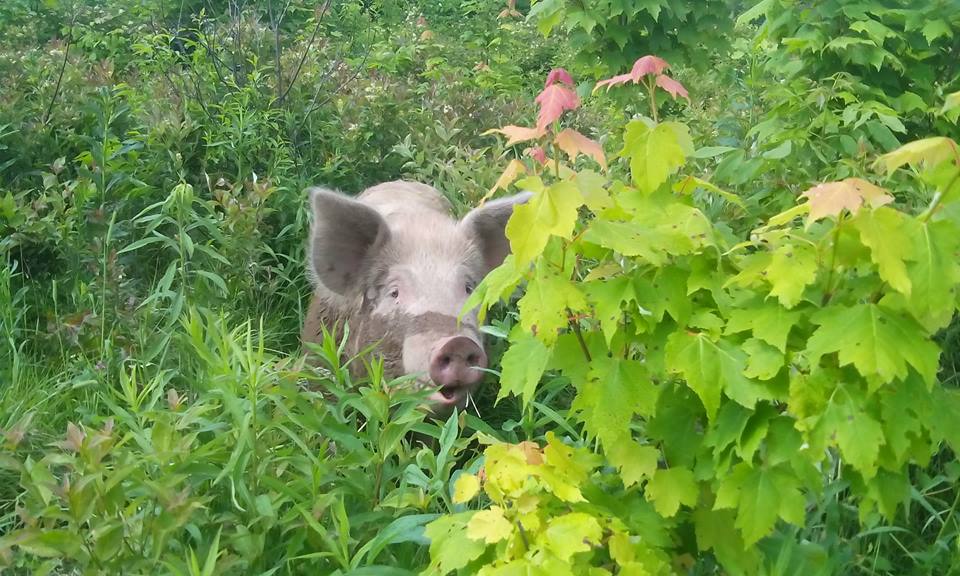
Raising pigs on pasture is wonderfully rewarding work, but it will not lead to a viable farm enterprise unless we take the time to develop our marketing program for effectively selling pastured pork. In this article I share some key points and tips I have gleaned in five years of pork production.
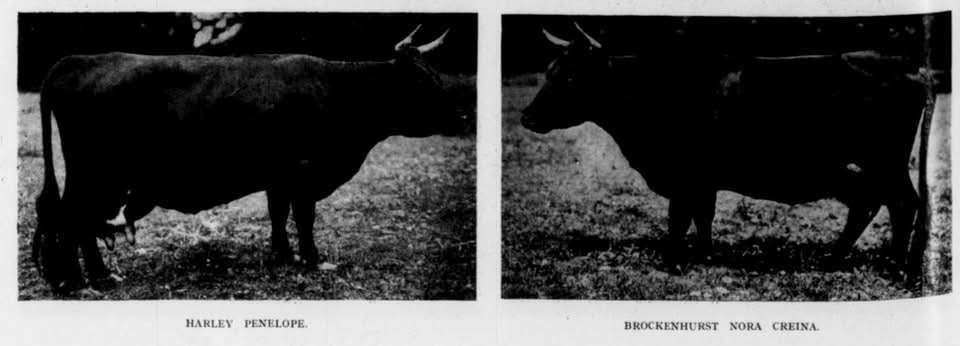
Did you know the look of a Dexter’s head was important to breeders and that there was what was considered a “Dexter Head”?
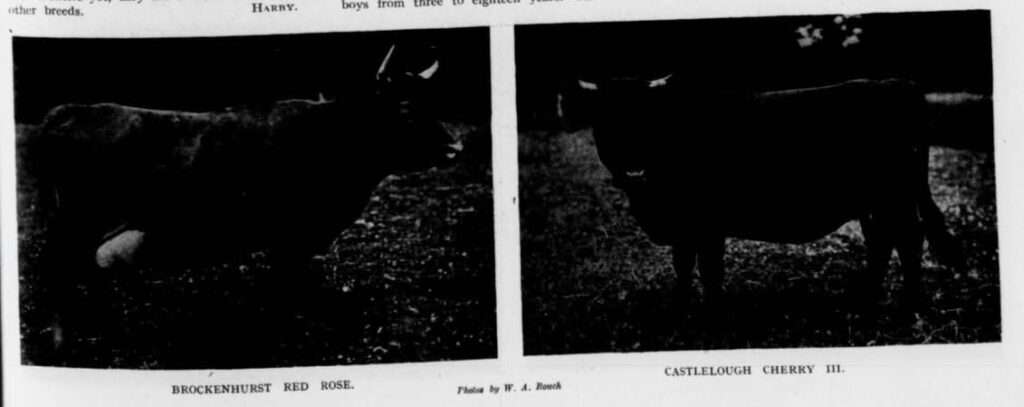
“Harley Penelope is good to carry in one’s eye as a type of a good Dexter cow. She has the quality and character, a sweet small Dexter head and carries her horns well.”
“I lost my heart to Red Rose, a very beautiful cow, she has the Dexter head to perfection”
Did you know that Dexters were known to give a good milk yield for their size and excelled on lower quality pasture?
“Naturally in these times, when the economy of feeding stock is of importance, the hardiness of a Dexter, the large milk given by them on a small quantity of food, and their ability to thrive on poor pastures make them particularly attractive”
Did you know that breeders put a lot of emphasis of breeding to “pedigree and type” not just pedigree or type alone? That people wanted to keep their diets similar so that they could retain their original attributes including size and hardiness.
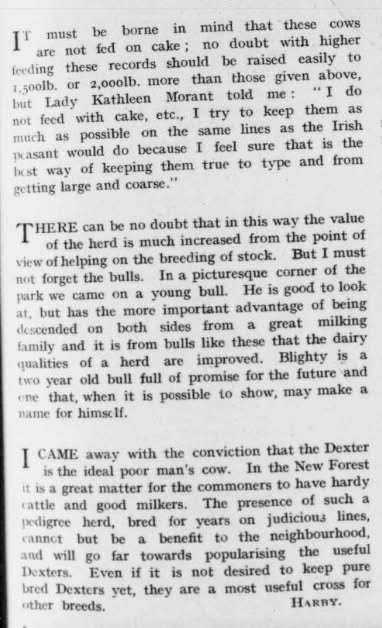
“It must be born in mind that these cows are not fed on cake: no doubt on higher feeding these records should be raised to 1500lb or 2,000 lb more than those given above, but Lady Kathleen Morant told me: I do not feed with cake ect., I try to keep them as much as possible on the same lines as the Irish peasant would do because I feel that is the best way of keeping them true to type and from getting them large and coarse.”
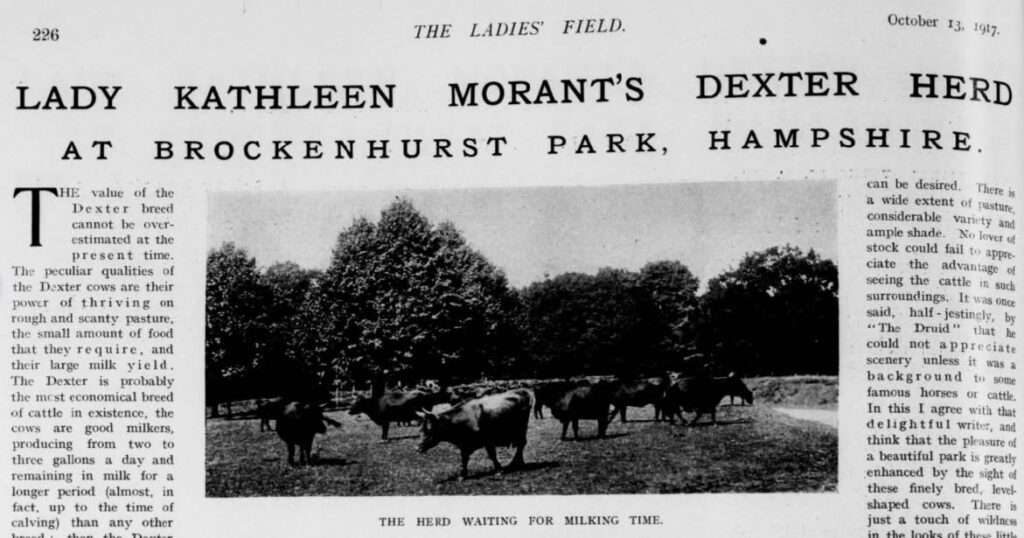
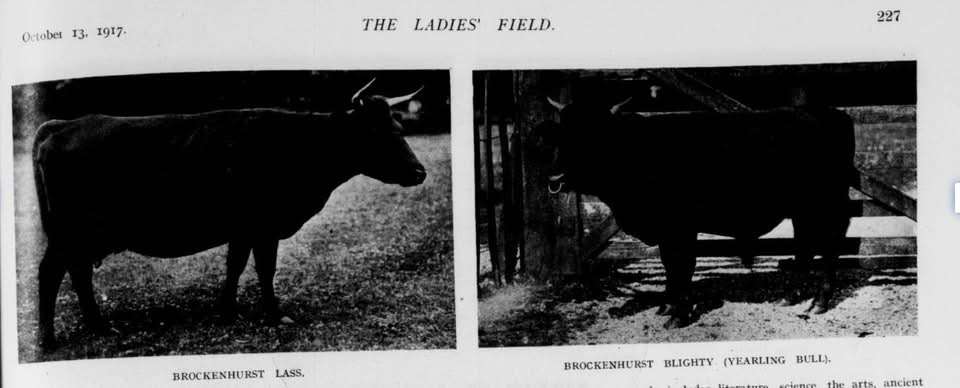
All these thoughts can be found in this newspaper clipping from 1917, in reference to Kathleen Morant’s Dexter herd along with pictures that describe even more than the words written in black and white can relate.
We’ve shared several articles on the importance of minerals for your Dexters.
We are discussing it again, as it’s a very important topic for the health of your herd.We cannot express loudly enough how important minerals are for your Dexters. Loose minerals are better than blocks, as they can consume much more in loose form, than they can by licking a block.Minerals are made by several different manufacturers. As with anything, you get what you pay for. We esp. like the VitaFerm brand. Many companies offer minerals that target different seasons or issues, i.e. supporting the reproductive system during breeding, heat stress in the summer, selenium, high mag, and others. Consult with your vet, mentor or a feed rep, to determine what could be lacking in your area and thus what you need to support in your herd. Some people have their hay tested, so that they can determine what they need to make up for in the minerals they supply for their cows.
Next, let’s talk about Kelp. We started using Kelp this year, for the first time. Thorvin Kelp, is an organic, natural supplement that is packed full of bioavailable minerals and vitamins. It can also be fed to other animals on your farm. The benefits of feeding Kelp to your herd are many. Some of those are improving breed back time, helping with weight gain, preventing foot rot & pink eye. It basically boosts the animal’s immune system. In turn, this helps lower your vet bills and helps keep your livestock healthier. Kelp can be fed free choice, alongside your loose mineral or it can be blended into a feed ration. Talk with your vet or feed rep, with any questions you may have for feeding Kelp to your herd. Apple Cider Vinegar or ACV, is another tool that many use to help build up their animals’ immune systems. We prefer the raw ACV, with “the mother” in it. Some say it helps improve cattle health and feed utilization. Others say it also helps prevent and eliminate parasites and resist disease. It’s also been said to reduce horn flies, by making their skin more acidic. It’s going to depend on the size of your water troughs, on how much to add. One recommendation I found, is to mix in 1-2 cups of ACV, per 20 gallons of water or ¼-1/2 cups per 5 gallons of water. Sick or stressed animals can get more, double or triple the amount of ACV, however I would check with my vet, before increasing it too much.
Worming: There are several different types of wormers available, that target different types of worms and parasites. They come in pour ons, oral, injection and block or pellet forms. If you have pregnant or lactating cows, make sure the one you chose is safe to use on them. Ask your vet or a mentor. Some breeders have a yearly worming schedule.If you have a poorly looking animal that is thin & has a dull looking coat, or it might have diarrhea or blood in their feces, the first thing you may want to do is to gather a fecal sample into a clean container and take it to your vet for testing. This isn’t costly and it will tell them/you the correct treatment to use. The problem can range from the animal needing worming, to possibly having coccidia or another disease that needs treated.
A lot of our Country is experiencing high temperatures right now. Usually, any added stress to cattle, can lower their immunity to some things. Higher temperatures can be stressful on animals. If possible, consider moving or working your cattle, during cooler days. Weaning in the hot summer months can be especially stressful for calves. Consider waiting to wean, until cooler months. Make sure they have ample shade to get to, and keep fresh, clean water available, throughout the day.
Veterinarian: YES! You need to establish a veterinary relationship early in your Dexter journey. They are your first go to in an Emergency and for advice. They need to visit your herd and get to know them. This will benefit you & your herd, in the future. Oftentimes, once they get to know you and the herd, you can obtain advice via a phone call and pick up meds, etc. at their office. Like it or not, there will be an occasion where you need an emergent visit. Your investment in your cattle, is worth calling a vet out in an emergency. Lots of breeders, can give advice from experience, but nothing replaces the professional assessment and treatment of a veterinarian who is familiar with your herd. We hope the ideas above, give you something to ponder, research and consider doing to benefit the health of your herd.
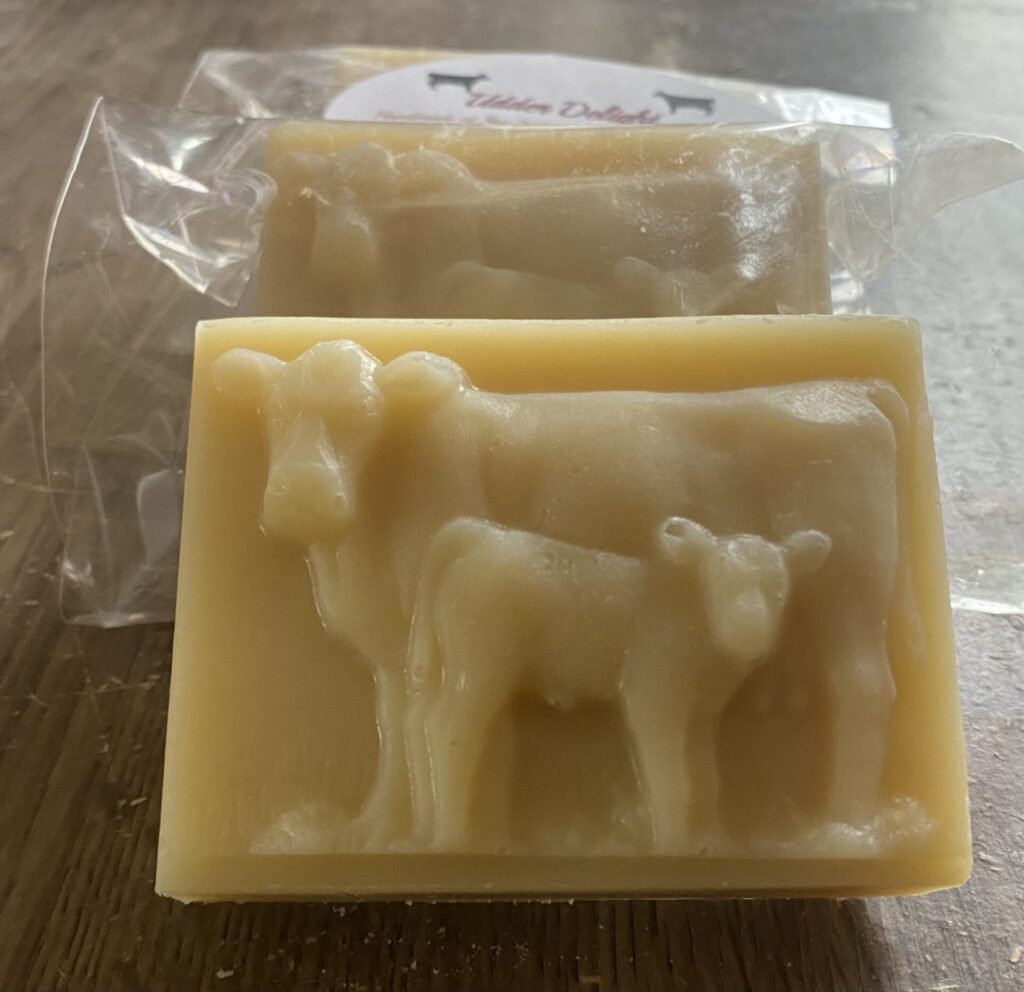
Here is a simple video that shows you how to make soap from tallow…you can replace the water part with milk or 50% milk and 50% water. Go ahead give it a whirl…your skin will love it!