beef

Information on Irish Dexter beef

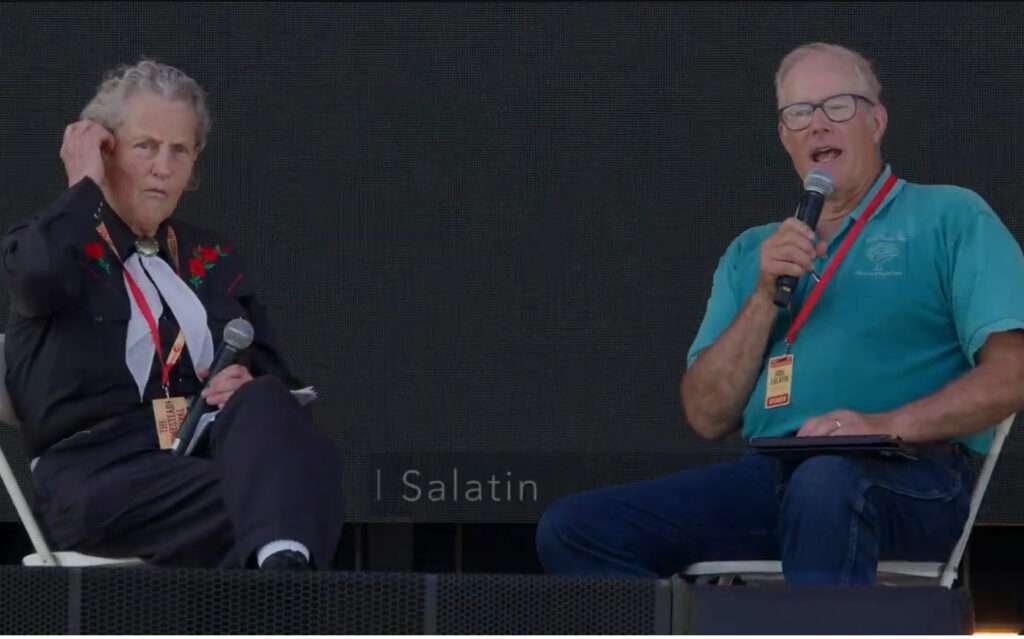
Cutting up The Beef podcast

This podcast covers some of the questions we all have when starting out with cuts from our Dexters. The cuts will be the same…just different overall yields.
They have some interesting ideas for selling to your customer base.

Cutting up The Beef podcast Read More »

Beef

Dexters ARE Irish and Proud of It

Where ever they roam Dexters are Irish and Proud Of It!

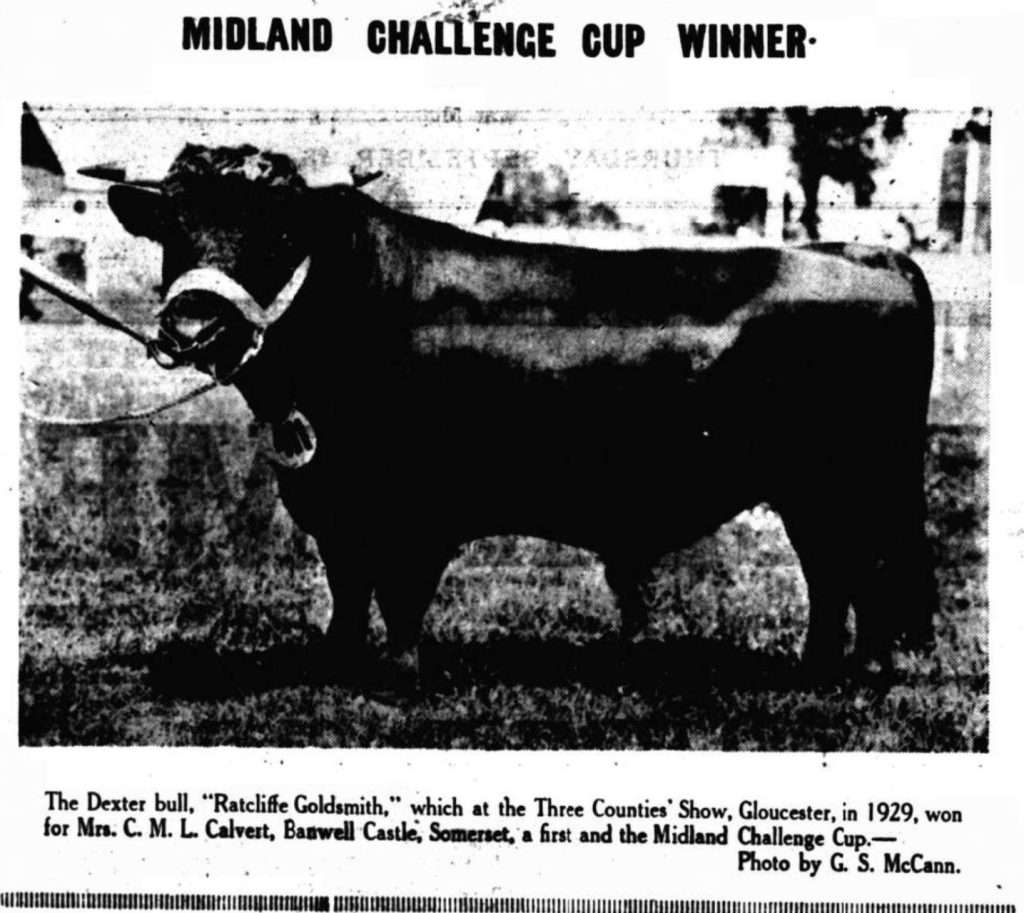
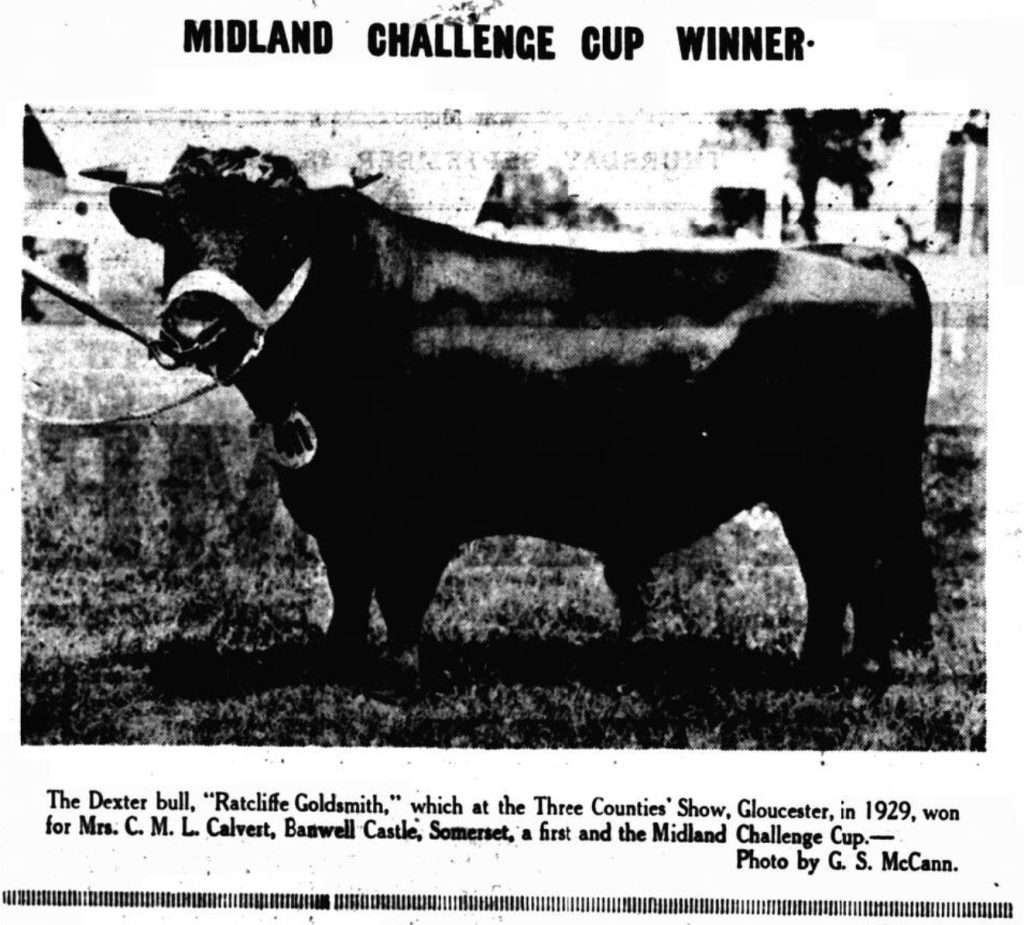
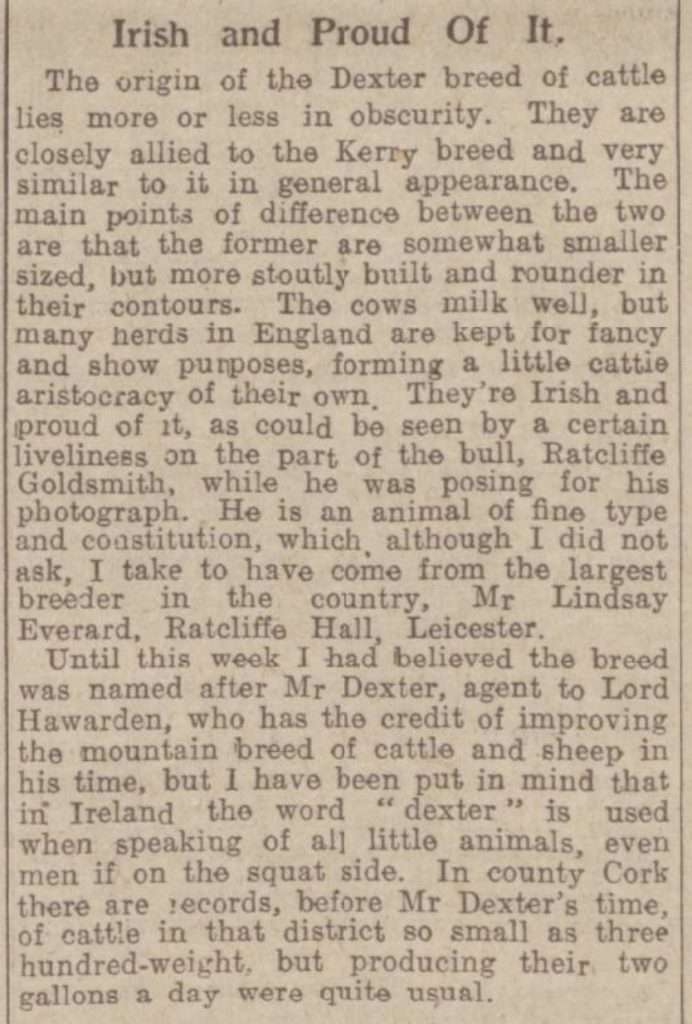
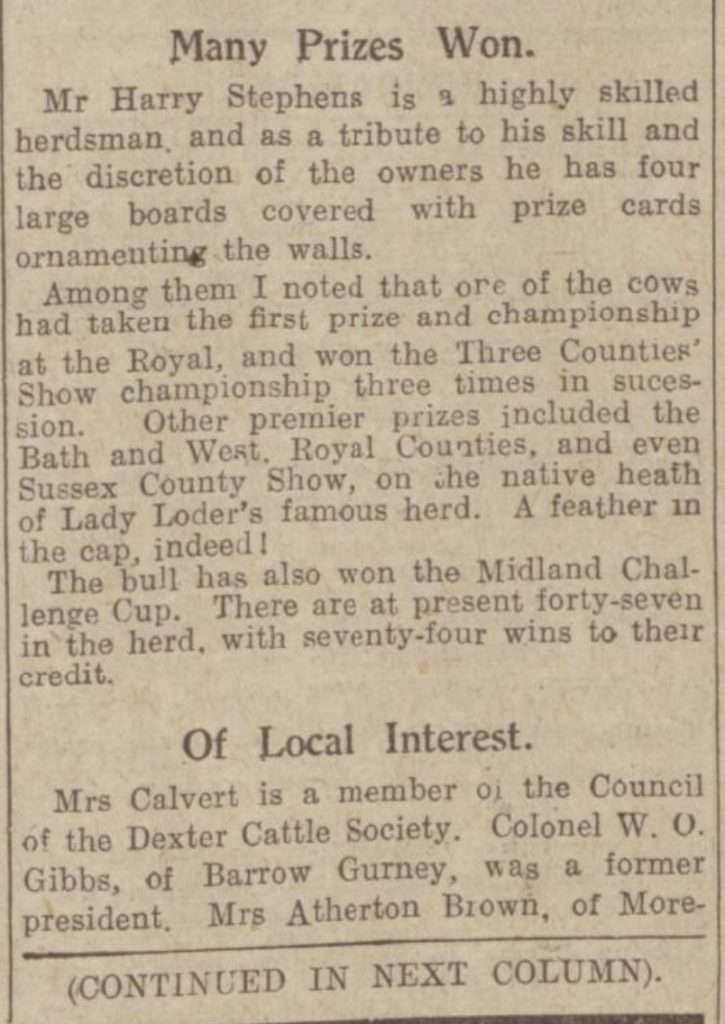
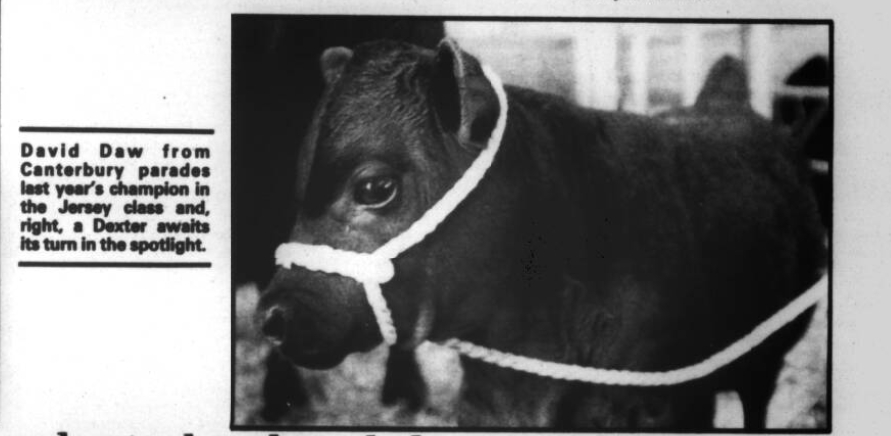
Dexters are well known as Irish Dexters even if many other points about them are debated. The above bull though registered with the Dexter Cattle Society is an Irish Dexter with a “fine type and constitution” as the article states. I checked, he certainly was owned and breed by Mr. W. Lindsay Everard of Ratcliffe. This article holds true to the fact that Dexters are known to be of a small type of cattle. That very small cattle were known to roam Ireland before “Mr. Dexter” was ever penned in History. In Kerry there was known to be some of the smallest type of cattle one can imagine, long before Dexters were ever established or organized into a true breed. So small of an animal that it is mentioned in this paragraph, but yet still producing 2 gallons of milk a day is a marvel indeed. The brown article was written on 14 Nov 1929, it’s from the Western Daily Press Bristol. The picture was taken from a later newspaper published in 1930. Though the Dexter was well known to produce ample milk and was “closely allied to the Kerry breed and very similar to it in general appearance.” The differences being that “Dexters are “more stoutly built and rounder in their contours”.

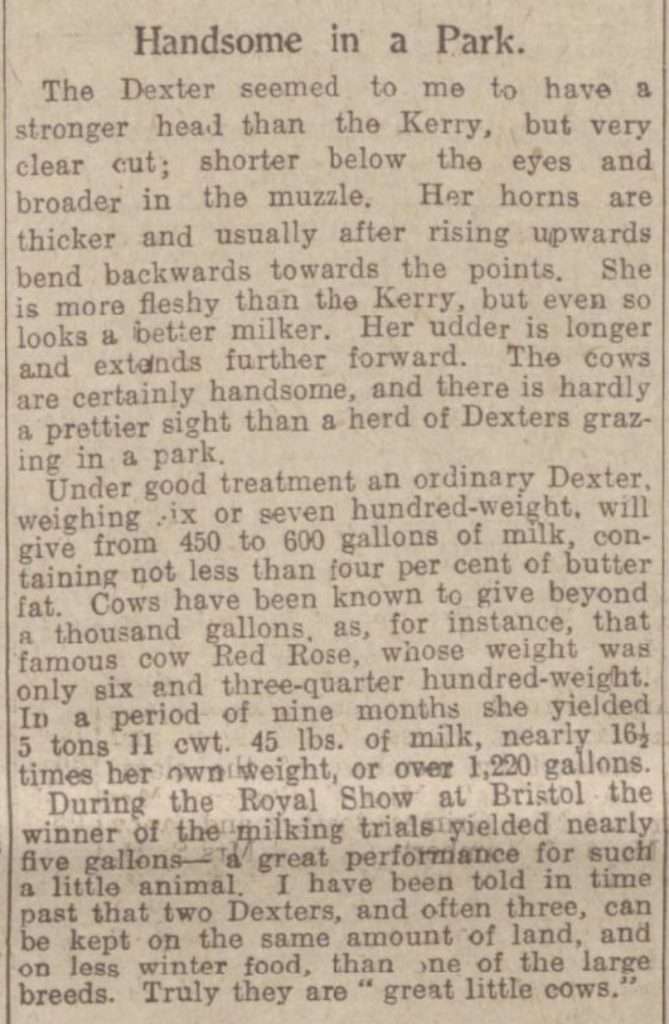
The Dexter has a “stronger head than the Kerry, but very clear cut, shorter below the eyes and broader at the muzzle”. The description of her horns are as follows ” Her horns are thicker and usually after rising upwards bend backwards towards the points”. It is interesting to note that she is even fleshier than the Kerry but was thought to look a better milker than the Kerry. Short cows with large udders seem to showcase the udder in a much more extreme way than a longer legged cow though the udder could be of the same size. The article really goes on to highlight the excellent milking attributes of a Dexter to great lengths. A point worth mentioning is that “there is hardly a prettier sight than a herd of Dexters grazing in a park”. I personally can’t help but look out at my hills and know this rings true to me today, just as much as it must have to the writer of this article in the past! Dexters truly are practical and beautiful when bred for all these amazing Historical traits!

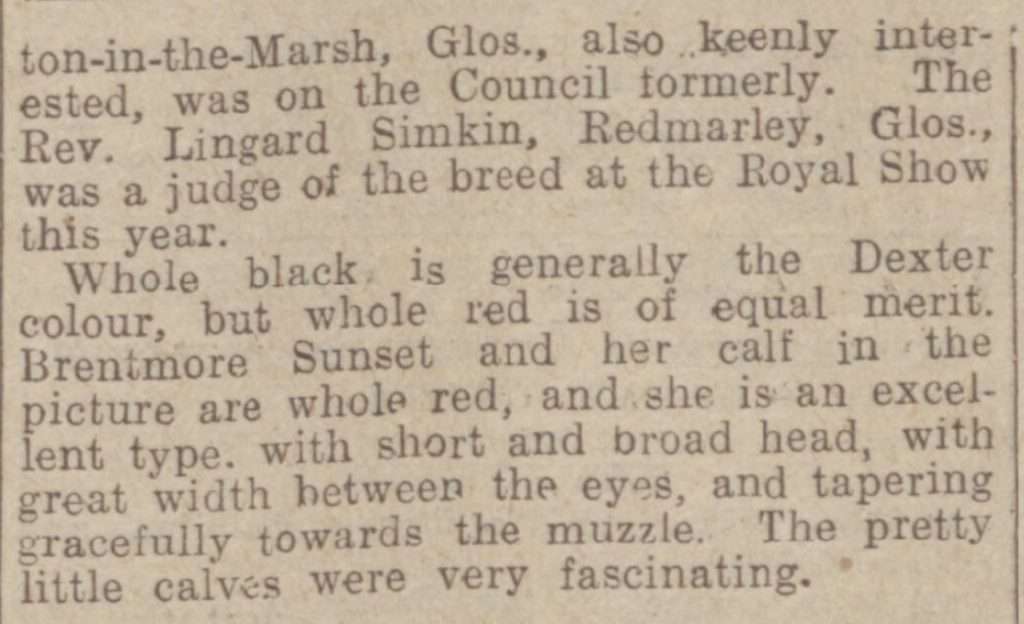
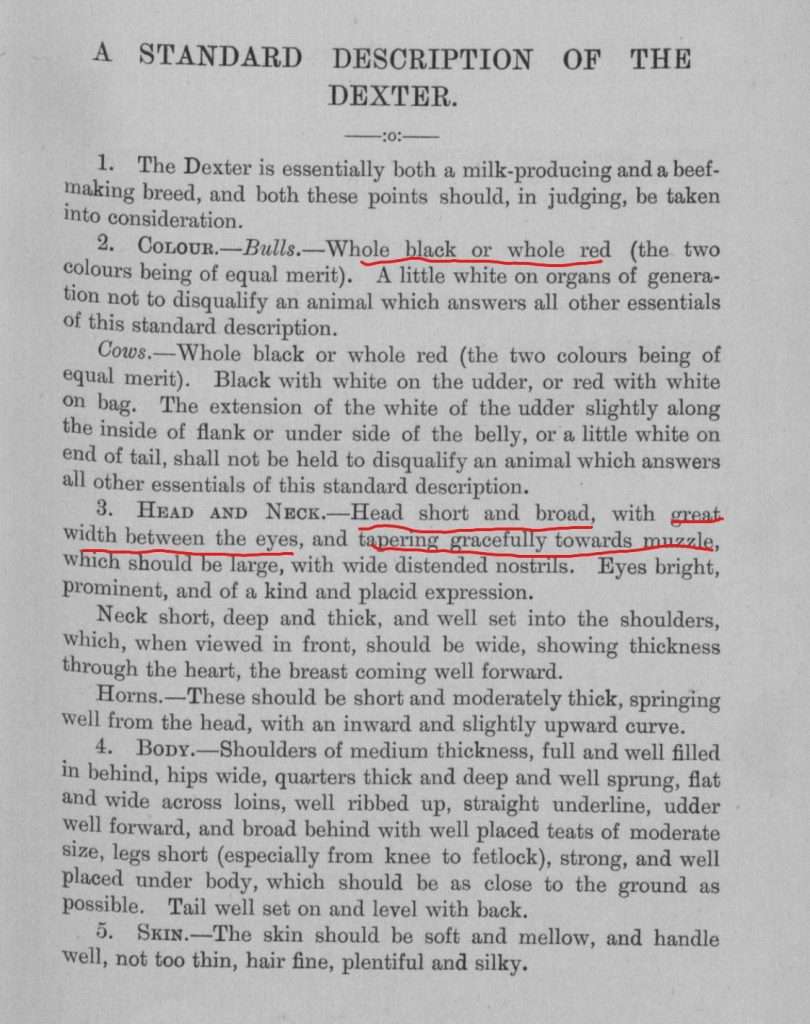
Breeders have long been concerned with breeding to “type” and a few points to mention in this last photo that align with the Standard Description of a Dexter is the color being “Whole black or whole red”. The “Head short and broad” with “great width between the eyes”, and “tapering gracefully twords the muzzle. Dexters definetley impress with their specific beautiful traits and charming ways which took hold of many a wealthy land owner who could aford to buy any exotic cattle they chose. In conclusion Dexters and their “pretty little calves are very fascinating”! They are Irish and Proud of it and those of us who breed them, have been taken by their Irish Charms.

Dexters ARE Irish and Proud of It Read More »

Historical

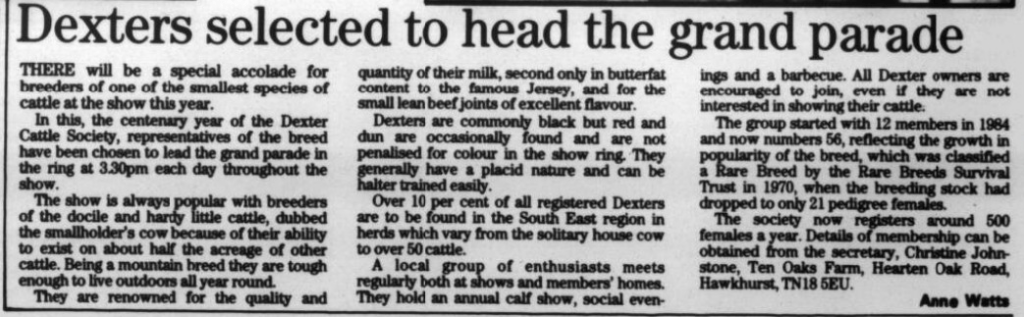
The Dexter: The SmallHolder’s Cow

Great for Small Acreage

Dexters have long been promoted the same way time and time again, “Docile and Hardy little cattle, dubbed the smallholder’s cow because of their ability to exist on about half the acreage of other cattle.” This is the niche market of a Dexter. They are well suited to beginners because they can endure a bit of accidental neglect from new owners and be a great fit for people who have small acreage. Today when large acreage is becoming increasingly expensive in many areas, but people are feeling a strong draw to get back to the country, the small acreage Dexter cow is the most perfect sell point. This is a Hallmark of the breed and one that should be promoted.

Quality and Quantity of their Milk and Beef

Dexter cattle are also a good fit for people who need a smaller amount of both meat and milk, but yet they are still “renowned for the quality and quantity of their milk, second only in butterfat content to the famous jersey, and for small lean beef joints of excellent flavor”. There are other breeds than Jersey that outperform Dexters in cream content but usually they are not breeds that produce a good quantity of milk. The Highland for instance produces about 10% butterfat, but for its larger size produces quite a bit less by volume for its size. This is why the Dexter is an all-around great little cow.

Great for Small and Big families alike

The current average amount of people in a US family today is 3.15, so in a small 3-person household butchering a Dexter steer goes a very long way. As Dexter beef producers we will have a much easier time selling whole or halves to people. This avoids having to get a USDA certified meat facility which in some areas could save you more money on butchering costs. Many people are more accustomed to the idea of buying meat in a smaller quantity when they need or want it. With smaller sides you can market to people to be able to only fill a portion of their chest freezer and have space left over for other things. If you have a larger family that enjoys eating lots of beef and drinking more milk, no problem, enjoy the benefit of growing out a larger herd with more Dexters!

This article was written 09 July 1992, and you will see the addition of dun is mentioned to the original color of black and red. Dun was added to the allowable Dexter colors and today many people never knew that black and red are the only 2 original colors.

Written By Danielle of Bryn Mawr

The Dexter: The SmallHolder’s Cow Read More »

Historical

What Do I Need to do Before I Drop off my Meat for Processing?

In this podcast, we learn about things we need to consider before we even schedule our meat for processing. Interesting fact is the return on the Dexter is higher than what is stated here. We experience much closer yields to 70% and our carcasses are smaller…so the freezer space issue is not as significant with the larger breeds.

[data-source-id=”source-c0522901-6157-4e5e-9aa6-d3c2cfdf22e6″] .ose-embedpress-responsive{ width: 600px!important; height: 600px!important; max-height: 600px!important; } [data-source-id=”source-c0522901-6157-4e5e-9aa6-d3c2cfdf22e6″] iframe{ width: 600px!important; height: 600px!important; max-height: 600px!important; } [data-source-id=”source-c0522901-6157-4e5e-9aa6-d3c2cfdf22e6″] .embedpress-yt-subscribe iframe{ height: 100%!important; } [data-source-id=”source-c0522901-6157-4e5e-9aa6-d3c2cfdf22e6″] .ose-youtube > iframe{ height: 600px!important; width: 600px!important; } [data-source-id=”source-c0522901-6157-4e5e-9aa6-d3c2cfdf22e6″] .ose-youtube{ height: 600px!important; width: 600px!important; } [data-source-id=”source-c0522901-6157-4e5e-9aa6-d3c2cfdf22e6″] .ose-giphy img{ height: 600px!important; width: 600px!important; } [data-source-id=”source-c0522901-6157-4e5e-9aa6-d3c2cfdf22e6″] .ose-google-docs img{ height: 600px!important; width: 600px!important; } [data-source-id=”source-c0522901-6157-4e5e-9aa6-d3c2cfdf22e6″] .ose-embedpress-responsive.ose-google-photos{ height: 100% !important; max-height: 100% !important; } [data-source-id=”source-c0522901-6157-4e5e-9aa6-d3c2cfdf22e6″] .embera-embed-responsive-provider-gettyimages, [data-source-id=”source-c0522901-6157-4e5e-9aa6-d3c2cfdf22e6″] .embera-embed-responsive-provider-gettyimages iframe, [data-source-id=”source-c0522901-6157-4e5e-9aa6-d3c2cfdf22e6″] .getty{ width: 600px!important; height: 600px!important; max-height: 600px!important; max-width: 100%!important; }

What Do I Need to do Before I Drop off my Meat for Processing? Read More »

Beef PipeDreams

Preserving Irish Dexter Dairy and Beef

By Eliena Bodtke, Stay’N Put Farm

Since many of us are homesteaders or practice some kind of preserving, I thought I would take a moment to discuss an alternative to canning, pressure canning and dehydrating. 

 Are you scratching your head, thinking where is she going with this?

Consider freeze drying.  While the initial cost seems daunting, it really is an excellent way to preserve your Dexter milk, yogurts, cheeses, colostrum and beef for 25 YEARS!  Think about when you’re over loaded with one veggie or another during gardening season.  The veggies, herbs or eggs when they are abundant, can be frozen and put into the freeze dryer anytime.  We still can and pressure can, but this gives us a  whole new option.  

We purchased a medium Harvest Right about a year and half ago and have been amazed at all the things we can preserve….it is less time consuming and in our opinion, and better quality product in many cases.

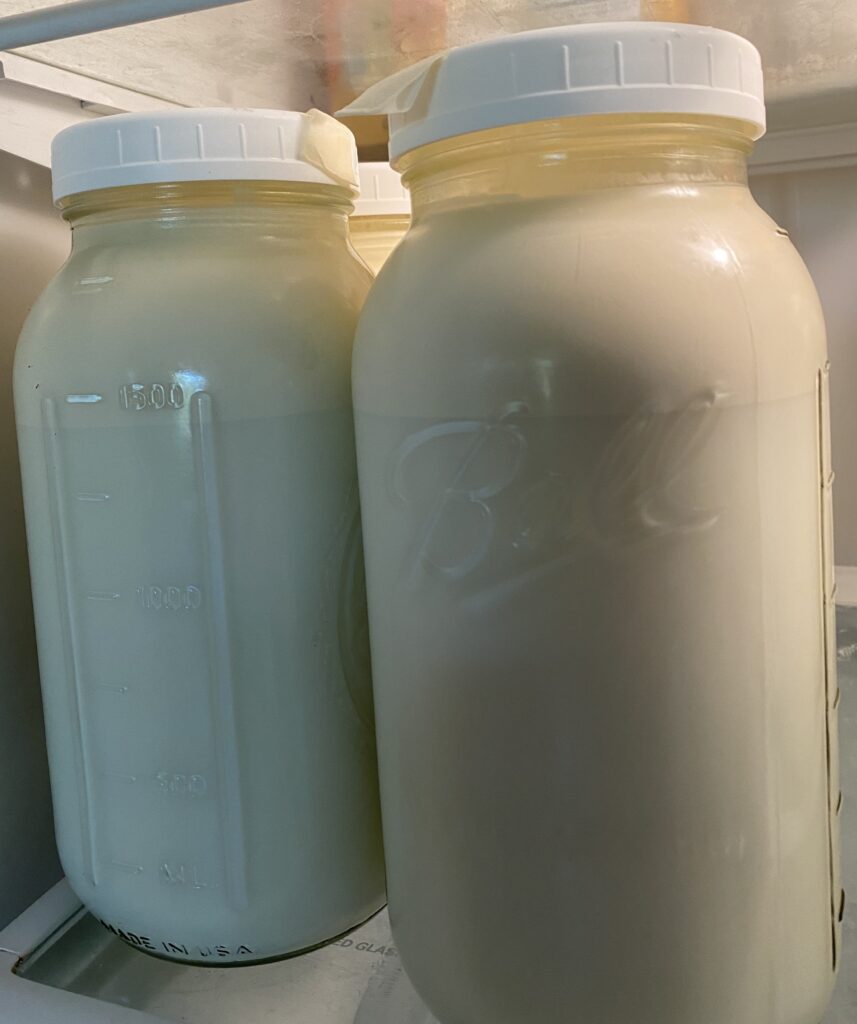
Canning of dairy is frowned upon by the USDA and in some cases consider unsafe, although people do it.  Freeze drying on the other hand, processes the dairy at lower temperatures and therefore does not pasteurize it…so if raw is your goal, it is good alternative.  If you pasteurize, you still follow the same method.  We pour a quart of milk on each tray and let the machine do its thing.  We have done it both with cream in and cream out…the choice is yours.  We find it needs to be blended when reconstituted, or another favorite is dry in our coffee, just like coffee creamer!

If you’re into selling, freeze dried milk and other products can be a good source income.  Take a look at the price of powdered milk in the store!  It is not uncommon to see freeze dried milk for $30-40 a gallon.  Let’s clarify this.  One gallon of freezer dried milk reconstituted into one gallon of drinkable milk…almost quadruples in price.

And don’t forget your Dexter beef!  Consider this scenario….you have some cuts left from your last processing and you would really like to eat it before you get into the next one.  Well, freeze dry it and then you have preserved it for 25 years.  It makes great gifts, as it is so light to ship.

How do you use this freeze dried beef?  We like to pour some of our Dexter  bone broth over it.  Let it sit in refrigerator over night and then use it in the next day or so.  The beef will only absorb as much broth as it can.  It doesn’t get mushy, which can happen with veggies.  Cook with it like you usually do.

Hope this article helps you on your farm, ranch or homestead.  I just love this technology and thought I would share.

Preserving Irish Dexter Dairy and Beef Read More »

Beef Milking

How to Get Your Product Into Grocery Stores

Grocery stores are a great way to put your business into overdrive, giving customers new options in ever-fashionable packaging. Whether you are looking to sell at local convenience stores or big-box wholesale grocers, it presents the perfect opportunity for your product.

Interested in learning more about how to get your product into grocery stores? In this ultimate guide, Mako PKG takes you through the whole process from start to finish.

How to Get Your Product Into Grocery Stores Read More »

Selling

Farm Sales…A Way I Find works

I think one of the hardest things for farmers, ranchers and homesteaders is when they need to sell something off the farm.  That journey should start well before you need to sell something.

Let’s look at the model I use for selling of Dexter beef.  

I share all of the information about our wonderful breed I can, on social media …especially things like, dropping the names of famous chefs that have come to appreciate the quality of our beef.  I also share podcasts, articles and pictures of Dexters in the field, on the plate and in its packaging from the butcher.

So now you have some beef that will be ready to be processed in a few months and you don’t need it for your family.  This is when you need to start looking for potential customers.

How to get started 

The first thing you need to do is decide what you are going to sell and its value.  One of the easiest ways to do this is to look at the market…check out sites like the Irish Dexter Cattlemen, Craig’s List and local social media sites.  By comparing what you see on these you will be able to determine what the price point of what is  selling in your area.  

Things to keep in mind are is it grass-fed and grain finished or grass-fed and grass finished.  The grass-fed grass finished tends to command a higher price.  Another consideration is vaccinated, as more and more folks are looking for unjabbed…this is a term I see more and more.  The more specialized your finished product is, the more you can ask. I say you can ask…because not every  customer values that.   It’s about building the clientele at this point.

Build your own customer base

Once you start to get customers, you will then need to retain them and encourage them to tell their friends.  We always follow up immediately after they get their first quarter or half. Your butcher can also be a big help to you.  He sees and works with a lot of different breeds and will have a much bigger customer base than you.  A really good butcher is so important to your finished product and especially your yield.  My butcher is wonderful about sharing what we have produced and bragging on it for us!

Not everyone knows what Dexter cattle are and that we have, well in my opinion and many of our customer’s opinion,  one of best dual purpose , beef and dairy breeds.  So, how do you get them to see the value of your beef and our  breed?   For us, it was finding like minded folks.  People who were not looking for meat from the local grocery store.  Someone who understood, that by buying the whole, half or quarter of the Dexter they would see an overall better value than the price of just the burger.  Our burger is ancestral beef, another differential that sets us apart from many of the other farmers in our area. It includes a percentage of organ meat.  This maybe valued by your customer,  if they are health conscious…or maybe not important to others or even a put off, to some.

Once they have bought from you, you need to ask them when they will need more.  You want to retain that customer and build on that base.  If they rave about it…ask them to tell their friends and family.  Word of mouth is so much less work and keeps your pipeline full.  If you can’t fill their needs, find another Dexter owner who you can work with and help each other.  For us, it’s about getting them to buy Dexter.

Dealing with objections

Common objects are:

I don’t know if I have enough freezer space…or how big a freezer do I need.  We have many articles, videos and personal writings on the this in the IDC Gazette  But the amount of beef produced is a huge selling feature, as the Dexter doesn’t give the average family, too much to deal with.

In many states they need to pay you for the Dexter and the butcher for the processing.  In other states, they are done at USDA facilities and payment can be made to you including the processing.  Or it can be sold as individual cuts.  If selling individual cuts, more homework will need to be done determining the prices of those individual cuts. So, money can be a factor, as some will need to accrue for it unless you are selling individual cuts.

And my all time favorite objection …I need to talk to my husband or my wife…and then you hear crickets.  You still need to follow up.  Understanding objections can only help you hone your selling skills and prepare you for crazy objections like this last one….lol

Using the Irish Dexter Cattlemen Marketplace

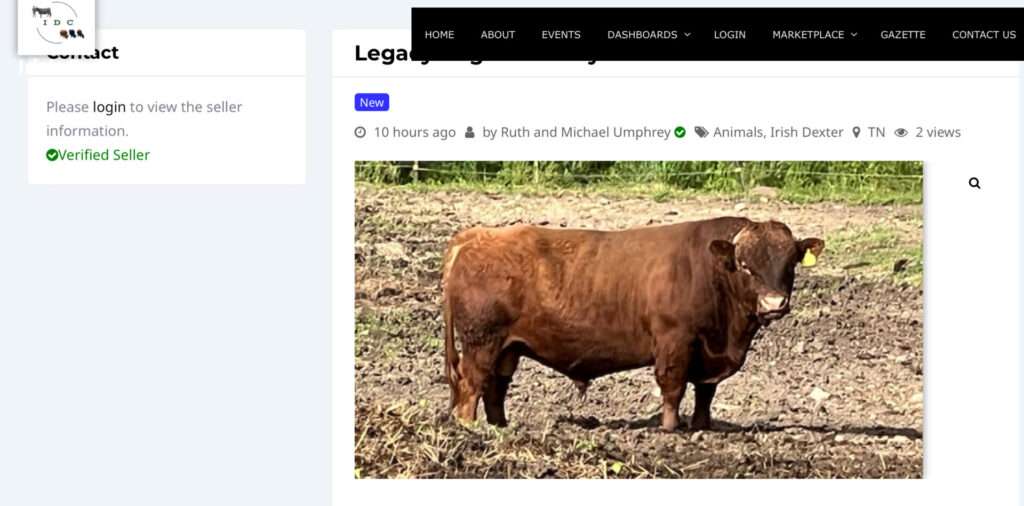
I use the ad I generate using the Irish Dexter Cattlemen for selling.  Why?  Because it’s looks professional,  I don’t have my own website and I don’t want to write a bunch of different ads.To best utilize the ad, I take a picture of it, so they have something to look at and then copy and paste the link of the ad into different social media groups and sometimes even Craig’s list.  Not everyone uses social media or Craig’s list.  So, by using the IDC Marketplace, I have exposure there on the website  and in the FREE monthly newsletter, giving me two more vehicles for selling.  By doing it this way, I only write the ad once and then copy and paste, giving it a professional and consistent look. Feed back from some of the buyers off the site have been very positive. They like that everything is in the ad…registration numbers if applicable, location, price and if it is negotiable and that they can have a private conversation.

When sharing on social media I choose local sites, as shipping, is not much of an option with cost of shipping and the need to keep it frozen.  I also use the Irish Dexter Cattlemen featured post on FB and some of the cattle groups that serve my area, as it’s just not feasible for people to drive great distances for their beef.

Repetition 

Just because you post something once doesn’t get it sold.  People don’t typically look back through post from a week ago or a month ago.  When  they’re wanting to buy something they usually look back maybe a couple of days. 

I suggest you post on Thursdays or Fridays and again on the weekend to get people looking at what you have available.  

If you are keeping your pipeline full, and you are building your clientele, the repetition will not need to be as much.  You will develop wait lists and those lists will need to be worked.  Just because they’re on your waitlist doesn’t mean they’re going to buy again. You need to touch base with them periodically and keep it current because they may have decided to buy somewhere else. I find if you touch base with them monthly or every other month, you’re more likely to keep them on your list of potential buyers.

So in conclusion, the important things to remember are

Look professional.

Start to sell before your are taking your Dexter for processing.

Build up the quality of the breed and its beef….you never know you may sell breeding stock too to that beef customer.

Learn to deal with objections in a positive manner.

Remember, posting it once doesn’t get it sold. 

Here is one of my favorite podcasts for educating buyers about our wonderful breed.

I sincerely hope this helps you…if you have more ideas, feel free to comment.  I would love to hear some of your feedback or unique ways of selling your beef and breeding stock.

Farm Sales…A Way I Find works Read More »

Selling

Dexter Arrival: A Homesteading Dream Realized, Hayburner Acres

Our journey to homesteading began about five years ago. My husband and I were searching for self-sustainability, a quieter life, and a deeper connection to the land. Raised in the suburbs with every modern convenience, we only knew which grocery store had the freshest beef. That was the extent of our food sourcing knowledge.

Once we acquired our acreage, we started, as many do, with chickens. At the time, I hadn’t even considered milking animals myself, so I went looking for farm-fresh milk. I found a local source, and with it, a whole new world. We began picking up a couple of gallons each week, but it didn’t take long before we wanted to produce our own.

That’s how we ended up with Nubian goats.

I was intimidated by the idea of milking and caring for them, but goats felt less daunting than a full-sized milk cow. Still, I had always loved and admired the Dexters at pickup. Just being around them brought a peace I couldn’t explain. They were a dream, something for “someday.”

Fast forward a few years, and someday finally came.

About a month ago, we brought home our first Dexters: a heifer and a steer. And how’s it going? In a word? beautifully.

The first thing I noticed was their peaceful nature. Just being near them calms my nervous system in a way I can’t begin to describe. I’m absolutely head over heels in love. I’ve started thinning down my goat herd to make room for more Dexters in the future.

I’m learning to be a pasture and grass farmer (also moving fencing, adding pastures) all to better serve my Dexters. I’m excited to contribute to the breed by selecting strong lines and continuing the work that’s already been poured into my girl, Fiona.

Am I still intimidated by the idea of milking them? Absolutely.
Will I do it anyway and love it once the time comes? Without a doubt.

There’s still so much to learn—about pasture management, breeding, and eventually milking—but I’m ready. With the right mentors and a heart full of determination, we’ll thrive. Fiona and Chuck are home now, and so are we. This is just the beginning of a lifelong journey with Dexters, and I couldn’t be more excited to walk it one peaceful step at a time.

I’m looking forward to many years alongside this incredible breed.

Dexter Arrival: A Homesteading Dream Realized, Hayburner Acres Read More »

Homesteading

TENET BEEF UPDATE

After a small sampling from one herd, it appears that the Dexter breed does have this highly inheritable genetic marker. It appears that the marker is found in those cows with the most milk production. This makes total sense, as they refer to the genetic marker as found in most easy keeping cattle.

Unfortunately no bulls were part of the initial testing and semen is not able to be tested for this marker.

So, now that we know the marker is there for the Dexter breed and that it seems to be in cows with most milk…we need more folks to test. It has been suggested that it maybe easy to get a few drops at ear tagging time and a simple tail stick for the older ones.

If you would like more information on how to get your herd tested, please reach out to the Irish Dexter Cattlemen and we will help you get started. It requires only a few drops of blood on a Tenet card sampler. The card is then sent of for sequencing.

It takes 5 days to get to the lab and 10-30 days for the sequencing to happen after being received.  They send your your results by email. Pretty simple procedure.

The thing that was most interesting was it was found in the cows with the most milk production. How cool would it be to be able to predict possibly milk production and beef tenderness? Duality!

In case, you need to brush up on this. Below is the podcast that started this adventure. This is NOT the Neogen testing that has been happening by a group of Dexter breeders.

TENET BEEF UPDATE Read More »

General

Perceived value ….true for dexter milk, beef and breeding stock

A CONVERSATION ABOUT PERCEIVED VALUE:

A customer asked me how much it would cost for a gallon of raw milk .

I gave them a price of $15/gallon.

The customer responded: That’s seems really high.

I asked: What do you think is a reasonable price for this?

The customer answered: $4 maximum

I responded: Ok, then I invite you to do it yourself.

The customer answered: I don’t know how to.

I responded: Alright, then how about for $4/gallon, I’ll teach you how to. So besides saving you $11, you’ll learn valuable skills that will benefit you in the future.

The customer answered: Sounds good! Let’s do it!

I responded: Great! To get started, you are going to need some things. You will need a cow (≈$3000), 45# of dry matter quality feed A DAY, feeders, waterers, an area to let her be a cow, a shelter, a clean area to milk, a milking machine or supplies to hand milk into, preferably electricity for this indoor area and heated water, countless gallons of water, fencing to contain this cow, etc.
Not to mention, there is a very real possibility that your single cow gets sick and doesn’t produce, a bull or someone to AI her because no pregnancy, no milk. Injury, illness, and unexpected weather conditions are always present. Now, you are back to square 1 if she doesn’t breed, dries up, get sick, or dies.

The customer answered: But I don’t have any of those things and I can’t justify buying all of these for a gallon of milk.

I responded: Ok. Well then for an additional $11/gallon, I can rent my supplies, building, and supply hay/grain/minerals/pasture to you.

The customer answered: Okay. That’s fair.

I responded: Great! We will start the project on Monday.

The customer answered: I work Monday through Friday. I’m only available on the weekends.

I responded: If you want to learn from me then you will need to work when I work. We milk everyday, 2x day, so you will need to be here at least 2 hours every morning and every night year round.

The customer answered: That means I’m going to have to sacrifice a lot of my time!

I responded: That’s true. Remember, when you do a job yourself you need to account for unproductive factors.

The customer answered: What do you mean by that?

I responded: Milking a cow doesnt just take a couple hours morning and night. It takes time to muck out her area, town trips to pick up cleaning supplies/teat dip, trucking for hay. It takes time to bottle the milk cleanly, it takes jars, it takes more cleaning of equipment and facility, it takes wear and tear on your milking equipment and feeding equipment. And thats all on top of your other chores/responsibilities.
So we will see you Monday morning, 6 am.

The customer answered: At 6am?!! My work day doesn’t usually start until 8am!

I responded: A cow thrives on a set schedule, milking 2x day should be as close to 12 hours apart as can be, so if you want to start later, that’s ok. But you will need to come back in the evening after your full day of work and milk again at that time, so if you want to start at 8 am, you will milk again at 8 pm. After clean up and bottling milk… you can head home around 10 pm. Saturday and Sunday included. Blizzards or 100 F. No days off here.

The customer answered: You know, I’m realizing that a lot more goes in to quality food than what a customer sees in the finished project. Your proposal of $15/gallon is very reasonable. I would like you to milk and have it ready for me to just pick up..

CONCLUSION:

When you pay for a job, especially a custom job, (whether it’s a physical project or digital project or GROWING AND RAISING FOOD) you pay not only for the material and the work to be completed. You also pay for:

✔️ Knowledge
✔️ Experience
✔️ Custom Skills
✔️ Tools
✔️ Time to plan
✔️ Time to prepare
✔️ Professionalism
✔️ Work Ethic
✔️ Excellence
✔️ Discipline
✔️ Commitment
✔️ Integrity
✔️ Taxes
✔️ Licenses
✔️ Sacrifices
✔️ Liabilities
✔️ Insurance

If you desire fresh, healthy, locally grown food, please don’t disrespect a farmer by trying to get them to lower their prices.

If their proposal exceeds your budget, there’s nothing wrong with going elsewhere.

Just remember.. you get what you pay for.

👉🏼 FARMERS: Know your worth and be confident in it.

👉🏼 CONSUMERS: Recognize their worth and be respectful of it.

Sharing this to support all my friends, family and clients who are Farmers, Entrepreneurs, Business Owners and Tradesman.

-Unknown and edited

Perceived value ….true for dexter milk, beef and breeding stock Read More »
Selling

Summer Heat Podcast- How It Affects Our Dexters and Other Livestock

Summer heat this seems endless. We hope that this podcast will help you recognize and help your Dexters deal with this heat. 

This podcast is brought to you by Irish Dexter Cattlemen, whose purpose is to promote the Irish Dexter breed by guiding farmers, ranchers, and homesteaders on how to become more sustainable. You can access all our podcasts of interviews with other farmers and ranchers and discussions on typical subject matters by becoming a member. This includes our entry level membership of $20 per year. Podcasts are stored in our relational multimedia database system and are searchable by topic by members. Members also gain access to a vast array of valuable articles on topics to assist you with your farm, ranch, or homestead. For anyone looking to take it to the next level, Irish Dexter Cattlemen provides breeder, services, and affiliate memberships that include an online branding dashboard where you can tell your story and develop your brand. Thank you for listening to this Irish Dexter Cattlemen podcast.

Brought to you by these Breeders, Affiliates, & Sponsors

Summer Heat Podcast- How It Affects Our Dexters and Other Livestock Read More »

Podcasts

Welcome to Spring:

By Shelley Hatfield/Whippoorwill Pines Farm

Spring is a beautiful time of the year!!  All the new babies, flowers popping their heads up showing off their colors, everyone itching to get their hands in the dirt!! But that also brings some problems if you have cows.  Here are a few things that I have found that make spring not so great.

First thing, with the crazy swings in the weather temps, you need to watch your cows for pneumonia.  This is a hard thing to notice but if  you keep watch you can start learning the signs.  One of the signs is lower head, their sides are “thumping” (meaning catching their breath), not alot of energy.  I had a steer go down and die the next day.  He had eaten the night before and looked fine.  But he was gone the next morning.  I asked the vet if I was doing something wrong.  She told me that it really doesn’t matter, it’s the big swings in the weather.  They have shelter, water and food. 

Keeping watch is one thing, but there is also a vaccine that you can give them once or twice a year to help with that.  It is a BRD vaccine.  Check with your vet to see if that is something that you want to give your cattle.  

We have talked about the mud before, but we will mention it again.  Make sure that your cattle don’t have to stand in the mud all the time.  That is something that can keep them from staying warm in the spring weather.  Make sure that they have a dry place to lay down.  

I’m not an expert, but I have learned some things along the way.  Some of those things I have learned the hard way….lol  These are just some things that I have learned on this journey of raising cattle. 

Welcome to Spring: Read More »

Beef