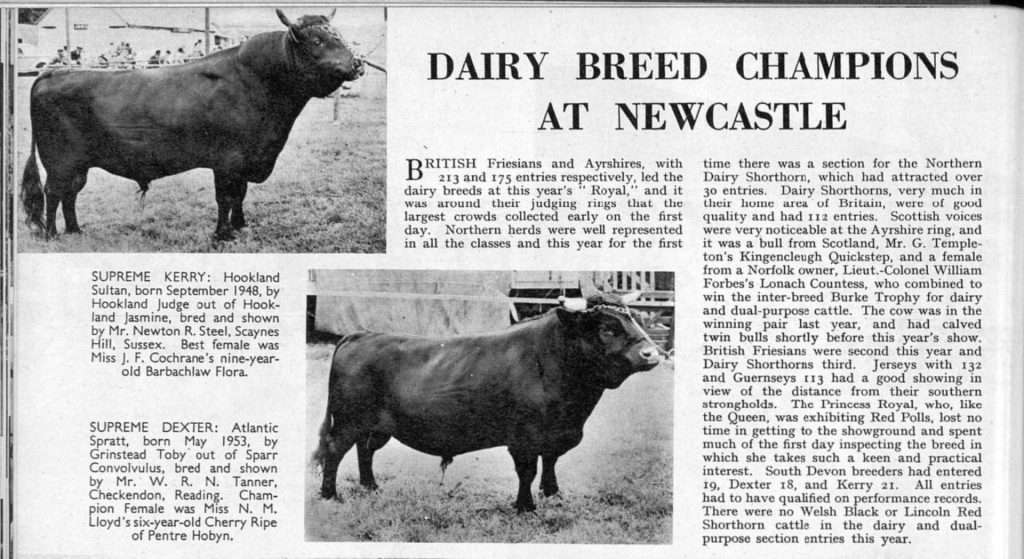
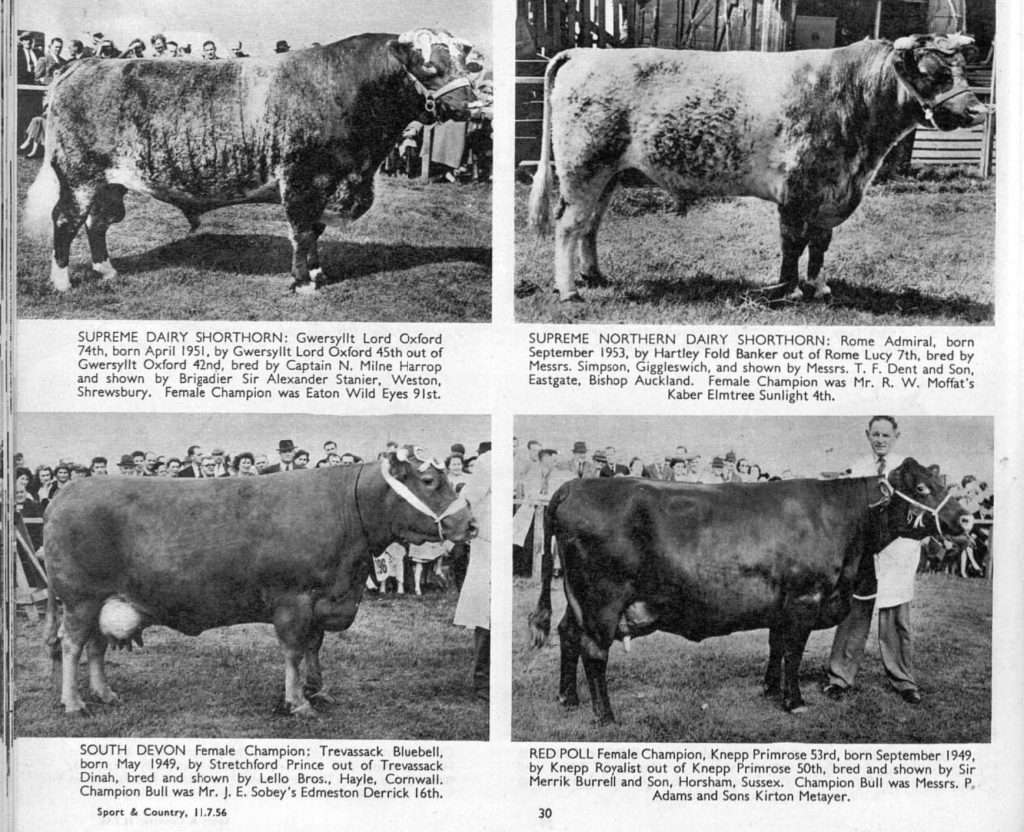
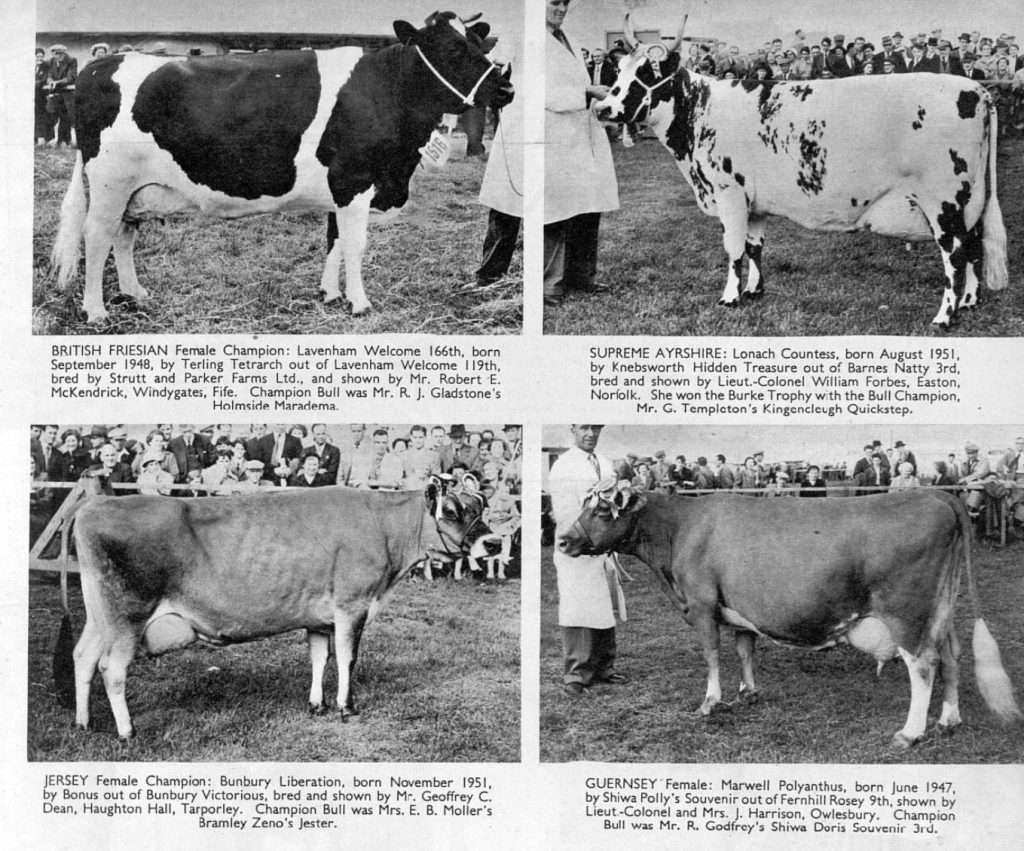
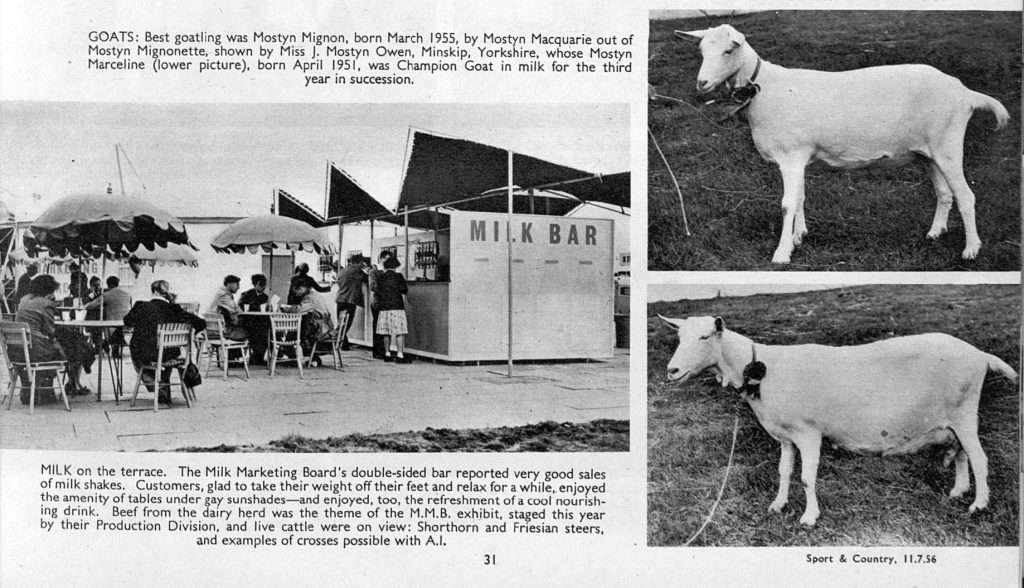
Atlantic Spratt was Shown with these Dairy/ Dual-purpose Breeds in 1956!
All Breeds entering the show had to have qualified performace records to compete.
Dexter Cattle put a High Emphasis on Dairy Traits
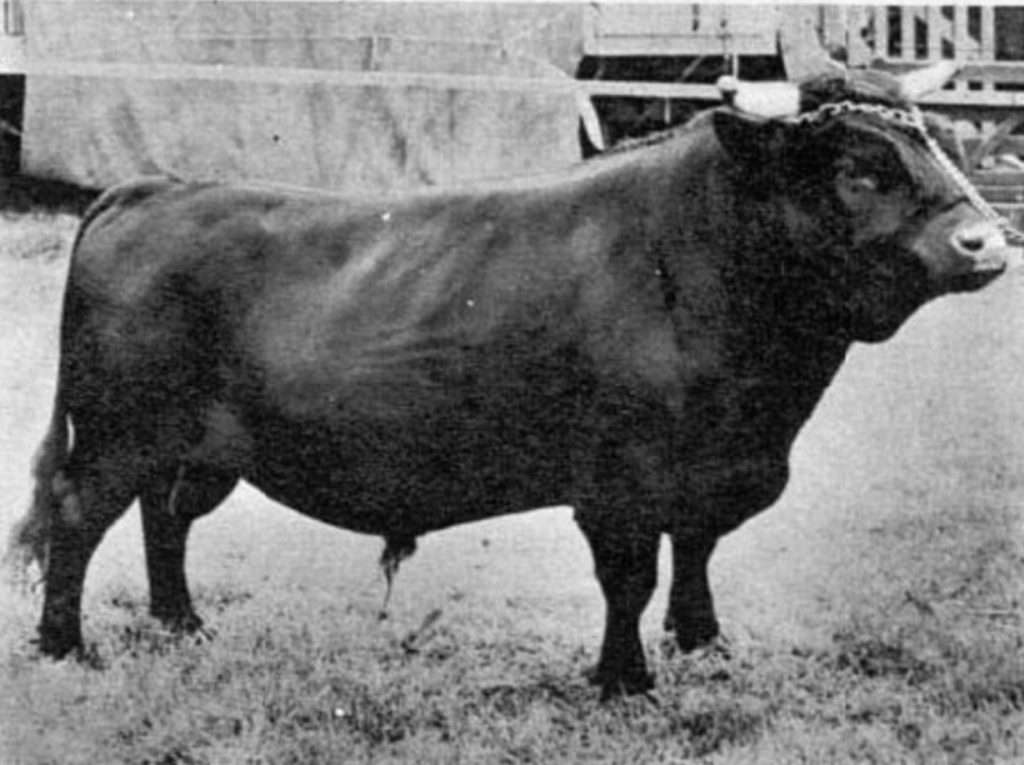
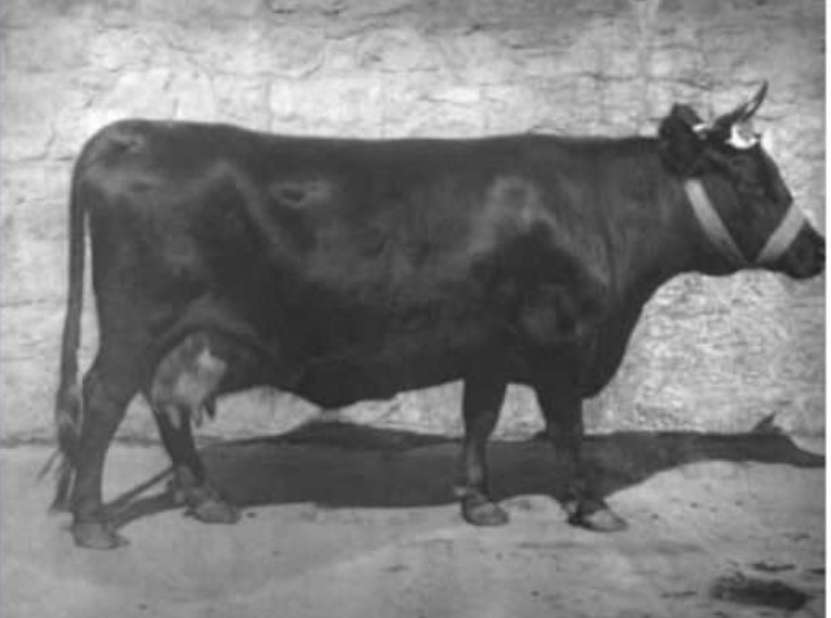
Dexter Cattle put a high emphasis on dairy traits and beef traits equally. Thoughtful breeders were honing these Irish cattle to excel in both capacities. One of the ways they were doing this, was by selecting bulls from dams with known milk records. Pedigree information is interesting to reflect on when you see repeated names in pedigrees and photos to document what genes might have been passed on from their ancestors. Looking at a bull alone will never tell you anything deeper about his genetics, than what you can evaluate with your eye. A nice-looking bull tells you nothing about what type of milk production his dam might of possessed. Thankfully with photos we can look back on bulls like Atlantic Spratt and see that he had a lot to offer besides just good looks. The fact that Spratt was presented at the show tells us that his dam was qualified by performance records, because it was a requirement to enter the show. Though none of the cows are perfect and much improvements can still be had in generations to come, evaluating them and their records goes to show that they were cows that could surely fill the pail.
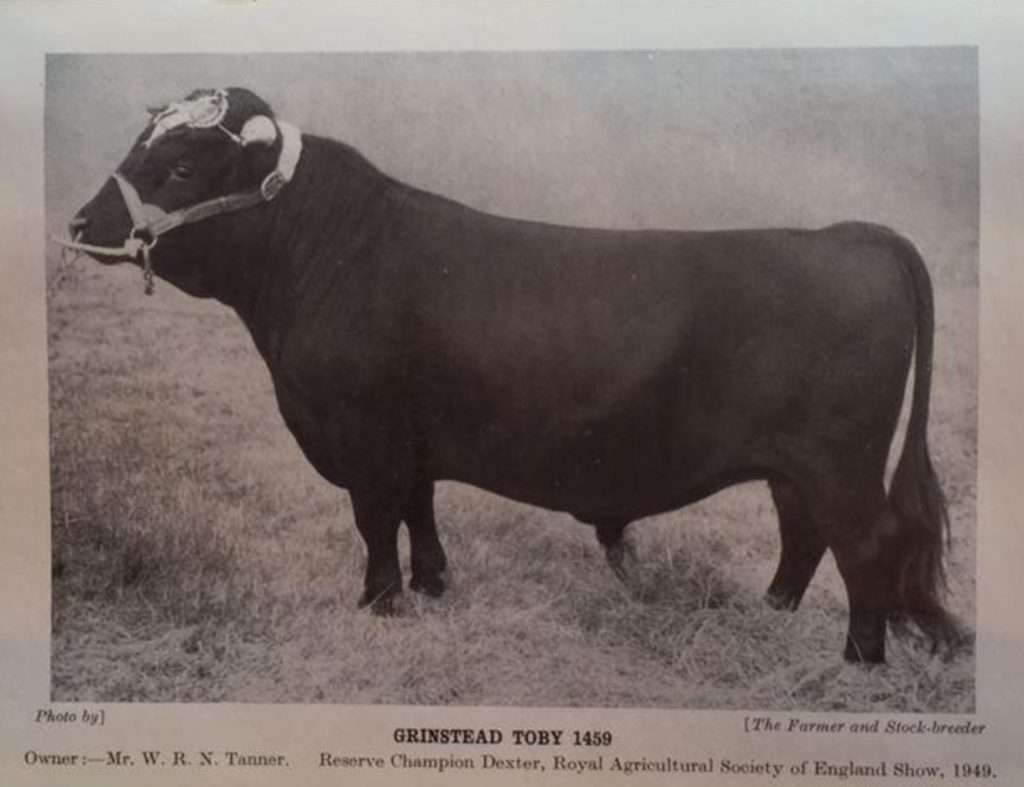
Grinstead Toby Sire of Atlantic Spratt
From this photo we can see where Atlantic Spratt got some of his good looks from. His sire was Grinstead Toby, a Reserve Champion Dexter, but to dig deeper I will investigate some of the females in Toby’s pedigree.
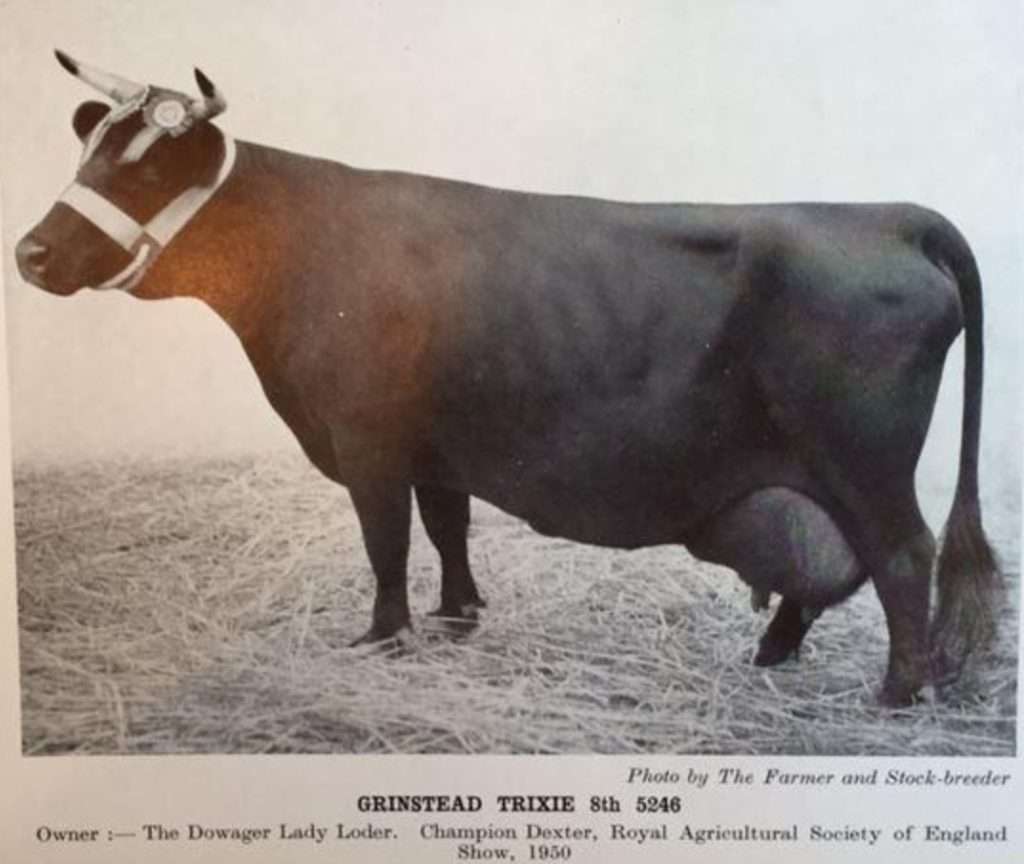
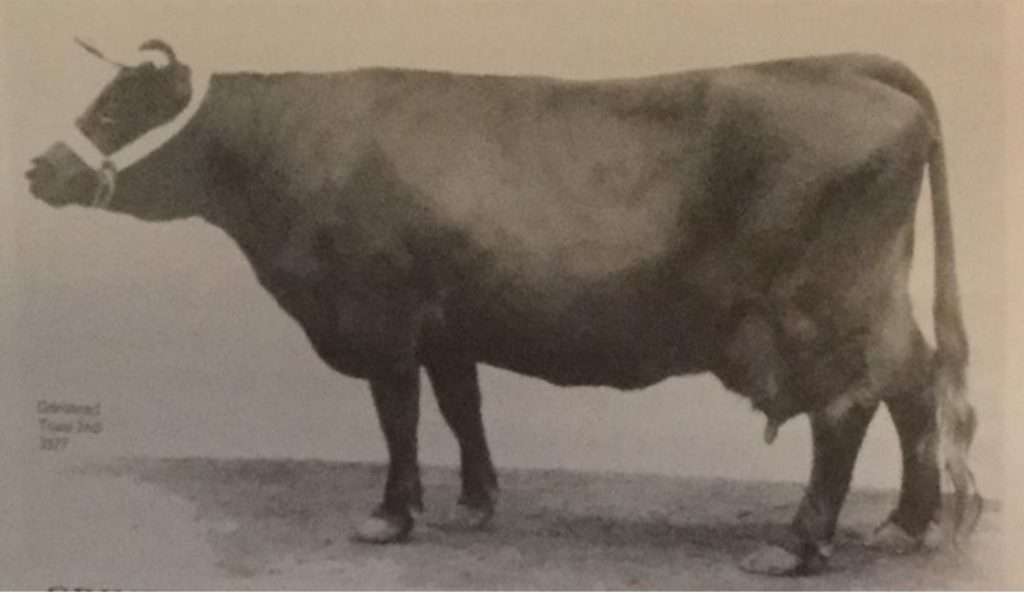
Grinstead Trixie the 8th From a Long Line of Doccumented Milkers
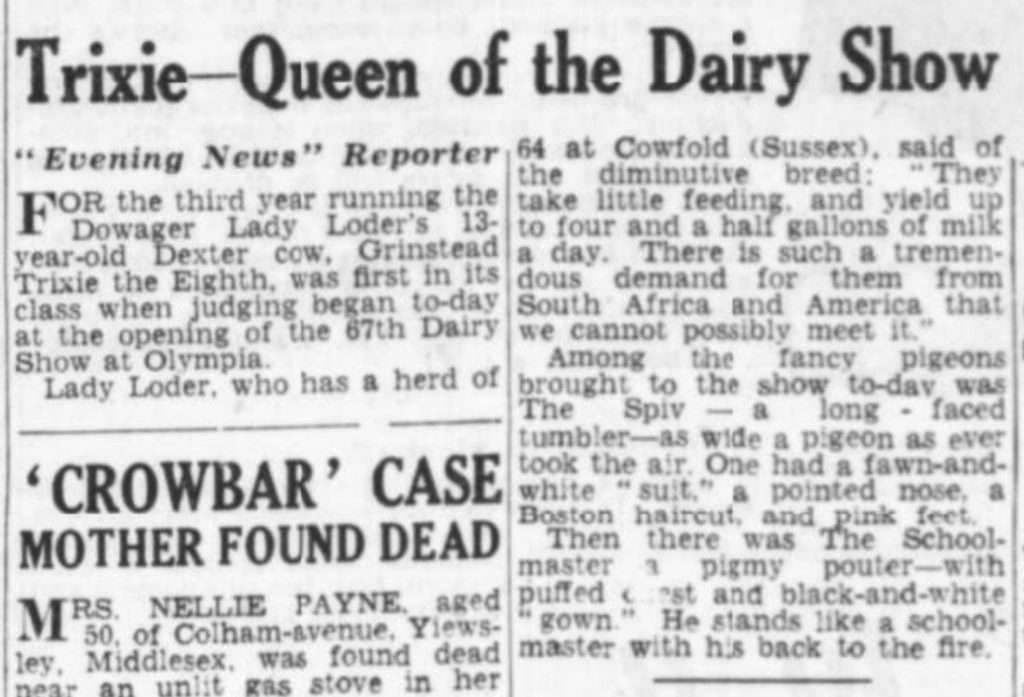
Grinstead Trixie 8th Queen of the Dairy Show
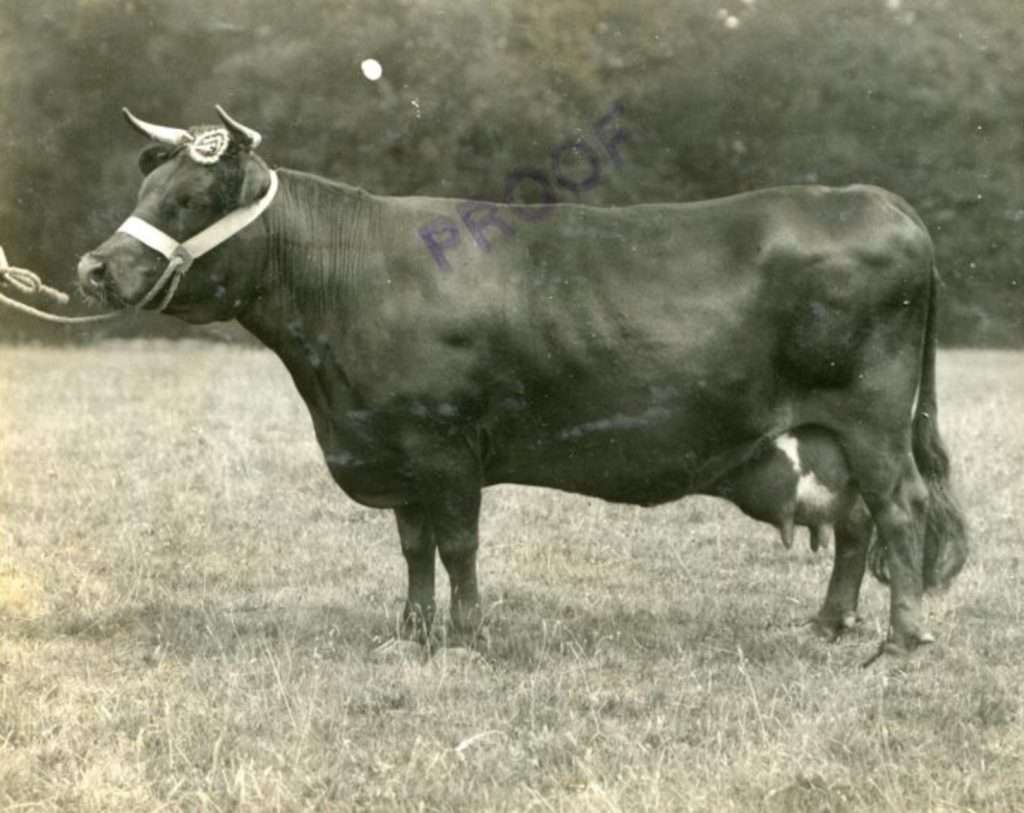
This is Grinstead Trixie the 8th. Lady Loder the breeder, was known for only selecting sires out of cows with proven milking records. Though this cow may seem like she has less than perfect attachment at 10 years old(the age in photo), she looks to have a good amount of volume. You will see in the article above, Trixie is “Queen of the Dairy Show” in October 1953 (then 13 years old and winning first prize for 3 running years). She was a top Dexter cow out of cows that were milking at 4 and a half gallons of milk a day. Lady Loder was known to cull hard and keep to a high standard. Trixie the 8th could have had improved udder attachment, but she definitely filled her part as a solid milk cow. Now I shall dig a bit further back in history to give the reader a greater understanding. Let us next consider Grinstead Trixie the second and likewise the original Trixie herself.
Grinstead Trixie the 2nd
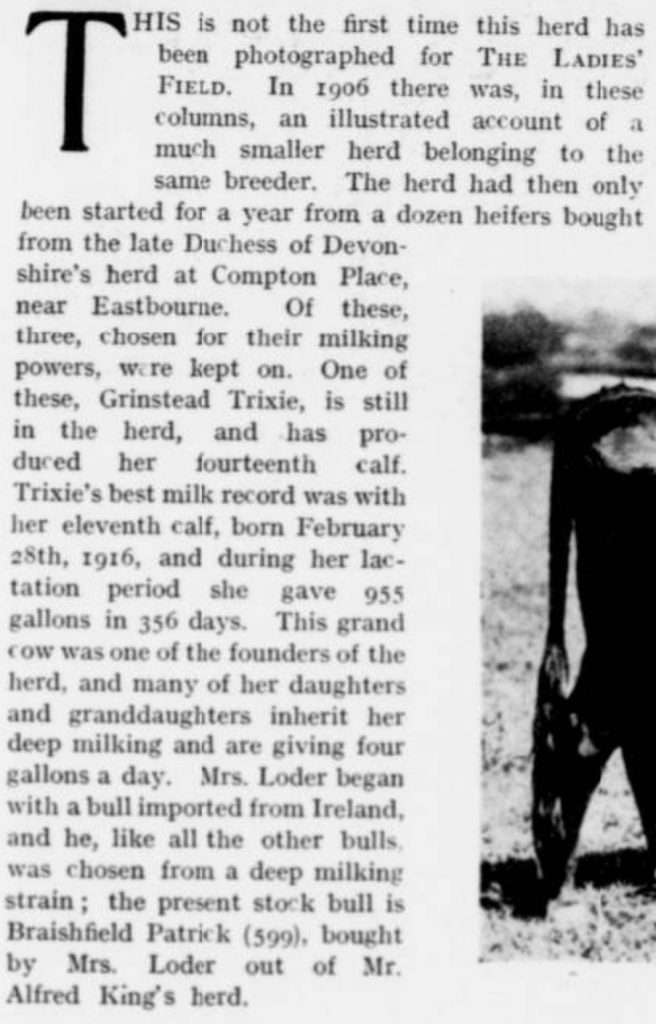
The Original Trixie of 1904 Foundation to Grinstead Herd
Just to give a very interesting historical compass to the full impact of the Grinstead Trixie line, let us delve deep into history, back to November 1919 when the original Trixie was being written about. The original Trixie was one of an original 12 cows that were obtained by Lady Lodger. Of those original cows she only kept three, Trixie being one of three top cows. Those 3 cows were chosen for their milking powers. Trixie was born in 1904 and was a foundation cow for the Royal Dublin Society. By 1919 she had produced her 14th calf, proving to be productive and already fairly long lived. What an exceptional cow to start your herd from. This cow was the foundation of Lady Loders Grinstead herd and imprinted her name on the herd for generations to come. Lady Loder in other statements had complained about some of the low quality Dexters that were being sold. Lady Loder may not have started with the best stock, but she culled down to just three cows to build her herd from and only used proven bulls that possessed dairy traits worth passing on to their offspring. She had a focused eye that considered the breed standard when evaluating and considering her Dexters by. Her legacy is one worth being remembered and replicated, showing you do not need much to start out with, but rather have a quest for quality and be willing to cull to obtain it.
Murrell Peach Blossom: Another cow in Spratts line
Murrel Peach Blossom who was likewise related to Atlantic Spratt was a challenge cup winner.
Grinstead Hawk 5th: Another cow in Spratts line
Grinstead Hawk obtained a register of merit for milk production in 1940, won 1st in the milking trails and won the reserve Nutt challenge cup and many more competitions. Though her flat feet and titlted teat may jump out as not quite perfect, there is much to be appriciated in a cow with solid milk production.
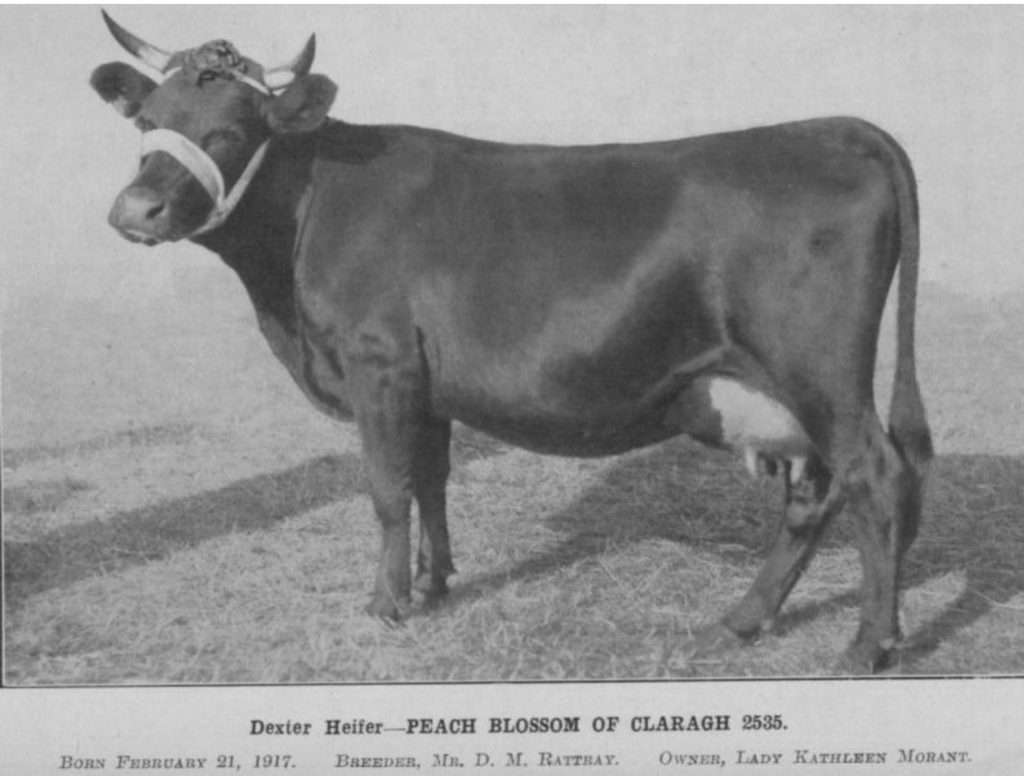
Peach Blossom of Claragh : A heifer in Spratts Line
Peach Blossom of Claragh won 2nd place for a cow in milk while competing against mature cows.
In conclusion to this article, I will leave you with this cow Grinstead Watercress, bred by Lady Loder though not directedly related to Spratt. This cow is graceful and well balanced a testament to her breeding. Some may say that she is not deep enough, but for a cow that I believe to be non chondro born in 1920 I’d say she is quite beautiful indeed. I hope this article inspires people, no matter the size of your herd or no matter how long you have been breeding that their is always room for improvement, no matter the current genetics in your herd. In order to truely preserve the wonderful Dexter traits of yesterday we must also be willing to impove our cattle of today.
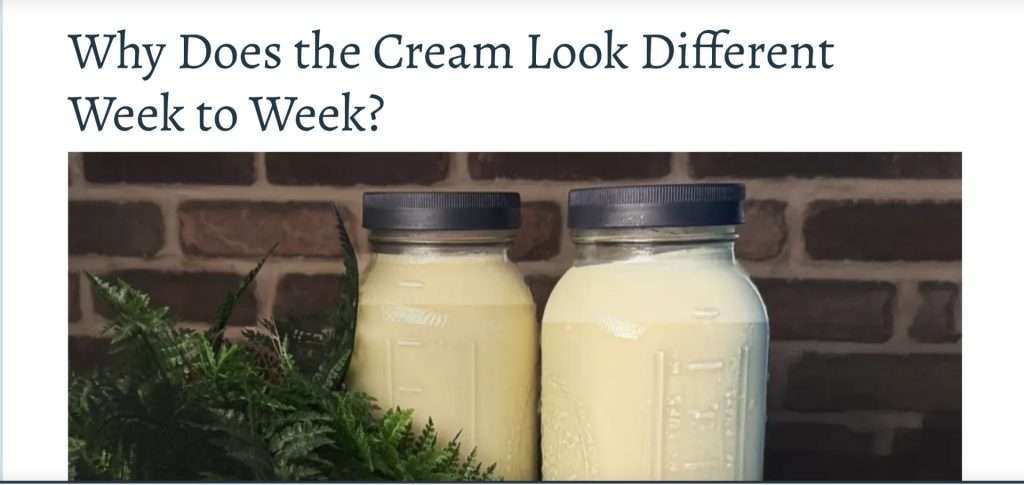
Here is an interesting article from a fellow Dexter milker, Michele Parsley. Real facts about how it varies and why. Don’t forget, some of our cream stays behind and never completely separates, making two incredible products, cream and still some pretty creamy milk for drinking or making something else. Celebrate your Dexter milk and cream!
COVID. It sucked. No matter what aisle of the plane that you sit in, even if you just want to stand in the middle, it sucked. There was tragedy, heart ache and despair. Some are still recovering. Some never will. All that said, it was eye opening for me. An introvert by nature (though very few of those that meet me will agree with that description), COVID was somewhat of a respite. It forced, for better or worse, solitude. For me, it brought peace. It got me thinking about our world and my place in it. It was time to start questioning old habits and accepting the norm. It was time to start doing.
Where do I start? As my late Dad would say, at the beginning. I started to look for property in a rural area. That was my first mistake. I didn’t have a solid foundation as to what I wanted to do. I looked at field, woods, and pastures. Some had homes, and others did not. About all of the properties were a good distance from where I lived and some were located in other States. After becoming exhausted and frustrated, I realized that my search was futile. I needed to establish what I wanted to do and with what animals.
My initial thought was horses. My thought is I could breed horses, and/or run a boarding business. It was my wife, ever the cynic, who asked the first pointed question. “Do you know how to ride a horse?”
Contrary to popular opinion in my household, I was a seasoned equestrian and rodeo champion. At least in my mind I dreamed I could be. That said, I scheduled horse back riding lessons. While I enjoyed the lessons, and riding, I started to think it was going to take a lot of time and experience to take other people’s horses in and provide appropriate care. But alas, fate had other plans. My wife quit asking about trivial things such as my ability to take care of horses and we sold our home and bought a home with horse stables and acreage. For me, it was heaven.
Then reality set in. I remembered what the goal was. The goal was to raise our own food. Horses would be welcome, but horse meat will never be in our diet.
The internet, love it or lump it, is a source of a great deal of information. I play the game. In that, I mean, I disregard all the “great” comments, and all the “terrible” comments and seek the middle, I tried to not seek articles that I favored but cast a wide net looking for neutrality. Just the facts, ma’am. What I found intrigued me. Dexter cattle. Ideal for beef, milk, and smaller areas of land. Hearty animals and docile in nature. Not miniature, but smaller in stature. Less intimidating for the new and not an animal that has to be considered a pet.
I compared to different breeds. I was intrigued by grass fed and milk that many argue is better suited to sensitive stomachs. Not only for feeding my family, but the potential of feeding others. I was not looking for marketing gimmicks but trying to fit a niche. My niche. I was told finding the acreage was the hardest part of raising cattle. I can say with 100% certainty, that is a lie. But I am having so much fun living my dreams with our Dexter cattle.
A little bit about the author for those who have read this article or maybe even the first article and scrolled to the bottom of this article just to see if someone had the guts to admit writing this. I own and operate a small farm called “Our Yellowstone LLC” in Illinois. I couldn’t do it alone, but will keep my wife’s name out of it to protect her innocence.
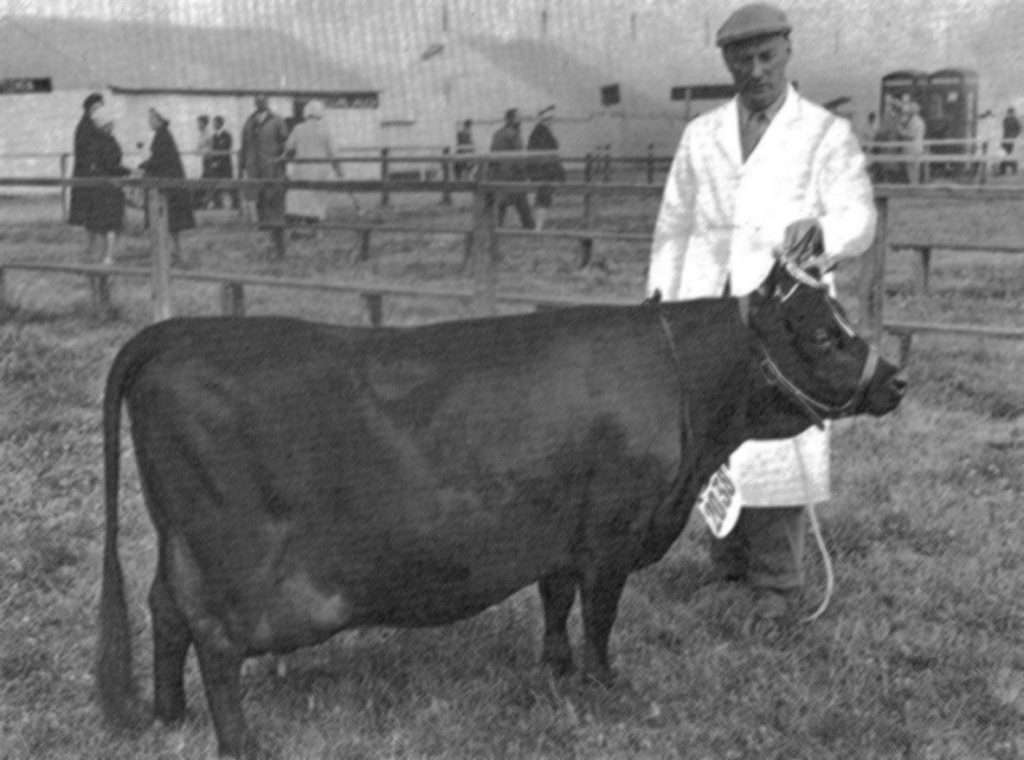
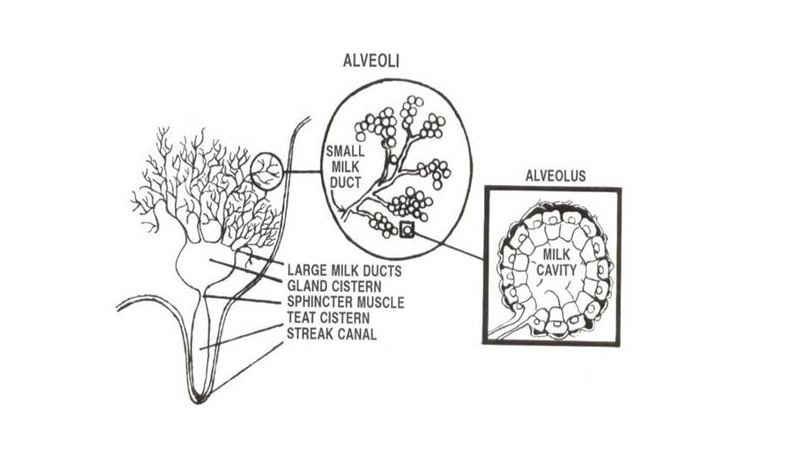
The old saying “No feet, no cow” is a phrase that denotes the importance of a cow’s ability to walk. Without good feet there can be no cow to stand on them, thus causing peril to the health of the cow. No Udder, no cow could be a similar maximum, denoting the importance of the cow’s udder. Without a good functioning udder, a cow cannot fulfill her role to nourish a calf or humans thus degrading her value as a cow. Not every Dexter needs an udder like Atlantic Alison, but the quality of a Dexter cow is tied up in the function and quality of her udder.
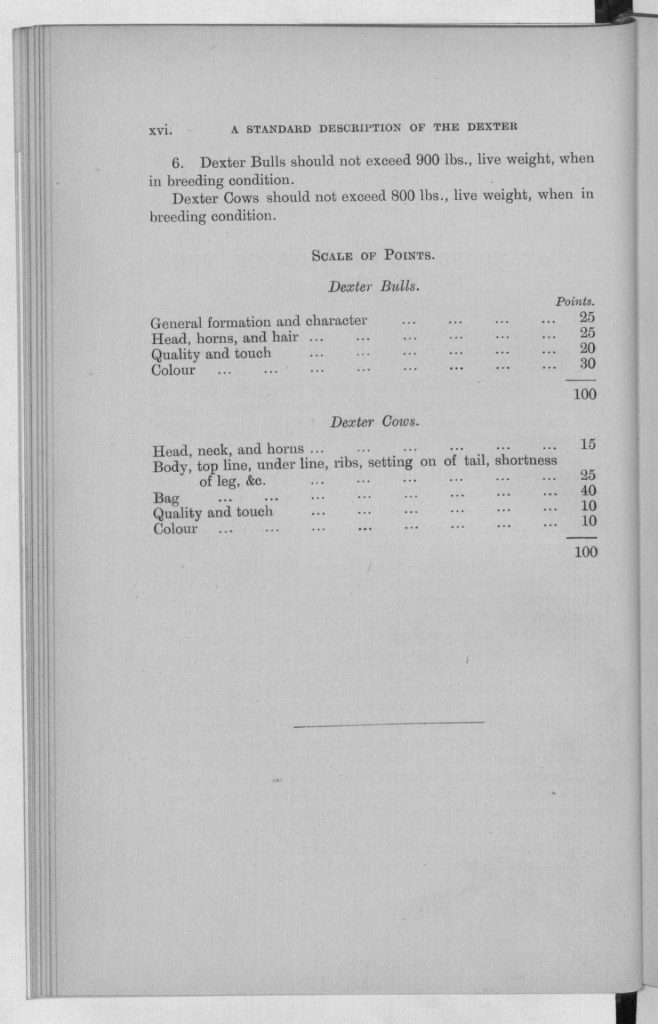
Scale of Points taken from the 1900 English Standard
This scale of points as seen above, is the first scale of points written for Dexter cattle and the most authoritative in breed history. It makes it clear what values can be attributed to a Dexter cow. As you can see udder traits are very important to the Dexter breed. There is no room in the Dexter breed for cows with truly bad udders, as it’s not agreeable to the standard scale of points. So, you see, 40% of a Dexter cows value of points is wrapped up in the quality of her udder, where only 25% goes for her body. That 25% is not just shortness or depth alone but “body, top line, under line, ribs, setting of tail, shortness of leg &c.” The point is cows with good udders are very important to the breed. A cow that lacks valuable udder points would scale very low as a Dexter in general. A cow that is not perfectly short could still score quite high as a Dexter if all other traits were ideal. A short Dexter with a bad udder would easily be beat by a taller Dexter with good conformation and an excellent udder.
How “Accidental” Breeding Created a Little Black Cull Heifer that Turned into One of the Best Milk Cows in the World…
The year was 2015, and I had never touched a cow before buying one. I had read every book I could find and devoured countless online articles about cattle, but I had absolutely zero real-life cattle experience. Still, I knew one thing for certain: I wanted a milk cow. That single desire was all the motivation I needed to bring home my first Dexter cow, Cassandra, in March of that year.
Cassandra—quickly nicknamed MooMa—was due to calve soon, and I couldn’t bear the thought of her living alone for three months. Cattle are herd animals, after all, and MooMa needed a companion. Our budget was tight, so I bought a wild little black cull heifer named Maggie She wasn’t registered because her dam had been bred by a “steer” that had retained one testicle when he had been banded. Maggie was also A1A1 milk, which at the time was a big deal for us so we had no intention of keeping her long-term. Her future, as far as we were concerned, involved freezer camp.
Maggie arrived already overwhelmed. Shortly before coming to our farm, she had been vaccinated, dehorned, weaned, and then hauled to a new home with complete strangers. By the time she stepped off the trailer, she was terrified. Kevin and I stood watching in horror as Maggie calmly stepped between two strands of hot wire as if they didn’t exist—and just like that, she was gone.
MooMa, older and steadier, began calling for her. Before long, Maggie came trotting back, stepping right between the wires again as though that was perfectly normal. We quickly added a third strand of wire and spent the next week wondering what on earth we had gotten ourselves into.
Maggie wouldn’t let us within fifty feet of her. Her fear seemed contagious, and soon MooMa didn’t trust us either. Time was ticking. I had just three months to turn MooMa into a milk cow. So every day—sometimes multiple times a day—I went out and simply sat in the pasture with them. Cattle are naturally curious. At first, they’d freeze and stare at me, clearly hoping that if they didn’t move, I wouldn’t notice them. But it didn’t take long for them to learn I wasn’t there to hurt them—and that I usually brought treats. Before long, my pasture visits became something all three of us looked forward to.
On June 10, 2015, MooMa gave birth to a little red bull calf we named Liberty. Five days later, I began milking her. The next nine months were a steep learning curve for both of us. I’d love to say she milked like a dream, but the truth is… quite the opposite. That story, however, is for another blog post.
When it came time to rebreed MooMa, my AI technician talked me into breeding Maggie as well. She had grown into a lovely little heifer and could, at the very least, provide us with beef. She was still mostly wild—nearly all my effort had gone into training MooMa—but Maggie didn’t need to be tame to reproduce, so we went ahead and bred her.
Throughout her pregnancy, Maggie came to the barn every single day. She stood quietly, watching me freequently dodge kicks and often times fight for every drop of milk from MooMa. What I didn’t realize at the time was that Maggie wasn’t just waiting for her “big sister” to finish—she was studying.
Fast forward several months. MooMa calved her second calf just days before Maggie had her first. Once again, I began milking MooMa, and once again, Maggie watched and waited.
Four days after Maggie calved, I walked into the barn expecting my usual routine and instead found Maggie standing squarely in the milk stanchion. She refused to leave. Waving my arms, yelling like a crazed person—nothing fazed her. Finally, exasperated, I looked at her and said, “Well, Maggie, I guess you’re going to be a milk cow today.” Fully expecting her to spook and bolt, I slammed my milk bucket loudly beneath her. She didn’t move. I washed her udder. Still nothing. When I finally grabbed a teat and squeezed, Maggie sucked in her gut and stood like a seasoned professional. No treats. No headgate. No kicks. No tantrums. This little black cull heifer wanted to be a milk cow.
Dexters are notorious for holding back their hind milk unless the calf is nursing. I’ve long accepted this and simply train calves to nurse on one side while I milk the other. But Maggie is different. She gives me everything she makes, trusting me to leave enough for the one thing she loves more than anything—her calf. When it’s time to wean, she handles it herself, yet she still comes to the barn every day, eager to be milked.
One year, while transitioning Maggie from a fall calving schedule to a spring schedule, I milked her for 380 days straight. In my book, that makes her a Super Cow. Maggie remained a cherished milk cow at MooShine Ridge for many years—a living reminder that sometimes the animals we least expect to keep are the ones who teach us the most.
About the Author:
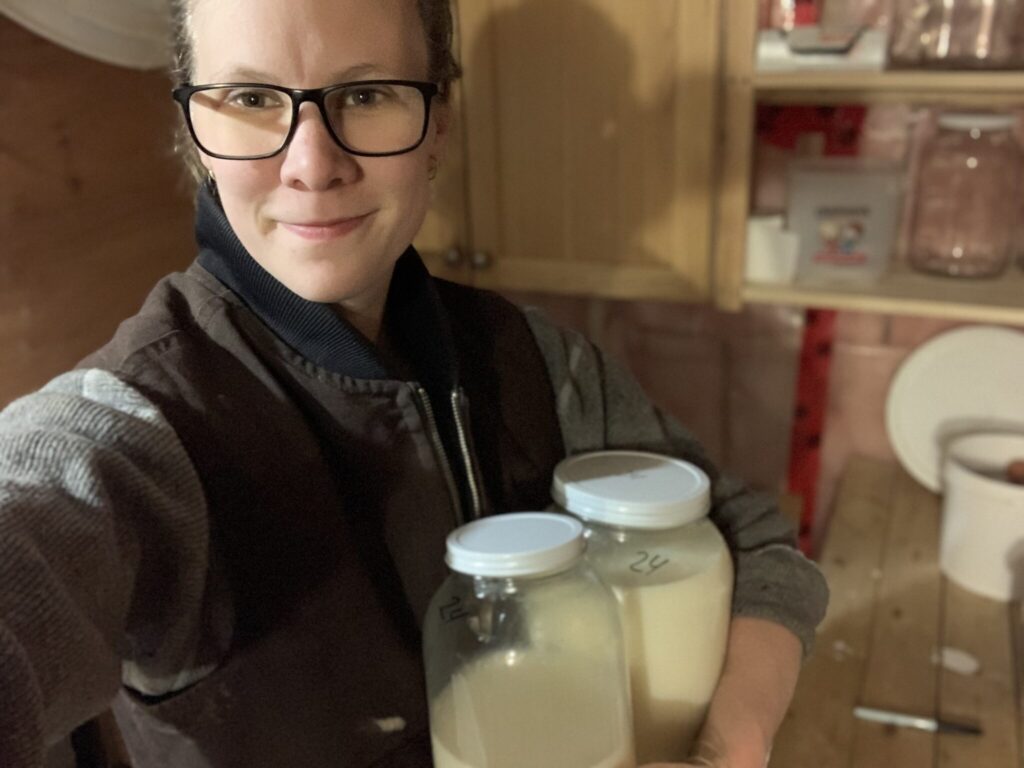
Kimberly Jepsen is the heart behind MooShine Ridge in Vinita, Oklahoma, where she and her husband, Kevin, have been raising dual-purpose Dexter cows since 2015. Their little farm store is a labor of love, offering Dexter beef, raw milk, and artisan cheeses made from their own cows. Kimberly has a deep passion for the Dexter breed and loves nothing more than sharing what she’s learned over the years—whether it’s guiding fellow farmers, helping newcomers discover the joys of small-scale farming, or simply introducing people to the rich, creamy flavors of her handcrafted cheeses. For her, farming isn’t just a business—it’s a way to nurture animals, the land, and the community she cares about. https://mooshineridge.com/
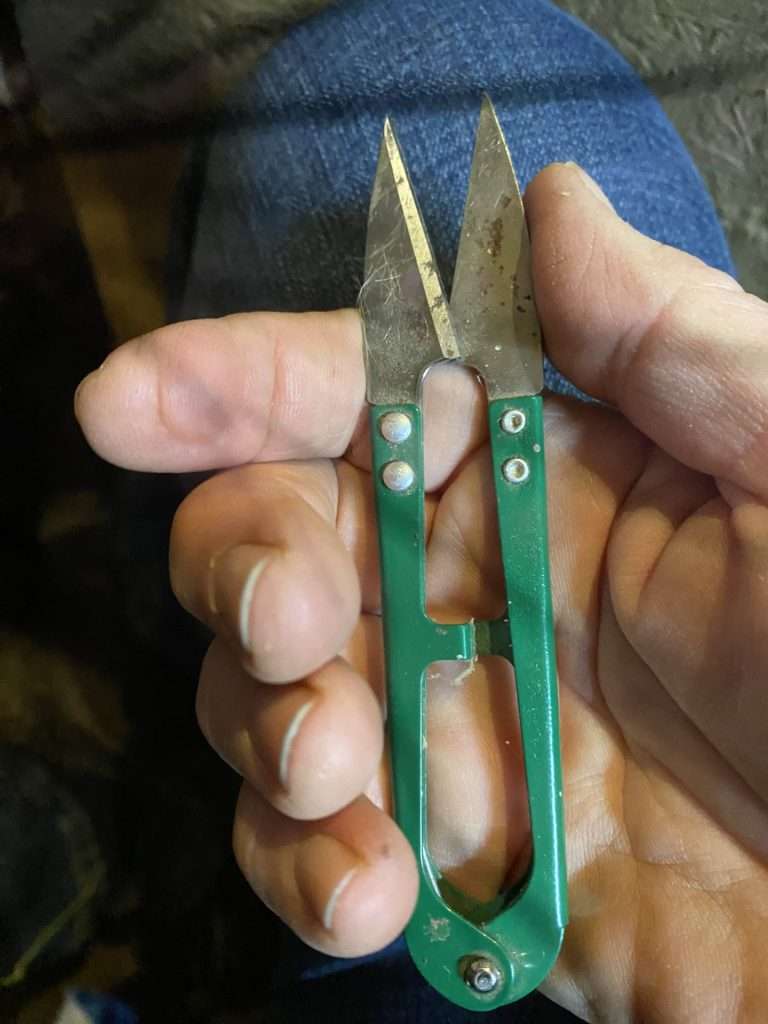
Let’s face facts. Some of our Dexter gals have some pretty hairy udders. All that hair is not something we want if we are trying to milk them and provide a clean product. I use these handy dandy scissors pictured below, but some folks also use electric clippers, as in the short video below.
What ever method you choose, make sure you do it, it makes cleaning the udder sooo much easier!
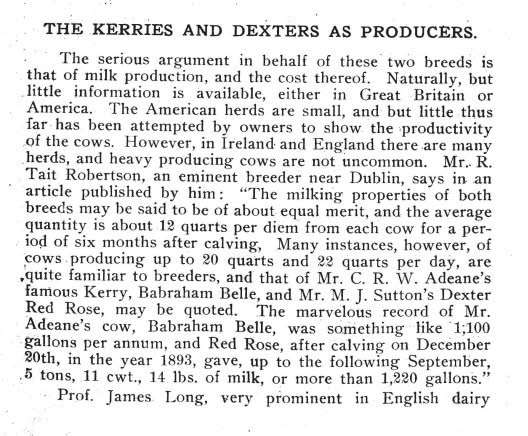
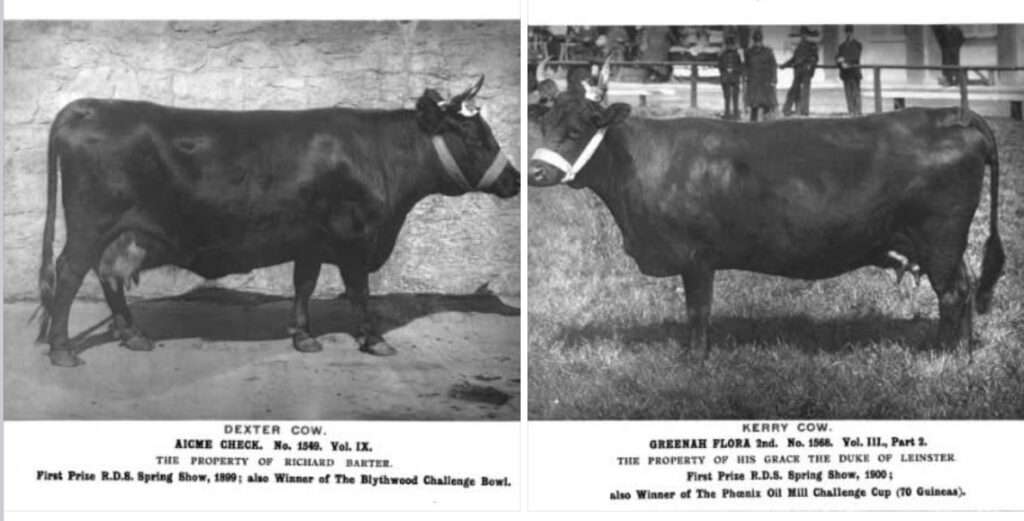
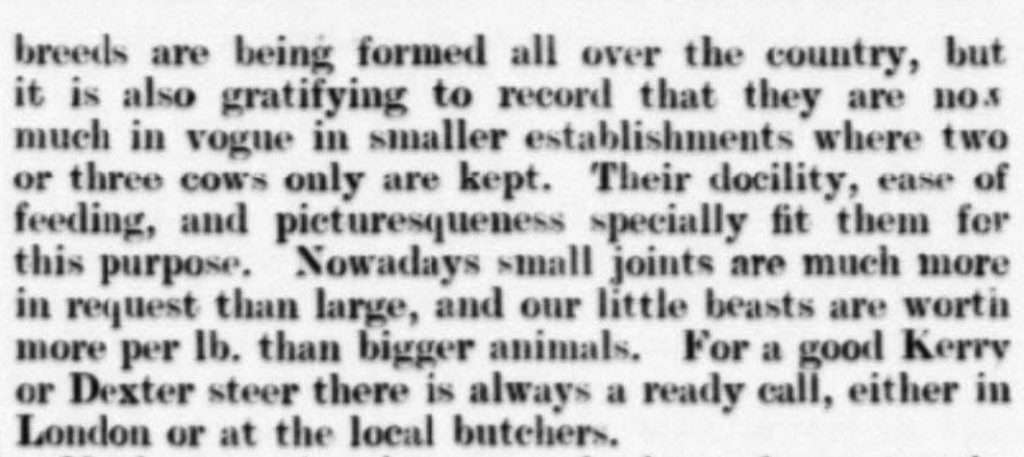
Many may not know that the Dexter at one time was known to have milking properties of equal merit as the Kerry, a known dairy breed, though they are a dual-purpose breed. Mr. R Tait Robertson was to of said ” The milking properties of both breeds may be said to be of about equal merit”. Who is R. Tait Robertson? He is the son of James Robertson, of whom bred or collected a large portion of the foundation Dexters sold to England and other places. He was an influential breeder. For an interesting photo reference of the amazing similarities of Dexter and Kerry cattle see Aicme Check (Dexter cow) and Greenah Florah 2nd (Kerry cow). I did not have to hunt far and wide to find examples that looked closely related. All I had to do is go to the 1901 Herd book and find the only available photos of an example Kerry and Dexter cow. And by the way note the classic white Dexter udder marking on the Kerry cow as this was a common Kerry trait feature too. Nose to nose as you can see in the photo comparison they do look quite alike.
Pasteurization is a personal choice! This history behind is interesting. Seems like the movement now is for smaller homestead dairies, selling to local folks. Give a listen, she gives many perspectives!
Knowing the value of your milk, can help you value the products you make from your milk. Here is one person’s breakdown.
There is a wide range of raw milk dairy prices across the board, but how do you know your prices make sense based off a gallon of milk?
Here is a simple breakdown on price setting costs!
Starting point: Milk value $15/gallon = $7.50/half gallon = $3.75/quart = ~$0.94/cup. This is your base price to compare against, you can enter any value and adjust accordingly.
Pricing based on your $15/gal milk: • Butter: $20–$25/lb • Buttermilk: $5–$6/qt • Cream: $12–$15/pint • Yogurt: $5–$6/qt • Fresh Cheese: $15–$20/lb • Aged Cheese: $50–$80/lb
Butter • 1 gallon of milk = ~2 cups cream. • 2 cups cream → ~¾ lb butter + 1 cup buttermilk. • That means ~1 lb butter takes about 2.5–3 gallons of milk. • If 1 gallon milk = $15, then just the milk input for 1 lb butter = $37–$45. 🧀Suggested price: $20–$25 per pound (raw, small-batch butter often runs $20–$30/lb at farmstands).
Buttermilk • Byproduct of butter. • Costs are “covered” by the butter pricing, so you can sell it lower. 🧀Suggested price: $5–$6 per quart.
Cream • A gallon of milk gives ~1 pint of cream, varies with breed/feed/individual cow. • That pint of cream “costs” the $15 you could have gotten for selling the whole gallon. 🧀Suggested price: $12–$15 per pint raw cream is a premium item and can be scarce.
Yogurt • 1 gallon milk makes ~1 gallon yogurt. • Plus starter and incubation, but not much shrinkage. 🧀Suggested price: $15–$18 per gallon, or $5–$6 per quart, slightly higher than milk since it’s value-added.
Cheeses • Yields vary a lot: • Fresh cheeses, chevre, queso fresco, paneer: ~1 lb cheese per gallon milk. • Aged/harder cheeses: ~1 lb cheese per 10 gallons milk. 🧀Suggested pricing: • Fresh cheese: $15–$20/lb. • Aged cheese: $50–$80/lb since the yield is tiny and aging takes space/labor.
As always, know your state regulations for dairy. Know your farmer. Shop local. Barter when you can!
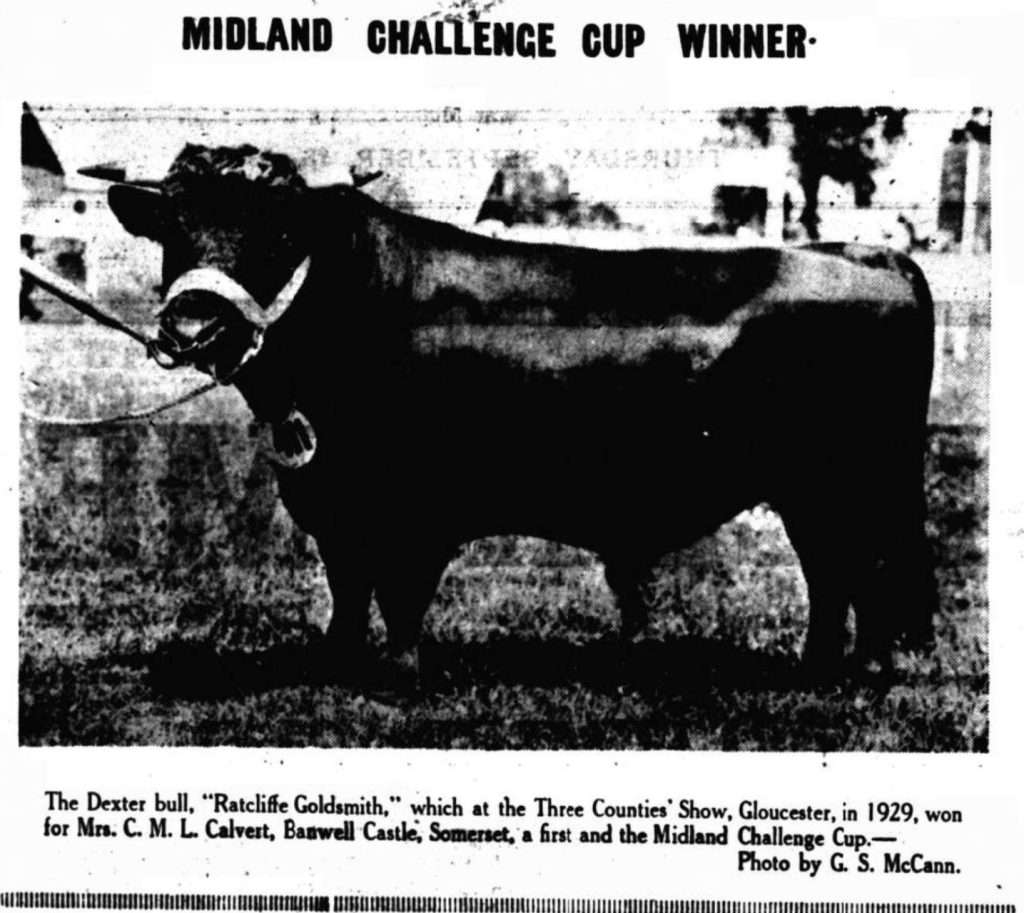
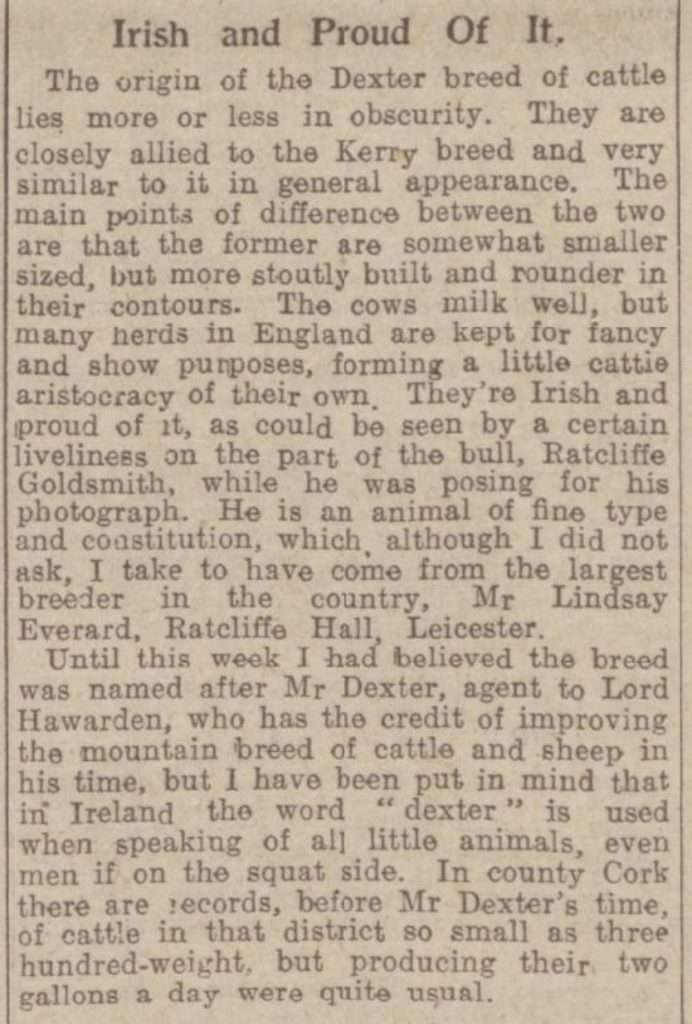
Where ever they roam Dexters are Irish and Proud Of It!
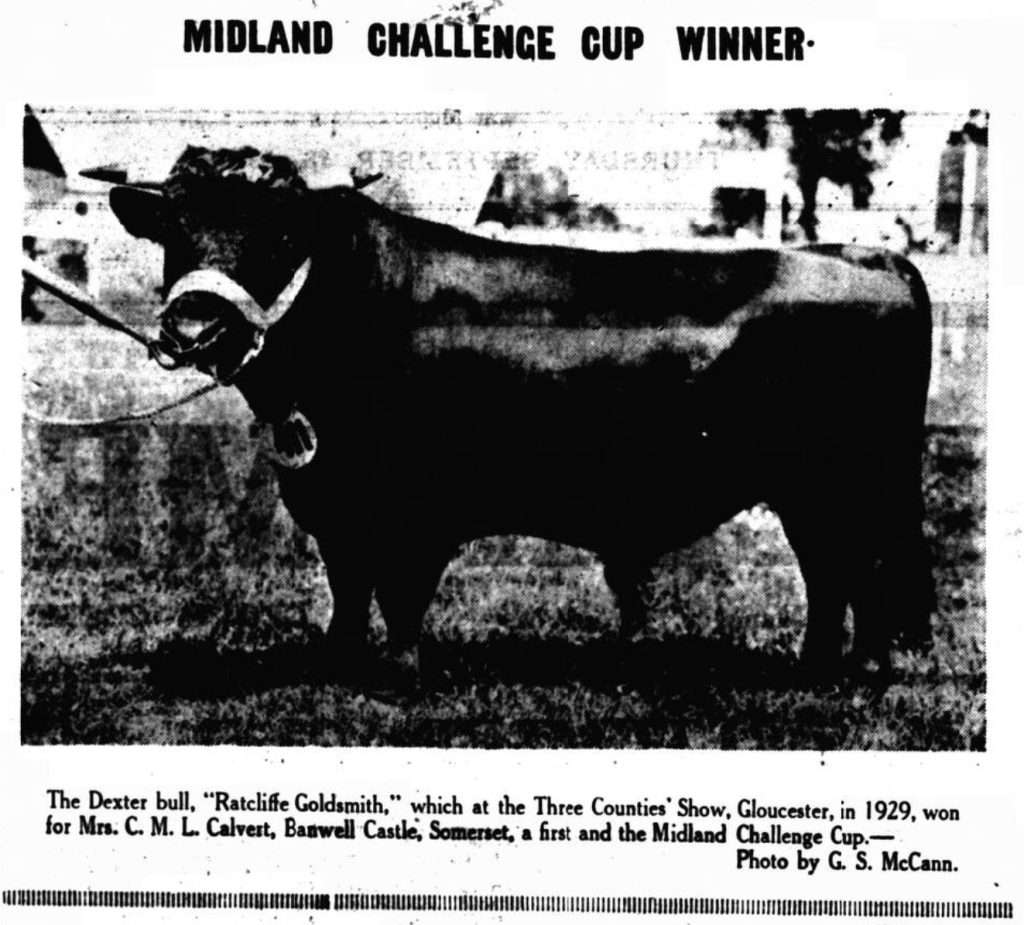
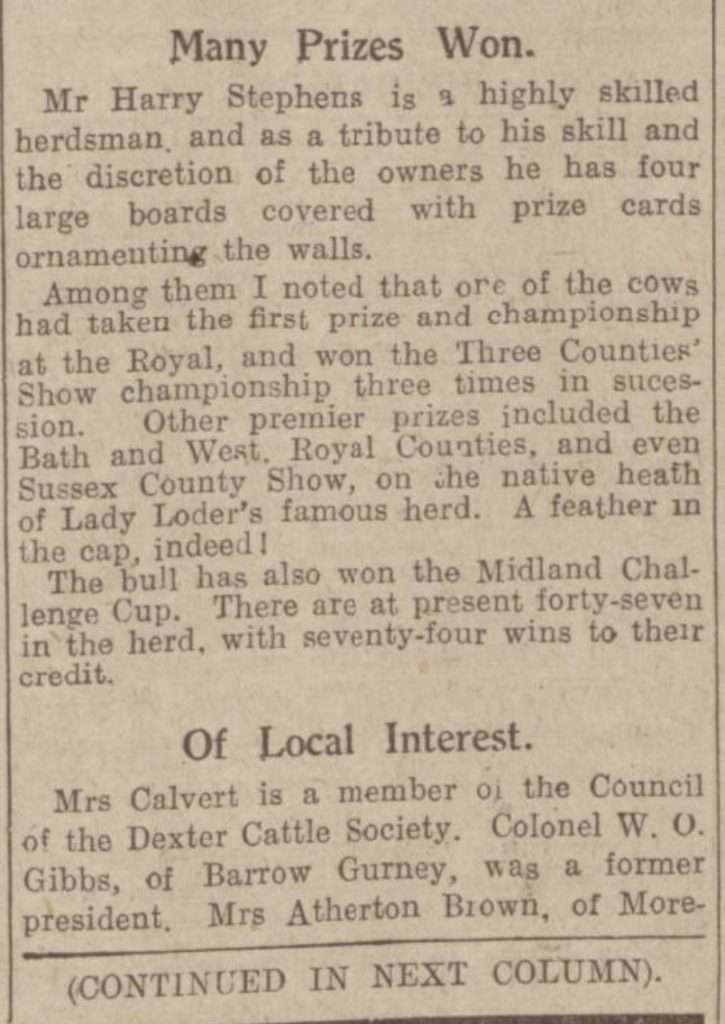
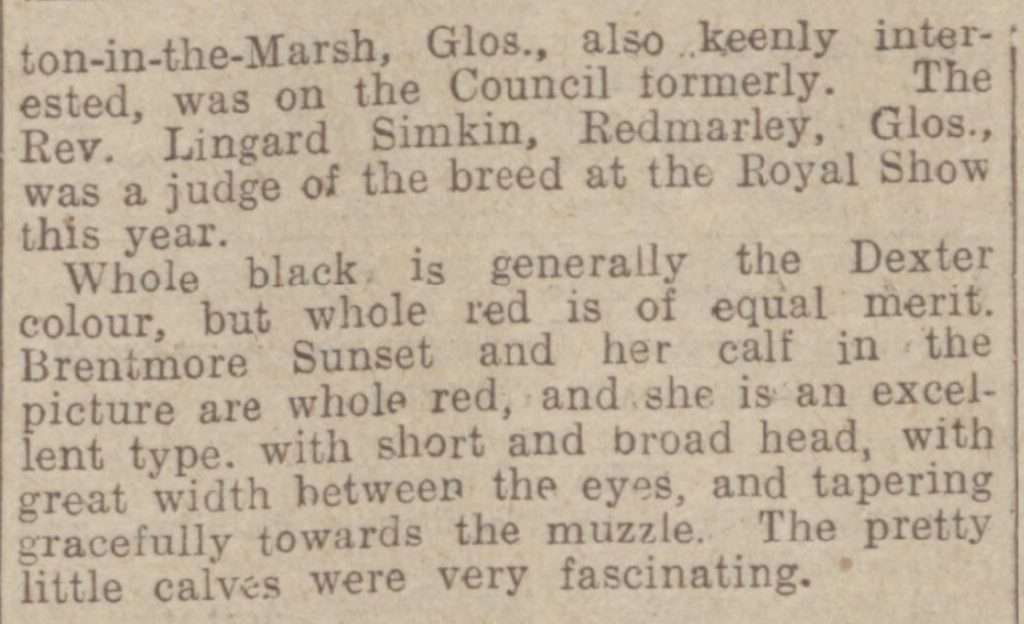
Dexters are well known as Irish Dexters even if many other points about them are debated. The above bull though registered with the Dexter Cattle Society is an Irish Dexter with a “fine type and constitution” as the article states. I checked, he certainly was owned and breed by Mr. W. Lindsay Everard of Ratcliffe. This article holds true to the fact that Dexters are known to be of a small type of cattle. That very small cattle were known to roam Ireland before “Mr. Dexter” was ever penned in History. In Kerry there was known to be some of the smallest type of cattle one can imagine, long before Dexters were ever established or organized into a true breed. So small of an animal that it is mentioned in this paragraph, but yet still producing 2 gallons of milk a day is a marvel indeed. The brown article was written on 14 Nov 1929, it’s from the Western Daily Press Bristol. The picture was taken from a later newspaper published in 1930. Though the Dexter was well known to produce ample milk and was “closely allied to the Kerry breed and very similar to it in general appearance.” The differences being that “Dexters are “more stoutly built and rounder in their contours”.
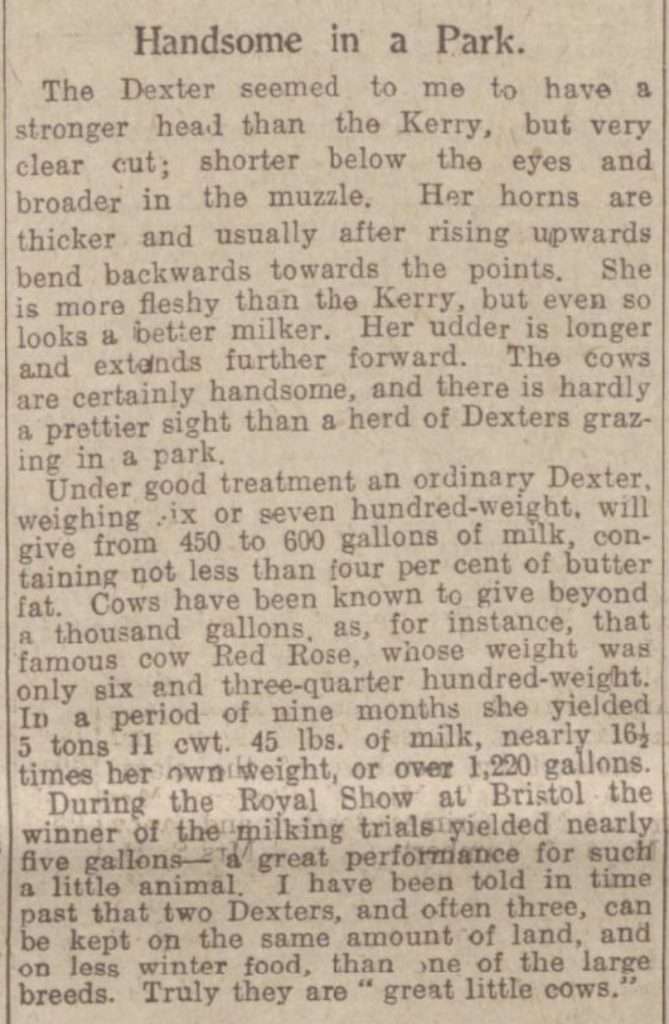
The Dexter has a “stronger head than the Kerry, but very clear cut, shorter below the eyes and broader at the muzzle”. The description of her horns are as follows ” Her horns are thicker and usually after rising upwards bend backwards towards the points”. It is interesting to note that she is even fleshier than the Kerry but was thought to look a better milker than the Kerry. Short cows with large udders seem to showcase the udder in a much more extreme way than a longer legged cow though the udder could be of the same size. The article really goes on to highlight the excellent milking attributes of a Dexter to great lengths. A point worth mentioning is that “there is hardly a prettier sight than a herd of Dexters grazing in a park”. I personally can’t help but look out at my hills and know this rings true to me today, just as much as it must have to the writer of this article in the past! Dexters truly are practical and beautiful when bred for all these amazing Historical traits!
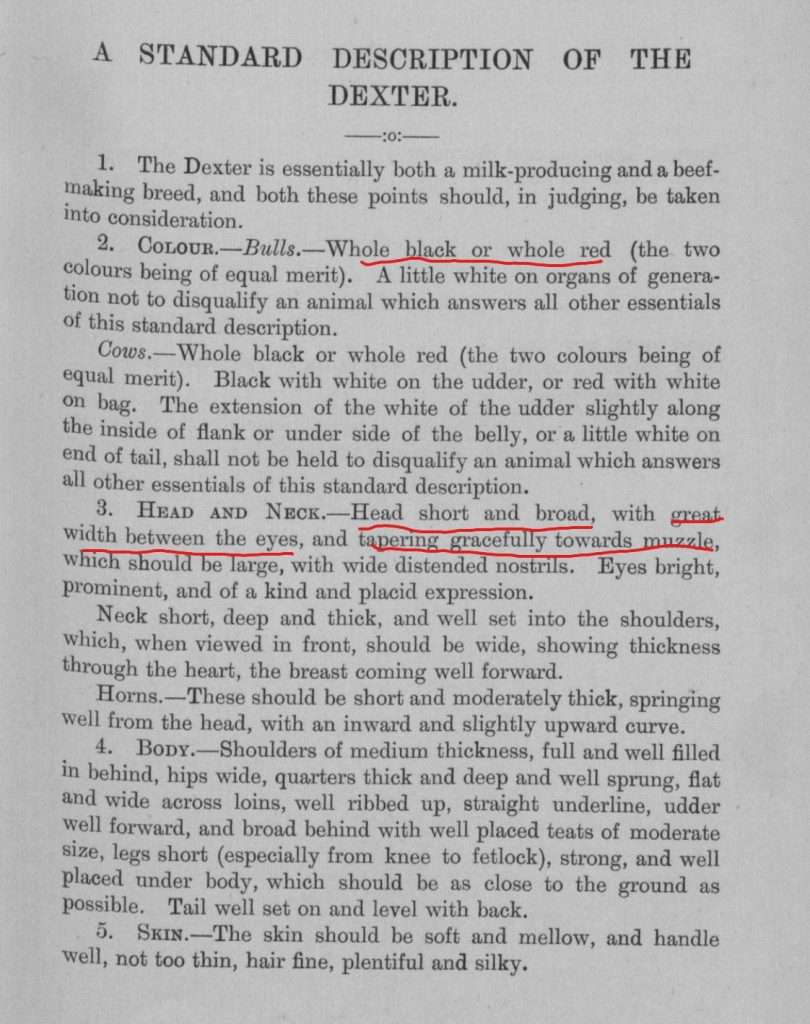
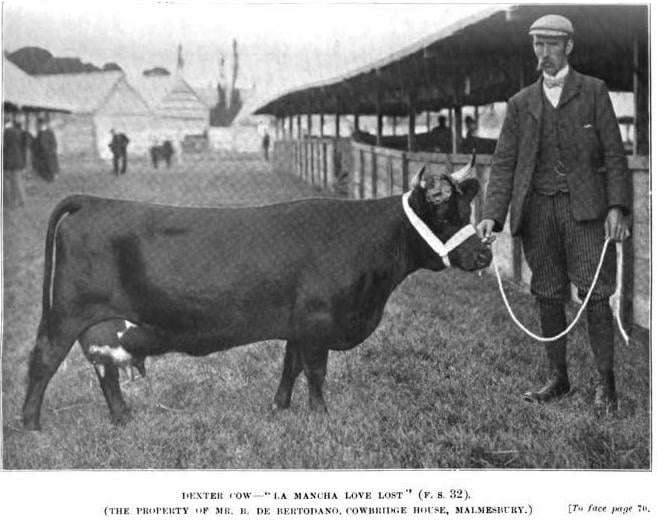
Breeders have long been concerned with breeding to “type” and a few points to mention in this last photo that align with the Standard Description of a Dexter is the color being “Whole black or whole red”. The “Head short and broad” with “great width between the eyes”, and “tapering gracefully twords the muzzle. Dexters definetley impress with their specific beautiful traits and charming ways which took hold of many a wealthy land owner who could aford to buy any exotic cattle they chose. In conclusion Dexters and their “pretty little calves are very fascinating”! They are Irish and Proud of it and those of us who breed them, have been taken by their Irish Charms.
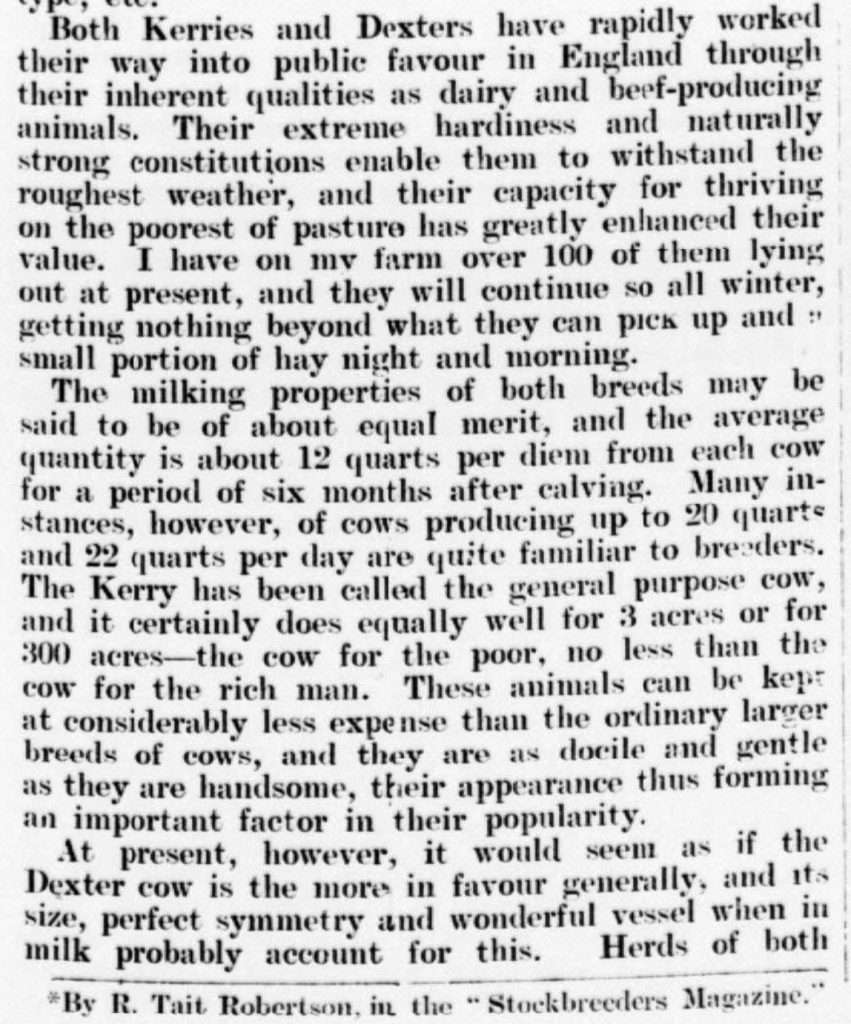
Dexters have long been hailed as hardy and thrifty even adaptable to locations from Africa to snow laden areas. This article I am sharing was written by R. Tait Robertson; he was a famous and most influential Dexter breeder for his day. He was not just any armature Dexter owner, since he was a foundational breeder of Dexter cattle and a generational farmer. He explained that” I have on my farm over 100 of them (Dexters) lying out at present, and they will continue so all winter, getting nothing beyond what they can pick up and a small portion of hay night and morning”. What this means is that Original Dexters could get by on just a little, but of course they could thrive on even more. It was often said that when the Dexters of Ireland went to the manor lands of England they grew greater in size due to the surplus. Dexters can do well on just forage and hay alone with no grain needed. They can excel on the best rations and produce even more, but if times get tough, they can more than get by.
Who was R. Tait Robertson?
Mr. Roberston was a very influential breeder, breeding in Malahide, County Dublin, Ireland. His family later had Church Farm in Babraham, Cambridge. His Dexters were esteemed as quality and were very sought after by the English who wished to keep them. He is the son of James Robertson. They were not just multigenerational farmers but multi-generational Dexter farmers who helped shape Dexters in their early years by breeding and selection. Dexters as we know them then owed a great degree of tribute to this influential family. Mr. R. Tait Robertson was also a judge for Kerry and Dexter cattle. He judged them by the merit that this article speaks to. Someone may say that Dexters are a beef breed that can milk, but Mr. R Tait Robertson said they have “equal merit” to Kerry cattle. They were not transformed in England to a milking breed but rather selected and bred by breeders like the Robertsons for great dual-purpose traits and were heavy in exceptional dairy traits. When R. Tait Robertson speaks to their equal merit remember that he was a judge for both Kerry and Dexter cattle and those judges gave prizes and entered both Kerry and Dexter cattle into the foundation herd books for the Royal Dublin Society. Dexters are not, nor have they ever been a beef breed that can be milked, but rather a dual-purpose breed with equal merit in milking traits to an ancient breed of dairy cattle (Kerry cattle) that can excel at grass-based feeding.
Lamancha Dexter Herd
Mr. R. Tait Robertson was the owner and or collector of the cattle in the La Mancha Herd. He or his family may not have bred them all but rather selected some as foundational cattle for the Dexter breed. You will often see La Mancha Dexters registered to him, his father or Robertsons and sons. His Dexters traveled to many countries and those Dexters that could be found “Lying out all winter long, getting nothing more than what they can pick up and a small portion of hay Night and Morning” run in the veins of our Dexters today. This article I shared was written on 16 December 1899 and La Mancha Love Lost was born in 1897. She was qualified by inspection most likely by Mr. R. Tait Robertson and would have spent time in his field while this article was written. It’s nice to think of such a beautiful cow lying out in your pasture all winter long, getting nothing more than what she can pick up and a small portion of hay night and morning then still looking so beautiful! That’s the kind of Dexter I want.
This is an interesting article on how people are returning to the old ways and using more and more of their processed beef. Healthier alternatives are growing in your pastures!
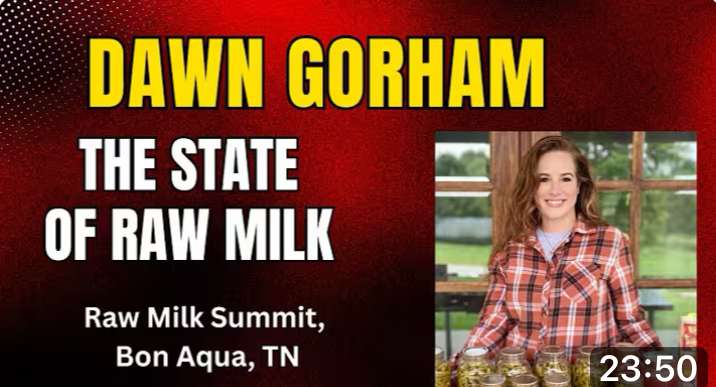
There was a Raw Milk Summit in Bon Aqua, TN. Several guest speakers included politicians, local producers and Dr. Ken Berry. This video is of the organizer Dawn Gorham of The Gorham Homestead. She has an interesting story and message for people who are trying to sell their milk thru herd shares in Tennessee. You will need to check your State Laws, but has some great advice for everyone.
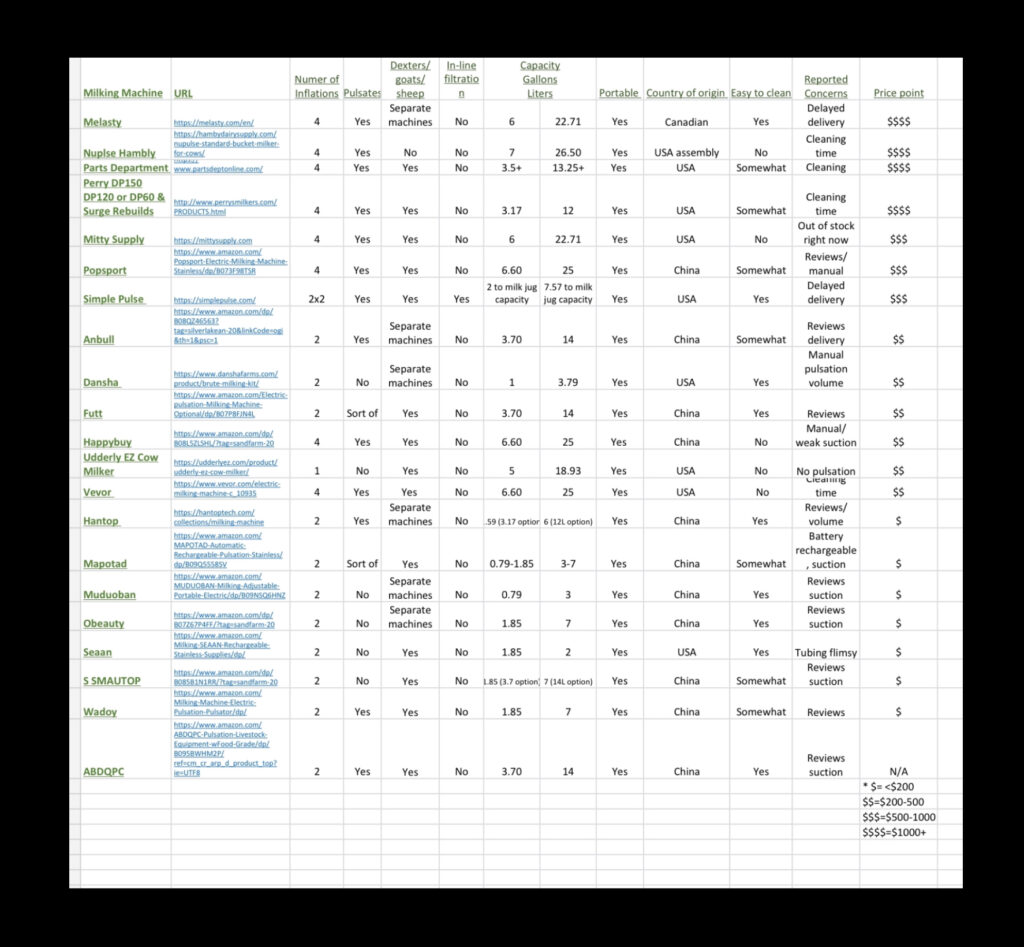
I believe that you should learn to hand milk your Dexters and other dairy animals. For me the journey was to master hand milking. I moved on to a machine after I was milking several Nubians and Dexters. My body was telling me I needed help. I have never regretted this, as you have to strip out after the machine and I am prepared for days with no power. Here is a podcaster from the Family Milk Cow and her perspective.
Since many of us are homesteaders or practice some kind of preserving, I thought I would take a moment to discuss an alternative to canning, pressure canning and dehydrating.
Are you scratching your head, thinking where is she going with this?
Consider freeze drying. While the initial cost seems daunting, it really is an excellent way to preserve your Dexter milk, yogurts, cheeses, colostrum and beef for 25 YEARS! Think about when you’re over loaded with one veggie or another during gardening season. The veggies, herbs or eggs when they are abundant, can be frozen and put into the freeze dryer anytime. We still can and pressure can, but this gives us a whole new option.
We purchased a medium Harvest Right about a year and half ago and have been amazed at all the things we can preserve….it is less time consuming and in our opinion, and better quality product in many cases.
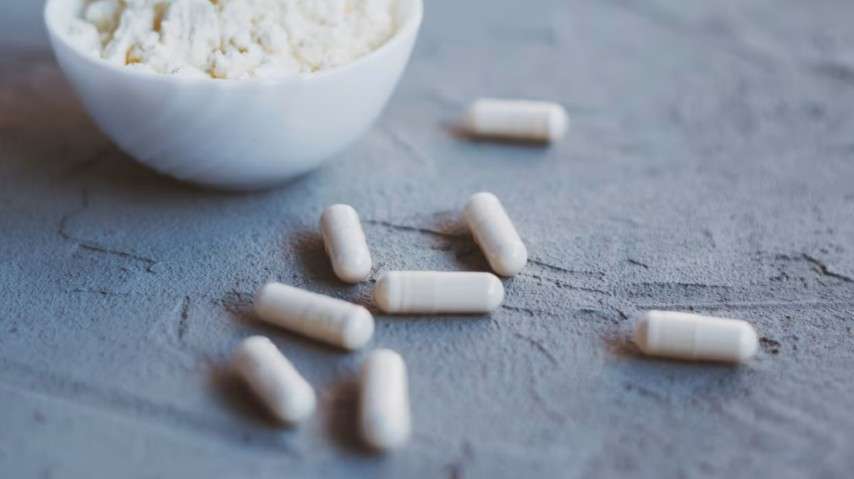
Canning of dairy is frowned upon by the USDA and in some cases consider unsafe, although people do it. Freeze drying on the other hand, processes the dairy at lower temperatures and therefore does not pasteurize it…so if raw is your goal, it is good alternative. If you pasteurize, you still follow the same method. We pour a quart of milk on each tray and let the machine do its thing. We have done it both with cream in and cream out…the choice is yours. We find it needs to be blended when reconstituted, or another favorite is dry in our coffee, just like coffee creamer!
If you’re into selling, freeze dried milk and other products can be a good source income. Take a look at the price of powdered milk in the store! It is not uncommon to see freeze dried milk for $30-40 a gallon. Let’s clarify this. One gallon of freezer dried milk reconstituted into one gallon of drinkable milk…almost quadruples in price.
And don’t forget your Dexter beef! Consider this scenario….you have some cuts left from your last processing and you would really like to eat it before you get into the next one. Well, freeze dry it and then you have preserved it for 25 years. It makes great gifts, as it is so light to ship.
How do you use this freeze dried beef? We like to pour some of our Dexter bone broth over it. Let it sit in refrigerator over night and then use it in the next day or so. The beef will only absorb as much broth as it can. It doesn’t get mushy, which can happen with veggies. Cook with it like you usually do.
Hope this article helps you on your farm, ranch or homestead. I just love this technology and thought I would share.
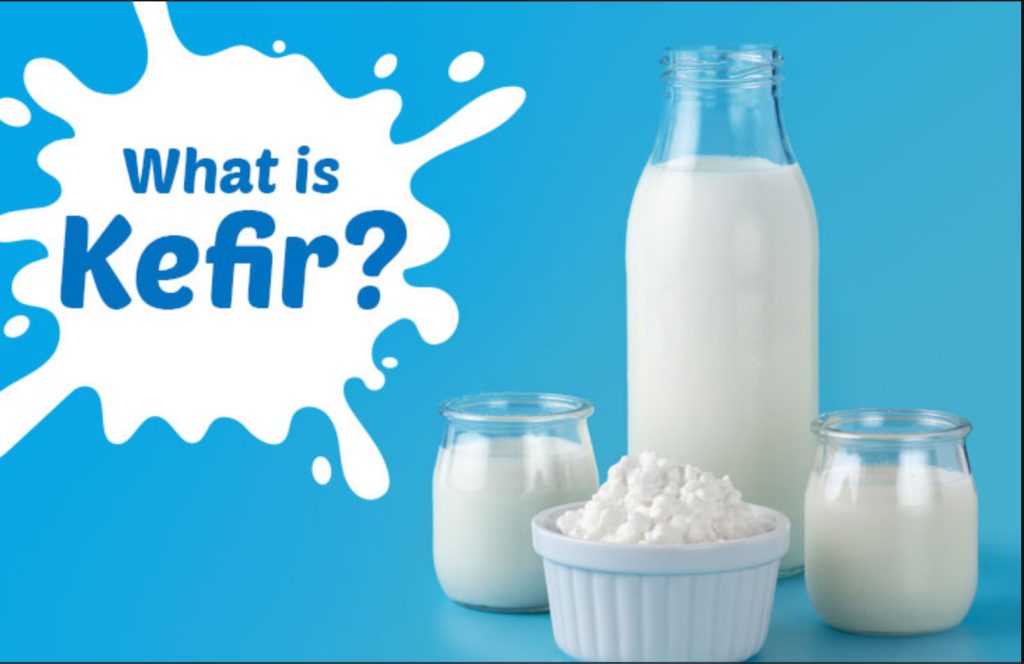
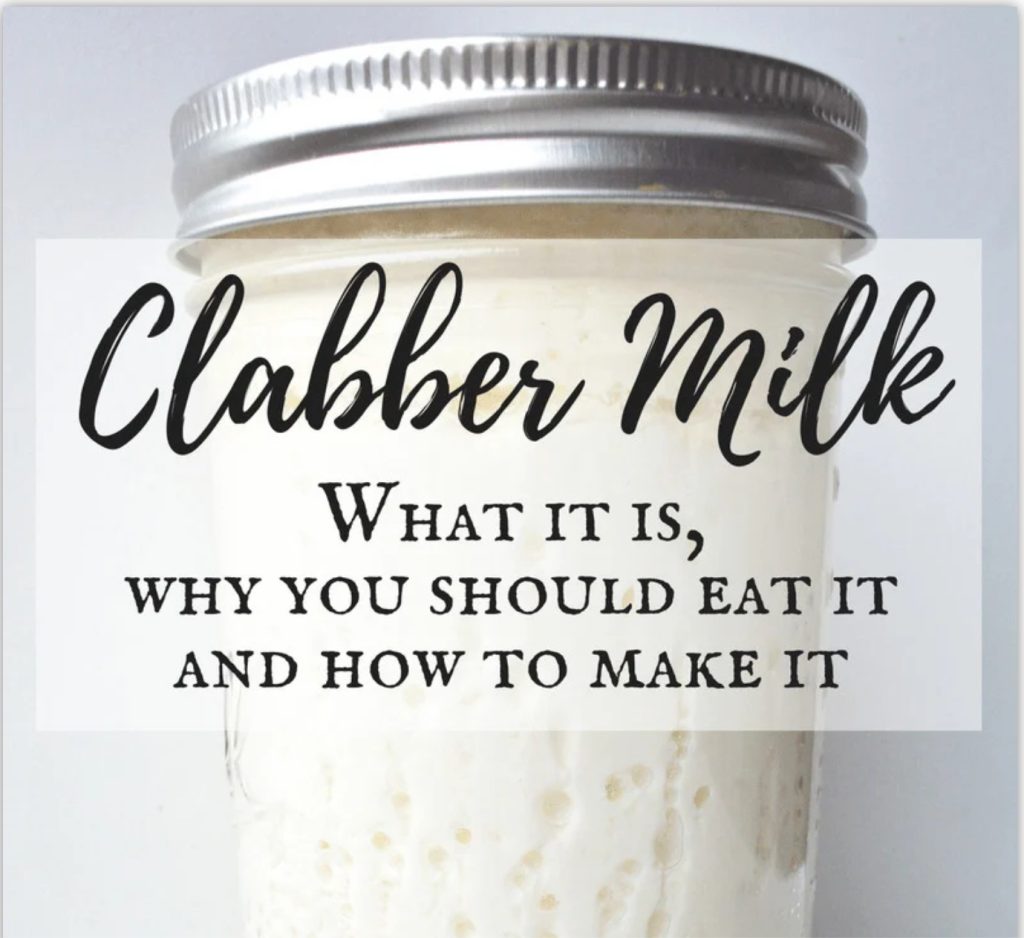
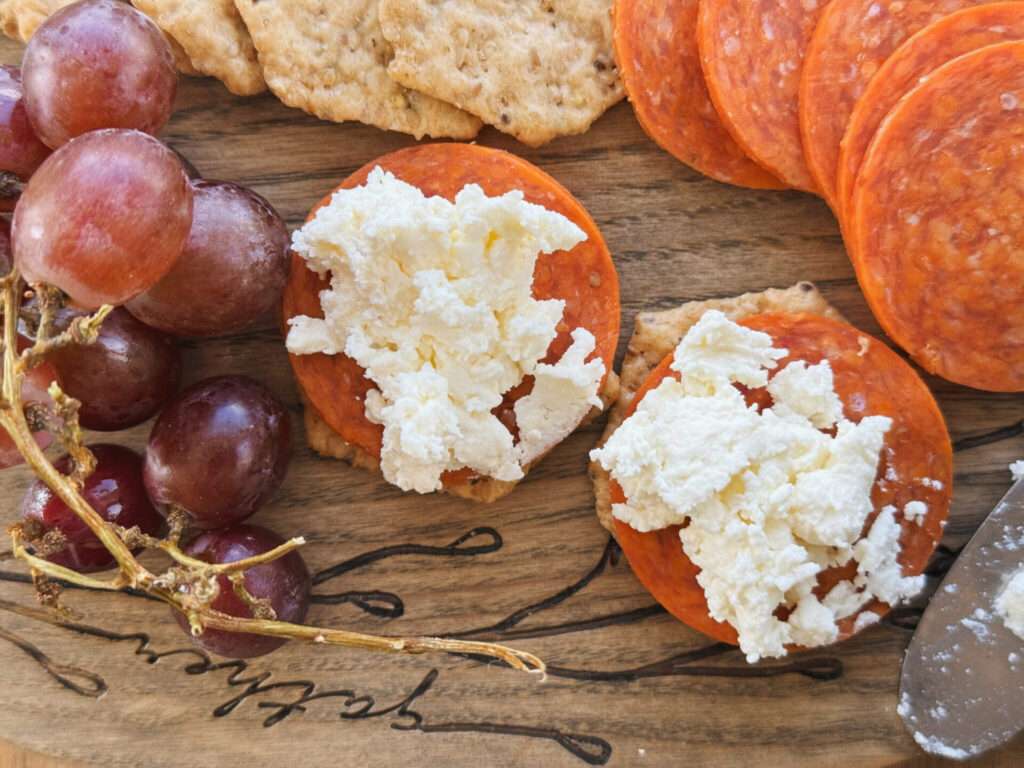
This the name used to describe chèvre cultured cow milk. Traditionally made chèvre is done with goat milk, but the process can be made with cow and sheep milk also. When made with sheep milk it is called brebis. We have experienced all three and love each of them. Give it a try and see what you think.
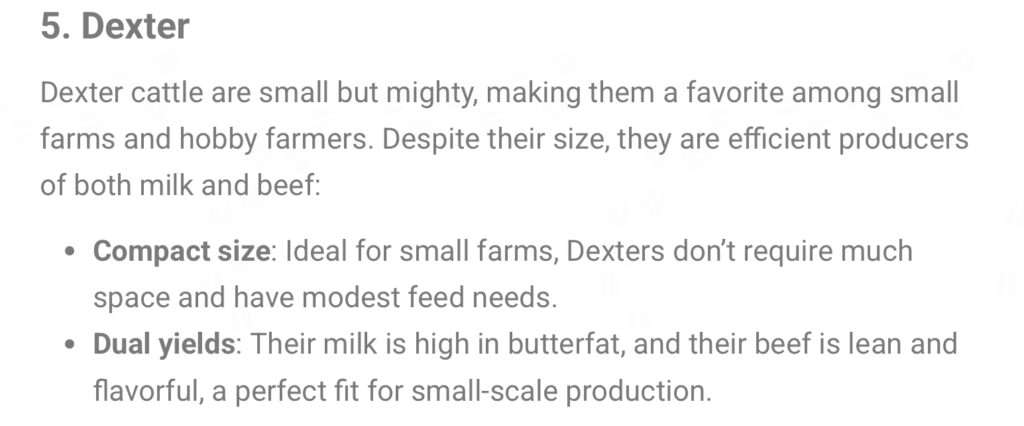
Dexters may only rank 5 in this dual-purpose breed list, but when you consider their size, they come out as number one for the small farm. Practical and versatile in being great for beef and milk. Often times people consider Dexters mini cattle, but the whole breed is naturally small with some individuals being extra small. It is interesting to note that Dexters make the list even though they are small in size and no one can discredit them for their diminutive size as though they are nothing more than a toy breed as they hold their own with the big boys.
I think one of the hardest things for farmers, ranchers and homesteaders is when they need to sell something off the farm. That journey should start well before you need to sell something.
Let’s look at the model I use for selling of Dexter beef.
I share all of the information about our wonderful breed I can, on social media …especially things like, dropping the names of famous chefs that have come to appreciate the quality of our beef. I also share podcasts, articles and pictures of Dexters in the field, on the plate and in its packaging from the butcher.
So now you have some beef that will be ready to be processed in a few months and you don’t need it for your family. This is when you need to start looking for potential customers.
How to get started
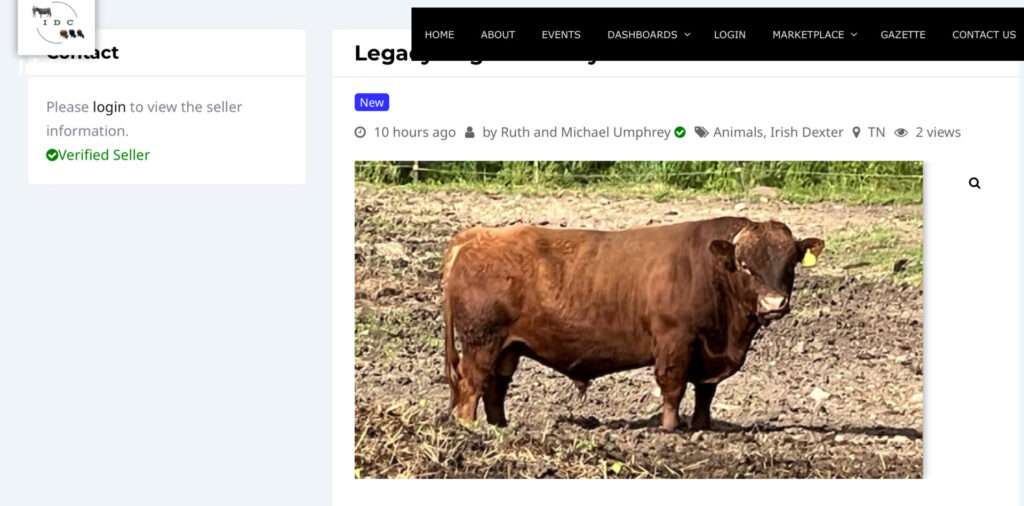
The first thing you need to do is decide what you are going to sell and its value. One of the easiest ways to do this is to look at the market…check out sites like the Irish Dexter Cattlemen, Craig’s List and local social media sites. By comparing what you see on these you will be able to determine what the price point of what is selling in your area.
Things to keep in mind are is it grass-fed and grain finished or grass-fed and grass finished. The grass-fed grass finished tends to command a higher price. Another consideration is vaccinated, as more and more folks are looking for unjabbed…this is a term I see more and more. The more specialized your finished product is, the more you can ask. I say you can ask…because not every customer values that. It’s about building the clientele at this point.
Build your own customer base
Once you start to get customers, you will then need to retain them and encourage them to tell their friends. We always follow up immediately after they get their first quarter or half. Your butcher can also be a big help to you. He sees and works with a lot of different breeds and will have a much bigger customer base than you. A really good butcher is so important to your finished product and especially your yield. My butcher is wonderful about sharing what we have produced and bragging on it for us!
Not everyone knows what Dexter cattle are and that we have, well in my opinion and many of our customer’s opinion, one of best dual purpose , beef and dairy breeds. So, how do you get them to see the value of your beef and our breed? For us, it was finding like minded folks. People who were not looking for meat from the local grocery store. Someone who understood, that by buying the whole, half or quarter of the Dexter they would see an overall better value than the price of just the burger. Our burger is ancestral beef, another differential that sets us apart from many of the other farmers in our area. It includes a percentage of organ meat. This maybe valued by your customer, if they are health conscious…or maybe not important to others or even a put off, to some.
Once they have bought from you, you need to ask them when they will need more. You want to retain that customer and build on that base. If they rave about it…ask them to tell their friends and family. Word of mouth is so much less work and keeps your pipeline full. If you can’t fill their needs, find another Dexter owner who you can work with and help each other. For us, it’s about getting them to buy Dexter.
Dealing with objections
Common objects are:
I don’t know if I have enough freezer space…or how big a freezer do I need. We have many articles, videos and personal writings on the this in the IDC Gazette But the amount of beef produced is a huge selling feature, as the Dexter doesn’t give the average family, too much to deal with.
In many states they need to pay you for the Dexter and the butcher for the processing. In other states, they are done at USDA facilities and payment can be made to you including the processing. Or it can be sold as individual cuts. If selling individual cuts, more homework will need to be done determining the prices of those individual cuts. So, money can be a factor, as some will need to accrue for it unless you are selling individual cuts.
And my all time favorite objection …I need to talk to my husband or my wife…and then you hear crickets. You still need to follow up. Understanding objections can only help you hone your selling skills and prepare you for crazy objections like this last one….lol
Using the Irish Dexter Cattlemen Marketplace
I use the ad I generate using the Irish Dexter Cattlemen for selling. Why? Because it’s looks professional, I don’t have my own website and I don’t want to write a bunch of different ads.To best utilize the ad, I take a picture of it, so they have something to look at and then copy and paste the link of the ad into different social media groups and sometimes even Craig’s list. Not everyone uses social media or Craig’s list. So, by using the IDC Marketplace, I have exposure there on the website and in the FREE monthly newsletter, giving me two more vehicles for selling. By doing it this way, I only write the ad once and then copy and paste, giving it a professional and consistent look. Feed back from some of the buyers off the site have been very positive. They like that everything is in the ad…registration numbers if applicable, location, price and if it is negotiable and that they can have a private conversation.
When sharing on social media I choose local sites, as shipping, is not much of an option with cost of shipping and the need to keep it frozen. I also use the Irish Dexter Cattlemen featured post on FB and some of the cattle groups that serve my area, as it’s just not feasible for people to drive great distances for their beef.
Repetition
Just because you post something once doesn’t get it sold. People don’t typically look back through post from a week ago or a month ago. When they’re wanting to buy something they usually look back maybe a couple of days.
I suggest you post on Thursdays or Fridays and again on the weekend to get people looking at what you have available.
If you are keeping your pipeline full, and you are building your clientele, the repetition will not need to be as much. You will develop wait lists and those lists will need to be worked. Just because they’re on your waitlist doesn’t mean they’re going to buy again. You need to touch base with them periodically and keep it current because they may have decided to buy somewhere else. I find if you touch base with them monthly or every other month, you’re more likely to keep them on your list of potential buyers.
So in conclusion, the important things to remember are
Look professional.
Start to sell before your are taking your Dexter for processing.
Build up the quality of the breed and its beef….you never know you may sell breeding stock too to that beef customer.
Learn to deal with objections in a positive manner.
Remember, posting it once doesn’t get it sold.
Here is one of my favorite podcasts for educating buyers about our wonderful breed.
I sincerely hope this helps you…if you have more ideas, feel free to comment. I would love to hear some of your feedback or unique ways of selling your beef and breeding stock.
Not everyone is comfortable with consuming raw milk. No need to buy an expensive pasteurizer if you have an instant pot in your kitchen. This article covers a few ways of doing pasteurization in your home. It can be done even if you don’t have the yogurt button, but it definitely makes it easier if yours does.
Our journey to homesteading began about five years ago. My husband and I were searching for self-sustainability, a quieter life, and a deeper connection to the land. Raised in the suburbs with every modern convenience, we only knew which grocery store had the freshest beef. That was the extent of our food sourcing knowledge.
Once we acquired our acreage, we started, as many do, with chickens. At the time, I hadn’t even considered milking animals myself, so I went looking for farm-fresh milk. I found a local source, and with it, a whole new world. We began picking up a couple of gallons each week, but it didn’t take long before we wanted to produce our own.
That’s how we ended up with Nubian goats.
I was intimidated by the idea of milking and caring for them, but goats felt less daunting than a full-sized milk cow. Still, I had always loved and admired the Dexters at pickup. Just being around them brought a peace I couldn’t explain. They were a dream, something for “someday.”
Fast forward a few years, and someday finally came.
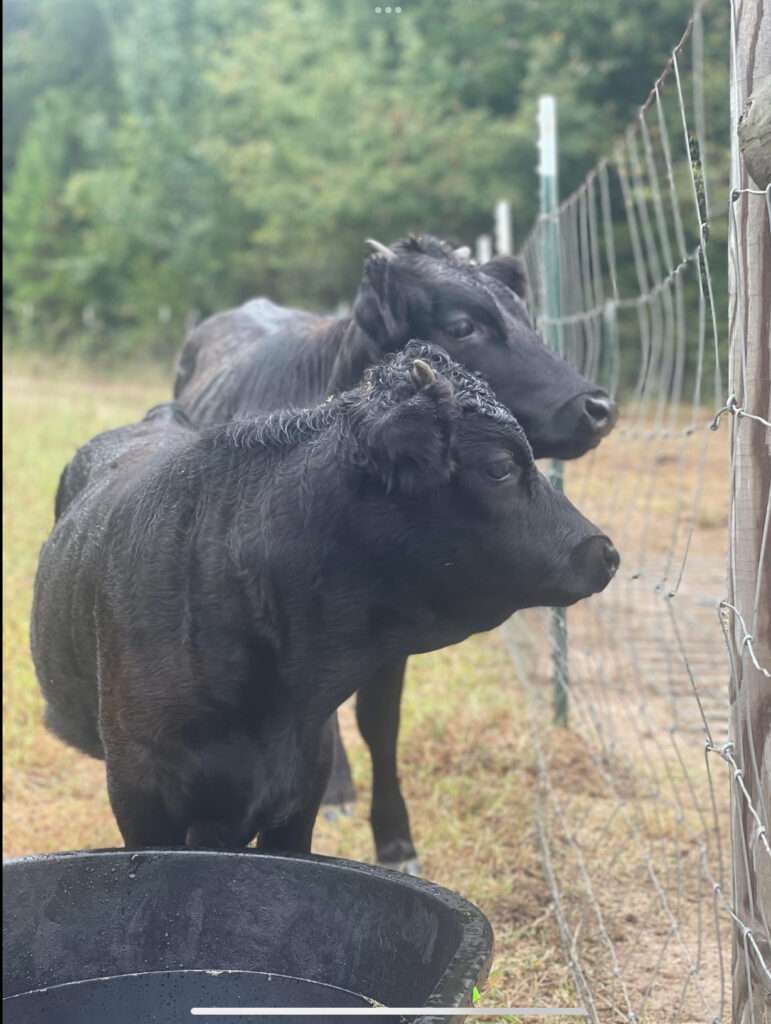
About a month ago, we brought home our first Dexters: a heifer and a steer. And how’s it going? In a word? beautifully.
The first thing I noticed was their peaceful nature. Just being near them calms my nervous system in a way I can’t begin to describe. I’m absolutely head over heels in love. I’ve started thinning down my goat herd to make room for more Dexters in the future.
I’m learning to be a pasture and grass farmer (also moving fencing, adding pastures) all to better serve my Dexters. I’m excited to contribute to the breed by selecting strong lines and continuing the work that’s already been poured into my girl, Fiona.
Am I still intimidated by the idea of milking them? Absolutely. Will I do it anyway and love it once the time comes? Without a doubt.
There’s still so much to learn—about pasture management, breeding, and eventually milking—but I’m ready. With the right mentors and a heart full of determination, we’ll thrive. Fiona and Chuck are home now, and so are we. This is just the beginning of a lifelong journey with Dexters, and I couldn’t be more excited to walk it one peaceful step at a time.
I’m looking forward to many years alongside this incredible breed.
For the first time milker or the heifer that is getting milked for the first time, there are some important things to remember for success. The article below goes over some of the basics.
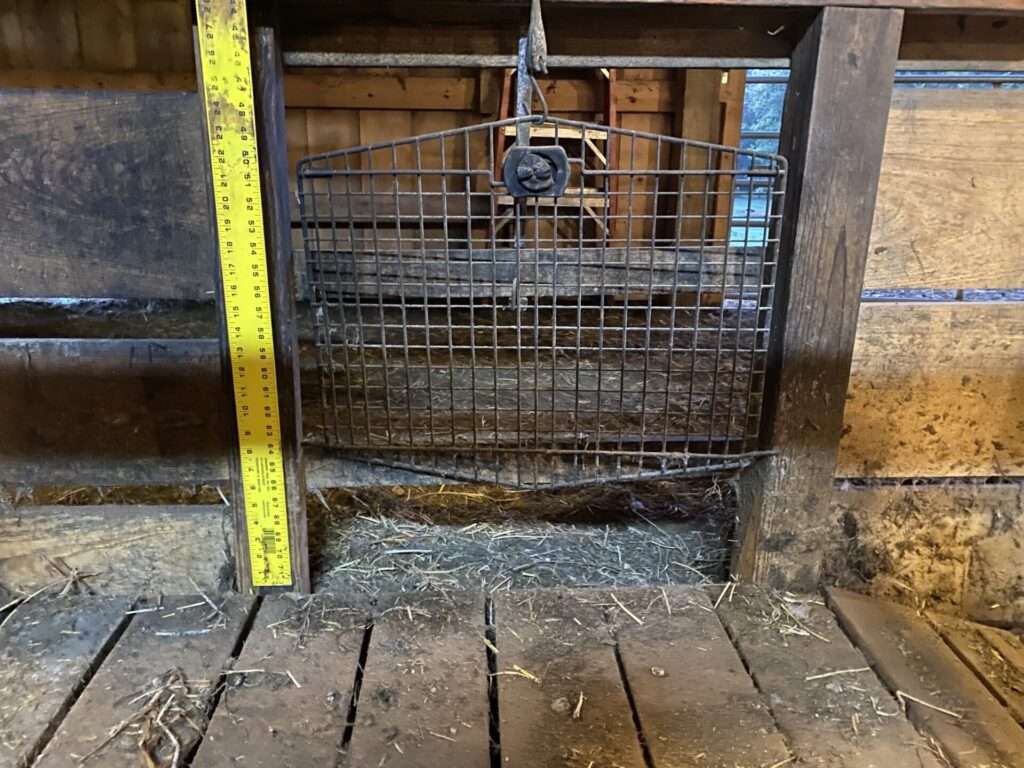
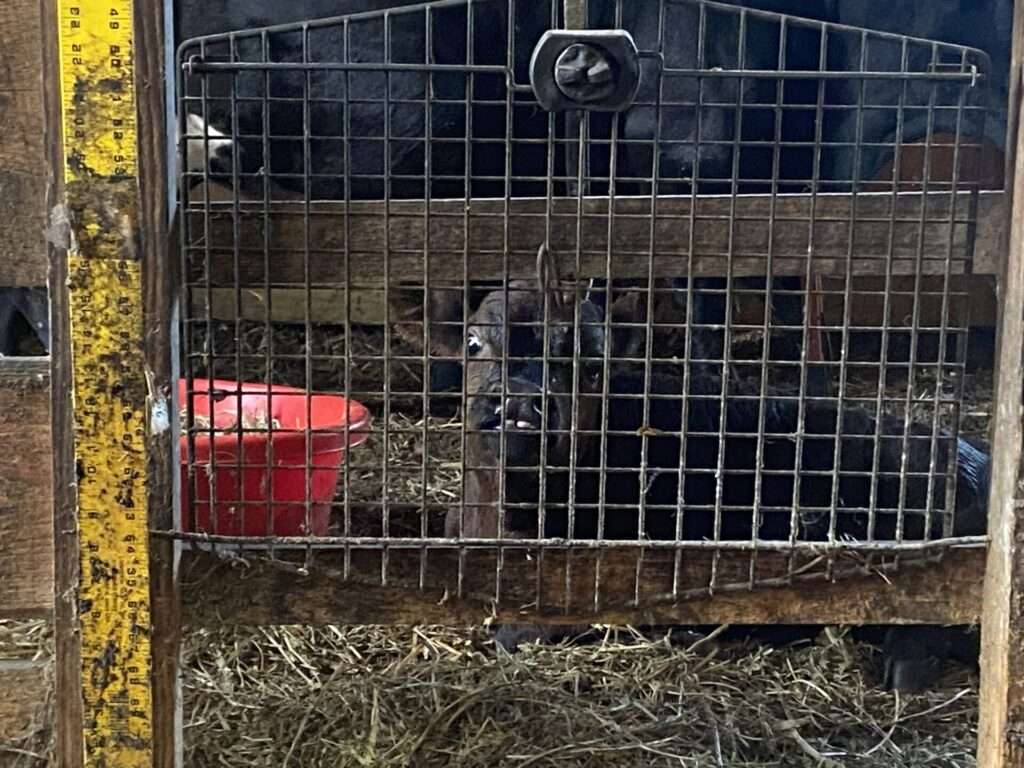
We have, thankfully, only had a few that were very stubborn. We found that putting the calf in front of the cow, so she can see it helps…but when nothing works…we have reverted to letting the calf nurse one side for a short time. I do say short time, as they can drain their moms with amazing speeds.
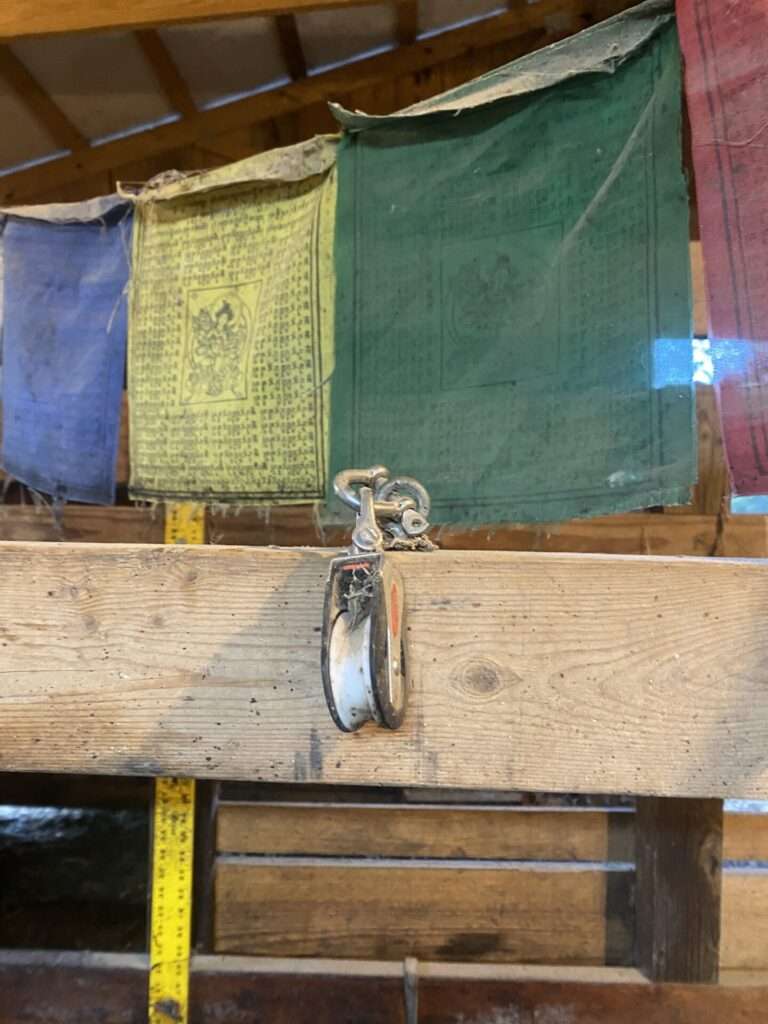
I have included photos of our calf let down gate to give you some ideas that have worked for us. You can see the calf thru the little gate on the first photo. On the second photo you see the pulley. When we need to use this system…which we thankfully have only had to a few times, we tie a rope the the gate, un hook the bungee, feed the rope thru the pulley and the whole gate goes up and down so we can quickly drop it once mom starts to let down.
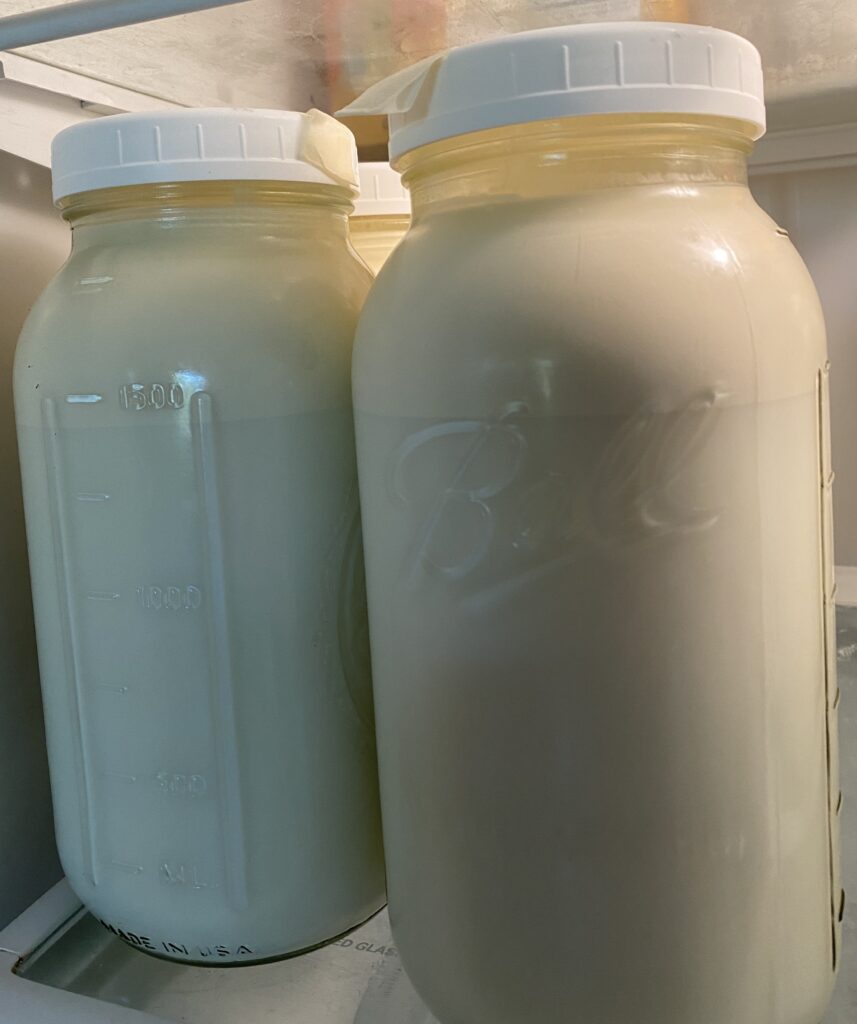
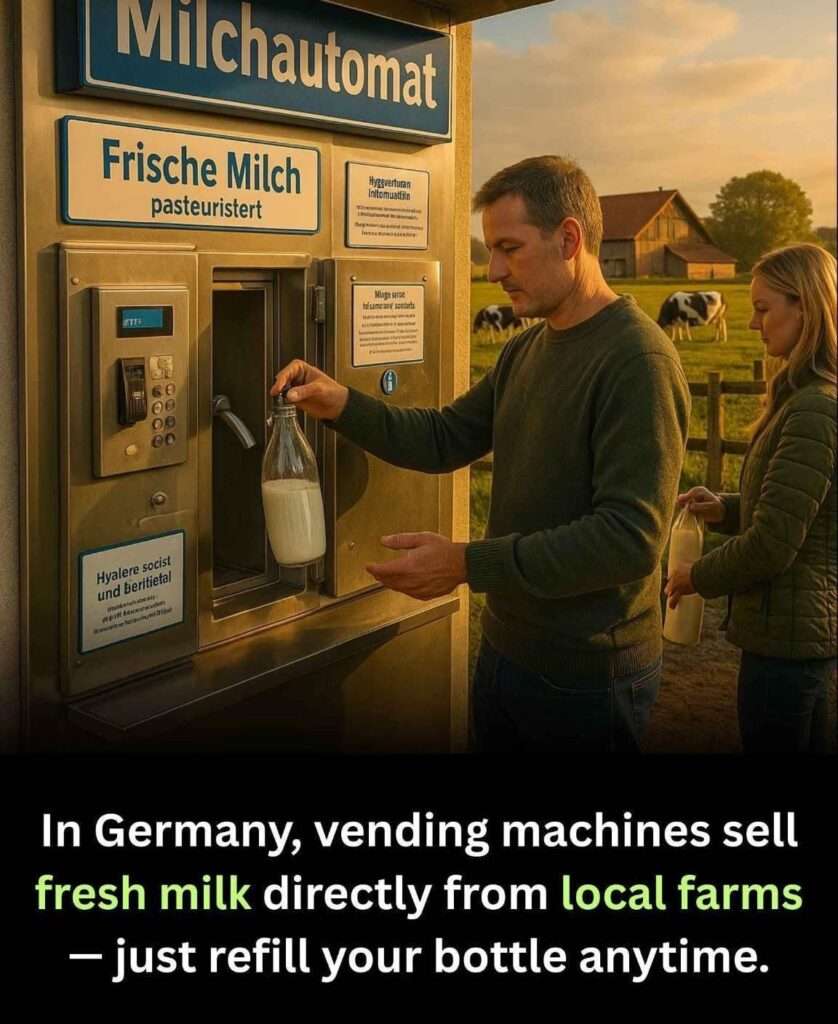
In Germany, a new wave of farm-to-table convenience is flowing through vending machines — quite literally. Across rural towns and even urban neighborhoods, you’ll find self-serve milk vending machines that dispense fresh, unprocessed milk straight from local farms. Open 24/7, these machines let customers refill their own bottles with creamy, cold milk at any time of day, reducing packaging waste and shortening the distance between farm and consumer.
Typically placed at the edge of dairy farms, village centers, or community markets, these vending machines are restocked daily with milk collected directly from the cows. Customers simply insert a coin or swipe a card, place their bottle under the nozzle, and watch as fresh milk fills it up — often still warm from the morning’s milking, or chilled for instant use.
Many stations also provide reusable glass bottles for purchase, encouraging zero-waste habits. Some even display details about the farm, the cows’ diet, and the time of last milking — giving full transparency in a world often disconnected from food sources.
These milk stations are more than just a novelty — they’re a return to tradition with a modern twist. By cutting out the middlemen and minimizing processing, Germany’s milk vending machines support small farmers, reduce emissions, and give people access to wholesome, local dairy with the push of a button.