grazing

Information on farming and ranching using Irish Dexter cattle
Different Winter Feeding Strategies

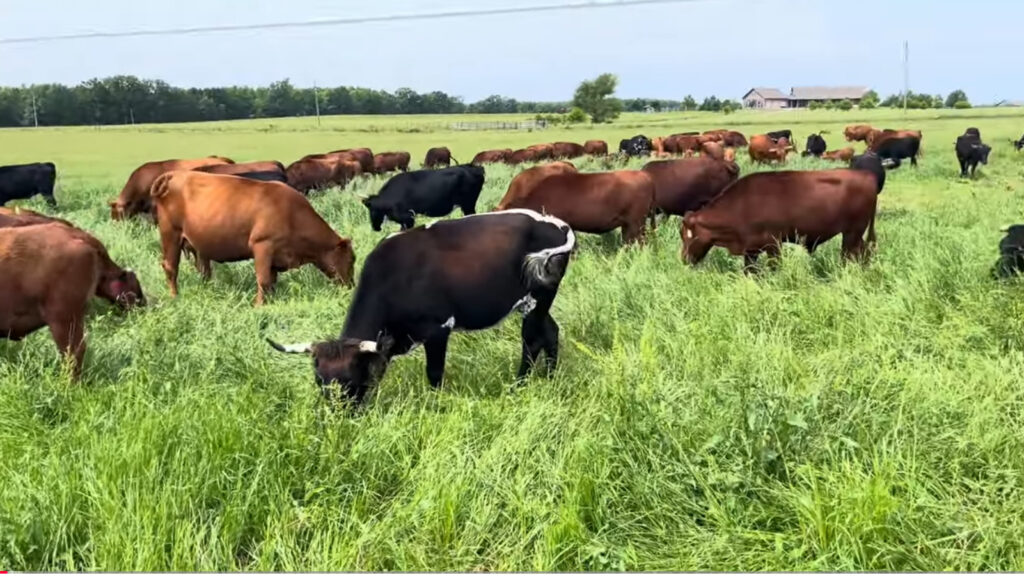
❄️”Winter-feeding is one of the largest costs for Canadian and US cow-calf producers. How this period is managed can make a big difference in both herd health and an operation’s bottom line.

From extended grazing systems to feeding stored forages, each method has its strengths and challenges. The right strategy depends on the operation, available resources and winter conditions.

Here’s a look at some common winter-feeding strategies, with the pros and cons of each.”

Read more: Different Winter Feeding Strategies

https://www.beefresearch.ca/blog/winter-feeding-strategy-pros-cons

Different Winter Feeding Strategies Read More »

Herd Health

Have You Considered Fodder To Feed Your Livestock?

Sprouts (also known as “fodder” when used for animals) are economical to produce.  Typical cost of production is less than 6 cents per lb.  This includes seed, water, and electricity.  Although sprouts cannot replace 100% of an animal’s diet, they have been scientifically proven to increase the digestibility of other feeds in the gut.  That means your hay or grain will become more valuable to the animals you feed.

Have You Considered Fodder To Feed Your Livestock? Read More »

Homesteading

The Climate Cow Podcast – Who Knew This Little Cow Could Do So Much?

A Deep Dive Podcast, brought to you by Irish Dexter Cattlemen, on topics of interest to all farmers and ranchers. Subscribe to the free, monthly Irish Dexter Cattlemen Tips & Tricks Guide to get early access

Brought to you by these Breeders, Affiliates, & Sponsors

A Deep Dive Podcast, brought to you by Irish Dexter Cattlemen, on topics of interest to all farmers and ranchers. Subscribe to the free, monthly Irish Dexter Cattlemen Tips & Tricks Guide to get early access.

The Climate Cow Podcast – Who Knew This Little Cow Could Do So Much? Read More »

Podcasts

Getting And Keeping Your Dexters In Optimal Condition.

Minerals are very important!

We’ve shared several articles on the importance of minerals for your Dexters.

We are discussing it again, as it’s a very important topic for the health of your herd. We cannot express loudly enough how important minerals are for your Dexters. Loose minerals are better than blocks, as they can consume much more in loose form, than they can by licking a block. Minerals are made by several different manufacturers. As with anything, you get what you pay for. We esp. like the VitaFerm brand. Many companies offer minerals that target different seasons or issues, i.e. supporting the reproductive system during breeding, heat stress in the summer, selenium, high mag, and others. Consult with your vet, mentor or a feed rep, to determine what could be lacking in your area and thus what you need to support in your herd.
Some people have their hay tested, so that they can determine what they need to make up for in the minerals they supply for their cows. 

Next, let’s talk about Kelp. We started using Kelp this year, for the first time. Thorvin Kelp, is an organic, natural supplement that is packed full of bioavailable minerals and vitamins. It can also be fed to other animals on your farm. The benefits of feeding Kelp to your herd are many. Some of those are improving breed back time, helping with weight gain, preventing foot rot & pink eye. It basically boosts the animal’s immune system. In turn, this helps lower your vet bills and helps keep your livestock healthier. Kelp can be fed free choice, alongside your loose mineral or it can be blended into a feed ration. Talk with your vet or feed rep, with any questions you may have for feeding Kelp to your herd. 
Apple Cider Vinegar or ACV, is another tool that many use to help build up their animals’ immune systems. We prefer the raw ACV, with “the mother” in it. Some say it helps improve cattle health and feed utilization. Others say it also helps prevent and eliminate parasites and resist disease. It’s also been said to reduce horn flies, by making their skin more acidic. It’s going to depend on the size of your water troughs, on how much to add. One recommendation I found, is to mix in 1-2 cups of ACV, per 20 gallons of water or ¼-1/2 cups per 5 gallons of water. Sick or stressed animals can get more, double or triple the amount of ACV, however I would check with my vet, before increasing it too much. 

Worming: There are several different types of wormers available, that target different types of worms and parasites. They come in pour ons, oral, injection and block or pellet forms. If you have pregnant or lactating cows, make sure the one you chose is safe to use on them. Ask your vet or a mentor. Some breeders have a yearly worming schedule.If you have a poorly looking animal that is thin & has a dull looking coat, or it might have diarrhea or blood in their feces, the first thing you may want to do is to gather a fecal sample into a clean container and take it to your vet for testing. This isn’t costly and it will tell them/you the correct treatment to use. The problem can range from the animal needing worming, to possibly having coccidia or another disease that needs treated. 

A lot of our Country is experiencing high temperatures right now. Usually, any added stress to cattle, can lower their immunity to some things. Higher temperatures can be stressful on animals. If possible, consider moving or working your cattle, during cooler days. Weaning in the hot summer months can be especially stressful for calves. Consider waiting to wean, until cooler months. Make sure they have ample shade to get to, and keep fresh, clean water available, throughout the day. 

Veterinarian: YES! You need to establish a veterinary relationship early in your Dexter journey. They are your first go to in an Emergency and for advice. They need to visit your herd and get to know them. This will benefit you & your herd, in the future. Oftentimes, once they get to know you and the herd, you can obtain advice via a phone call and pick up meds, etc. at their office. Like it or not, there will be an occasion where you need an emergent visit. Your investment in your cattle, is worth calling a vet out in an emergency. Lots of breeders, can give advice from experience, but nothing replaces the professional assessment and treatment of a veterinarian who is familiar with your herd. 
We hope the ideas above, give you something to ponder, research and consider doing to benefit the health of your herd.

Getting And Keeping Your Dexters In Optimal Condition. Read More »

Herd Health

Try Pl@ntNet now!

Pl@ntNet is a tool to help to identify plants with pictures. It is organized in different thematic and geographical floras. Choose the one that corresponds to your region or area of interest from the list below. If you don’t know what to choose, select “World flora” which has the widest coverage but will give less accurate results than a more focused flora.

Pl@ntNet is a citizen science platform that uses artificial intelligence (AI) to facilitate the identification and inventory of plant species. It is one of the world’s largest biodiversity observatories, with several million contributors in over 200 countries.

The Pl@ntNet application, available in web and smartphone versions (AndroidiOS), lets you identify tens of thousands of plant species simply by taking a photo of them.

Try Pl@ntNet now! Read More »

Technology

Willow for Grazing

Are cows that eat willow better for the planet? A Queens University research project aims to find out if Willow can make farming more carbon neutral.

One aspect of Agroforestry uses trees as forage for livestock, and is gaining in popularity. Willow contain anti-parasitic compounds, they can be a great buffer around water sources, and have other great benefit to livestock and pasture. Do you graze Willow trees, or would you give it a try?

https://theorkneynews.scot/2021/10/12/willow-as-a-feed-for-livestock-pioneering-research/

Willow for Grazing Read More »

Farm Management

When can my cows start grazing?

The question that starts rolling around in all our brains the moment the weather turns and we see the fresh green forage poking through the soil is, when can I start grazing my cattle? This is an important question and one that requires some observation. Turning the cows out too soon could have significant impact on the length and quality of forage growth during the entire grazing season. The hay is usually dwindling at this point and everyone is eager to start grazing. But, please pause and read this short article for advice and have a great grazing season!

https://cropsandsoils.extension.wisc.edu/articles/when-can-i-start-grazing/#:~:text=So%2C%20when%20can%20you%20start,20%20days%20of%20forage%20available.

When can my cows start grazing? Read More »

Farm Management

Farmer-led research

When you are considering trying something new it is always helpful to have the wisdom of others who have tried and failed or succeeded. We’ve done a little winter bale grazing with our Dexter herd, and the effects on the pasture are dramatic and obvious (a swath of lush green and clover through a mostly browning pasture). Here is a great farmer led study on the benefits of bale grazing that I have found compelling. Have you or would you try bale grazing?

https://practicalfarmers.org/research/bale-grazing-effects-on-soil-and-pasture-plant-communities/?fbclid=IwZXh0bgNhZW0CMTEAAR12RUqGZHHVrzgIknlKpftHaJXMNRuzAbjeQdmtnQ7LYIbs4_DRrmEA8dY_aem_nwVxF1iDSxHNk7PRtA41fA

Farmer-led research Read More »

Farm Management

Small-scale beef production

Below is a great article for those getting in to beef production on a small scale. Thinking through resources, knowledge, budget, production, marketing, as well as talent and interest level. There is a great quote from the last point: “You are much more likely to be successful if you are interested in and passionate about what you are doing.”

https://www.extension.iastate.edu/smallfarms/top-ten-considerations-small-scale-beef-production

Small-scale beef production Read More »

Beef

Keeping Cows in the Winter Part #4

By Shelley Hatfield/Whippoorwill Pines Farm

Photo courtesy of Royal Fare Farm

Part #4 of this series is MUD, ugh!!!  I’m thinking that most of us have dealt with mud at one point or another.  Some of us deal with mud more than others.  Right now we are dealing with a lot of mud around my place. You have to really watch foot rot and thrush when you are dealing with mud.  Also you have to make sure they aren’t standing in mud because that makes it hard for them to stay warm.  Even if it is only their legs that are caked in mud.  If you don’t have much room for them to move around, you might want to add gravel and/or wood chips to help with the mud.  Another way to help them stay off mud is to do rotational grazing in the winter.  This lessens the chances that your pastures will turn to mud.  The cows will be moving all the time and won’t be staying in one area.  I hope these little articles are helping you all!!  Happy Winter!!

Keeping Cows in the Winter Part #4 Read More »

Beef

Do you need lots of acres to raise beef cattle? By Shelley Hatfield- WP Farm


 Do you need lots of acres to raise beef cattle?  The answer is absolutely not! But you will need to be a little more prepared than farms who have several acres.  You will need to have sturdier fences for one thing.  Farms with several hundred acres have room for the cows to roam so they aren’t as likely to get out.  I’m not saying they don’t ever get out on large farms but it is not as often.  Smaller farms, the cows don’t have the room to roam.  You need to make sure that your outer perimeter fencing is strong and tight.  That can be barbed wire, woven wire, or the combination of both.  This will keep you and your neighbors in good standing….lol
 Land is the second  thing that I want to talk about. With Dexters it doesn’t take as much as with “full sized” cows.  It is 1.5-2 acres per TWO cow/calf pair of Dexters.  But that doesn’t mean that you can stick them on any ole grass and they will grow well.  You have to maintain your pastures.  That is what I’m in the process of doing myself.  I’m working to get my pastures into regenerative grazing.  Which will help with how well my pastures stay.  
 Thirdly, you will need hay, which is something that all cattle farmers need usually.  Unless you are in some states that you can grow it year round.  But you need to make sure that you have good healthy hay.  That is important for the health of your cows.  You don’t want them to get sick.  
 One last thing, keeping your animal healthy is an overall, big or little farm, thing you need to do.  I think as a small farm it is easier to keep a watch on things than a big farm.  You have a more intimate relationship with your Dexters when you don’t have 100s to keep an eye on.  
 I am a small farm with not alot of acres, that is why I chose the Dexters at first. But as time as went on, they are so much more that good for small farms.  But that is for another time.  
 So in conclusion, you don’t need acres and acres of land to raise beef cattle.  You just need to make sure what you have is the best that it can be. 

https://www.motherearthnews.com/homesteading-and-livestock/livestock/raising-cattle/how-i-raised-a-years-worth-of-grass-fed-beef-for-practically-nothing-zbcz2201

https://www.motherearthnews.com/homesteading-and-livestock/livestock/raising-cattle/how-i-raised-a-years-worth-of-grass-fed-beef-for-practically-nothing-zbcz2201

Do you need lots of acres to raise beef cattle? By Shelley Hatfield- WP Farm Read More »

Beef

An article for the Irish Dexter Cattleman website

An article for the Irish Dexter Cattleman website Read More »

Beef Farm Management

Heat stress and its impact on bull fertility

Heat stress and its impact on bull fertility Read More »

Farm Management
Content is for Members Only

Become a Member of Irish Dexter Cattlemen

  1. Register First for free newsletter
  2. Go to Dashboard/My Account
  3. Then At bottom, Buy a membership
Enable Notifications OK No thanks