Who Says Irish Dexters Aren’t Hardy?
Who Says Irish Dexters Aren’t Hardy? Read More »
General
By Sue Pollington
If you spend the money to buy a trained Dexter milk cow please define what you expect by this and tell the seller you choose.
Does this mean halter trained, lead trained, stanchion trained, milking trained, trailer trained?
When I was buying my first cow, I wanted a trained milk cow that I could halter, lead, and who would stand to be milked and had been milked. What I got was a cow pregnant with her second calf who has been milked, she could be haltered and would kind of be lead. She had never ridden in a trailer or been in a stanchion.
This brings up an important point. Find out how a cow has been trained to milk. My first cow was trained to come into a milking parlor, go to a trough with hay and stand there to be milked while she ate. She was not tied or haltered for this. Luckily for me, my first cow had a great temperament, was patient, understanding and willing, so she would let me fail and we could both find a way to make it work together.
Just as you will be training your cow, they will also be training you.
Within our first lactation (milking season) together, my first cow and I got really good at leading, she learned to enjoy the stanchion, I learned to milk with lots of help from my cow. We have become very comfortable together and I am looking forward to her next calf in the Spring so I get to milk her again.
Sue Pollington
If You buy a trained Dexter milk cow…. Read More »
Selling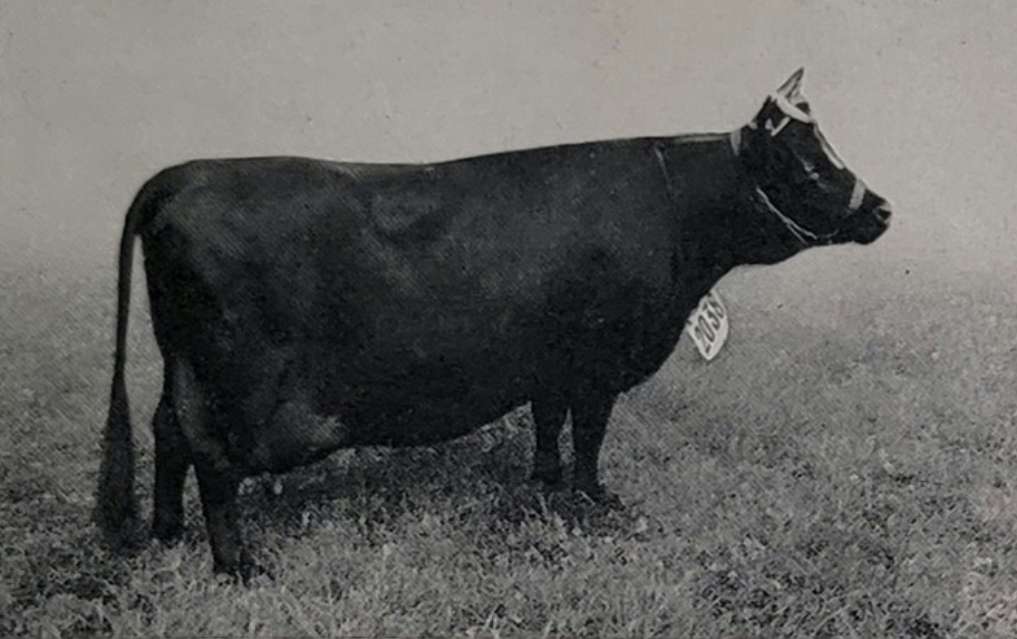
 Milk Yields Record taken from a Dexter Cattle Society Booklet
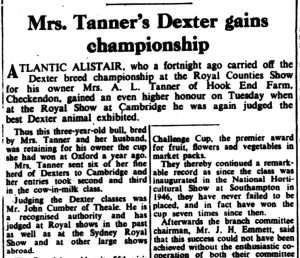
No date was given in this pamphlet but if we consider the Dexters that are pictured we can get a close idea of the date. The top Dexter is Atlantic Alision, she was born Jun 12, 1956. A very beautiful Dexter, but her milk yield was not recorded in the data. The second Dexter looks to be either Atlantic Sprat or his son Atlantic Alistair, I lean towards the latter due to the angle of the legs. You can see some pedigree information on Atlantic Alistair here Legacy | World Dexter Information and it will show you a picture that looks very similar. He was born Jun 9, 1957. The Atlantic Herd was owned by Mrs. W. R. N. Tanner of Hock End Checkendon. Spratt was first in his class and went on to win the Silver Challenge Sheild. Atlantic Alision likewise was a prize winner. Mrs. Tanner had many prize winning Dexters and had a memorable herd of Dexter cattle. Both examples are great pictures to represent Dexter cattle.
 Butterfat Content in Dexter cattle
It is interesting to note that many of these cows had higher butterfat contents. Much higher than a Holstien and some producing as much as some Jersey cattle. The Dexter milk separates cream out slower than a Jersey and some of the butterfat remains in the milk retaining richness to the milk even after skimming the thick cream off the top. These records are a testament to those high butterfat amounts. In order to have a proper milk tests all cows should stay in milk for the same duration of time and ideally be fed a very similar diet. It is very rare today that people will keep their cows in milk for ten months. I however can attest to milking Dexters for 10 months during many lactations and can say there are still Dexters today that will hold a lactation well.
The final consideration I must only discuss for those who may be new to Dexters, so this article does not confuse someone into thinking that Dexters must have a genetic problem that causes them to lose offspring. Some Dexter cattle carry a genetic trait that when two carriers are bred together can be lethal. At one time it was common to breed towards what was considered a Dwarf type. Dwarf being exactly as it sounds, having short and broad features. This trait was widely favored by Dexter breeders and at one time selected for, even eliminating Dexters that were not of the Dwarf type (Chondrodysplasia negative) or so called “long legged”. Of course, during this time there was no test for Chondrodysplasia, so not every Dexter that was selected for that had short legs was Chondrodysplasia positive, but many would have been. Very early on observant breeders recognized that there were sometimes bulldog calves that were being produced from the mating of one dwarf type to another dwarf type, while at times other short and broad looking Dexters when mated together were not producing bulldog calves. With “selective breeding” some people have sought to retain and select shorter and still broad looking Dexters without having bulldog calves. These mid-legged Dexters as some people called them were shorter than the long-legged Dexters but were Chondrodysplasia negative. The long-legged type (Chondrodysplasia negative) some people called the Kerry type. The mid-legged Dexters though they were shorter and fit the breed standard better than the long-legged Dexters still look a little different than Chondrodysplasia positive Dexters. Chondrodysplasia positive Dexters have a look to them that is unique, and there are still people to this day that like them and choose to breed them to retain their unique traits. The two Dexters photographed in my opinion were most likely Chondrodysplasia positive but of course without testing we will never know as there are many short Dexters that have short and broad features that do not have Chondrodysplasia.
Breeding Chondrodysplasia positive Dexters is now simpler than ever because a genetic test was created that identified the gene and now breeders can test to know if their Dexter is Chondrodysplasia positive or negative. With this knowledge comes the ability to breed without the negative outcome of a risk of a bulldog calf. If you only breed a carrier to a non-carrier, you will never end up with a bulldog calf, but instead you have a chance of getting either a Chondrodysplasia positive or negative Dexter from the mating. So, breeders who still like the Chondrodysplasia type can have the chance of obtaining it through wise breeding choices with never having a risk of a bulldog. For anyone who may be reading this who does not know the Chondrodysplasia status of their Dexters you can find the test here. Simple to test and fairly inexpensive but will save you a lot of loss because knowledge is power. Bulldog Dwarfism (Chondrodysplasia) in Dexters | Veterinary Genetics Laboratory
The other benefit of testing is that if you do not want to breed Chondrodysplasia carriers, you can likewise use testing to select for Dexters that do not carry Chondrodysplasia while still maintaining the breed standard. Today with testing being so affordable it makes sense to test all Dexters to make informed breeding choices and help buyers evaluate the genetics of each Dexter a breeder has to offer. From great milk yields, butterfat content, excellent beef and the choice of breeding the dwarf type (chondro) or not, Dexter cattle have a variety of genetic traits that can please people with a various goal.
This article was written By Danielle of Bryn Mawr. This article cannot be copied or reprinted without prior consent.
Dexter Milk records Read More »
Historical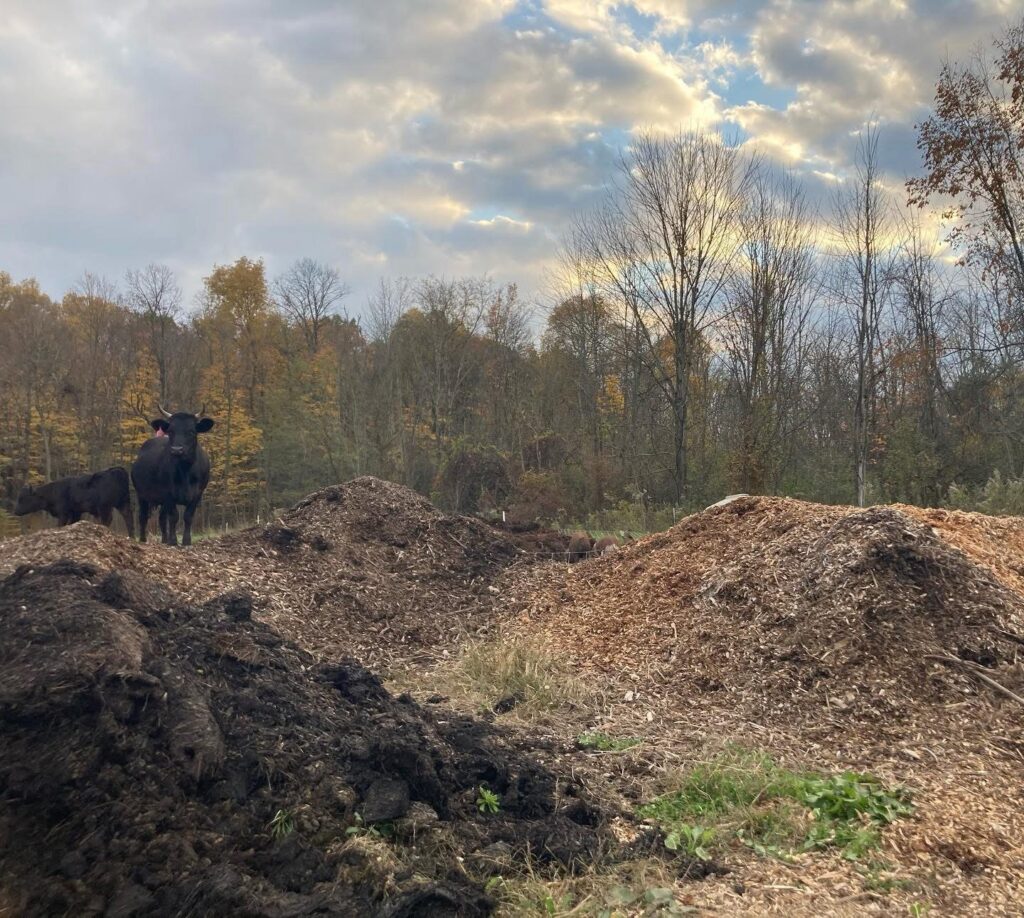
The article below has some simple, cost-effective solutions to managing mud on your farm or ranch. there are also a few more in-depth, long term solutions if you have the time and resources to complete them.
We have used wood chips in high traffic areas of our farm with good results. And, we get free wood chip drops from local arborists, so it is very cheap. The added benefit is that the manure and wood chips make great future compost for the garden.

If I had a dollar for every time I said, “I’ll remember that later” I’d be a millionaire. But, the times I actually do remember are really rare! If you’re like me, and you need a little help creating better permanent records here is a great podcast to listen to:
https://podcasts.apple.com/us/podcast/livestock-walaau/id1580454679?i=1000611070012
Financial Record Keeping Read More »
Farm Management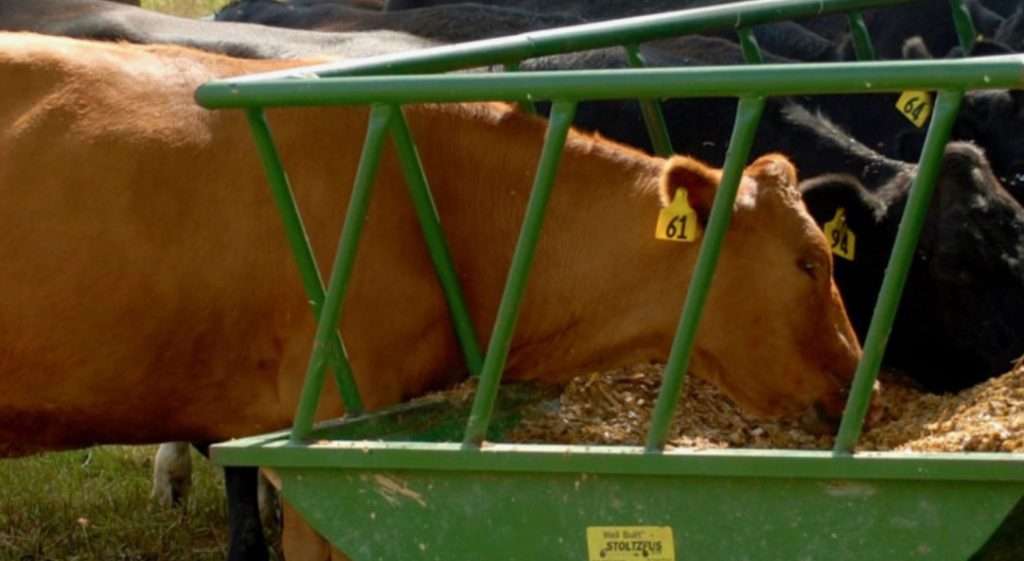
Minerals are a small, but mighty, nutrient requirement for cattle. These elements cannot be made by the body and they are essential for proper function of the skeletal, immune, and muscular systems.
Cattle Nutrition – Minerals Matter Read More »
Herd Health
Dexter beef is a breed of cattle that is known for its quality and taste. It is commonly known in foodie circles that Dexter beef is some of the tastiest around and really good to eat.
The Quality Of Dexter Beef Read More »
Beef Selling
By Judy Sponaugle of Legacy
Another registry “innovation” finds the US herd a hodgepodge of mediocre and forgettable initialed herd names. The US is the ONLY country in the world that has so little respect for Dexters they guarantee breeders basic anonymity by using initials of farm names as herd identifiers! Goodness but it IS forgettable.
Here’s an example. I was trying to convince a new breeder about to register a first calf NOT to use the initials encouraged by the US registries for it all but determines anonymity for their herd. Truth be told. . . . there are only two initialed herds in the US I remember by initials, both because the owners were/are prominent in the breed. So, . . . I gave this person examples of wonderful and imaginative herd names, and then I looked at the state of Virginia ( where the owner lived) and picked out three herds with initials. I know most herds and owners by heart through constant research. . . and I looked at the initials and began the process of trying to remember the herds. It was a struggle! One of the herds I knew very well because my own bloodlines founded the herd and it was a perfect example of how even a constant researcher will NOT recognize herd initials. Almost guaranteed anonymity and obscurity unless the person becomes a huge long-term breeder with a large herd.
Woodmagic was chosen by Beryl Rutherford because it was based on a favorite book from childhood, and all her Dexters were named after woodland creatures and birds. Grinstead brings a smile to one’s face, with or without the beautiful photos of that herd and it’s dominance in pedigrees through the years. Most English herds were named after the homes or estates or towns where they grazed. It would be interesting to know the history of the choice of La Mancha for the Robertson family’s Dexter herd, but Round Chimneys leaves little to the imagination. Parndon was a parish in Essex, England, and the origins of Ypsitty is still a mystery to me. My least favorite herd name in the English records is Bryn-y-pin because it was difficult to type.
American herd names prior to the 90’s were also imaginative and memorable. Peerless certainly lived up to it’s identity, and every Missouri Dexter owner would immediately know the roots of “Shome”! Shamrock immediately brings to mind the hallowed green leaf of Ireland, while Rainbow and Rainbow Hills are colorfully soothing to imagine. Talisman is a herd name I always liked, and there is a Virginia herd that lives in literal “Paradise”. The Lone Star and Cascade herds identify their geographic locations but also denote history, and Chautauqua identifies an area of NY where the herd is located. ( Another typing challenge for me).
Then we have SGF and SMD. These herds are owned by long-time well known breeders. Can you immediately identify these herds or do you have to stop and think as I did with a herd I knew as well as my own? In England, or Australia, or even Canada, you would most likely know these herds as Spruce Grove or Silver Maple and the identifier would be far more memorable.
One registry started this and the other continued this nonsense of encouraging owners to use initials and give US Dexter herds guaranteed mundane, boring, and unimaginative herd identifiers. This is an “only in America” tradition that needs to fade into the obscurity IT deserves. Please registrars. . . . STOP . .. . .suggesting to owners to use initials. If you are fairly new to the breed. . . . . then CHANGE those initials to a memorable herd identifier and INSIST on it.
IF. . . you are a new breeder and happen to read this page. . . . . . . . . . . . . your Dexter breeding program deserves a unique identity. I strongly urge you not to be led down the initialed path to anonymity.
THINGS TO CONSIDER ABOUT YOUR HERD IDENTIFIER. A LITTLE BIT OF HISTORY! Read More »
Historical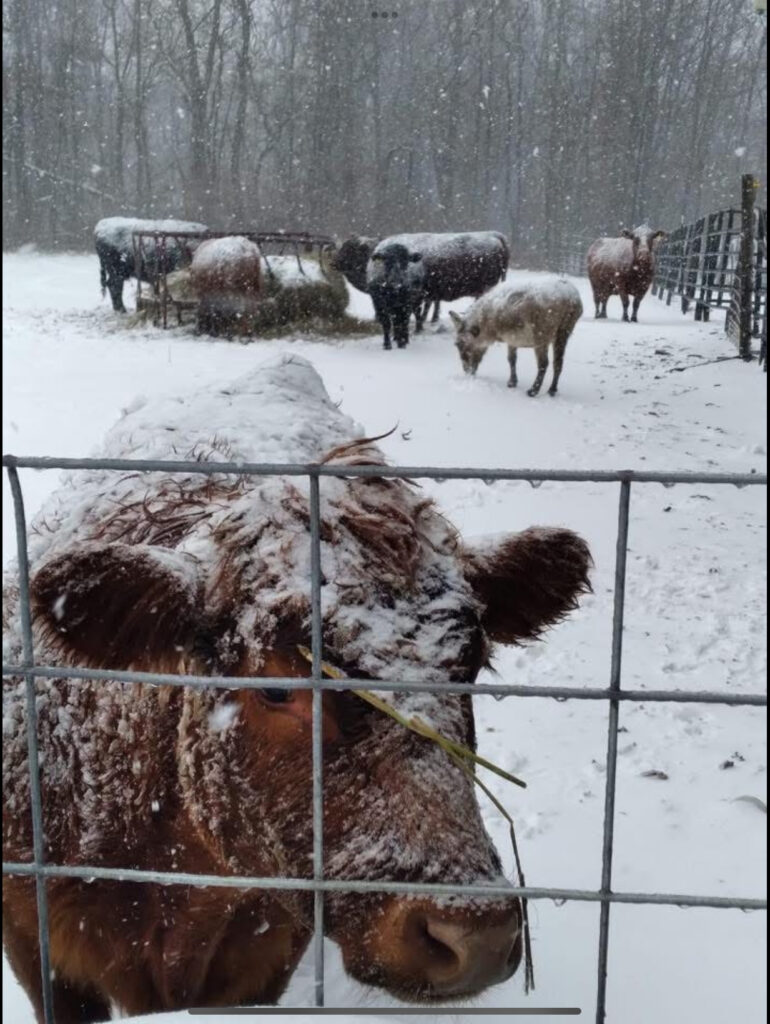
Cattle expected to live outside during the winter should remain outside to adjust to the changing conditions as winter approaches.
https://extension.umn.edu/beef-cow-calf/preparing-your-cattle-severe-winter-weather
Cattle and Severe Weather Read More »
Herd Health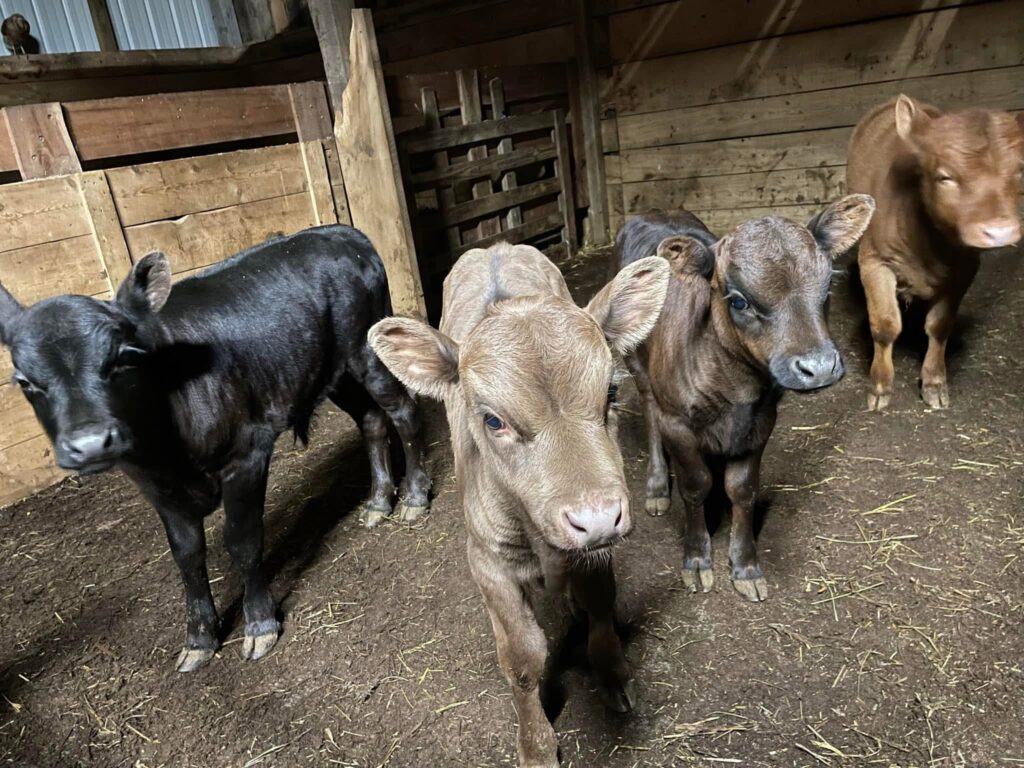
Now’s the time to start planning ahead. Here’s a checklist to help you plan and prepare to improve
Calf Refresher & A Checklist Read More »
Herd Health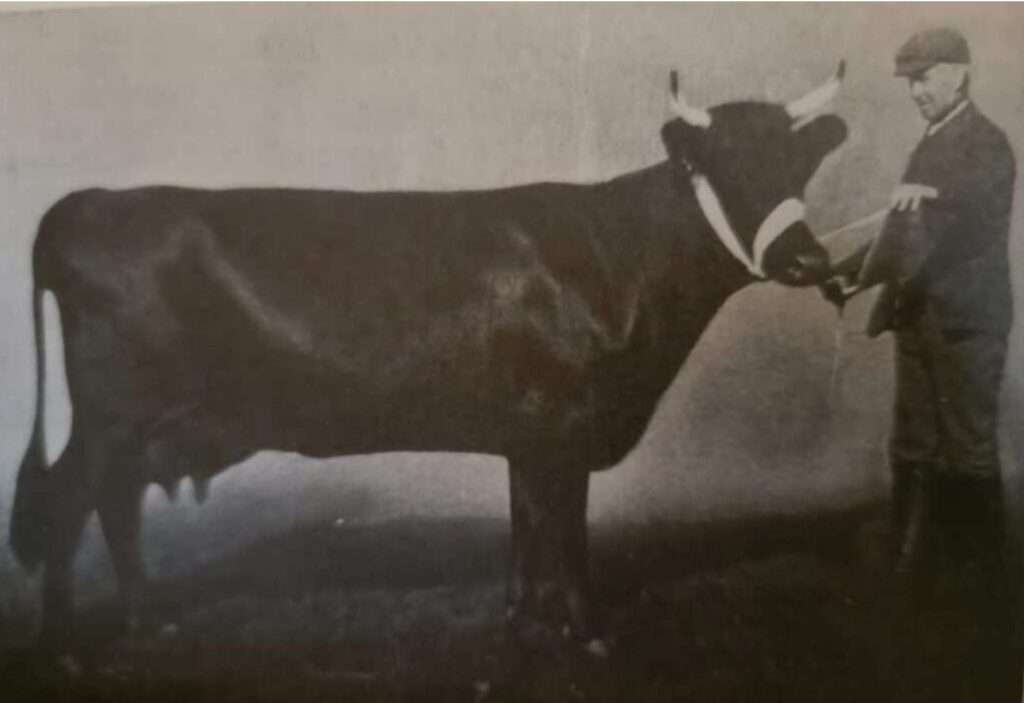
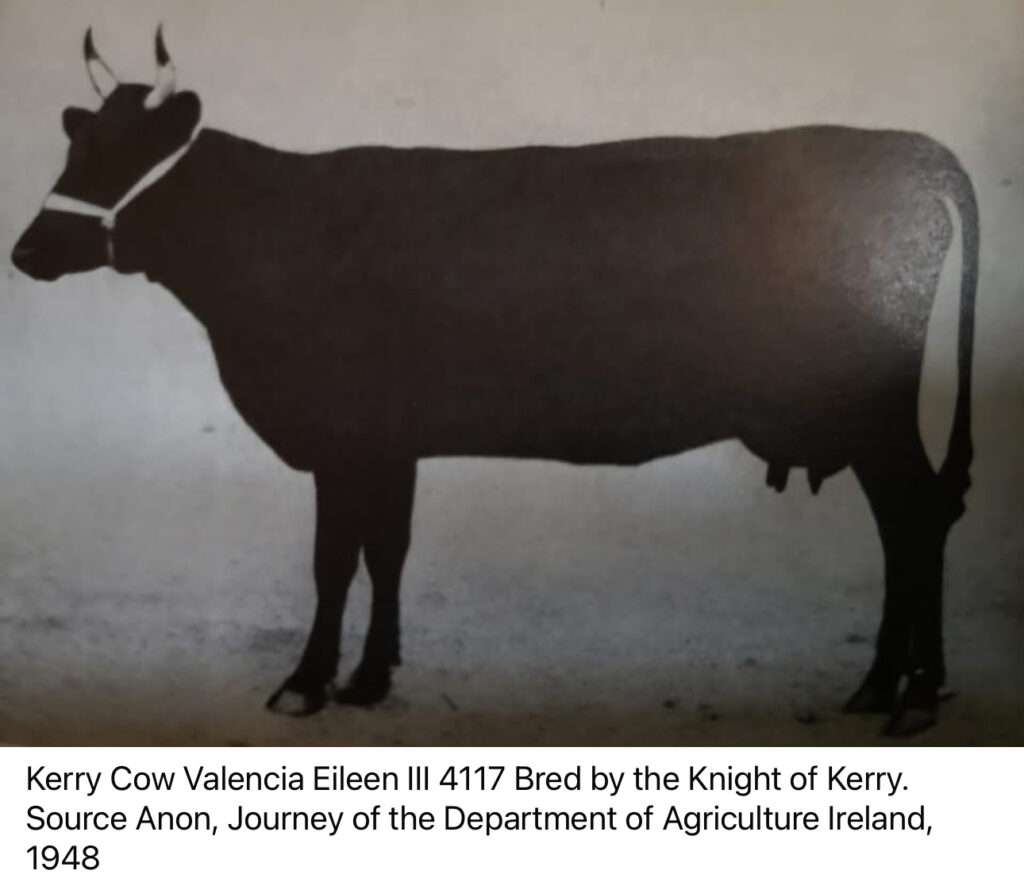
How much dairy should we put in to a Dual purpose Dexter cow. If you were to consult the English herd books they would say 40 percent for the “Bag” with the remaining percents being 15 for the “Head and neck”, 25 for the “Body, top line, under-line, ribs, setting of the tail, shortness of the leg, ect.”, 10 for “Quality and Touch” and 10 for “Colour”. So 40 points goes to the quality of the udder while 25 points gets divided up between the “Body, top line, under-line, ribs, setting of the tail, shortness of the leg, ect.”. It seems to me that in Dexters the focus today tends to fall primarily on mostly two aspects alone: shortness of leg and body type with general conformation coming in at the end. Even with 3 aspects it only accounts for 25 points for a Dexter. So there is a hyper focus on 25 % of a Dexter while the 40 percent in often neglected. The length of a cow’s leg and it’s depth are not the only traits that define a Dexter. Of course, we can’t forget the other traits that almost no one talks about, the “Head and neck”. You don’t get much meat off a head but it adds a distinct breed defining trait to a cattle type to set them apart.
It’s interesting to note that Kerry cattle that became a distinct dairy breed separated from the dual-purpose Dexter also list 40 points for the udder. The only difference is that more details are mentioned about the bag, “Udder, size, situation of teats, milk veins and escutcheon”.
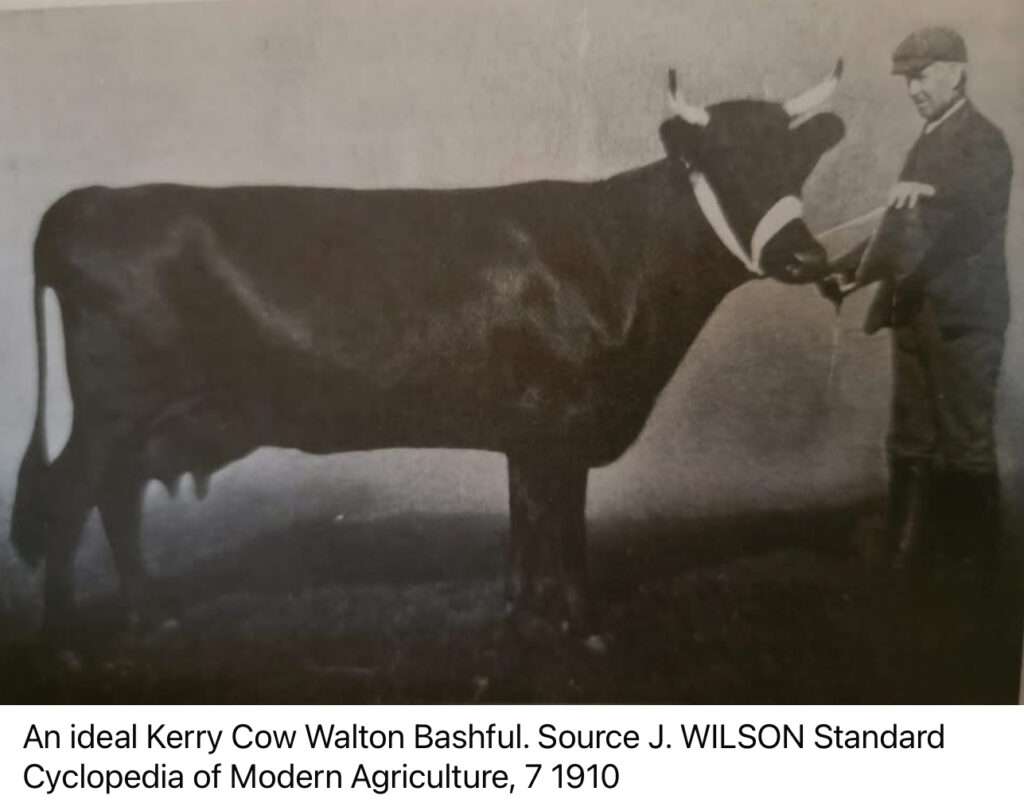
Now before major concern sets in, consider that this point system is based on an ideal cow. There will always be cows in a breed that are not ideal, but the goal is to breed for the ideal cow. If you look at the 3 pictures of Kerry cattle, I will share you will see that Walton Bashful is listed as ideal and her udder is the best of the three cows shown. I’d say if an udder is ideal enough for a Kerry it can likewise be good enough for a Dexter that uses the same 40 percent system. Of course, there is no problem with having an even better udder than this cow does! The next Kerry is Valencia Eileen III. You will immediately see that she could improve on her forward attachment, but she was a Kerry all the same. The final cow is Ard Caeina Una. You will see she has some attachment issues, and you will tell that her udder is hanging lower by her hocks. The placement of her teats are too close and awkward but they were still put to use, as you will see by reading her milk record. Her yield 14,562 lbs with her butterfat at 4.33 percent. Still a valuable Kerry cow. With Dexters we need to seek generational improvement in dairy traits as Dexter’s udder points are just important as Kerry cattle, but we also need to remember that improvement is generational and culling cows with good production and butterfat won’t instantly fix a problem. It could lead us to a breed full of cows with very tight nonproductive udders just because new people think a tight looking udder is an aesthetically pleasing udder.
The Dual Purpose Dexter And The Kerry History Read More »
Historical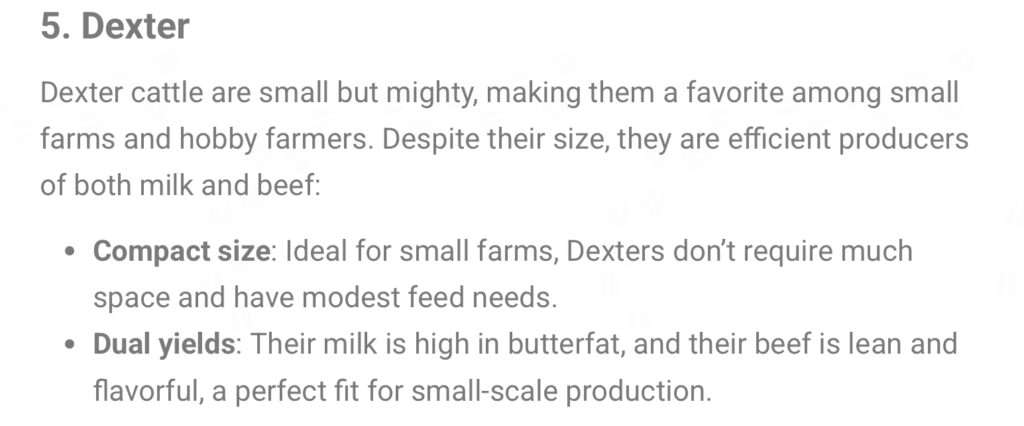
Dexters may only rank 5 in this dual-purpose breed list, but when you consider their size, they come out as number one for the small farm. Practical and versatile in being great for beef and milk. Often times people consider Dexters mini cattle, but the whole breed is naturally small with some individuals being extra small. It is interesting to note that Dexters make the list even though they are small in size and no one can discredit them for their diminutive size as though they are nothing more than a toy breed as they hold their own with the big boys.
Click the link below to read the article
Dexters are a TOP-RANKING DUAL-PURPOSE BREED Read More »
Beef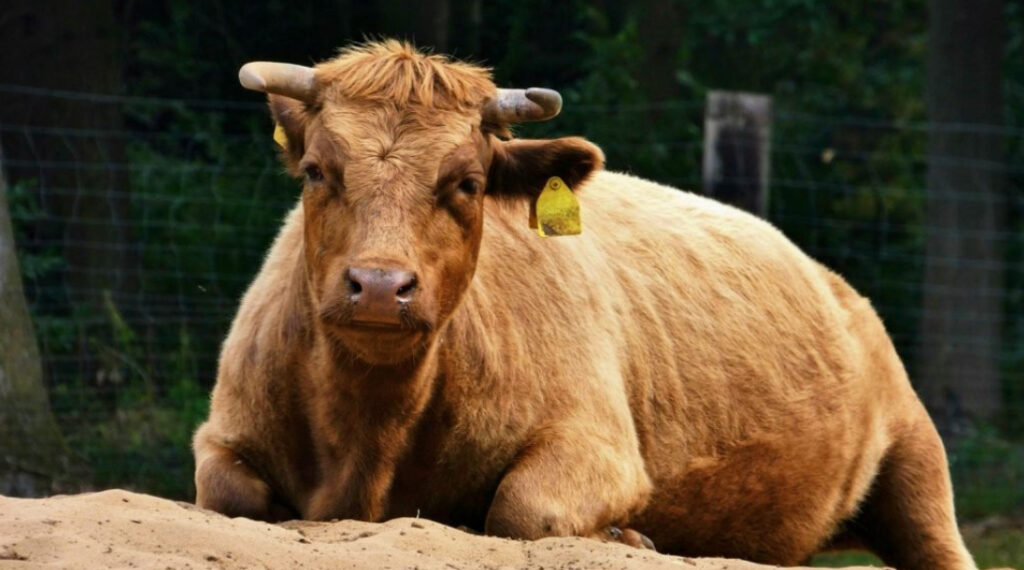
Mini Cows Are Perfect For Preppers and Small Homesteads
Homesteading Dexter Cattle Read More »
HomesteadingWe all should consider having a herd health plan in place. At some point in your journey, you will likely encounter some health issues.
Dexters are hardy cattle and often don’t require any additional help to stay healthy, besides good nutrition. However, if you’re bringing in new cattle or transporting your cattle to other places, you may want to consider some of the ideas below.
It’s always good to have a plan in place, before you need it.
Submitted by Pam Baker, MCD
https://www.bovinevetonline.com/news/education/establish-complete-herd-health-plan
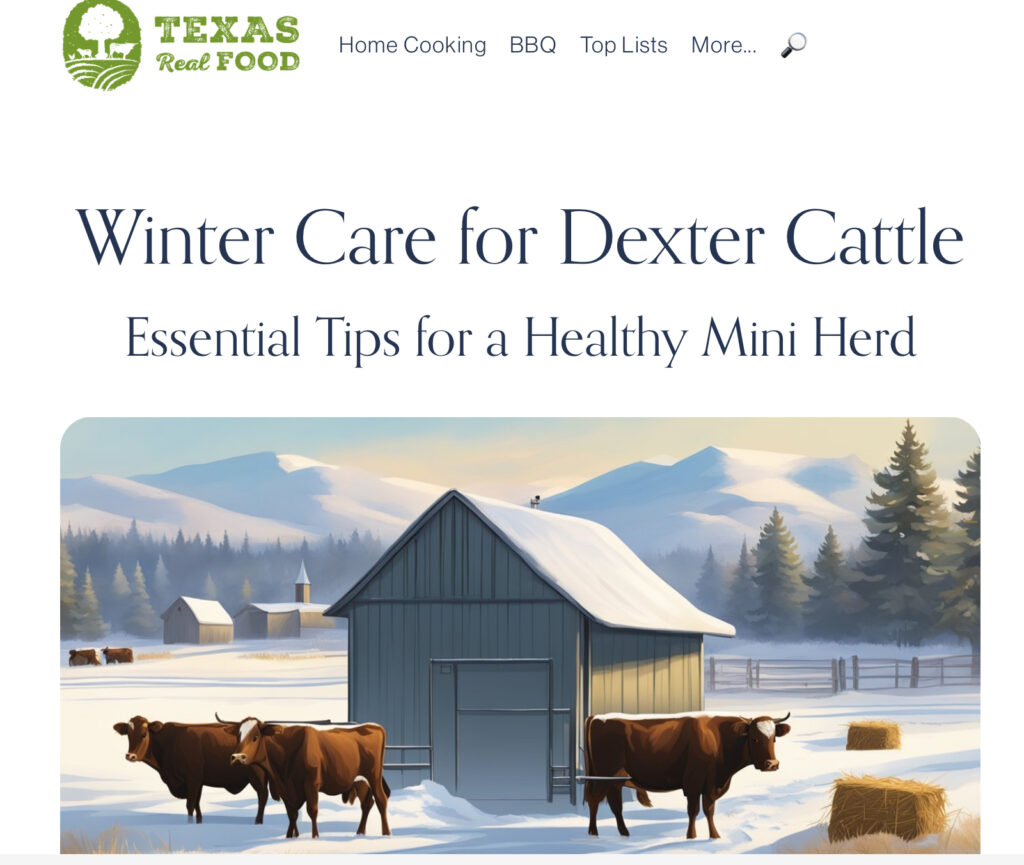
Nutritional needs during winter are critical for maintaining health
https://discover.texasrealfood.com/dexter-cattle/winter-care-for-dexter-cattle
Winter care for Dexter cattle Read More »
Farm Management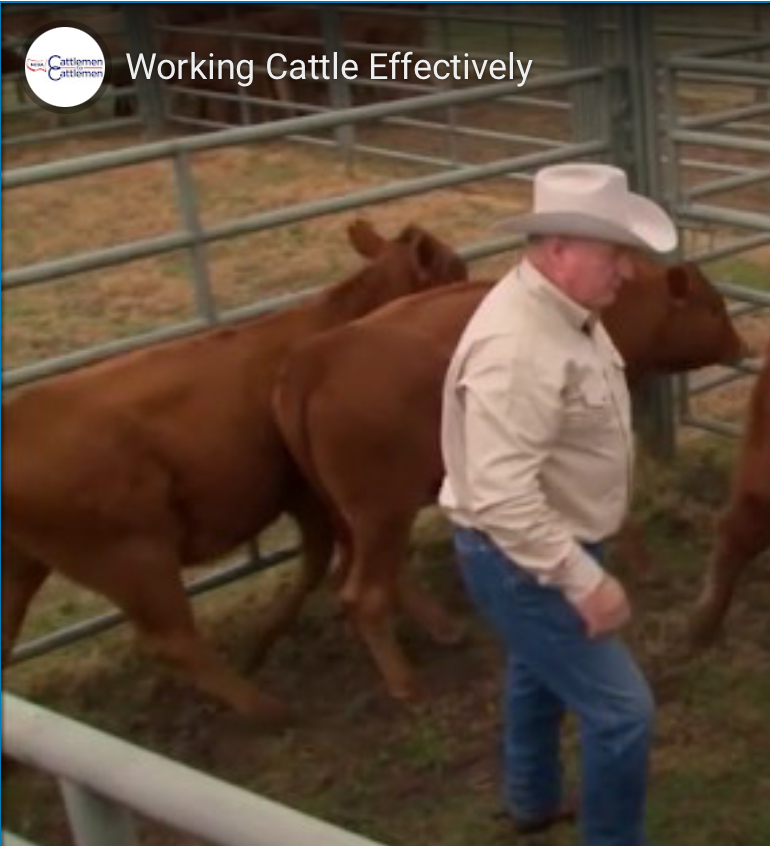
Dr. Ron Gill shares tips on working a cattle
Working Cattle Effectively Read More »
Farm Management