milk

Information on milk and dairy using Irish Dexter Cattle
Dual-Purpose Dexters winning off their own backs

Dual- Purpose Dexters for an Equal Show

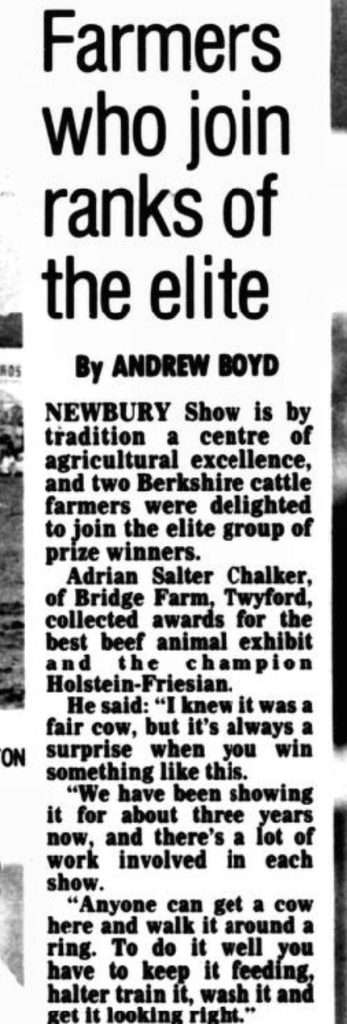
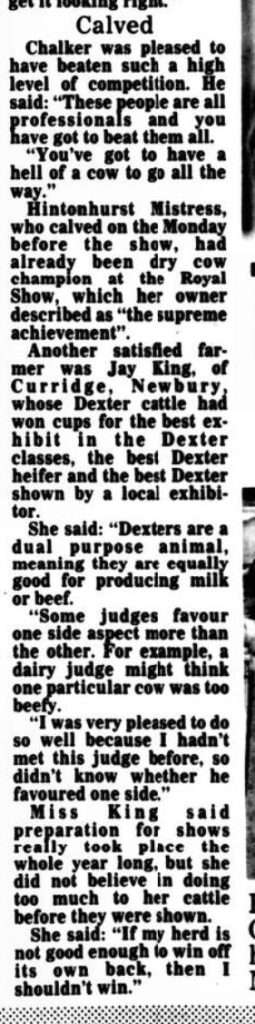
This article written in 18 September 1989 from Reading Evening Post lets us know that much of the confusion on judging dual-purpose Dexters has been around for a long time. Dexters are a dual-purpose breed, so both dairy and beef traits are supposed to be considered equally, therefor a well-balanced Dexter in both traits would be most apt to win a show if a judge were to judge accordingly. The common problem is that when judges consider a Dexter they will look at it with their beef or dairy perspective and have a hard time balancing the two as many judges are most accustomed to judging one or the other. The only thing that keeps judges in line with a breed is having an accurate standard to breed by and a scale of points to score by. No judge should be asked such a difficult task of judging a breed without the standard of the breed as it sets him up to only fall back on his personal area of expertise which may be dairy or beef.

              This article gives a quote by a Miss King, it says “preparation for shows really took place the whole year long, but she did not believe in doing too much to her cattle before they were shown.” She went onto say “If my herd is not good enough to win off its own back, then I shouldn’t win”. The value in this statement is that one must properly care for their livestock all year round if you expect them to win a show, but good quality cattle look great even when just standing unprepared in a pasture.

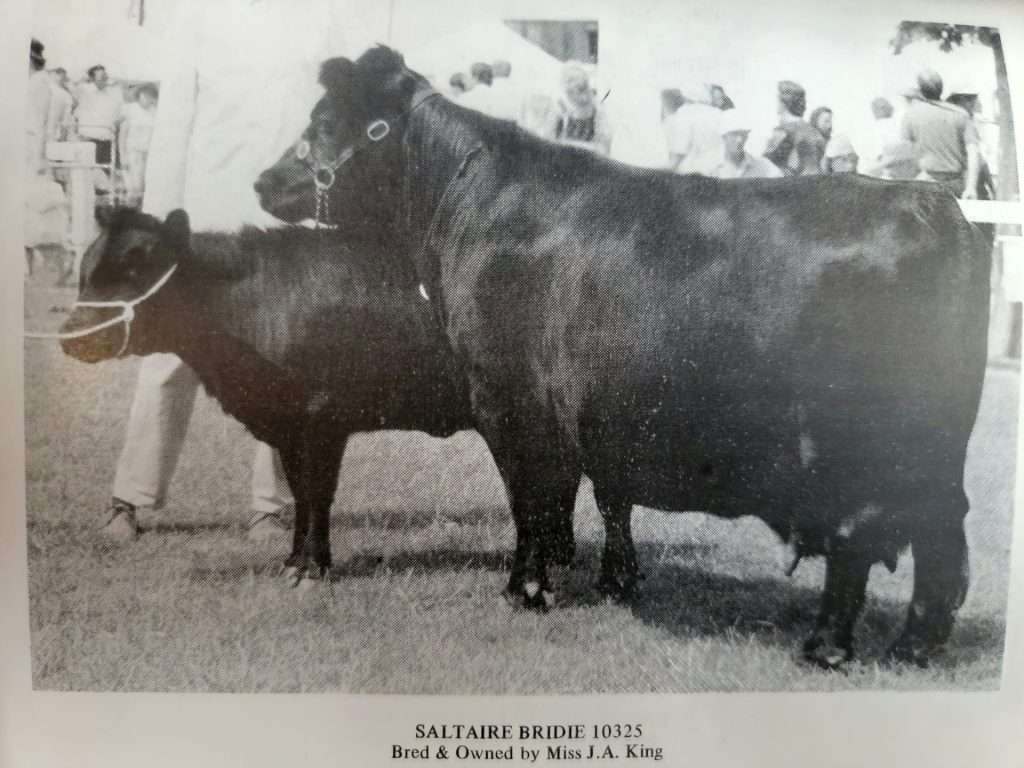
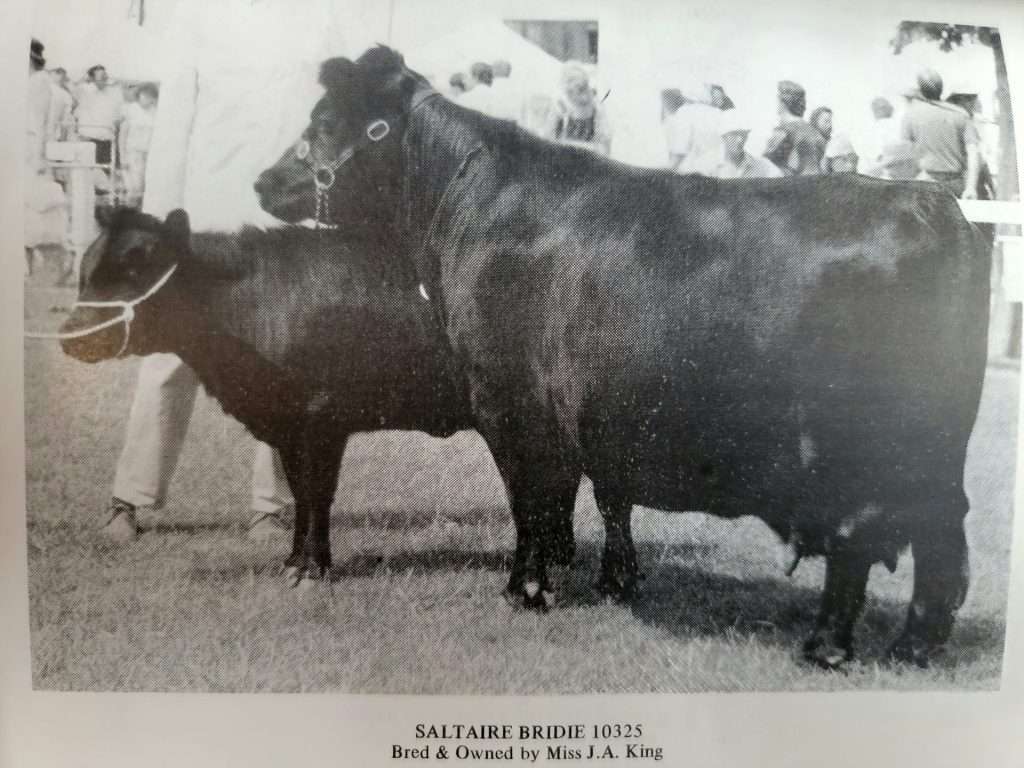
              It is interesting to note that this Jay king would have been the woman who owned the Saltaire herd. The Saltaire herd produced one of the most well-known bulls in all of history due to his major impact on the breed by spreading polled genetics far and wide. He was born about 1 year after this article on Sep 29th 1990. Here is a photo out of the 1989 DexterCattle Society Herd book of a Saltaire Bridie both bred and owned by Jay King.
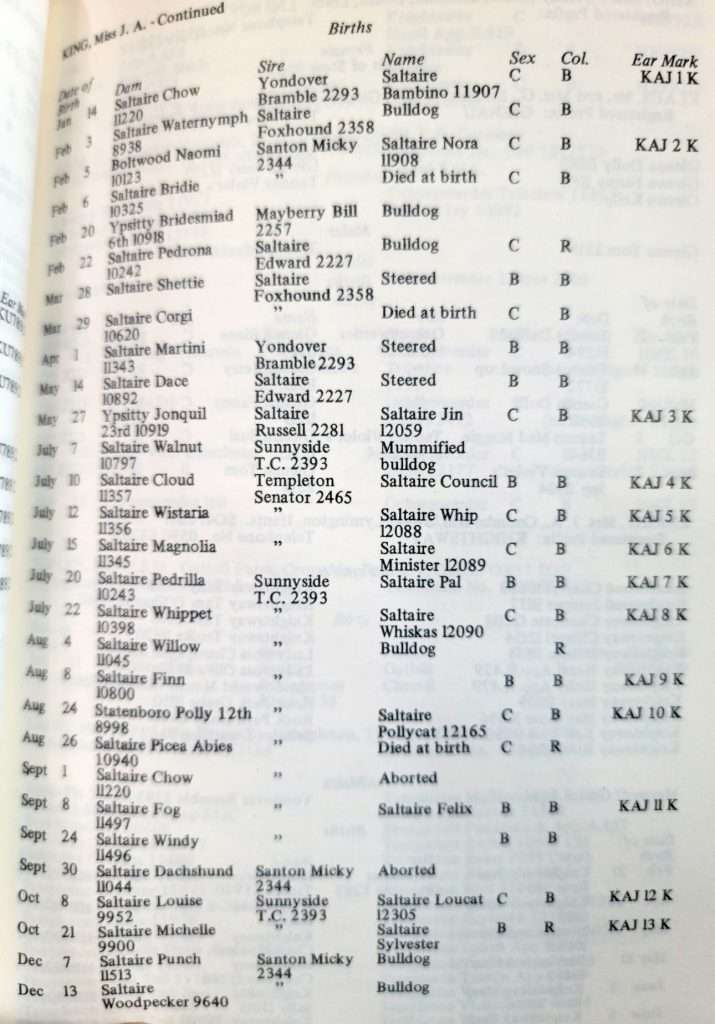
Saltaire Breeding Record for 1989

Here is the breeding record for the Saltaire herd in 1889 from the Dexter Cattle Society Herd Book. It is interesting to note that only 15 out of 27 calves were living calves. People often wonder if Chondro carriers were much more prevalent in days past and the answer is yes, they were. We can not go back and genetically test them to prove their chondro status but the notes of bull dog calves shows that a large majority of Dexters were chondro carriers and the pictures tend demonstrate this by their phenotype often times. Reasons like this is why no one could ever deny that the chondro dwarf Dexter had a major role in the History of Dexter cattle.
This Article was written by Danielle of Bryn Mawr. If you wish to reshare this article, please contact the writer first. This article was written to share facts and let the reader use those facts for their own education.

Dual-Purpose Dexters winning off their own backs Read More »

Historical

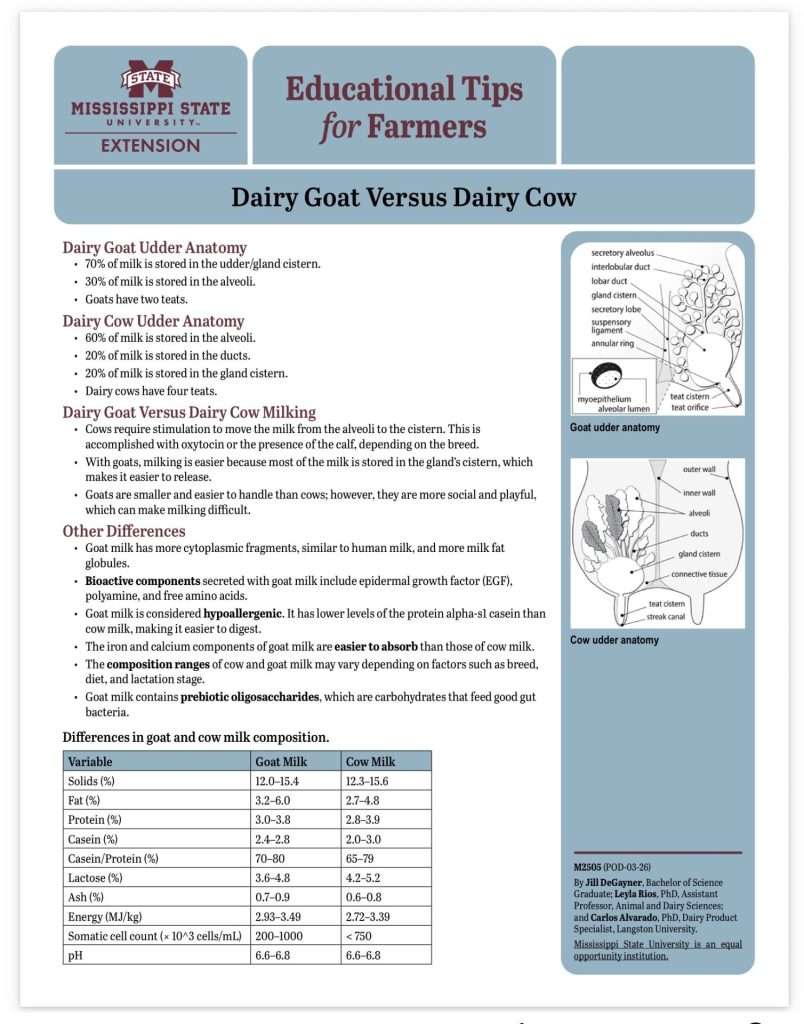
udder differences in goat and cow

Many of us raise more than one species of livestock on our homesteads. There are many benefits to both the pastures and the livestock worm loads with either running them together or rotationally one after the other.
But there are many differences in them including the udder. Here is a article and graphic explaining the differences in the goat and cow.

https://extension.msstate.edu/publications/educational-tips-for-farmers-dairy-goat-versus-dairy-cow

udder differences in goat and cow Read More »

Homesteading
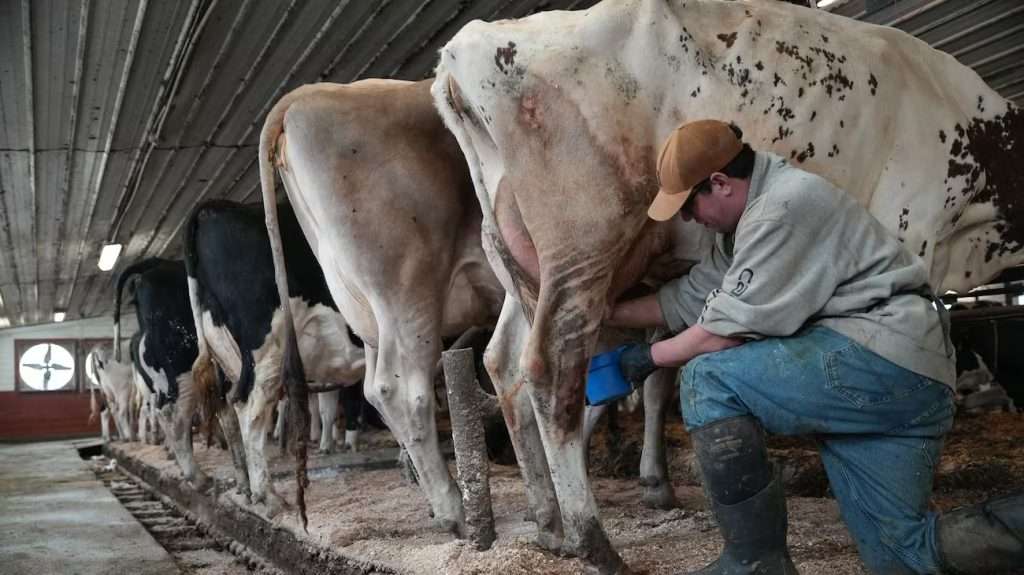
Choosing the right cow for your homestead

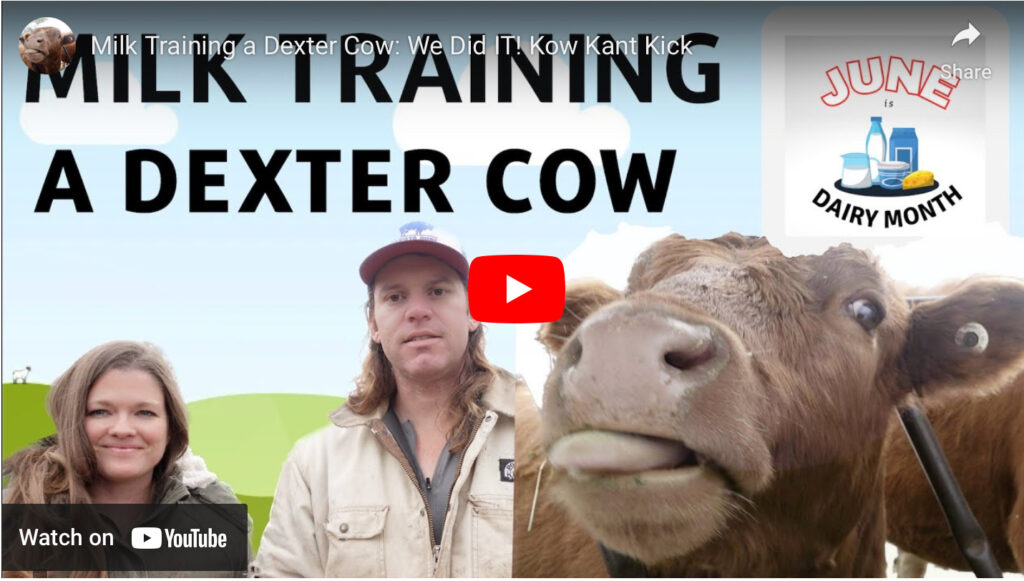
I really enjoyed this podcast about how to choose a milk cow for your homestead. While she is very pro Jersey, they do mention the Dexter and the principles for looking for the right cow for your farm, ranch or homestead are essentially the same.

Interestingly she does recommend the trained cow, she did not take the route, but explains the long game to get there. Which ever route you choose, the Dexter should definitely be considered. Less food, easy keepers, little to no metabolic issues have been my experience.

They talk about Angus Jersey being some of the best beef…someone needs to feed them some Dexter!

Listen up ….remember the Dexter is has been the right choice for many of us….we just need to spread the word!

Homesteading with a milk cow
American FarmSteadHers~ Your Homesteading & Gardening Podcast

Jenny asks the questions as someone interested in a future dairy cow, and Donna answers with her experience. We go over the very basics of looking for and keeping a family dairy cow on the homestead.americanfarmsteadhers.com americanfarmsteadconvention.com

Listen on Apple Podcasts: https://podcasts.apple.com/us/podcast/american-farmsteadhers-your-homesteading-gardening/id1615836366?i=1000596157232

Choosing the right cow for your homestead Read More »

Homesteading
PRICE OF GOLD AND THE PRICE OF CATTLE

Here is a good video that gives you some food for thought. Interesting history on the price relationship. Are we valuing our Dexters herds like history has valued the cattle market?

Another thing to think about is we produce a dual purpose animal. There’s value in both the milk and the meat!! This video is really speaking only to the meet when you add the milk and it’s value you get a whole different perspective.

PRICE OF GOLD AND THE PRICE OF CATTLE Read More »

Selling

UDDER CARE. HOW TO AVOID FROST BITE OR DAMAGE

Spring is right around the corner, but for many you are still dealing with cold and snow. Caring for a dairy cow during the winter can be a challenge, but it doesn’t need to be insurmountable!

Teats chap and freeze when wind-chills are at zero and below. You may choose not to post dip at all, which is fine. You can also use products like Winterset, or Revive (from IBA.)

Treat chapped teats with Udder Balm or similar, and be careful to not over milk your cow.

Providing plenty of hay and water, plus a bedded shelter or tree line for wind protection is all she needs otherwise! She heats up from the inside out, with rumination serving as her furnace. She is very likely much more comfortable than you are in this weather!


Juliette is a monthly contributor to the Irish Dexter Cattlemen Newsletter and the author behind many of the articles on the FB group The Science of Owning. Dairy Cow.

Here is a link to other suggestions for dealing with it.
https://www.agproud.com/articles/19093-tips-for-dealing-with-frostbite-and-other-teat-health-issues

UDDER CARE. HOW TO AVOID FROST BITE OR DAMAGE Read More »

Milking

Sustainability Podcast – The Irish Dexter

Sustainability Podcast - The Irish Dexter History

A Deep Dive Podcast, brought to you by Irish Dexter Cattlemen, on topics of interest to all farmers and ranchers. Subscribe to the free, monthly Irish Dexter Cattlemen Tips & Tricks Guide to get early access.

Brought to You by These Breeders, Affiliates, & Sponsors

Crest Point Farms Online

Since 2024
0 ads

Stay’N Put Farm Online

Since 2024
1 ad

Ashrons Acres

Since 2024
0 ads

Stumpys Acres

Since 2024
1 ad

Maple Creek Dexters

Since 2024
0 ads

Pipe Dreams Farm Butchery

Since 2025
0 ads

Hayburner Acres

Since 2025
2 ads

Grandma's Dexter Farm

Since 2025
2 ads

DeVine Farms

Since 2025
0 ads

Bryn Mawr

Since 2026
0 ads

Sustainability Podcast – The Irish Dexter Read More »

Podcasts

Milk Fever – Prevention and treatment By Juliette Albrecht

Juliette Albrecht is a contributing member of the Irish Dexter Cattlemen, who was born and raised in the dairy industry. She has helped a fellow IDC member save their cow. Look for her articles each month and for past articles in the Gazette.

Juliette also runs two Facebook groups. One is under her name. The other is called The Science of Owning Dairy Cattle.

☆☆ Milk Fever
It scares so many dairy cow owners, and for a rightful reason. However I hope that I can shed some light on it and take away a bit of that fear. Hypocalcemia (milk fever) is brought on by the sudden demand for calcium that comes prior to delivery and directly afterwards. This taps her muscles, which carry that, heavily. In a pre calving scenario it will affect labor, since the cow needs muscles to contract. Often in this case she will need assistance. Characterized by lethargic movement, dull, dark eyes, and drop in body temperature, it can also lead to her going “down.”

●● Prevention

First calf heifers are less prone to this, but it CAN happen in them. Commonly it affects 3rd lactation and beyond. From the time she delivers her calf you are either setting her up for a great following lactation, or one doomed to fail. It all start with NUTRITION. Dairy cattle are beautiful, but oh so delicate. She needs fiber, energy, starch, protein, bypass protein and minerals to simply survive. (Keep an eye out for Mariah Gull and her weekly posts regarding this subject!) When a cow calves in she loses body weight rather rapidly. During this time she “milks off” condition. Peak is considered to be day 30 to 90 in milk. If she is being fed correctly, she will not become too thin. Coupled with a good deworming protocol, she will slowly regain weight. At roughly day 80 she ideally will be bred back, and than her body weight will continue to rise. Grain should rise as she peaks to meet her milk volume, than slowly decrease as it falls. If she goes into late stage lactation either too thin or on the alternate, overweight, she is being setup for metabolic problems. During the dry period I either cut grain off completely (during spring and summer grazing, when forage quality is high) or feed a 2 to 3 lb per head feeding rate during the fall and winter.

Transition refers to the time before estimated due date. This commonly starts at 3 weeks out from calving, and technically extends to 30 days in milk. This is my protocol.

1) stop salt access, as it increases the chance of edema.

2) feed either a high fiber, grassy hay or have her graze similar.

3) feed 3 lbs a day of our parlor grain (18 percent protein)

4) top dress with the negative DCAD Soy Chlor

Five to seven days prior to delivery her appetite will drop. If it is significant I give B Complex.

On this protocol I see very little metabolic problems. However I always give Bovikalc to…

A) an assisted birth

B) twins

C) a cow with a known history for metabolic problems (milk fever, metritis, ketosis)

Should she go down, IV calcium is the only way to get her back up.

A cow that has had milk fever typically never reaches her full potential in milk volume for that lactation.

Milk Fever – Prevention and treatment By Juliette Albrecht Read More »

Milking

“Dairy Breed” Champion Dexter Bull Atlantic Spratt

Atlantic Spratt was Shown with these Dairy/ Dual-purpose Breeds in 1956!

All Breeds entering the show had to have qualified performace records to compete.

Dexter Cattle put a High Emphasis on Dairy Traits

Dexter Cattle put a high emphasis on dairy traits and beef traits equally. Thoughtful breeders were honing these Irish cattle to excel in both capacities. One of the ways they were doing this, was by selecting bulls from dams with known milk records. Pedigree information is interesting to reflect on when you see repeated names in pedigrees and photos to document what genes might have been passed on from their ancestors. Looking at a bull alone will never tell you anything deeper about his genetics, than what you can evaluate with your eye. A nice-looking bull tells you nothing about what type of milk production his dam might of possessed. Thankfully with photos we can look back on bulls like Atlantic Spratt and see that he had a lot to offer besides just good looks. The fact that Spratt was presented at the show tells us that his dam was qualified by performance records, because it was a requirement to enter the show. Though none of the cows are perfect and much improvements can still be had in generations to come, evaluating them and their records goes to show that they were cows that could surely fill the pail.

Grinstead Toby Sire of Atlantic Spratt

From this photo we can see where Atlantic Spratt got some of his good looks from. His sire was Grinstead Toby, a Reserve Champion Dexter, but to dig deeper I will investigate some of the females in Toby’s pedigree.

Grinstead Trixie the 8th From a Long Line of Doccumented Milkers

Grinstead Trixie 8th Queen of the Dairy Show

This is Grinstead Trixie the 8th. Lady Loder the breeder, was known for only selecting sires out of cows with proven milking records. Though this cow may seem like she has less than perfect attachment at 10 years old(the age in photo), she looks to have a good amount of volume. You will see in the article above, Trixie is “Queen of the Dairy Show” in October 1953 (then 13 years old and winning first prize for 3 running years). She was a top Dexter cow out of cows that were milking at 4 and a half gallons of milk a day. Lady Loder was known to cull hard and keep to a high standard. Trixie the 8th could have had improved udder attachment, but she definitely filled her part as a solid milk cow. Now I shall dig a bit further back in history to give the reader a greater understanding. Let us next consider Grinstead Trixie the second and likewise the original Trixie herself.

Grinstead Trixie the 2nd

The Original Trixie of 1904 Foundation to Grinstead Herd

Just to give a very interesting historical compass to the full impact of the Grinstead Trixie line, let us delve deep into history, back to November 1919 when the original Trixie was being written about. The original Trixie was one of an original 12 cows that were obtained by Lady Lodger. Of those original cows she only kept three, Trixie being one of three top cows. Those 3 cows were chosen for their milking powers. Trixie was born in 1904 and was a foundation cow for the Royal Dublin Society. By 1919 she had produced her 14th calf, proving to be productive and already fairly long lived. What an exceptional cow to start your herd from. This cow was the foundation of Lady Loders Grinstead herd and imprinted her name on the herd for generations to come. Lady Loder in other statements had complained about some of the low quality Dexters that were being sold. Lady Loder may not have started with the best stock, but she culled down to just three cows to build her herd from and only used proven bulls that possessed dairy traits worth passing on to their offspring. She had a focused eye that considered the breed standard when evaluating and considering her Dexters by. Her legacy is one worth being remembered and replicated, showing you do not need much to start out with, but rather have a quest for quality and be willing to cull to obtain it.

Murrell Peach Blossom: Another cow in Spratts line

Murrel Peach Blossom who was likewise related to Atlantic Spratt was a challenge cup winner.

Grinstead Hawk 5th: Another cow in Spratts line

Grinstead Hawk obtained a register of merit for milk production in 1940, won 1st in the milking trails and won the reserve Nutt challenge cup and many more competitions. Though her flat feet and titlted teat may jump out as not quite perfect, there is much to be appriciated in a cow with solid milk production.

Peach Blossom of Claragh : A heifer in Spratts Line

Peach Blossom of Claragh won 2nd place for a cow in milk while competing against mature cows.

In conclusion to this article, I will leave you with this cow Grinstead Watercress, bred by Lady Loder though not directedly related to Spratt. This cow is graceful and well balanced a testament to her breeding. Some may say that she is not deep enough, but for a cow that I believe to be non chondro born in 1920 I’d say she is quite beautiful indeed. I hope this article inspires people, no matter the size of your herd or no matter how long you have been breeding that their is always room for improvement, no matter the current genetics in your herd. In order to truely preserve the wonderful Dexter traits of yesterday we must also be willing to impove our cattle of today.

“Dairy Breed” Champion Dexter Bull Atlantic Spratt Read More »

Historical

LET’S TALK CREAM AND DEXTERS

Here is an interesting article from a fellow Dexter milker, Michele Parsley. Real facts about how it varies and why. Don’t forget, some of our cream stays behind and never completely separates, making two incredible products, cream and still some pretty creamy milk for drinking or making something else. Celebrate your Dexter milk and cream!

https://www.mountainheritagefarm.com/blog/cream-variation

LET’S TALK CREAM AND DEXTERS Read More »

Milking

DEXTER CATTLE – JOY, LAUGHTER, AND HEARTBREAK PART II

COVID.  It sucked.  No matter what aisle of the plane that you sit in, even if  you just want to stand in the middle, it sucked.  There was tragedy, heart ache and despair.  Some are still recovering.  Some never will.  All that said, it was eye opening for me.  An introvert by nature (though very few of those that meet me will agree with that description), COVID was somewhat of a respite.  It forced, for better or worse, solitude.  For me, it brought peace.  It got me thinking about our world and my place in it.  It was time to start questioning old habits and accepting the norm.  It was time to start doing.  

Where do I start?  As my late Dad would say, at the beginning.  I started to look for property in a rural area.  That was my first mistake.  I didn’t have a solid foundation as to what I wanted to do.  I looked at field, woods, and pastures.  Some had homes, and others did not.  About all of the properties were a good distance from where I lived and some were located in other States.  After becoming exhausted and frustrated, I realized that my search was futile. I needed to establish what I wanted to do and with what animals.  

My initial thought was horses.  My thought is I could breed horses, and/or run a boarding business.  It was my wife, ever the cynic, who asked the first pointed question. “Do you know how to ride a horse?”  

Contrary to popular opinion in my household, I was a seasoned equestrian and rodeo champion.  At least in my mind I dreamed I could be.  That said, I scheduled horse back riding lessons.  While I enjoyed the lessons, and riding, I started to think it was going to take a lot of time and experience to take other people’s horses in and provide appropriate care.  But alas, fate had other plans.  My wife quit asking about trivial things such as my ability to take care of horses and we sold our home and bought a home with horse stables and acreage.  For me, it was heaven.  

Then reality set in.  I remembered what the goal was.  The goal was to raise our own food.  Horses would be welcome, but horse meat will never be in our diet.  

The internet, love it or lump it, is a source of a great deal of information.  I play the game.  In that, I mean, I disregard all the “great” comments, and all the “terrible” comments and seek the middle,  I tried to not seek articles that I favored but cast a wide net looking for neutrality.  Just the facts, ma’am.  What I found intrigued me.  Dexter cattle.  Ideal for beef, milk, and smaller areas of land.  Hearty animals and docile in nature.  Not miniature, but smaller in stature.  Less intimidating for the new and not an animal that has to be considered a pet.  

I compared to different breeds.  I was intrigued by grass fed and milk that many argue is better suited to sensitive stomachs.  Not only for feeding my family, but the potential of feeding others.  I was not looking for marketing gimmicks but trying to fit a niche.  My niche.  I was told finding the acreage was the hardest part of raising cattle.  I can say with 100% certainty, that is a lie.  But I am having so much fun living my dreams with our Dexter cattle.

A little bit about the author for those who have read this article or maybe even the first article and scrolled to the bottom of this article just to see if someone had the guts to admit writing this.  I own and operate a small farm called “Our Yellowstone LLC” in Illinois.  I couldn’t do it alone, but will keep my wife’s name out of it to protect her innocence.  

DEXTER CATTLE – JOY, LAUGHTER, AND HEARTBREAK PART II Read More »

Selling

No Udder, No Cow!

Atlantic Alison Showing off an Exceptional Udder

The old saying “No feet, no cow” is a phrase that denotes the importance of a cow’s ability to walk. Without good feet there can be no cow to stand on them, thus causing peril to the health of the cow. No Udder, no cow could be a similar maximum, denoting the importance of the cow’s udder. Without a good functioning udder, a cow cannot fulfill her role to nourish a calf or humans thus degrading her value as a cow. Not every Dexter needs an udder like Atlantic Alison, but the quality of a Dexter cow is tied up in the function and quality of her udder.

Scale of Points taken from the 1900 English Standard

This scale of points as seen above, is the first scale of points written for Dexter cattle and the most authoritative in breed history. It makes it clear what values can be attributed to a Dexter cow. As you can see udder traits are very important to the Dexter breed. There is no room in the Dexter breed for cows with truly bad udders, as it’s not agreeable to the standard scale of points. So, you see, 40% of a Dexter cows value of points is wrapped up in the quality of her udder, where only 25% goes for her body. That 25% is not just shortness or depth alone but “body, top line, under line, ribs, setting of tail, shortness of leg &c.” The point is cows with good udders are very important to the breed. A cow that lacks valuable udder points would scale very low as a Dexter in general. A cow that is not perfectly short could still score quite high as a Dexter if all other traits were ideal. A short Dexter with a bad udder would easily be beat by a taller Dexter with good conformation and an excellent udder.

No Udder, No Cow! Read More »

Historical
Enable Notifications OK No thanks