Dexter Milk Yields Recorded
 Milk Yield Record taken from a Dexter Cattle Society Booklet
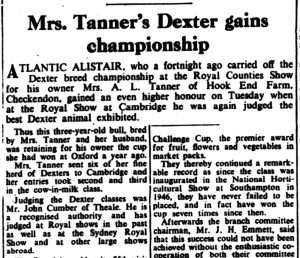
No date was given in this pamphlet but if we consider the Dexters that are pictured we can get a close idea of the date. The top Dexter is Atlantic Alision, she was born Jun 12, 1956. A very beautiful Dexter, but her milk yield was not recorded in the data. The second Dexter looks to be either Atlantic Sprat or his son Atlantic Alistair, I lean towards the latter due to the angle of the legs. You can see some pedigree information on Atlantic Alistair here Legacy | World Dexter Information and it will show you a picture that looks very similar. He was born Jun 9, 1957. So this pamphlet was sometime after 1956-57. The Atlantic Herd was owned by Mrs. W. R. N. Tanner of Hock End Checkendon. Spratt was first in his class and went on to win the Silver Challenge Sheild. Atlantic Alision likewise was a prize winner. Mrs. Tanner had many prize winning Dexters and had a memorable herd of Dexter cattle.
It is interesting to note that many of these cows had higher butterfat contents. Much higher than a Holstien and some producing as much as some Jersey cattle. The Dexter milk separates cream out slower than a Jersey and some of the butterfat seems to cling in the milk retaining richness to the milk even after skimming the thick cream off the top. These records are a testament to those high butterfat amounts. In order to have a proper milk test all cows should stay in milk for the same duration of time and ideally be fed a very similar diet. It is very rare today that people will keep their cows in milk for ten months. I however can attest to doing just this and can say that Dexters can hold the lactation for that time with no problem.
The final conmsideration I must only discuss for those who may be new to Dexters so this article does not confuse someone into thinking that Dexters must have a genetic problem that causes them to loose offspring. Some Dexter cattle carry a genetic trait that when two carriers are bred together can be lethal. At one time it was common to breed twords what was considered a Dwarf type. Dwarf being exactly as it sounds, having short and broad features. This trait was widely favored by Dexter breeders and at one time selected for even eliminating Dexters that were not of the Dwarf type (C