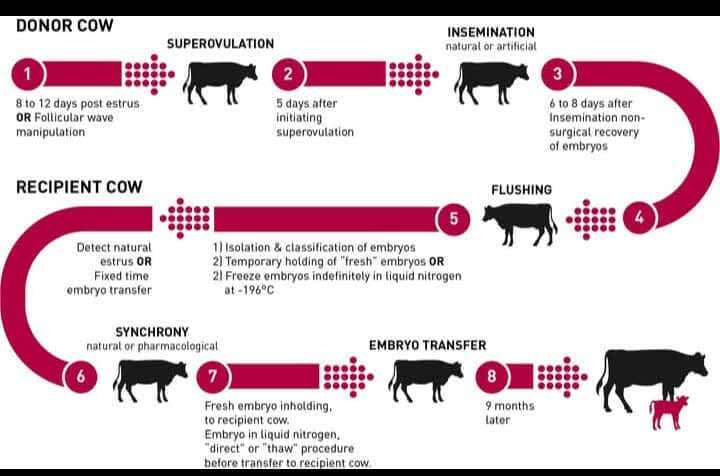
The basics of Embryo Transfer
The “donor dam” is usually a high quality, registered animal.
It begins with FSH (Follitropin) injections, to “super ovulate,” ending in Lutalyse, Estrumate or Estridiol to bring her into heat, followed by insemination and flushing.
Recipients in my world tend to be virgin heifers, but I’ve had older cows successfully carry ETs also. They are synchronized to have the embryos implanted at precisely the right time.
Flushing takes place using a catheter (similar to an AI pipette but longer.) The embryos are then sorted under a microscope, with the ET vet or tech categorizing them 1 (excellent) through 4 (not fertilized.) Grade 1s can be frozen. Grade 2s have a chance but have to be put in immediately.
Success rates vary from 40 to 65 percent. Fresh embryos typically have a higher conception rate then frozen versions.
On a random sidenote it is pretty cool to see a recipient give birth to an ET of a different breed. I’ve had numerous Holsteins carry Swiss calves, and it is an almost surreal experience at the time of delivery.
Embryos offer some the chance to purchase a high type calf with less expense, albeit a bit more risk. They can be a way to get some great genetics into your herd.