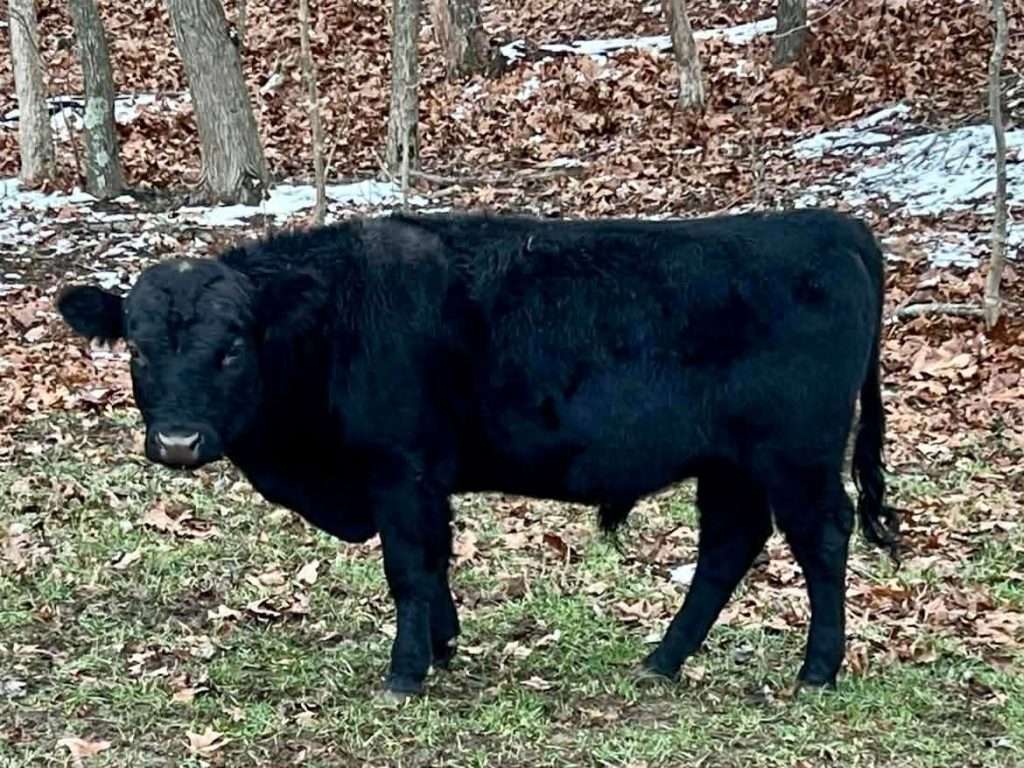
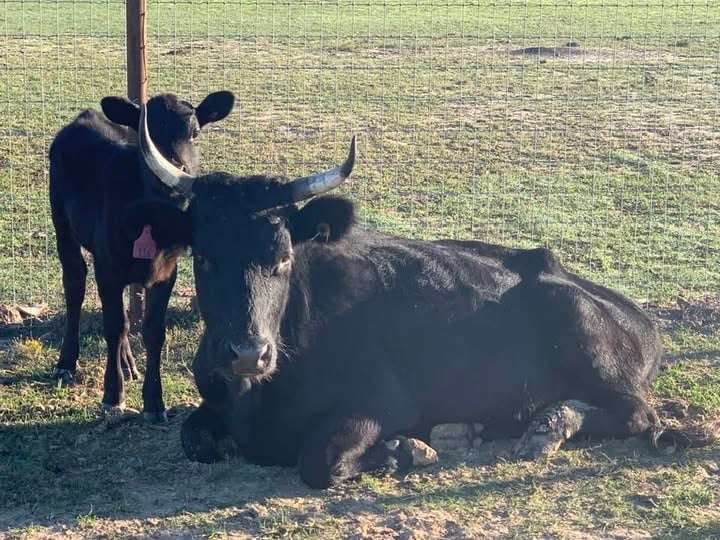
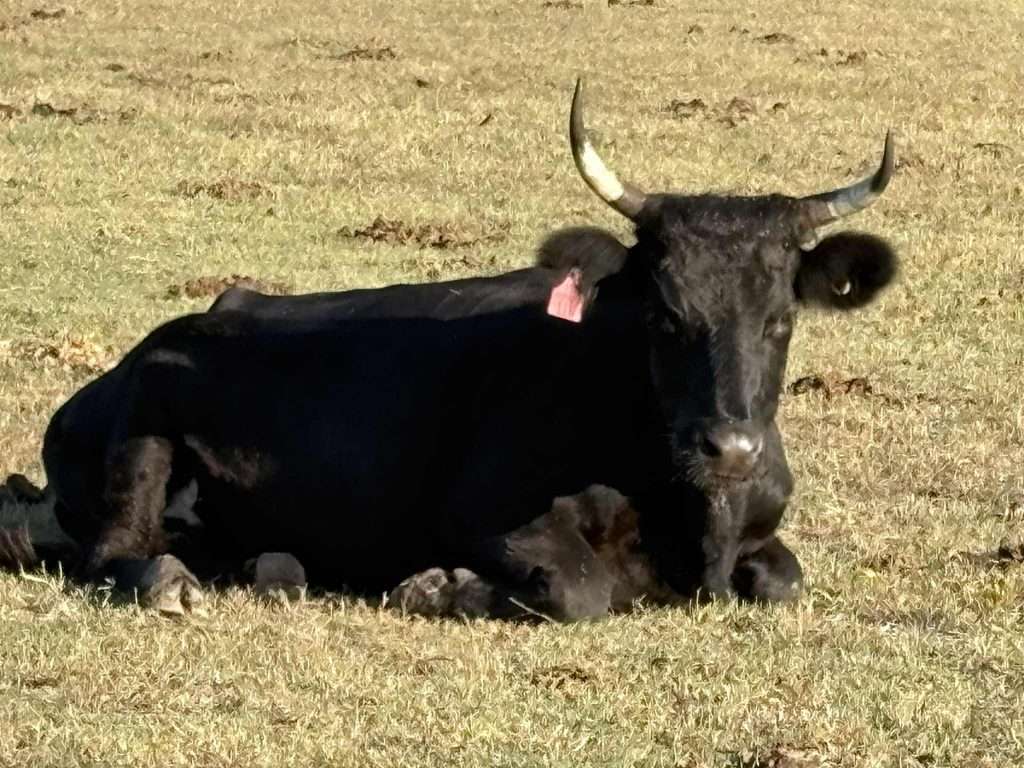
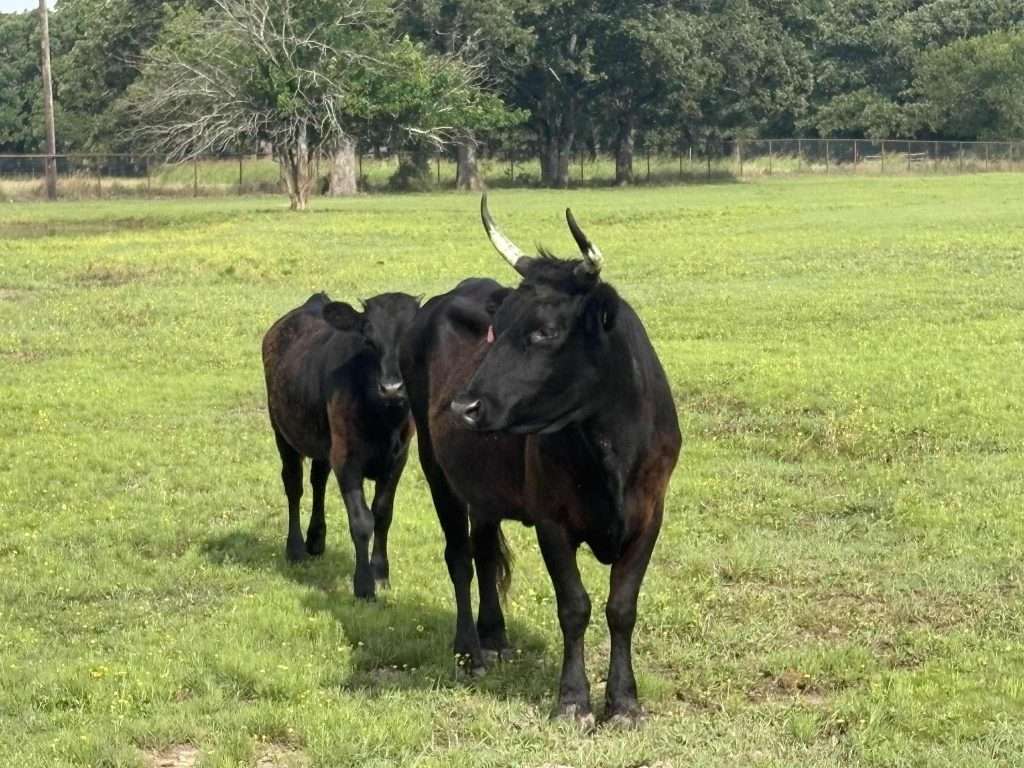
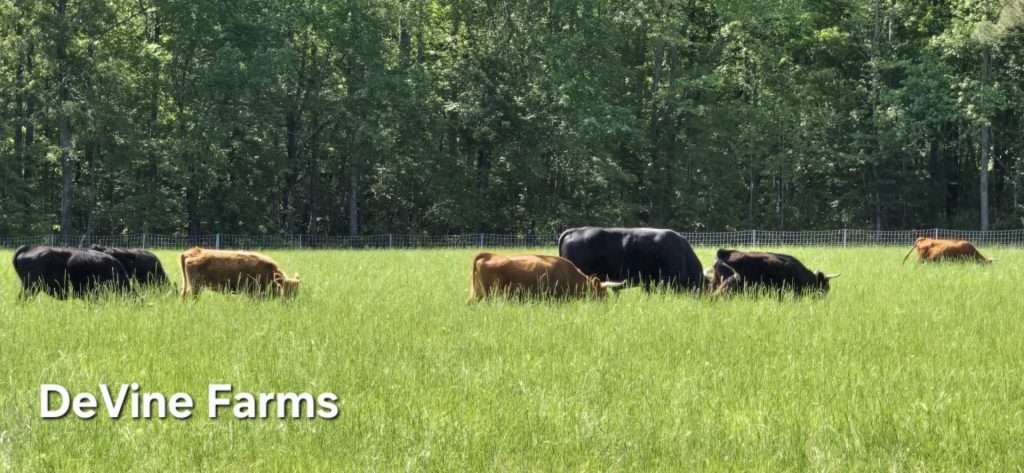
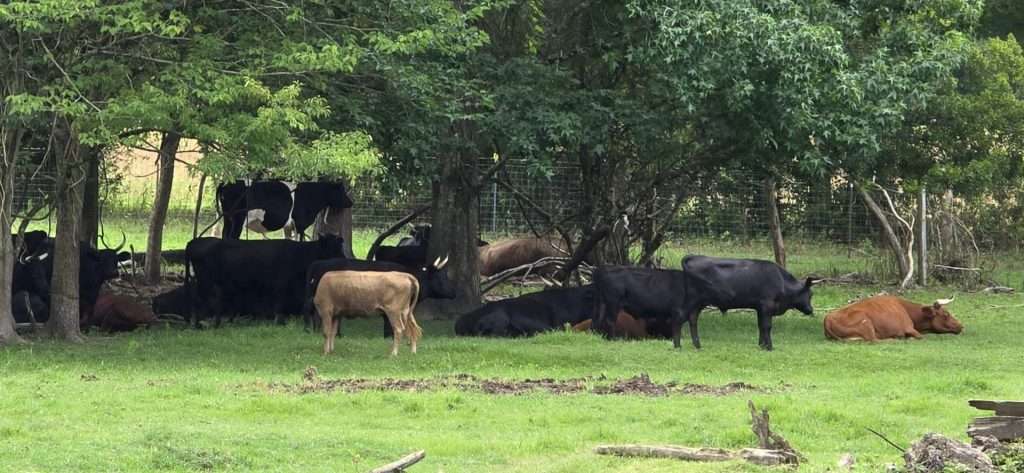
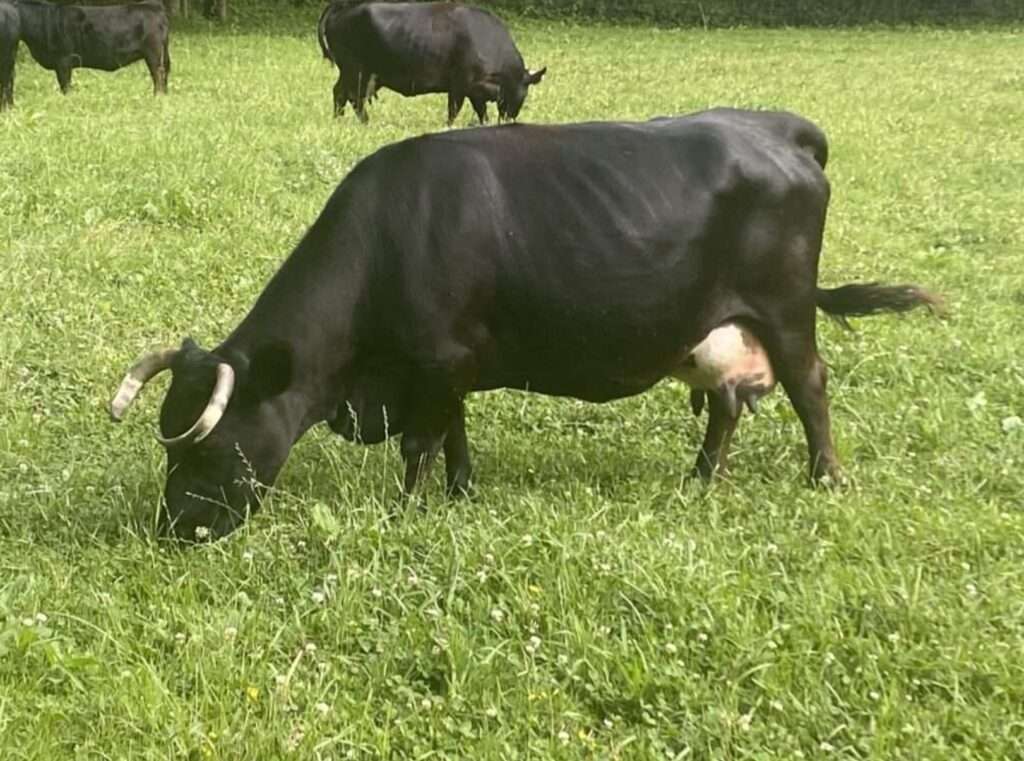
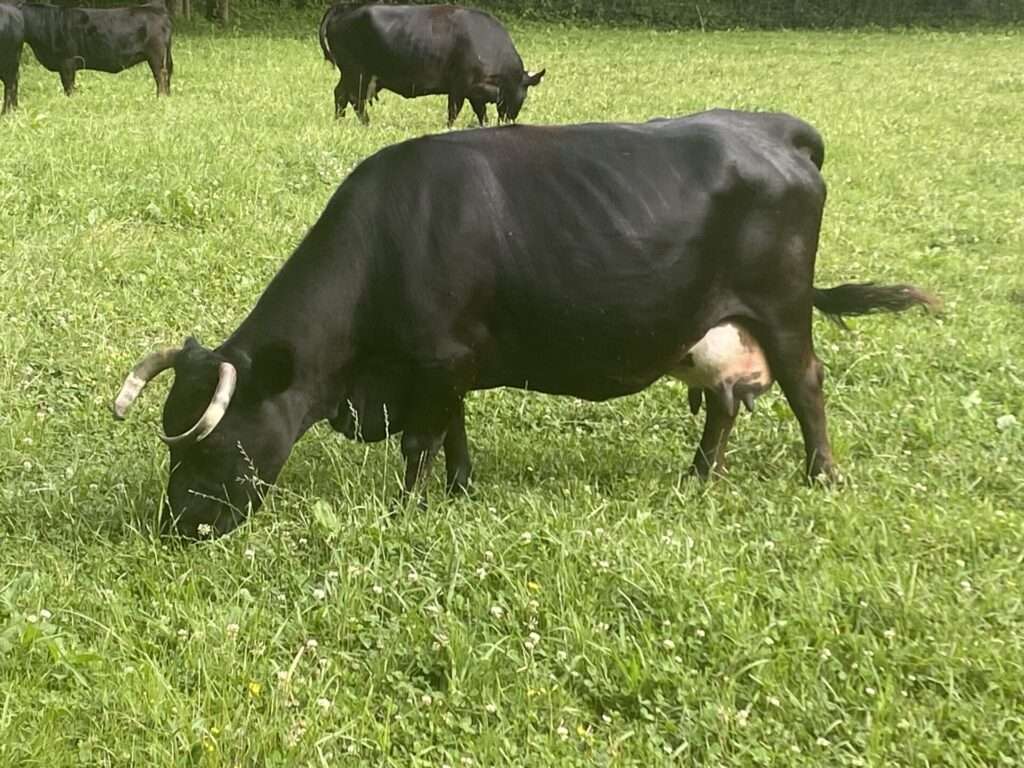
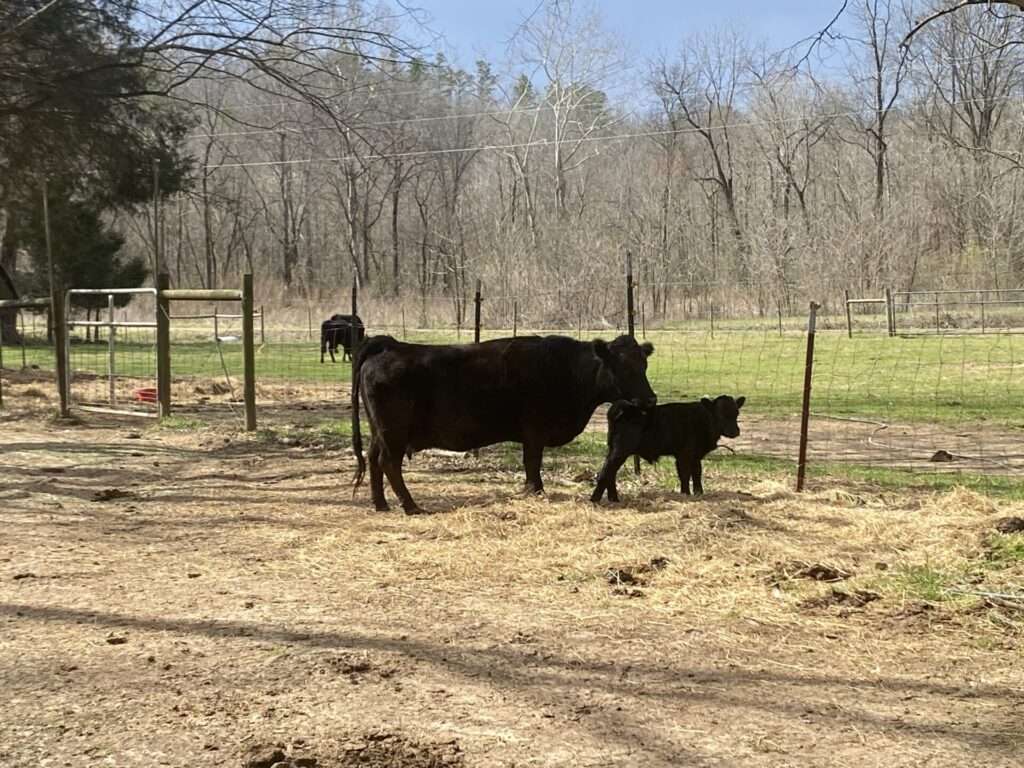
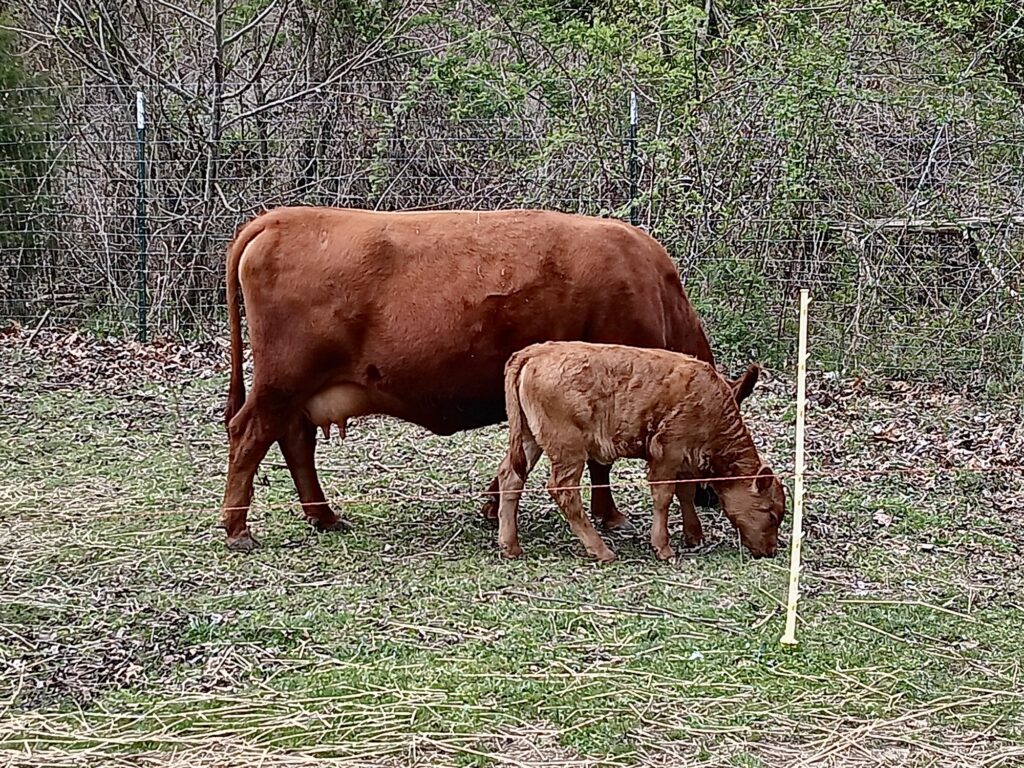
They are here! My wife and I watched the cattle huddle around the hay bale located in the horse turnout next to our stables. The cattle didn’t take long after delivery to settle themselves. I had let the grass in the turnout grow out and with the red and black of the cattle settled against the green grass the scene was picturesque.
Months before, while at the vet for my dog, Bear, I once mentioned that we were considering getting a horse. Our vet said, “get cattle, they are easy.” Could it be that easy? Now what do I do. They pretty much take care of themselves, don’t they?
Yes and no. Mostly no. Grass fed? It was November and hay was needed. Grain fed? I wanted to feed a little grain as a training tool and to get them to follow me.
I had purchased the following equipment and supplies:
Tractor. Don’t need too big, but didn’t want too small. I elected to buy new and take advantage of zero interest. Bucket. Bale fork. Mower. Expensive. But I was in this for long haul. What the heck? You only live once.
Hay. I have come to learn that this is one of the biggest expenses. I contracted with a local farmer to cut the hay on our pasture. He took 2/3rds and I got a 1/3. At the time, I didn’t have any other options. With 4 head of cattle, and no equipment, the arrangement would iwork, but not for long. I learned that quickly. I also started questioning whether or not some folks were looking out for my best interests. Sneak peak. They were not.
100 gallon steel water tank. I bought one and then quickly learned I was going to need more,. When the cattle move, the tank does too.
Hay bale ring. The idea was to minimize hay waste. See water tank. I quickly learned I would need more.
Grain. I started with an all natural variety from a local farm store. Apparently all natural is a heck of a lot more expensive to produce as it was more than 3 times the price more than a product that is not natural per bag, It adds up. So does the weight. 50 pound bags. One bag at the time. Is it worth? It might be for you or your customers.
Fencing. The cattle were fine for the winter. In fact, they were spoiled. Complete access to our stables to come in and out as they please. I heard Jubilee whisper to Liberty, “don’t tell him, but I could get used to this.” Given it was said in a series of moos, that conversation is subject to interpretation. I got my first quote on the high tensile fencing. Prepare yourself for sticker shock. That said, one of the best things that I did. My advice, don’t go cheap. Got on the list. The installer would be here sometime this fall. That didn’t work out.
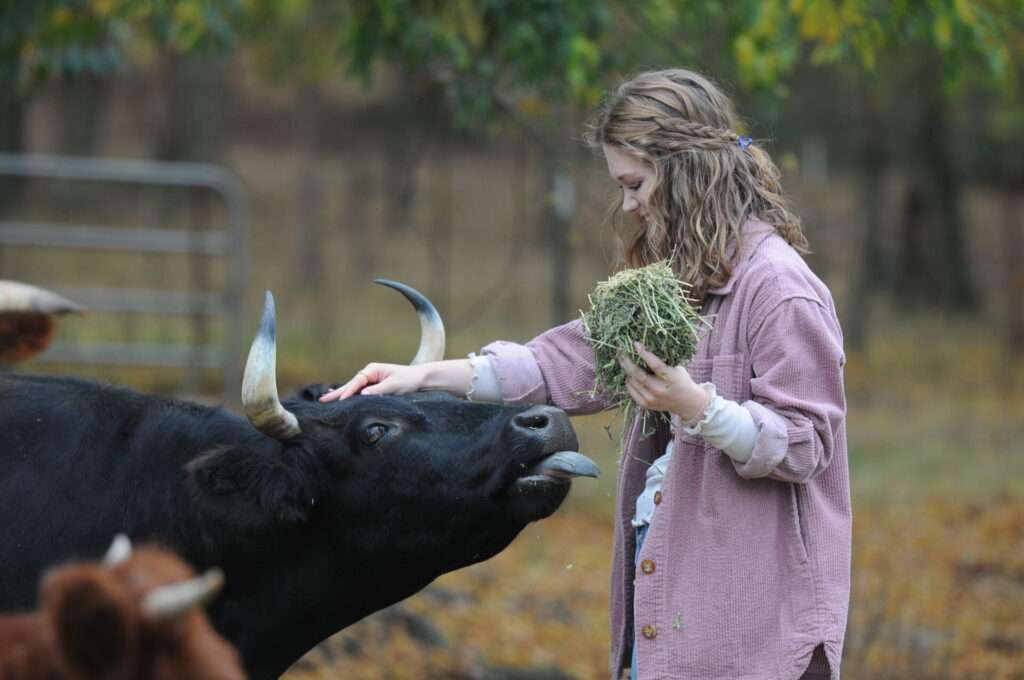
Every day I would walk out with the cattle. I didn’t force myself on them in the beginning and let them come to me. It didn’t take long at all for Bitsie to come up to me and gently nudge me looking for a scratch. Jubilee and Liberty gradually came. All wanting attention. Willow, the heifer, was a little slower in her approach. Younger and more cautious. Sometimes it works that way. But once she got used to me, and I got used to her, she never fails, to this day, to give me hugs.
Everything was great. The vet was right. This wasn’t that hard.
Oh crap. I say that literally and figuratively. There was a lot of it. Cattle loved the stable but they didn’t respect the sanctity of the stable bed. What am I going to do with all of that manure? I have a plan.
A little bit about the author. I own and operate a small farm called “Our Yellowstone LLC” in Illinois. I couldn’t do it alone, but will keep my wife’s name out of it to protect her innocence.
Check us out! Click on the button at the bottom. Feel free to submit some of your videos to wrangler@irishdextercattlem. We are looking for contributors!
Hello to all our IDC Newsletter subscribers and members. With the February Newsletter release coming up this weekend, we mark two years of providing informative & educational information to our followers. What started with a genuine love for the breed, a desire to help others & their Dexters, plus a goal to bring more breeders together and promote the breed, IDC has grown beyond our expectations. Our small team of Eliena Bodtke, Janelle Soja and myself, along with our website & Newsletter producer Bob Curlee have made it our mission. Not to mention our many contributors who have all committed countless hours to researching, writing and providing valuable information for you. All the while building the Gazette, our huge library that stores all of our past Newsletters. These Newsletters can be accessed & searched at any time by our members.
We often mentor and help others with ideas, advice etc. when contacted. If we hear of a concerning topic or a seasonal issue, we try and address those in the Newsletters. We are grateful that many knowledgeable contributors have chosen to come alongside us in providing valuable informational articles in the Newsletter. Many are Dexter owners from different parts of the Country, with different viewpoints, from different associations, but all coming together for the good of the breed we all love. We cover countless topics like history, health, dairy, beef, farm management, homesteading and more. We often share cheese, soap making or bread making in our homestead section, as well as stories written by new owners. We also have contributors who are not Dexter owners, but they have experience with diary, beef or homesteading. Our team feels that if we can encourage and support new breeders, they stay longer and succeed in the Dexter breed. This not only helps them, it helps the breed. We hope you will join us as a member of the IDC soon. Members get more perks than just the Newsletter. If you belong to one of the associations or an affiliate then you will receive a discount on your membership with IDC. Please contact the affiliates for your discount membership code or reach out to one of us. We can even help you set up your own storefront for whatever you may have to sell from the farm. You are not limited to just Dexters. Thank you for being part of the Irish Dexter Cattlemen community…where we are helping Farmers & Ranchers grow, innovate, build, manage, regenerate, produce and above all promote, market and sell your Dexters.
Come check out our growing TikTok account and join the fun! Our content is a great mix of cute, fun, informative, and everything in between—there’s something for everyone. Be sure to follow us so you don’t miss out.
Want to see your Dexters or your farm featured? We’d love that! Feel free to send photos and/or videos to 📧 tiktok@irishdextercattlemen.com
We’ll also be posting new ads on TikTok. I’m currently catching up on existing ads, and once we’re up to date, your ad will be posted as soon as it goes live on the website.
Have content ideas or interesting Dexter facts to share? Photos, videos, and suggestions are always welcome, just send them to the email above.
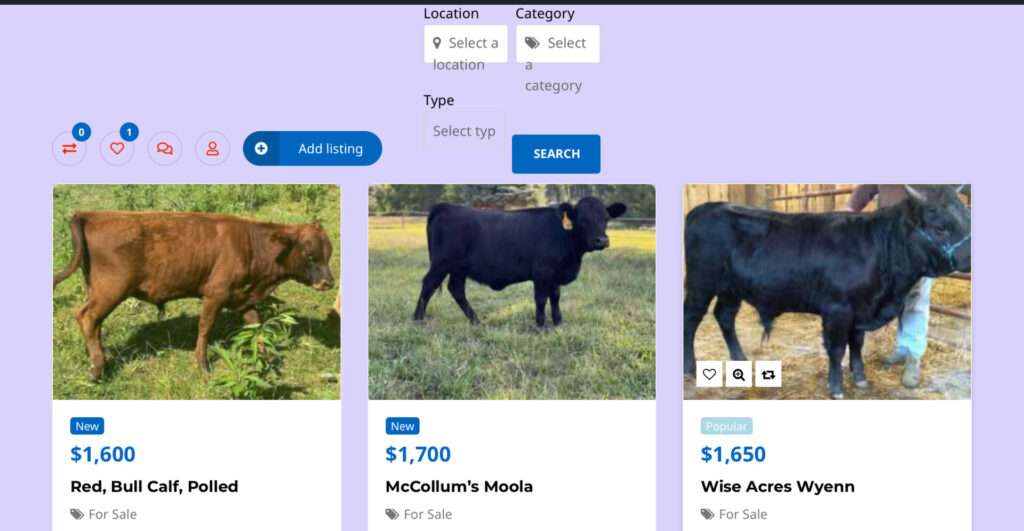
Did you know that we have given everyone a free ad to try out the Irish Dexter Cattlemen Marketplace? That’s right! Give it a try!
I have found it a great place to produce a professional looking ad that can be shared anywhere.
Recently, we have tweaked some of the features to make it easier to use. The pictures are automatically resized to work with the system. No pre approval process. We can tweak it later if we need to. And also a team behind you that can help you make it what you want it to be.
Here are some recently posted ads. Check them out!
Irish Dexter Cattlemen is about farmers & Ranchers. A critical design feature of the website was to connect farmers & ranchers with each other using the latest technology. For example, whenever you list an item for sale in the MarketPlace, you instantly become connected to the buyers interested in your item. Buyers can directly message you and ask questions about the cow you have just listed. As the seller, you begin to collect the names and email addresses of all your potential buyers. This is one way farmers & ranchers become connected to each other..
Announcing the Documents Vault, a new way farmers & ranchers can share information with other farmers & ranchers, plus a unique way to dramatically simplify the sale and transfer of your Irish Dexter. In fact, you can use the Documents Vault to sell and transfer any item you have on the farm. The key feature is how it can share.
How Do I Access It?
Casual users browsing the Irish Dexter Cattlemen website, users who have registered for free on the website, and members who have registered and then have become members, all have access to the Documents Vault in increasingly feature rich ways depending on their chosen level.
To access the Documents Vault, mouse over Dashboards on the main menubar, then select My Documents Vault. If you are a casual user, this will open the Public Documents Vault containing folders and documents relevant for public viewing. If you are a registered user, this will open your Private Documents Vault where you can create you own personal folders where you can upload files and documents plus you will have acess to folders and files shared with you by other farmers & ranchers. If you are a member, you will have access to the same files and folders as do registered users plus you gain access to significantly more valuable documents that enhance your farming operation.
What is it? How can I use it?
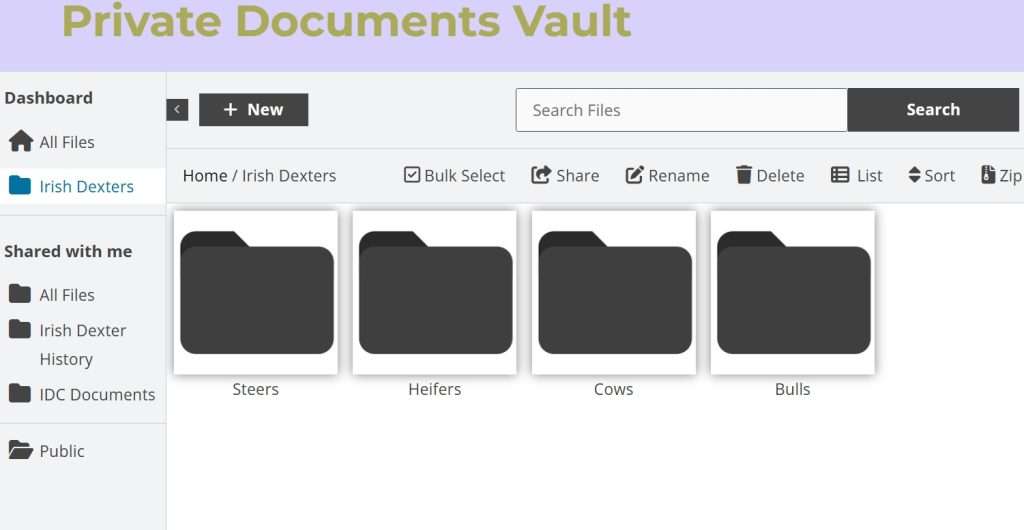
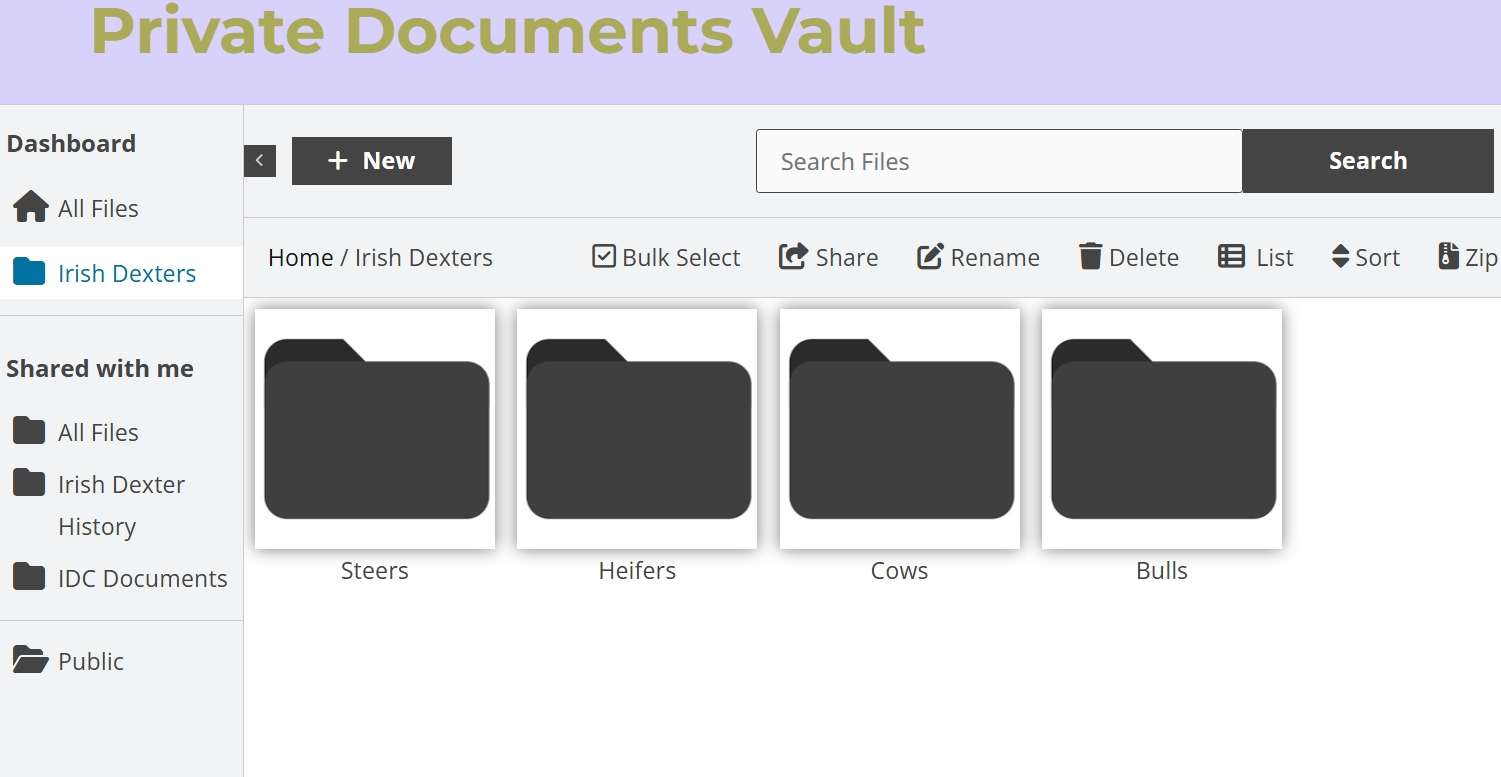
The Documents Vault is no different than an ordinary file system except in one important way. It provides you with file and documents sharing. To begin, use the New button to create folders or upload files. In this example, a new folder was created and labeled Irish Dexters which you can see on the left under Dashboard. Clicking on this folder allowed for it to be opened and four more folders were created as you see above. Click on the Cows folder and here you can create a separate folder for each of your cows. Click on a specific cow’s folder and you can begin uploading the documents for that cow. What kind of documents? The system accepts Word documents Excel spreadsheets, PowerPoint presentations, text files, pdf documents, images, and photos. This means you can upload a photo of your brucellosis certificate provided to you by your vet. Upload your cow’s registration certificate provided to you by your registrar. Upload the genetic tests provided by your genetics testing lab. Upload your cow’s photos. Collect all the documents as they occur. Use your smartphone to capture your documents. What’s the benefit? When time comes to sell your cow, or heifer, or bull, one simple click of the Share button transfers all your cow’s information to your new buyer. This is how you build value for your farm and your buyer will instantly see that your farm is where they want to buy more cows.
How do I share?
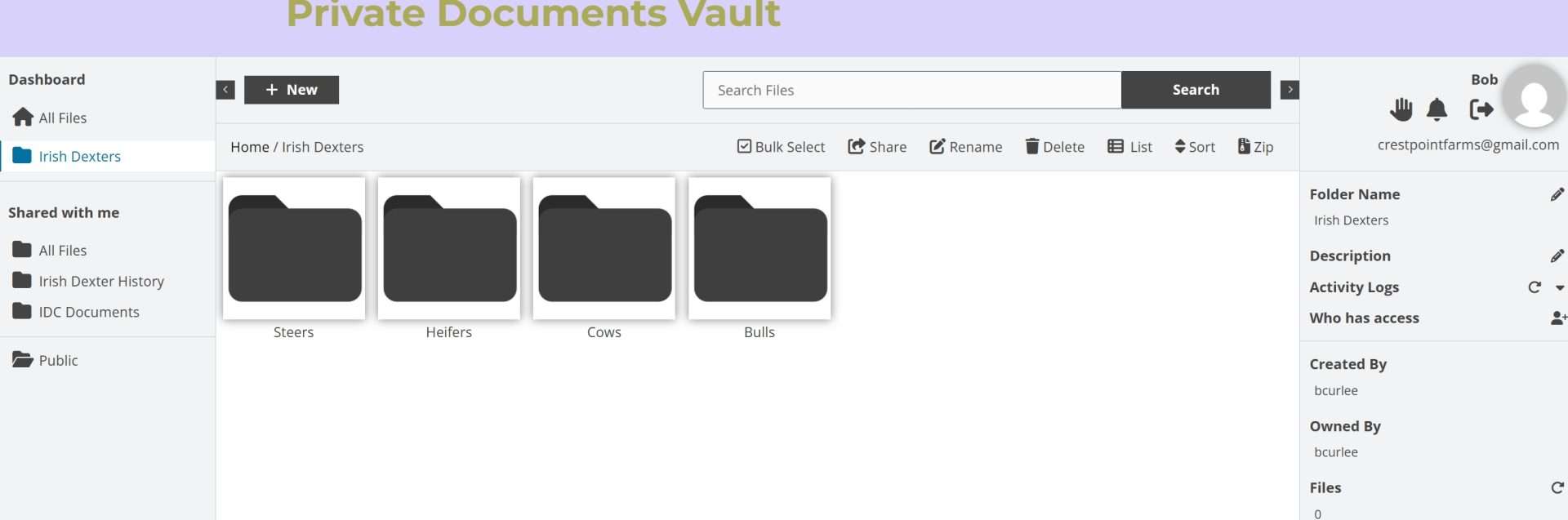
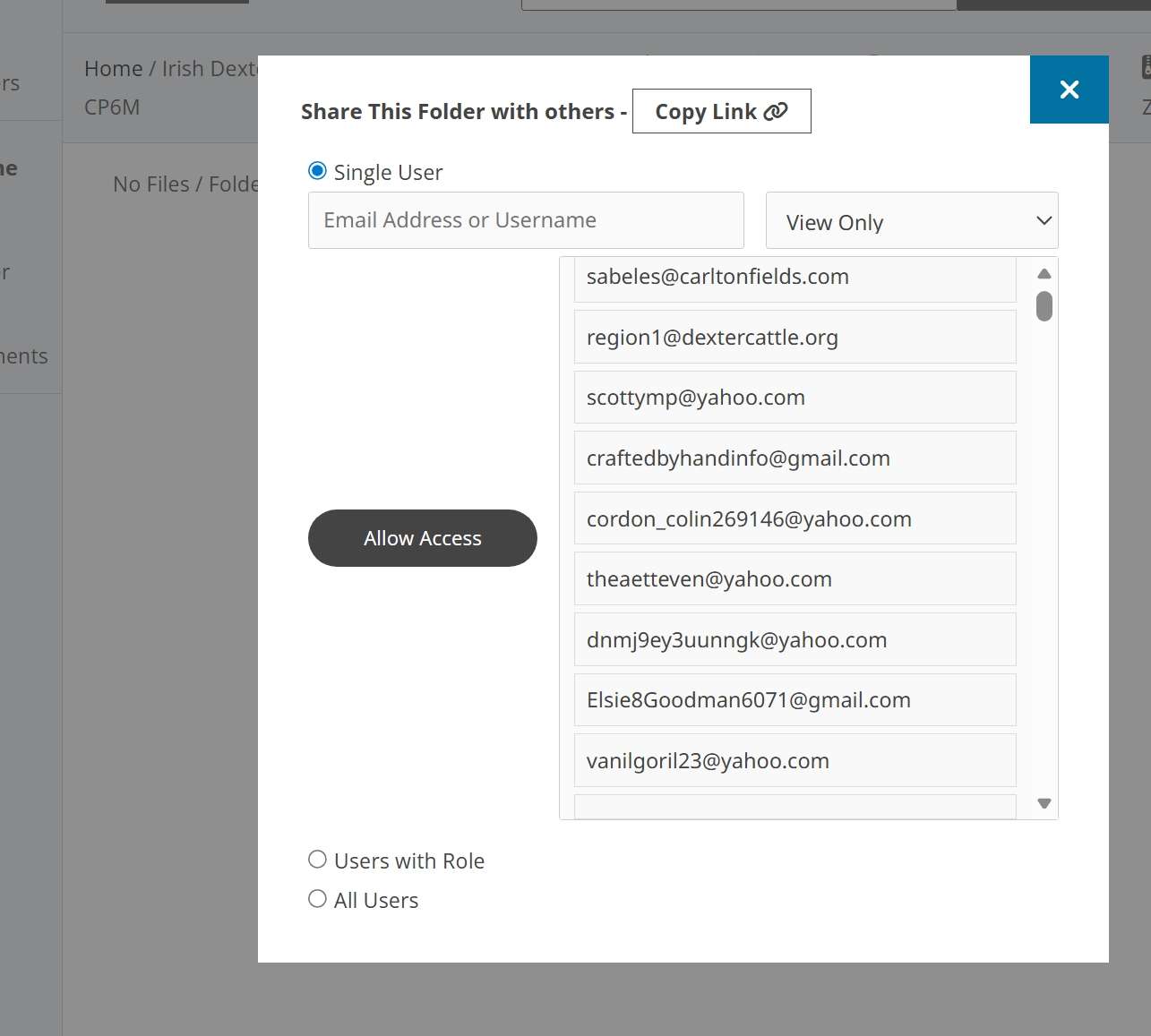
Click on the folder then click on the Share button. It’s as easy as that. In the Share window (shown above) you can enter the buyer’s email address (they must complete a free registration on the website first) and then choose how you want to share your folder. Your choices are View Only, View and Upload, or Full Access. Any folder or for that matter, any single document can be shared. Sharing does not remove the folder or document. You continue to have full access to it, just as before. This new tools makes it even easier to sell and transfer your Irish Dexters and you have a direct record of who bought your cow. They buyer has a direct record of where they bought each animal. They are sure to buy more from you again.
Summary
Your fundamental, underlying goal in the operation of your farm is to build value. The Documents Vault does just that. It keeps you organized and it demonstrates to your buyers a significantly higher degree of trust. They are assured that they get everything they bought. This means that your buyers will be contacting you first for all their future purchases. The example here was for your Irish Dexters, but anything on your farm can be documented and shared in the same way. Also, you can add new information on how you farm and capture information you think is valuable and easily share it with everyone at Irish Dexter Cattlemen by selecting All Users in the Share window. The Documents Vault is how Irish Dexter Cattlemen connects farmers & ranchers.
If you are an Association with geographically disbursed members. If you are a farm or ranch retail business looking to expand your business. If you are a service catering to farmers and ranchers. If you are a registry searching for ways to promote your breed. Or perhaps you are a large breeder thinking about gaining broader attention. Then an Irish Dexter Cattlemen Affiliate Program is exactly what you need. First, take a look at our current Breeders, Affiliates, & Sponsors. You can click on any one of them and look at their Online Branding Store. Then, further below, you will find more details on the Affiliate Program.
What geographic areas are covered by Irish Dexter Cattlemen?
Irish Dexter Cattlemen has members and subscribers predominantly all over the United States, Canada, and Mexico, We also cover the United Kingdom (England and Scotland), Ireland, South Africa, Brazile, Argentina, Australia, and New Zealand.
What is the focus of Irish Dexter Cattlemen?
Irish Dexter Cattlemen focuses on farmers and ranchers to guide them in ways to be sustainable, productive, and profitable. This can include grazing, fencing, water resources, dairy production, milking, regenerative agriculture, organic practices, animal selection, equipment choices, increasing the value of your operation, the history of Dexter cattle, farm management, your herd health, branding & selling your farm products, implementing technologies to assist you with your operation, and much more.
Why should I become an Affiliate?
Associations, registries, retailers, and services can add significant value to our farmers and ranchers. That is exactly Irish Dexter Cattlemen's mission. The more we help you, the more we help our farmers & ranchers, many of whom buy, sell, raise, show, and promote Irish Dexter cattle.
How Does Irish Dexter Cattlemen Help You?
When you become an Irish Dexter Cattlemen Affiliate, you get:
An Online Branding Store
Instant Branding recognition
200 Ads for one year
Sponsorship of every Tips & Trick Guide
Sponsorship of every current & past Deep Dive Podcast
A Private Newsletter for your group
Author permission to create your own articles for your own newsletter
A Private Documents Vault to store and share documents with your group
The upgrading of your lengthy material into new technology Flip Books
Irish Dexter Cattlemen's mission is to leverage new technology in a manner useful to farmers and ranchers. Affiliates provide valuable services to these same farmers & ranchers. Understanding this, Irish Dexter Cattlemen strives to make these new technologies available to Affiliates so that they too can enhance their services and become more successful.
As we evaluate and implement future technologies, how these technologies can be designed to be useful to Affiliates is at the top of our list. The ability to Share, the ability to share with members, the ability to share between farmers & ranchers is number one.
What is the Branding Store?
The Irish Dexter Cattlemen Online Branding Store is how you tell your story about your operation or organization. Your Branding Store contains your logo, your banner, your organization's name, the link to your ecommerce store or your website, your contact information and phone number, all your social media links, your slogan, and your organization's description.
You may want other people in your group to assist with creating your various story line ads and product ads. For this, the Branding Store provides a Manager Function where you invite members to become Branding Store Managers. These Managers can then assist with creating and publishing your ads.
The Branding Store becomes your hub linking all your ads together. It's where you manage all your ads in one place.
How does the Marketplace Advertising work?
When a farmer has an Irish Dexter for sale, or a pig for sale, or wants to sell his beef, or needs to sell a tractor, or has produced some soap for sale, or has milk to offer, they need an easy way to create an ad for their product. Plus, they are looking to reach the right buyer. Most importantly, they want the buyers who see their ad to communicate directly with them. All this is what the Irish Dexter Cattlemen Marketplace advertising system provides.
Ads are easy, simple, fill-in-the blank forms. Every item on the farm has its own ad template that you select when you are creating your ad. Click on a few checkboxes, upload your photos, then write a sentence or two on the item you are selling. Click Publish and you get the widest exposure to exactly the people you most want to see your ad.
Your ad instantly appears in the Irish Dexter Cattlemen Marketplace. But that's not all. Your ad is automatically published in the monthly Irish Dexter Cattlemen Tips & Tricks Guide distributed that month. Your ad is published in each Affiliate newsletter that is distributed that month.
Once published, you can see the number of views you have gotten for your ad when you go to your free My Account Dashboard. Any decent technology should put you in direct contact with the buyer, and that's what the My Account Dashboard provides. Buyers can chat directly with you. You get email notifications of each chat message. The My Account Dashboard keeps a complete record of every chat exchange.
The Irish Dexter Cattlemen Marketplace is an easy-to-use advertising system. It leverages your ad to get the greatest exposure possible using the Marketplace and expands it into multiple newsletters giving you the exposure you need.
What is the Tips & Tricks Guide?
The Irish Dexter Cattlemen Tips & Tricks Guide is a monthly newsletter chuck full of valuable articles that are links to published material on the Internet. The newsletter is sent to subscribers in the United States, Canada, Mexico, United Kingdom, Ireland, South Africa Brazile, Argentina, New Zealand, and Australia. The vast majority of subscribers are in the United States.
The Irish Dexter Cattlemen Tips & Trick Guide is a free newsletter catering to farmers & ranchers, some experienced, many seeking for guidance on making their operations more sustainable, plus numerous folks dreaming of becoming a successful farmer. More and more of these folks are subscribing, supporting, and becoming members of Irish Dexter Cattlemen each month to such an extent that Irish Dexter Cattlemen is now the largest organization supporting them in the Irish Dexter world. The Irish Dexter Cattlemen Tips & Tricks Guide newsletter is the primary vehicle that reaches out to them each month.
Will my Online Branding Store be Published in the TIps & Tricks Guide?
Yes. The moment you publish your Online Branding Store, you get instant recognition with thousands of subscribers, readers, buyers, podcast listeners, and recipients of the Irish Dexter Cattlemen Tips & Trick Guide newsletter. Every Irish Dexter Cattlemen Tips & Trick Guide will publish your Branding Store logo. Every Affiliate private newsletter will publish your Branding Store logo. Every podcast in the Irish Dexter Cattlemen Gazette will publish your Branding Store logo. These subscribers, listeners, and readers are the very people you are most wanting to reach. They are experienced farmers. or knowledgeable ranchers, or new to farming, or the folks who dream of becoming farmers. Every click on your published logo will display your Branding Store and all your published Ads. This is what your Online Branding Store can do for you.
What is the Documents Vault and why is it important?
Every farmer and rancher has critical documents about their operation. Too often these documents are spread across their own desktop, tablet, and cell phone, siloed away. Their farms are frequently small homesteads.
Farmers stive to manage a successful business by working hard on the farm, and usually off the farm in order to support it. Once every year or perhaps every two years, a critical event occurs that generates important income for their operation. A buyer and seller come together to enact a transaction.
Wouldn't it be nice if that transaction were to occur simply, smoothly, and efficiently to the benefit of both the buyer and seller? Now it can. This is the fundamental function of the Documents Vault.
How does it work? The farmer creates a folder on his newborn calf. Registration papers and certificates are upload to this folder. Calf photos of birth, nursing on its mom, taking its first run across the pasture, head butting its sire to establish dominance are all uploaded. Genetic tests are performed, and the results get uploaded to the calf's folder. The sire has his folder. The dam has her folder. The vet is called, and their work gets uploaded. The buyer calls and has their questions. The sale occurs, the brand inspector provides their paperwork, the Bill of Sale is created, and all this is uploaded.
Now the magic of the Documents Vault occurs. The seller asks the buyer to register with IrishDexterCattlemen.com. Then the seller selects the calf's folder and shares it to the buyer with read and write permissions. The sire's folder and dam's folder is shared to the buyer with read only permissions. The Documents Vault has created such an unprecedented level of trust with the buyer that they will become the seller's repeat customer and best word-of-mouth advertiser. This is the Irish Dexter Cattlemen Documents Vault and why it is so important.
Sure, this can be done on your own desktop, or tablet, or phone. What's so special about the Documents Vault is that folders and documents can be all shared with your buyer in such a way that you retain all your documents on the sire, on the dam, and even on the sold calf. Plus, you will see what the buyer adds to the calf's shared folder. The buyer will see all the new documents you add to the sire and dam folders without the buyer being able to change them. This method of sharing makes all the difference and is unique in the word of agriculture.
How can I use the Documents Vault?
The Documents Vaut is designed to be a sharing platform. You can create your own group's private folders. Then upload your Word, pdf, Excel spreadsheet, PowerPoint presentation, photos, or text documents to each folder you create. Once completed, this is where sharing becomes so important and valuable. Each folder, or even each document within each folder can be shared with anyone or everyone, in your group. Board members can have their private folders. Officers can have separate folders. Team members can store their team documents in the team's folders. Finally, certain folders and files can be shared with the entire group. If you have historical files that need to be shared, some kept private and many to be shared with your group, this is the perfect solution for you.
What is the Deep Dive Podcast
Every month, the Irish Dexter Cattlemen Deep Dive Podcast team produces an audio podcast that becomes published on Spotify and on the Irish Dexter Cattlemen Gazette. Anyone visiting IrishDexterCattlemen.com can click on Gazette in the top menubar, and then click Podcasts to listen to any of our published Deep Dive Podcasts. Each of these podcasts will take an often difficult, complex subject and do a deep dive to explain and discuss it in a friendly, positive, easy to understand way. On Spotify, you can search Irish Dexter Cattlemen and find the podcasts there. More and more, people are using their smartphones to listen to and get their news. Podcasts are a perfect way to get to folks who either already have Irish Dexter cattle or who want to become Irish Dexter cattle farmers.
Can Affiliates Request Podcast Topics?
Yes. You can send us your request, and our Deep Dive Podcast team will look at producing it. Podcasts are first published to Spotify, where you can review it. A posting to the Irish Dexter Cattlemen Relational Multimedia Database will then be done with your group's tag so that the podcast is included in your newsletter.
Will my Branding Store be a Sponsor of Podcasts?
Yes. The moment you publish your online Branding Store, every current, and every past Deep Dive Podcast in the Irish Dexter Cattlemen Multimedia Relational Database, called the Gazette, will automatically display you as a Sponsor giving you instant brand recognition. Your Online Branding Store logo will appear immediately below each Deep Dive Podcast. Listeners can click on your logo which will take them to your Online Branding Store where they can learn more about what you do and see all your current Ads that have been posted to the Irish Dexter Cattlemen Marketplace. Your online Branding Store will include your link to your website, your phone number, and a way they can direct message you.
Affiliates get our own private Newsletter?
Yes. A newsletter template is created for you. At the top is your logo and the name of your newsletter. Below this is the General section that will contain all your private General postings. A General posting can be, for example, a flip Book of your group's Journal, or your important announcements., or reminders to everyone. The General section is followed by the articles you have chosen for your group. If you don't have time to write original content, then you can browse thru the Gazette containing hundreds of articles, searchable by topic, and categorize these to be included with your newsletter. Every Affiliate newsletter will contain a list of Sponsors and a list of classified listings for sale. You can tell your group that their advertisements in the Irish Dexter Cattlemen Marketplace will be included in each newsletter. You choose the frequency for sending each newsletter. When you are ready, drafts will be sent to you first to approve. The final is then emailed to each person in your group. If anyone in your group decides they would prefer to not receive your newsletter, they can unsubscribe the bottom of each newsletter. One significant benefit of having your own newsletter is if anyone in your group falls off your group's rolls, they will continue to receive your newsletter. We do not remove them from our subscriber list. This means you can market your service to everyone in your current group and to every past member of your group. You provide us with your group's name and email address list on a frequent basis so that new members will be added to your group. The system will automatically handle any duplicates.
Can Affiliates Create Our Own Articles?
Yes. Just let us know who you want to be designated as an article Author. Your articles can be private to just your members for inclusion in your newsletter or made public.
What's An Irish Dexter Cattlemen Flip Book?
The Irish Dexter Cattlemen Flip Book Generator System is a way to take flat pdf files and re-create them into beautiful online new technology books that visually appear as books with pages that flip just like a physical book. It works on desktops, laptops, tablets, and phones. Readers can resize these books on the fly to zoom in, zoom out, or be full screen if desired. Flip Books can be searched. Readers can share your Flip Book with anyone on Facebook, Twitter, WhatsApp Instagram, Pinterest, or via email.
Can You Convert My Stuff Into Flip Books?
Yes. In most circumstances, anything you provide can be reformatted to a pdf file which is used as input to the Filp Book Generation System. It will automatically scan your file for Internet address URL links and email addresses and then activate them to be clickable links in the output Flip Book.
Can My Newsletters Publish My Flip Books?
Yes. A general posting can be created for you that includes your Flip Book. This posting is positioned at the top of your newsletter. If your group produces a periodic document such as a quarterly Journal, then we can update this posting as you require.
How Do I Sign Up to be an Affiliate?
Signing up means that you have identified a group email address where all system messages will be sent, such as Ad expiration notices, notices of chat requests, and emails from the Ads you have placed. This group email address is then registered on IrishDexterCattlemen.com resulting in the creation of your new My Account that appears under Dashboards on the top menubar after logging in with this new email address. Finally, open your My Account and select "You can buy a membership from here" located at the bottom of the My Account Dashboard. Clicking on "here" will open the membership selector page where you can select and pay for the Affiliate Package. You will need to use your group's credit card or bank ATM card to complete this transaction. We will be notified and will start the setup process for your Affiliate account.
What do I Need to do After I Sign Up?
Provide us with your logo, a banner image for your Branding Store and newsletter, provide us your login username (usually your email address), give us the name for your newsletter, and provide us the names and email addresses of everyone you want to receive your newsletter in Comma Separated Values (CVS) format.
How Much Does All This Cost?
$250 per year using your group's credit card or your bank's ATM card. The Irish Dexter Cattlemen system will automatically charge your account each year and provide you reminders.
What Happens If I Stop Being An Affiliate?
If you choose to stop your automatic annual Affiliate membership, your Online Branding Store will expire, and your primary login will be paused. This means your Branding Store will no longer show as a Store in the Stores Dashboard on the Irish Dexter Cattlemen website. Your branding Store will no longer appear as a sponsor of the Irish Dexter Cattlemen Tips & Ticks Guide. Your Branding Store will no longer appear in any other Affiliate's newsletter. Your Branding Store will no longer appear on any podcasts. Your future private newsletters will not be published. You will no longer be able to upload additional documents to your primary Documents vault. Nothing will be deleted, such as your articles, your Documents Vault folders and stored documents, your podcasts, your flipbooks, your past newsletters will remain, and your members will continue to be able to access everything.
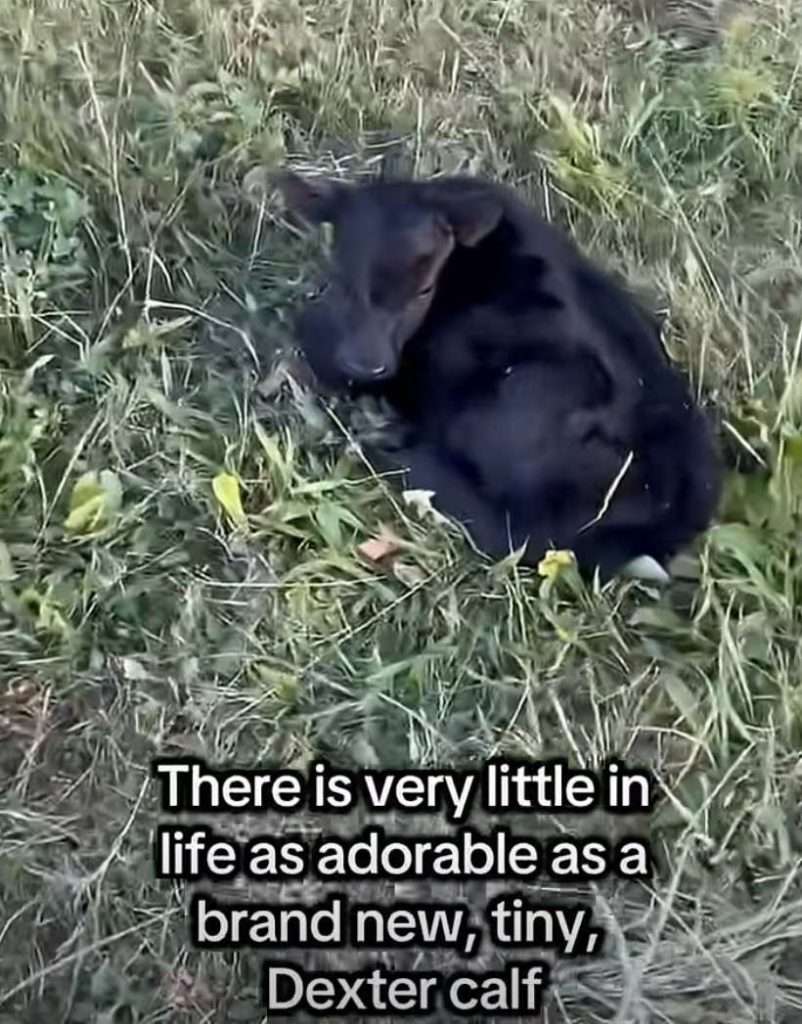
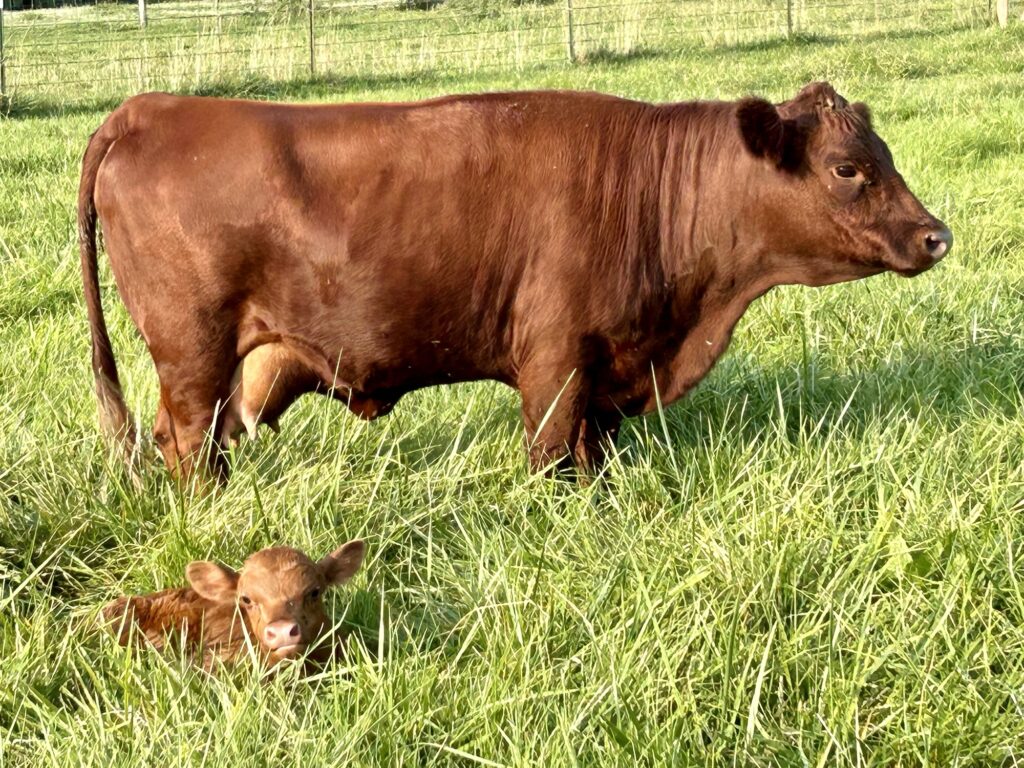
The mama is #116 Briarhook Juno Legacy # L03860LH-19HH and bull calf born September 29 with Fitz’s Golden Legacy Dillen. Dillen is our current sire, and he is the progeny of Colorado Chief and Chautauqua Demelza.
About the author… Angie Gaines grew up in the Sandhill Piedmont of North Carolina. As a child she accompanied her grandpa to cattle auctions. They raised feeder stock in the wonderful sandy loam. Her mother and father raised registered Polled Hereford cattle and their favorite standing bull was called Jerry Justin Banner 3rd. Almost twenty years ago Angie decided to be part of the preservation of the Irish Dexter cattle loved in Ireland. When she shared a photo of her beginning herd her mother aged 78 exclaimed; “Wow, look at those horns”. Angie responded with “ Mama, if a cow wants to hurt you they don’t need horns to do it”. Angie now resides in Texas with her wonderful Irish Dexters and Curly Mustangs.
====================
I gaze out my window on a rainy day and see three beautiful Black horned Irish Dexter cows, Juno, Flora and Faye grazing on the lush Spring grass in the Lone Star State. I wonder what it was like when their ancestors grazed just outside a little hamlet known as Argyle about 100 miles Northwest of Dallas, Texas of me. Their ancestors were the foundation for a line of Irish Dexter cattle that 50 years later would be known as the Legacy “Colorado” line and I am intrigued that these wonderful cows have made an interesting journey back to Texas.
“Mark and Marge (Davis) were living in Colorado when they first read about little cows known as Irish Dexters. Mark borrowed a trailer and traveled to Argyle, Texas to purchase his first cow and calf and a 14-month old heifer. ‘The cow was milking, but she was very wild”, he said with a chuckle. “A rancher friend of ours taught me to milk.” The couple later purchased a herd bull from Decorah, Iowa and in 1966, they and 5 cattle moved to Delaware. Mark Davis was a past President of the American Dexter Cattle Association.” He was also the Delaware registered agent for PDCA incorporation until recently.
The oldest Colorado cow owned by Mark and Marge Davis listed in our wonderful resource the Legacy Irish Dexter Registry is Colorado Queen (circa 1967). She goes back to Lady Knight who was bred by Dr. Harvey Goettsche in Dallas, Texas and Edmonde LeRoux, Argyle, Texas. Dr. Goettsche, was a well-known dentist who enjoyed the ranching life as a hobby. His partner Edmond LeRoux, had a beautiful ranch in Argyle, Texas and was a retired American Airline pilot with an impressive history of helping U.S. troops fly to destinations including the Far East, Japan, Australia and more with the Military Airlift Command and American Airlines.
Lady Knight has awesome ancestors who are beloved in our Irish Dexter community including Grinstead and Peerless. She is also the dam of the well-known bull Colorado Chief whose sire was an Irish Dexter bull Mark Davis went to Iowa to and brought back to Colorado. Marge Davis shared this in a phone conversation. She shared the wonderful journey that has become the foundation for the Colorado herd.
Briarhook Juno
Since we have explored how Lady Knight and her heifer left Argyle, Texas and became the foundation of the wonderful Colorado herd, let’s go back and explore how the Irish Dexter cattle came to be found in Texas. Lady Knight was the progeny of a nice bull registered as Captain Fortune and bred by Otto C. Jensen. Captain Fortune’s ancestors were direct registered cattle from the Peerless herd. “The foundation for the Peerless herd at Decorah, Iowa, was obtained by John Logsdon from the Elmendorf Farm, August A. Busch and James J. Hill, in 1919. Later, two bulls were obtained successively from Daniel Guggenheim, owner of Hempstead House herd. In 1944, when the Peerless herd had their first public sale, the herd numbered 150 head of cows and heifers! Peerless herd is the oldest Dexter herd in the United States. “ (Remember the Busch name as we continue this journey through history.)
With the tireless work, Judy Sponaugle has put together a researchers dream, creating the Legacy Irish Dexter Registry. Within a few short strokes on my keyboard and a quality internet connection, I am able to see that Lady Knight’s dam was the beautiful Black Duchess who was born in 1958. Edward Lord bred her with Atlantic Cornelius as her sire and Framfield Roda 7th as her dam. Both of Lady Knight’s parents were registered in the Dexter Cattle Society (DCS) founded in the United Kingdom. Both Atlantic and Framfield’s dams were the well-lovedGrinstead dams and going back till the beginning of the DCS (Dexter Cattle Society) conception circa 1892.
Back to the Lone Star state, we find a handsome Black Bull named Mark Anthony. His parents are Black Duchess and Atlantic Cornelius. His owner and breeder is a well know colorful character in the history of Texas, Clint Murchison. In my search, I have found little documentation about Irish Dexters, but it was well known that Mr. Murchison loved ranching. Ernestine Orrick Van Buren points out in her book Clint: Clinton Williams Murchison: A Biography : “In the late 1930s Murchison began diversifying his investments. He acquired numerous life-insurance companies, banks, bus lines, publishing firms, heavy industrial building materials companies, and an assortment of companies serving such leisure activities as hunting, fishing, travel, and gardening. He was a cattleman throughout his life and acquired extensive ranches in Mexico and East Texas. He experimented in improving cattle strains and in developing superior grazing grasses.”
Yes, millionaires loved our Irish Dexters, too! Speaking of millionaires let’s go back and visit the Anheuser Busch family and their involvement in Irish Dexter cattle and Texas. I ran across a 1916 newspaper article from Waco, Texas where 14 Irish Dexters belonging to Anheuser Busch Dexter Cattle. The cattle was transported via train to show their exhibit known the Bevo during a “tick” quarantine. The event appears to have hugely popular. We do know from well-kept records that , “In 1914, August A. Busch of St. Louis, Missouri purchased Dextersfrom C.D. Gregg of St. Louis and established the Grant’s Farm Herd. Additional animals were purchased by August Busch in 1915 from Elmendorf Farm in Lexington, Kentucky. The Elmendorf Herd was dispersed in 1917.” Perhaps a few of these wonderful cows stayed in Texas.
The Colorado herd of Irish Dexter cattle that Mark and Marge Davis created has an amazing history and enjoyed passage with many friends they encountered along the way. I feel fortunate to be friends with those who continue this line of Irish Dexters including Judy Sponaugle (owner of the Legacy Registry and Preservation Project ), The Mendenhalls, Lori Goldman and several others. I am especially grateful to Pam Baker, for the opportunity to add Juno, Flora and Faye in our herd and welcome them back to the Lone Star state where their ancestors once roamed.
#125 Briarhook Flora Legacy L03859LH-20HH with heifer Fitz’s Golden Finlee, Legacy #L04703TH-23HH. Flora’s sire is Colorado Orpheus Legacy # L01683LH-13HH. Orpheus goes back to Lady Knight and Peerless Perfection II.
When you start thinking about owning Irish Dexter cattle it is important to consider it as a long-term relationship, time involved, and expenses. One of my favorite things to tease visitors about as we walk or drive through our herd is, “Dexters are like Lay’s potato chips. You cannot have just one.” That slogan idea is from a 1963 Lays ad campaign and it holds true in my book. Dexters are herd animals who feel safer and calmer when they are with others. Once someone meets this docile, charming, and surprisingly efficient miniature breed, it is hard not to fall head over boots for them.
If you are new to the breed, I highly recommend setting up a farm visit with a reputable breeder. Offer to buy some feed or bring a small donation to respect their time. Be warned though. You may not want to leave. This article is meant to give you the broad strokes of what to consider when deciding if Dexters are right for you. I encourage everyone to do additional research on estimated pricing based on your area.
The Real Costs of Starting a Herd
The initial purchase of the cattle is only one part of the investment. You will need to consider land, fencing, shelter, handling equipment, feed, hay, feed and hay storage, a trailer unless you can rent or borrow one, a tractor, breeding costs, parasite and worming management, predator control, veterinary care, and even a reliable pet sitter. It may take several years to recover your startup costs depending on how simple or how fancy you want your operation to be. Dexters are a dual-purpose breed and, when cared for properly, can provide milk and beef for nearly two decades. I personally know of cows that were productive into their late teens and one in her twenties.
Land and Stocking Numbers
The most common question is, “How many Dexters can I have per acre?” The answer depends on your total acreage, pasture quality, rotational grazing practices, growing season, and pasture maintenance. Many Dexter resources recommend one acre for the first cow and half acre for each additional animal. When advising beginners on small acreage, I suggest the 1.5 rule. Multiply your total fenced acres by 1.5 to estimate the number of Dexters you can support with a safety buffer. For example, 4 acres x 1.5 equals 6 Dexters. If you divide your pasture into multiple paddocks and rotate your herd, your grass recovers better, it stronger, and parasites have time to die off.
When done strategically—through rotational or intensive managed grazing—short bursts of high stocking density followed by long rest periods can stimulate stronger root systems. Plants recover fully before being grazed again, resulting in: deeper and denser roots, improved soil structure, better drought resilience, and more balanced plant communities. What this all means to you? You can graze more efficiently and have more Dexters. That is a huge win!
Be prepared to do land maintenance, soil testing, weed control, and fertilization vary by region. Your local USDA or Farm Services Agency office can offer free guidance and resources. They are a great place to start.
Shelter
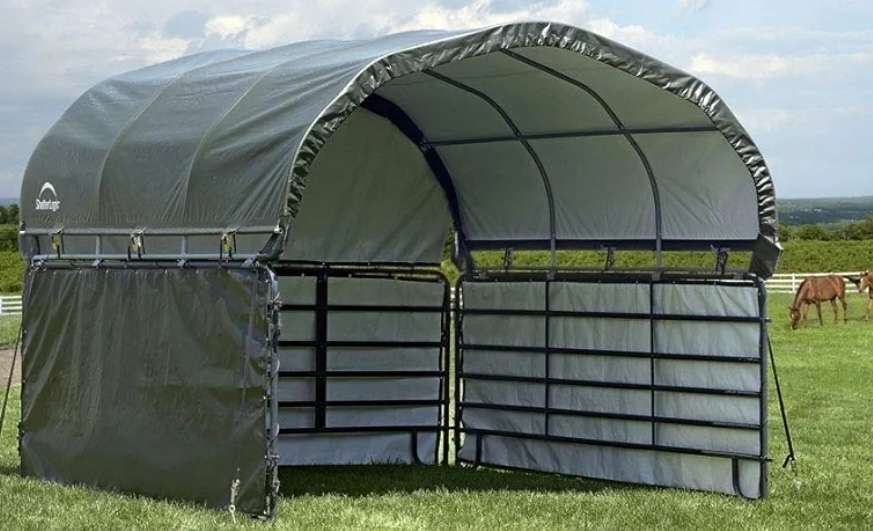
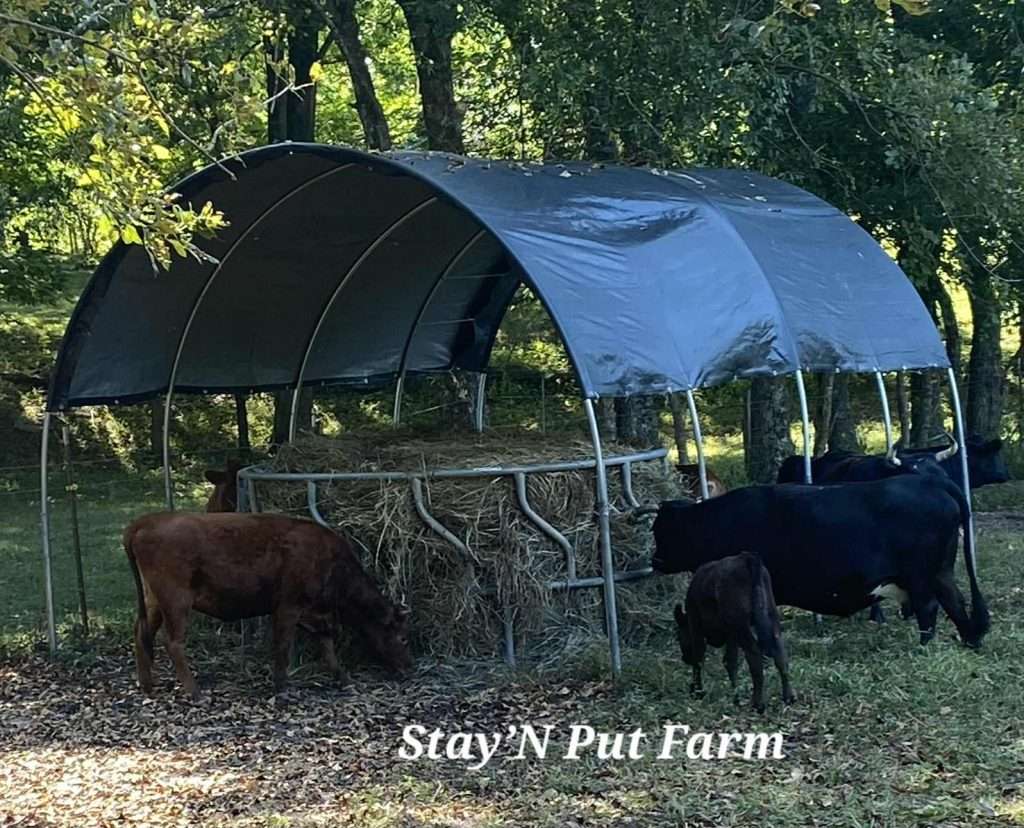
Dexters need protection from heat and extreme weather. A three-sided shelter with the opening facing South is ideal. Even if you have shade trees, build a shelter. When storms roll in, cattle avoid trees because of falling limbs and wind stress. A simple carport-style shelter works well, especially if you need to put a round bale inside for them to eat around it, approximately $2500. You can even do a larger three-sided shelter with hay storage in back and put up gates or doors to keep them away from the hay. Two other options: Shelter Logic 12 ft x 12 ft type, 3-sided run-in around $350 plus, need 3 of the 12 ft corral panels $390 (see photo) or a DIY hoop shelter around $450 depending on materials you use (see photo). Whether, it is wood or metal, I recommend a shelter of some sort.
Feed, Hay, and Storage
Feed and hay costs depend on your climate, seasons, and hay quality. Buying in bulk or buying hay in the summer before winter prices rise can save a significant amount of money. In hot and humid climates, storing hay under cover is essential because mold develops quickly. Never feed moldy hay. Mold can cause respiratory illness, reproductive issues, and long-term immune problems. Avoid storing feed or hay near fuel and farm chemicals because it can absorb fumes that cattle can smell (even when we do not) and can be toxic. Feed should also be rodent free so storing in rodent proof containers is imperative. Feed should also be kept in something raccoon aka “trash pandas” cannot get into.
Handling Equipment and Veterinary Care
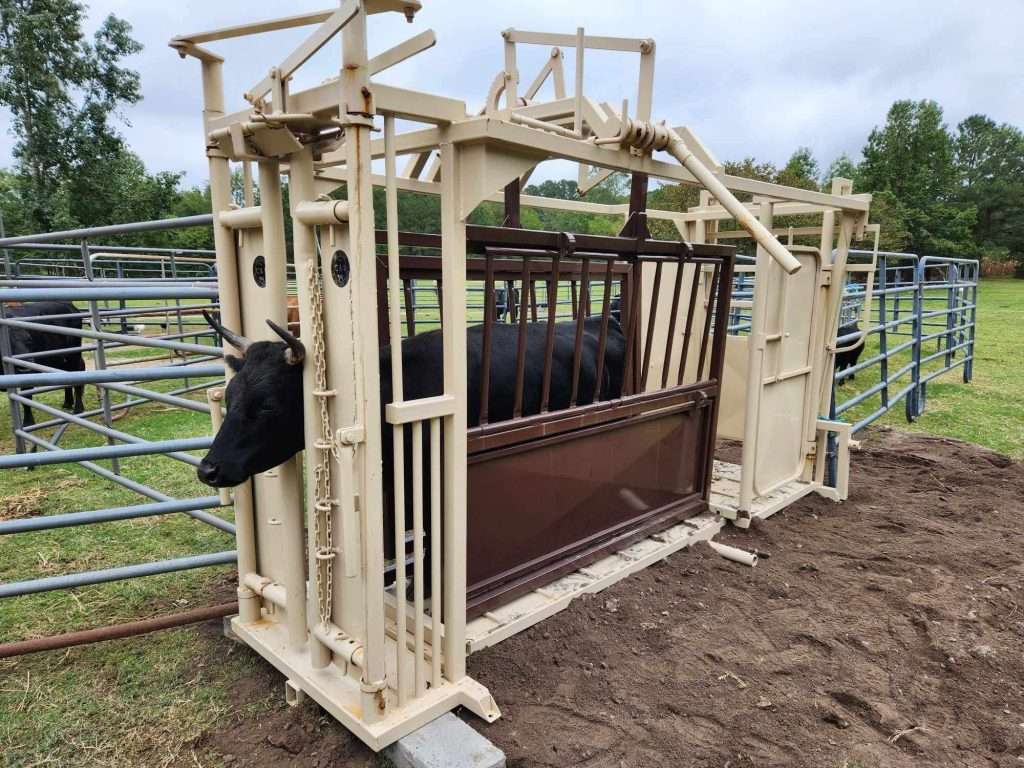
One larger investment is a proper headgate and squeeze chute. You can find some great DIY plans online or buy a metal one. Be aware most veterinarians will not treat cattle on-farm without safe handling equipment. Even though Dexters are smaller, they can still injure you or your vet if they are stressed or in pain. A squeeze chute with headgate protects everyone and the squeezing calms the animal during treatment. Corrals or catch pens help immensely when you need to bring them in for vet checks, load them on a trailer, or handle for training.
We can call our cattle into the holding pen from 40 acres away just by hollering, “Cow, cow!” They come running because that is where we feed them daily. No halter or chasing needed. We try and teach our clients easy tips like this to be successful.
The Cost of a Good Dexter
Could you go to a livestock auction and buy a “Dexter” cheap? Yes, but you may end up with a sick, stressed, or crossbredDexter that could cost hundreds in vet bills before you even know what you have. Instead, buy from a reputable breeder who DNA tests, registers, and raises animals with known temperament, worming and healthy parents you can see. When you load up your Dexters in the trailer the sale should not end there. When you are buying a Dexter from a reputable breeder, you are buying knowledge, mentorship, and support that lasts past pickup.
Example Startup Costs (Assuming you already have land, fencing, and gates)
• 3 pregnant registered Dexters @ $2,500 each: $7,500 • 1 registered bull calf (6 months old): $1,500 • 3-sided carport shelter: $2,500 or Hoop House $400 • Veterinary Well visit and new client start up: $150 to $250
•Water troughs and miscellaneous items $500 • 1st year feed, hay, minerals, vaccines, protein tubs, veterinary, wormer, grass seed/fertilizer @ $1,500 a Dexter x 4: $6,000
Total basic first-year startup depending on shelter type: $15,000 to $17,500
Final Thoughts
I know it seems over whelming but it really is not if you plan everything out and be clear about your goals. Whether you want to be a breeder, produce milk and meat to sell or raise just for your family, starting a Dexter herd is not just a financial decision, it is a lifestyle choice. You are building self-sufficiency and a rewarding family experience.
The first few years do require patience and planning, but the payoff can be meaningful both financially and personally. If interested in financing reach out to your local USDA/FSA office about farm loans. Farm loans can cover everything you need for start-up including land. When the investment starts to show returns, the feeling is a great sense of accomplishment. Dexters give back what you put into them. It never gets old seeing your herd grazing or the birth of a new calf.
Don’t forget, “Dexters are like Lays you can’t have just one.”
After a small sampling from one herd, it appears that the Dexter breed does have this highly inheritable genetic marker. It appears that the marker is found in those cows with the most milk production. This makes total sense, as they refer to the genetic marker as found in most easy keeping cattle.
Unfortunately no bulls were part of the initial testing and semen is not able to be tested for this marker.
So, now that we know the marker is there for the Dexter breed and that it seems to be in cows with most milk…we need more folks to test. It has been suggested that it maybe easy to get a few drops at ear tagging time and a simple tail stick for the older ones.
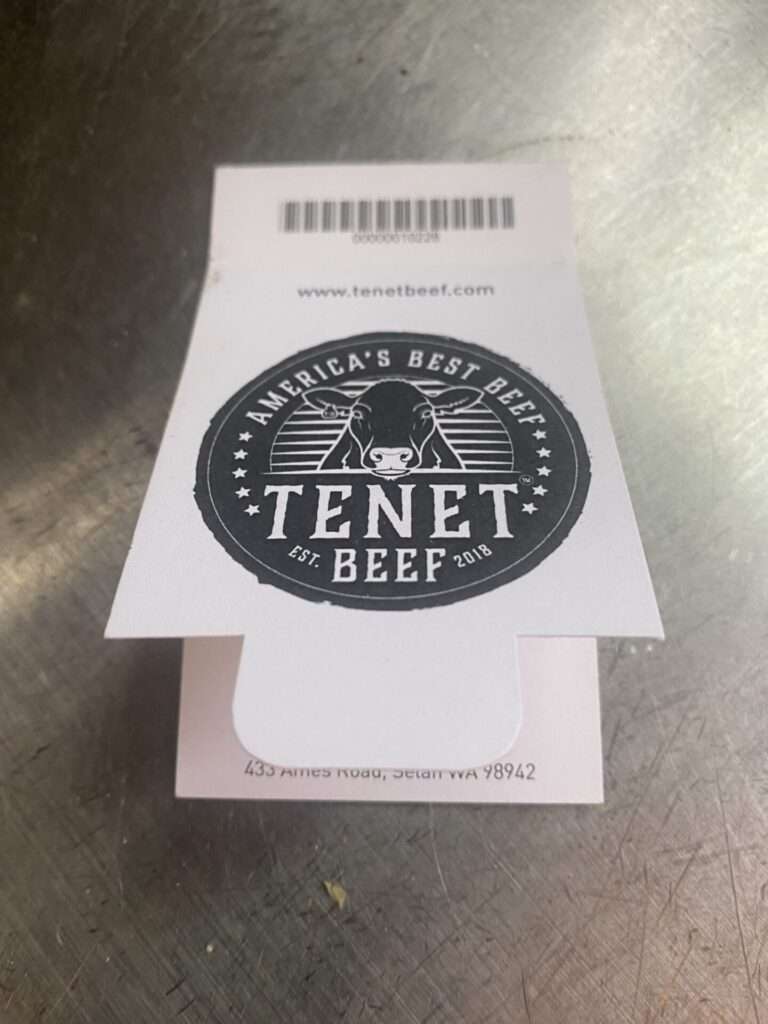
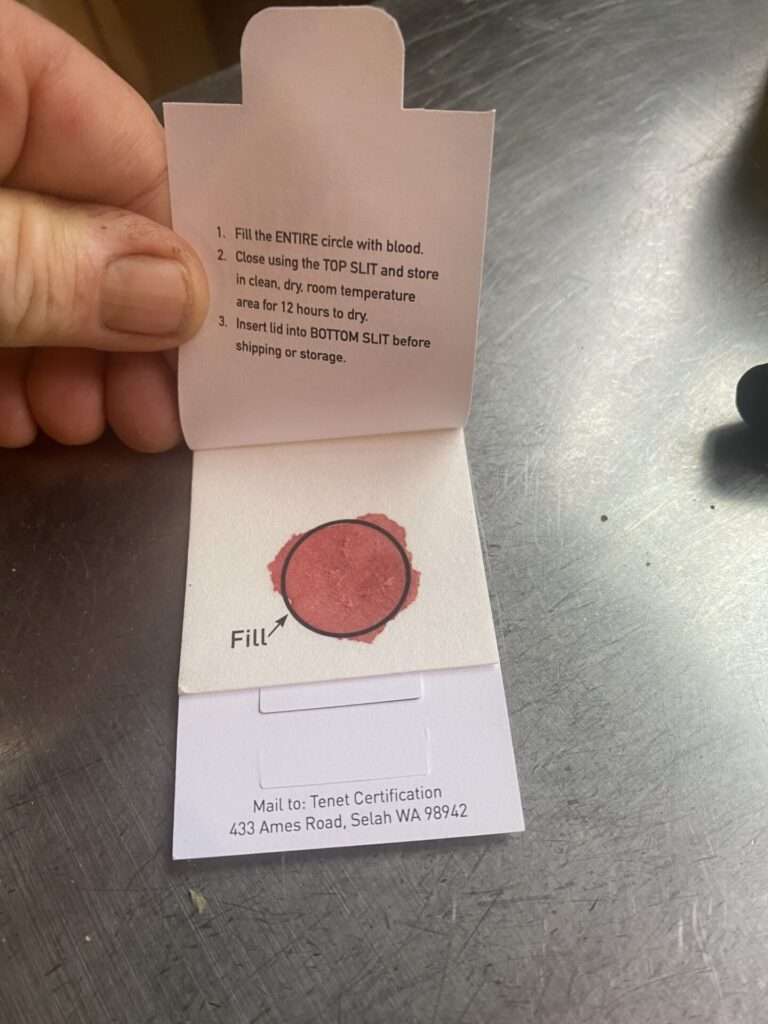
If you would like more information on how to get your herd tested, please reach out to the Irish Dexter Cattlemen and we will help you get started. It requires only a few drops of blood on a Tenet card sampler. The card is then sent of for sequencing.
It takes 5 days to get to the lab and 10-30 days for the sequencing to happen after being received. They send your your results by email. Pretty simple procedure.
The thing that was most interesting was it was found in the cows with the most milk production. How cool would it be to be able to predict possibly milk production and beef tenderness? Duality!
In case, you need to brush up on this. Below is the podcast that started this adventure. This is NOT the Neogen testing that has been happening by a group of Dexter breeders.
Dexter cattle, with their compact size and delightful appearance, are a top choice for small-scale farmers and homesteaders. The chondrodysplasia trait, resulting in shorter legs and a stout build, is a defining feature often criticized but offers significant benefits when managed responsibly. This article counters negative sentiments about chondrodysplasia by highlighting its advantages—calm temperament, successful calving, efficient pasture use, and aesthetic appeal—using research from agricultural universities and practical insights. Written for those eager to raise charming Dexter cattle but hesitant due to concerns about chondrodysplasia, it provides a clear, evidence-based case for the trait’s value.
Calm and Approachable Nature
Chondrodysplastic Dexters are celebrated for their gentle demeanor, ideal for farmers new to livestock. Oklahoma State University’s Department of Animal and Food Sciences notes that smaller cattle breeds, like Dexters, are typically less intimidating and easier to handle due to their reduced size (Oklahoma State University, Breeds of Livestock, breeds.okstate.edu). The short stature of chondrodysplastic Dexters simplifies tasks like herding, milking, or veterinary care, reducing stress for both the farmer and the cattle. Their docile behavior fosters a safer farm environment, making them a practical choice for hobbyists or families. This temperament aligns with sustainable, low-stress farming practices, enhancing the appeal of chondrodysplastic Dexters for beginners.
Successful and Safe Calving
Critics of chondrodysplasia often cite the risk of bulldog calves, a lethal condition caused by inheriting two copies of the chondrodysplasia gene. However, modern genetic management eliminates this concern, ensuring healthy calving outcomes. Research from the University of Sydney, cited by UC Davis’s Veterinary Genetics Laboratory, demonstrates that breeding a chondrodysplasia carrier with a non-carrier produces healthy offspring with a 50% chance of inheriting the short-legged trait, avoiding bulldog calves entirely (UC Davis VGL, Bulldog Dwarfism in Dexter Cattle, vgl.ucdavis.edu). Dexters’ small size further reduces calving difficulties, with lower dystocia rates compared to larger breeds. A study from Kansas State University’s Agricultural Experiment Station highlights that smaller cattle breeds have fewer birthing complications, supporting Dexter’s reliability in producing healthy calves (K-State Research and Extension, k-state.edu). Responsible breeding ensures chondrodysplastic Dexters thrive as a productive herd.
Optimized Pasture Efficiency
Chondrodysplastic Dexters are exceptionally suited for small farms due to their low land requirements. Their compact size allows for higher stocking rates, maximizing productivity on limited acreage. Oklahoma State University’s Beef Cattle Manual indicates that Dexters can be sustained on 0.5 to 1 acre per cow, compared to 1.5 to 2 acres for standard breeds, making them ideal for resource-conscious farmers (OSU Extension, extension.okstate.edu). Research published in Animal Production Science confirms that smaller cattle breeds like Dexters exert less pressure on pastures, supporting sustainable grazing practices (Anim. Prod. Sci., 2020, doi:10.1071/AN19432). This efficiency lowers feed costs and environmental impact, allowing farmers to maintain more animals without compromising land health—a key advantage for those with small plots.
Charming and Marketable Appearance
The aesthetic allure of chondrodysplastic Dexters is a standout feature. Their short legs, robust bodies, and expressive faces create a “cute” look that captivates farmers and consumers alike. The American Dexter Cattle Association notes that chondrodysplastic Dexters are often “proportionally balanced and visually appealing,” making them a draw for agritourism, farm visits, or niche markets like specialty beef or dairy (American Dexter Cattle Association, Chondrodysplasia Overview, dextercattle.org). Social media posts from groups like “Dexter Cattle – Chondro Cuties” highlight the enthusiasm for their unique appearance, which boosts their marketability (Facebook, Dexter Cattle – Chondro Cuties, facebook.com). This charm translates into economic benefits, as their distinctive look attracts attention and adds value to small-scale operations.
Countering Negative Perceptions
Negative views on chondrodysplasia, such as claims of it being a “painful genetic disease” or calls for its eradication, often stem from misinformation or outdated concerns (Facebook, Dexter Cattle Breeders, facebook.com). These critiques overemphasize the bulldog calf risk while ignoring modern solutions. Genetic testing, available through institutions like Texas A&M University, allows farmers to identify carriers and breed strategically, eliminating the risk of lethal outcomes (American Dexter Cattle Association, Chondrodysplasia Overview, dextercattle.org). A 2007 study in Mammalian Genome from the University of Sydney confirms that heterozygous chondrodysplasia carriers exhibit no health detriments, displaying robust growth and adaptability (Mammalian Genome, 2007, doi:10.1007/s00335-007-9066-9). Posts on platforms like Facebook also clarify that chondrodysplasia is a manageable trait integral to the Dexter breed’s identity, not a flaw to eliminate (Facebook, Dexter Cattle Enthusiasts, facebook.com). With proper management, the trait’s benefits far outweigh any perceived drawbacks.
Conclusion
Chondrodysplastic Dexter cattle are a valuable asset for small-scale farmers. Their gentle nature simplifies management, reliable calving ensures herd vitality, efficient land use maximizes resources, and charming appearance enhances market appeal. Supported by research from Oklahoma State University, Kansas State University, and the University of Sydney, chondrodysplasia is a manageable trait that adds unique value to Dexters. For farmers seeking cute, productive cattle, chondrodysplastic Dexters are an excellent choice when paired with responsible breeding practices.
Featured image
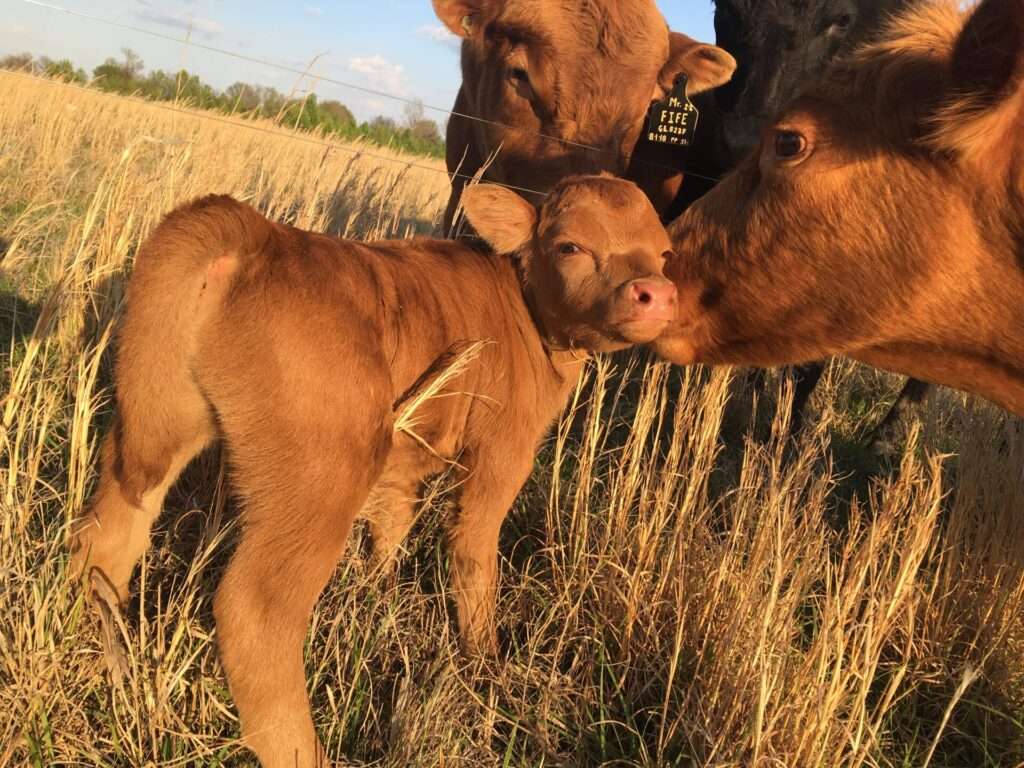
Family picture with herd sire Mr. Fife: 3797
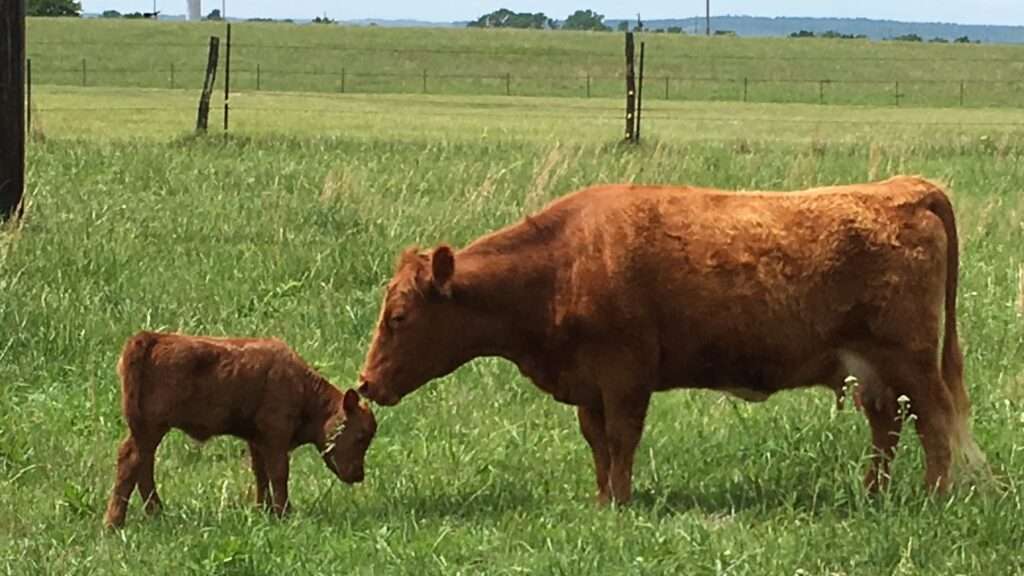
Cow named Butter Diary’s Rosebud ADCA 045563 and her calf Butter Diary’s Lil Bit 049867. 5008 and 2698 (calf in these pictures is Lil Bit)
References
American Dexter Cattle Association. “Chondrodysplasia Overview.” dextercattle.org. Accessed August 11, 2025.
Oklahoma State University. “Breeds of Livestock – Dexter Cattle.” breeds.okstate.edu. Accessed August 11, 2025.
Oklahoma State University Extension. “Beef Cattle Manual.” extension.okstate.edu. Accessed August 11, 2025.
UC Davis Veterinary Genetics Laboratory. “Bulldog Dwarfism in Dexter Cattle.” vgl.ucdavis.edu. Accessed August 11, 2025.
Kansas State University Research and Extension. “Cattle Breeding and Management.” k-state.edu. Accessed August 11, 2025.
Cavanagh, J.A., et al. “Genetic Basis of Bulldog Dwarfism in Dexter Cattle.” Mammalian Genome, 2007, 18, 808-814. doi:10.1007/s00335-007-9066-9.
Animal Production Science. “Grazing Efficiency of Small Cattle Breeds.” 2020. doi:10.1071/AN19432.
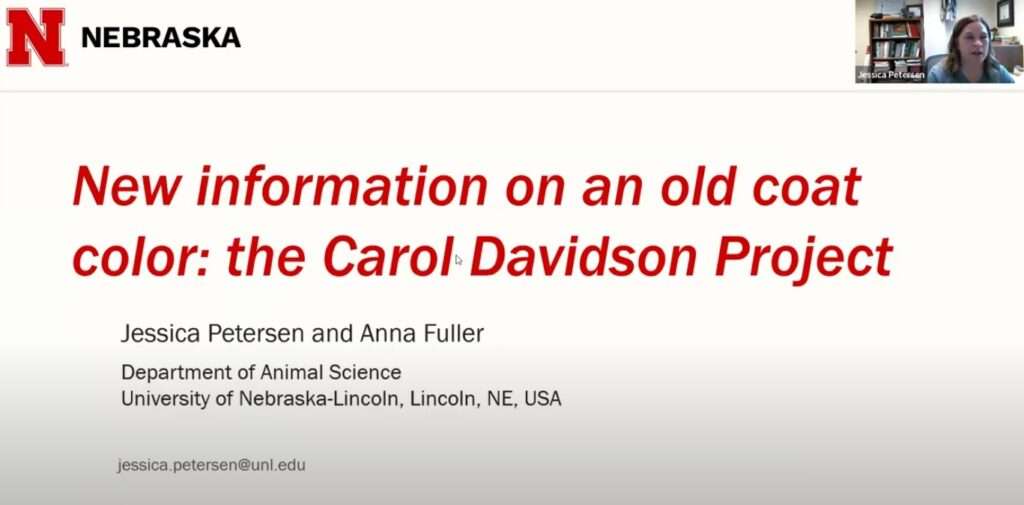
This is the Dexter Dun Project Webinar, also known as the Carol Davidson Project, hosted by Jessica Petersen, PhD, Department of Animal Science, University of Nebraska-Lincoln, Nebraska
Here is a video that Nancy Bowers, Lonestar Ranch did on blood testing one her Dexters. This the same technique that you will need for testing for Tenet beef tenderness, except you will need much less….lol.
I have sent in 7 tenet tenderness tests to see if our Dexters have this genetic trait. Unlike other testing this is not done on scale and there is no comparison to other breeds. It’s either there or not there. I truly believe that the tenderness of the beef is correlated to milk and that is sooo important in our dual purpose breed. We are working with them to prove this theory!
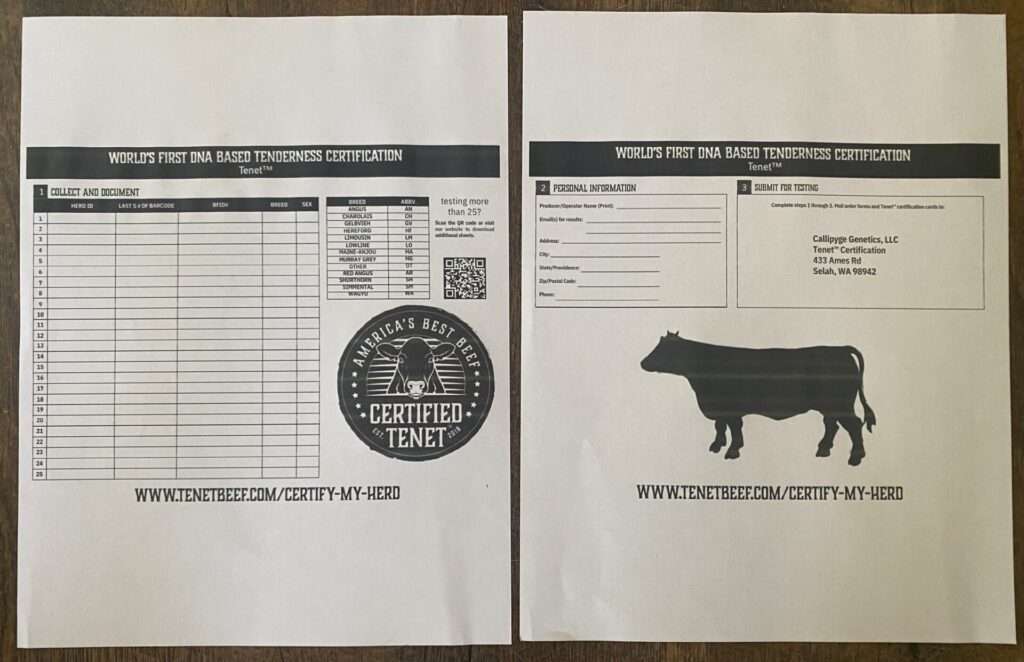
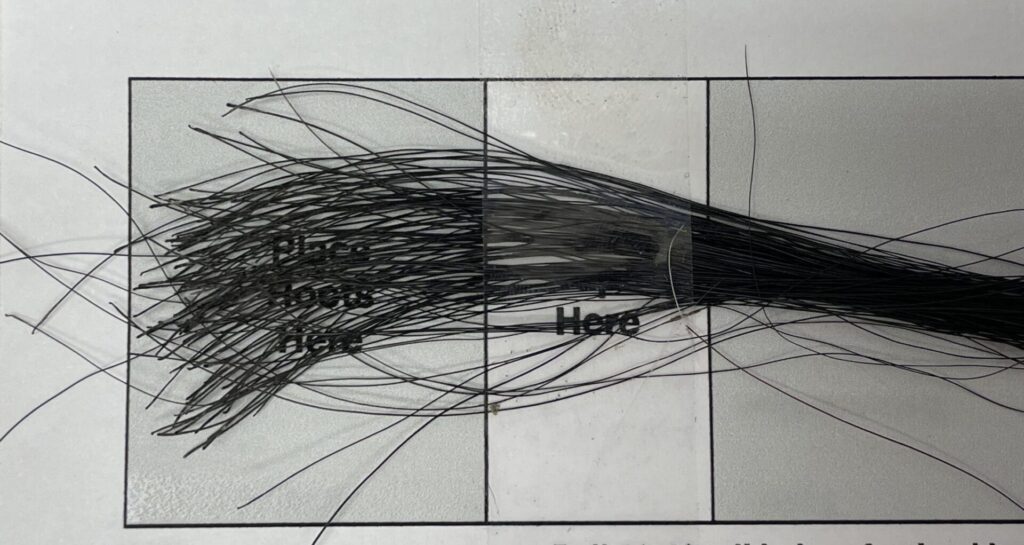
I have included what the cards look like, the paperwork that is needed…note it is very little. You can pay on line or send in a check. It is better for the lab if you pay with a check, so that they don’t loose the processing fee, but they are very accommodating.
I’m not sure if horns, polled or the dwarf incite more spirited conversations in the Dexter world. I am proud to have all of those in our small homestead farm, truly, experiencing all the Dexter has to offer even on our small acreage. I have become frustrated and even angered by some of the reactions to all of these traits, that are all part of our amazing breed. Diversity was defined in our breed standards and have existed since the “birth” of our breed. We have so many things to celebrate… like a unique color mutation in our stunning duns. Our duality, some of the richest milk that is easily digested like the goat. And at the same time some of the best beef, that has found its way into restaurants of the famous Chefs like Ramsay. And a unique BD1 gene, that has given birth to many many other breeds! BD1 is a treasured genetic report on our farm. Our experience with the dwarf has been purely positive, for both dairy and meat. We never breed a carrier to a carrier. So we have never experienced some of the awful things that one person beats to death on one of the FB pages. I do love our non carriers too, as it takes one of each to make the dwarf! It’s interesting that most of the folks that speak out about the dwarf negatively , have never experienced the dwarf…they rely on the propaganda of one! And standing up to him on his site…well the comments disappear or they go into forever pending. He must control the narrative! We have not experienced the arthritis in the Dexters which could occur in both the carrier and the non carrier…or could it be the result of tick borne disease, that affects us humans. There are not good recordings of deaths of all Dexters, so the reports that dwarf pass earlier than non carriers, is only a guess, without documented proof. Again something, that fits a narrative. And let’s talk about the associations and their responsibilities to protect the dwarf and it’s heritage… both have members and board members that share some or all of the detrimental beliefs about the dwarf, hopefully, a balance will be maintained in beliefs or the dwarf is doomed. I have changed my opinions on some aspects over the last 14 years, but one thing I have never changed are my feelings about are the dwarf. The dwarf or carrier, it’s all just terminology that describes a Dexter that truly has stolen my heart.
This is the first of our articles on chondrodysplasia in Dexters. Also called chondro-carriers, shorties, or dwarfs. these terms refer to the same cattle, and will be interspersed throughout the article. Keep in mind, they all mean cattle who are carriers of the dwarf gene.
Per Miriam Webster chondro means cartilage & dysplasia is an abnormal growth or development.
It’s a personal decision to breed chondro carrier Dexters. Of course, it’s your decision what to breed on your farm. But, let’s sort out some of the facts on these endearing little cattle.
Some long time breeders have told me that they believe the dwarf Dexters played an instrumental part in the formation of the breed, as the non-chondro, longer legged Dexters got registered in with the Kerry cattle. They also believe that there are two body types in the dwarves. That will be discussed in a later article.
Just a few of the traits and statements that those who own and experience the pleasures of owning a dwarf believe.
“Chondros are the breed. If we lose them we lose the breed.”
“Maximum beef on minimum forage.”
Personalities are one of a kind
Great mothers
High milk production
Great for first time cattle owners
Of course, breed responsibly. Never breed two carriers together and you will never get a bulldog calf. (If you did, the chance is only 25%, but why risk it?)
Those that I see exaggerating & spreading the hate for chondro carriers are using human graphics from the internet and applying their own labels. I have found no professional veterinary opinion stating they should be eliminated. Of course, none of those who love them would want or allow them to suffer. Many Dexters I know of are living into their teens. How many commercial breeds do you see living that long?
Some dwarfs will get osteoarthritis later in life. So will some non-chondros. A lot depends on the bloodlines, the terrain they live on and the care they receive. This also applies to the longer legged non-chondros. Humans also tend to get osteoarthritis later in life. They also can get forms of dwarfism. We don’t eradicate them. It can be managed, IF it happens.
So, please…. educate yourself on this genetic mutation, before you make a judgement.
The following is a scientific explanation from UC Davis. We choose the BD1 test, when we get any calves from our carriers. The BD2 test is for a specific line from a specific bull.
The internet has become an invaluable tool to ranchers, farmers and homesteaders looking to buy or sell livestock. But, scammers have infiltrated the industry making online sales and/or purchases more difficult to navigate. Here are some great tips to avoid getting scammed. And, as a bonus they can help you develop great contacts and relationships with the people you are buying or selling to.
Here is a testimonial from someone who paid to get access to the Irish Dexter Cattlemen Gazette!
Yes. This is a big need. I believe there are a lot of people like us out there but the world is so commercialized that breeds like dexters don’t have as much information to learn from. This is gonna be a great tool for us and I’m sure it will help us grow more into what we’re wanting to accomplish on our farm in the future. Carrie Ann Bowers
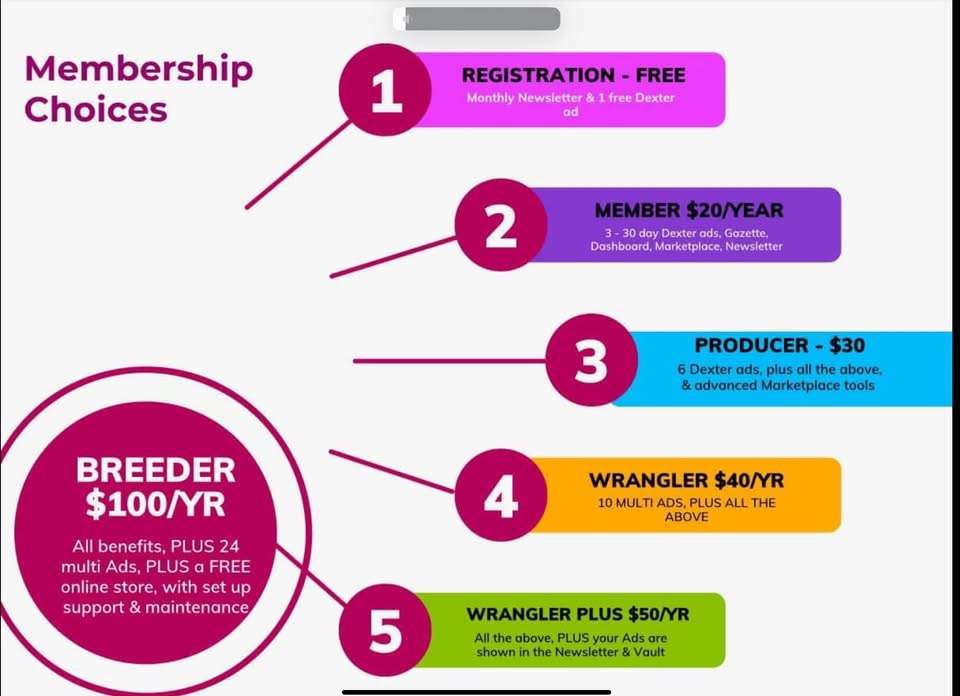
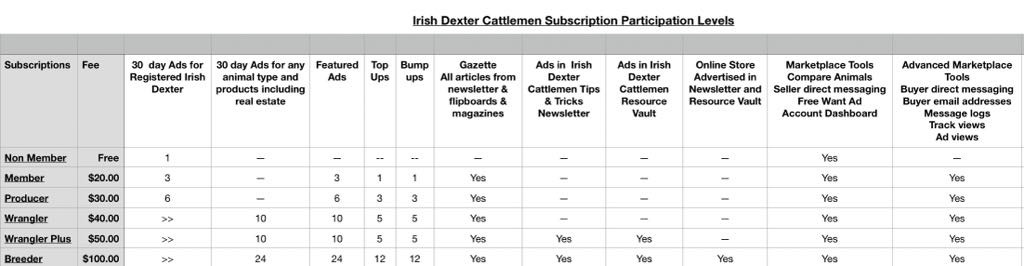
Hope this simple spreadsheet shows you the different levels that you can participate. An example of an entry level participation is … access to our gazette and all the past articles in the Tips and Tricks Newsletter, many magazines , the ADCA, PDCA and Legacy publications in clipboard formats with an easy to use search feature…you will need to spend $20. This feature has allowed me to help so many when they have a specific question about a topic we have already covered.
You will need decide your level of participation, register and then enjoy your subscription benefits.
We are always looking for people to help. If you want to join an exciting and dynamic team…reach out!
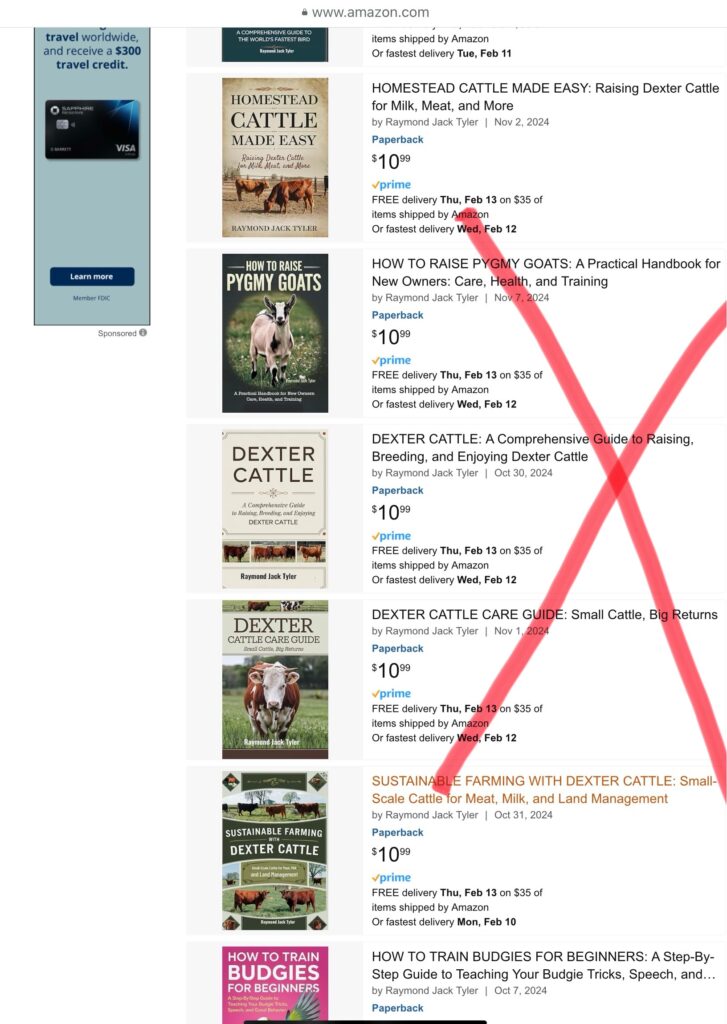
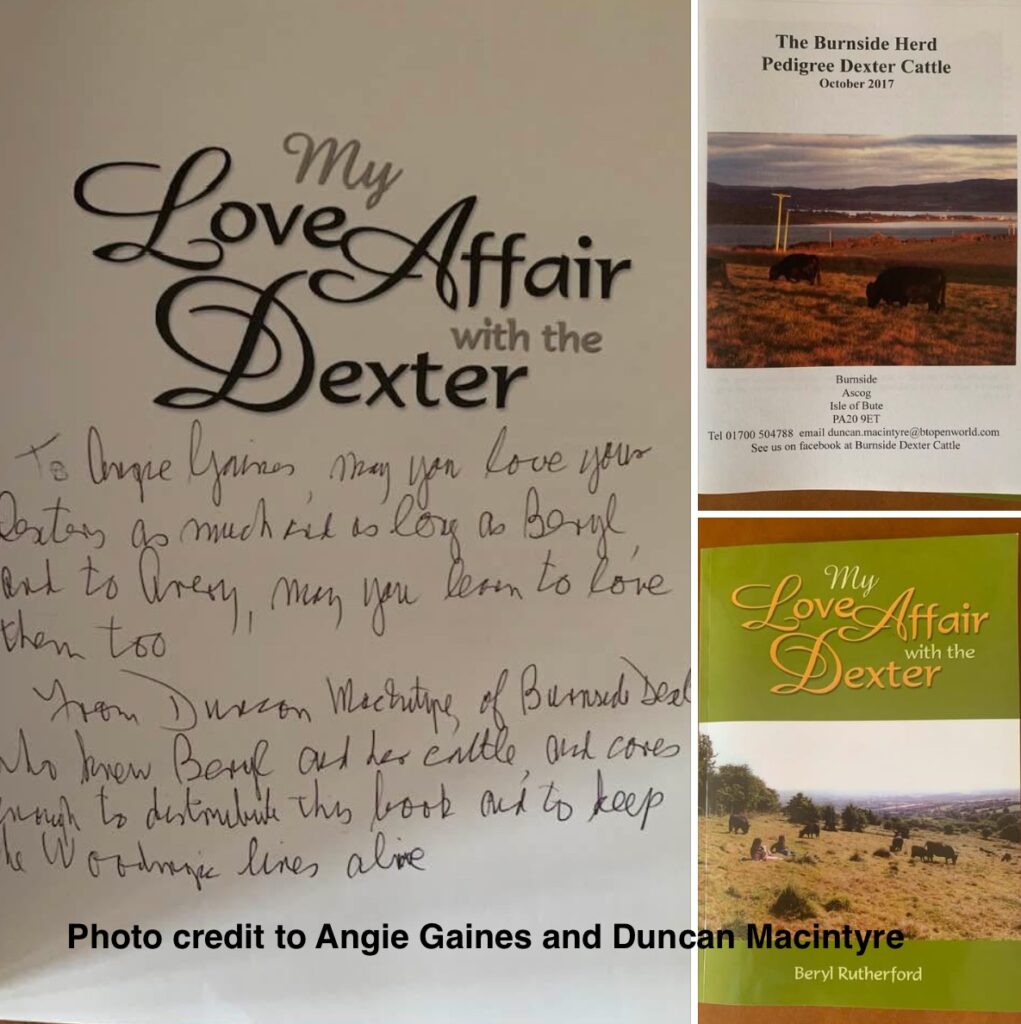
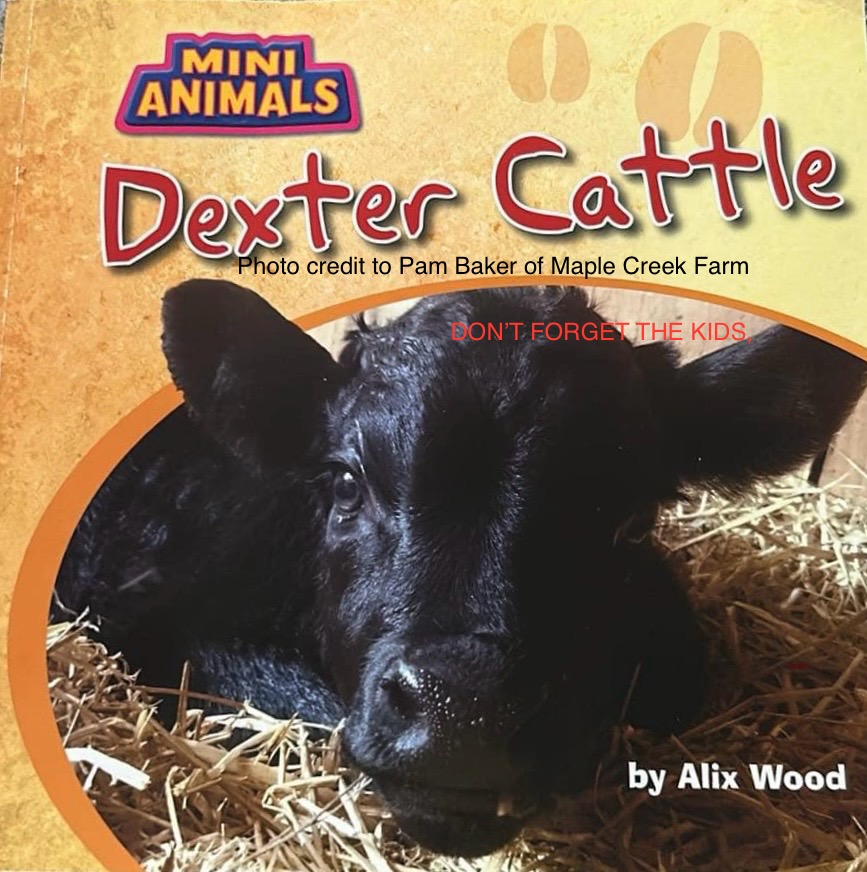
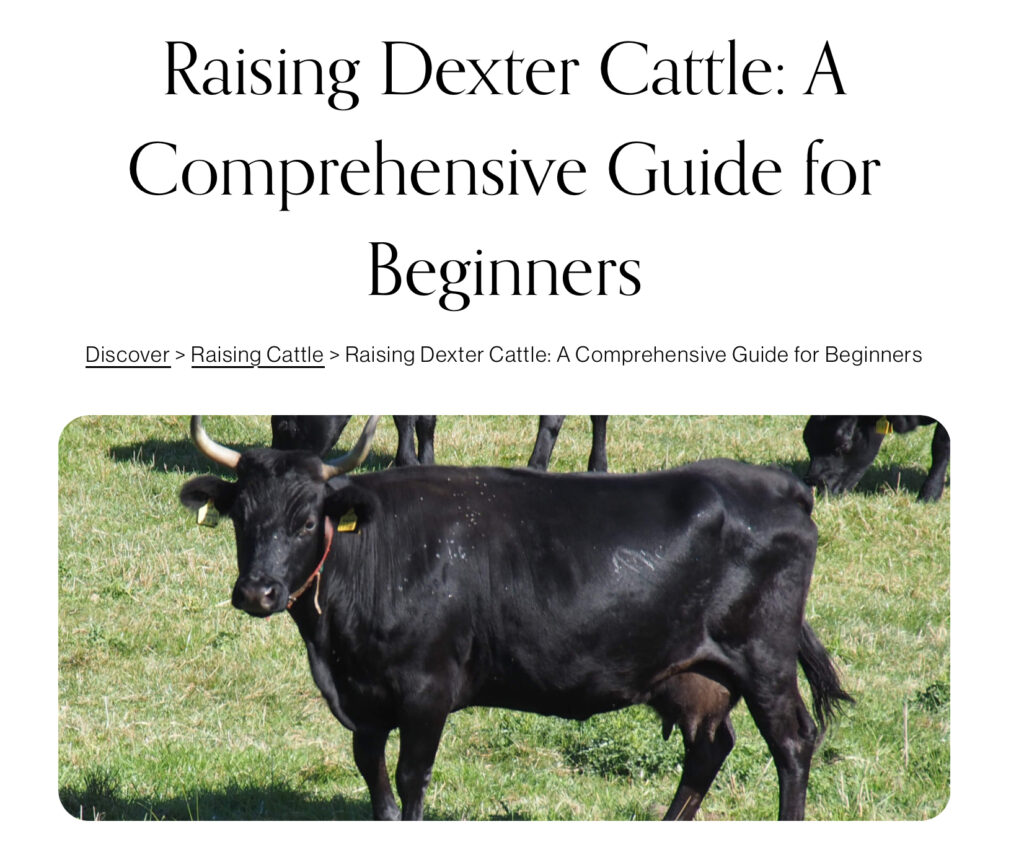
Danielle Lowther of Byrn Mawr Dexter farm sounded the alarms this month. She found a bunch of books listed on Amazon that must be AI generated with little to no knowledge of what a Dexter looks like, let alone how to care for them.
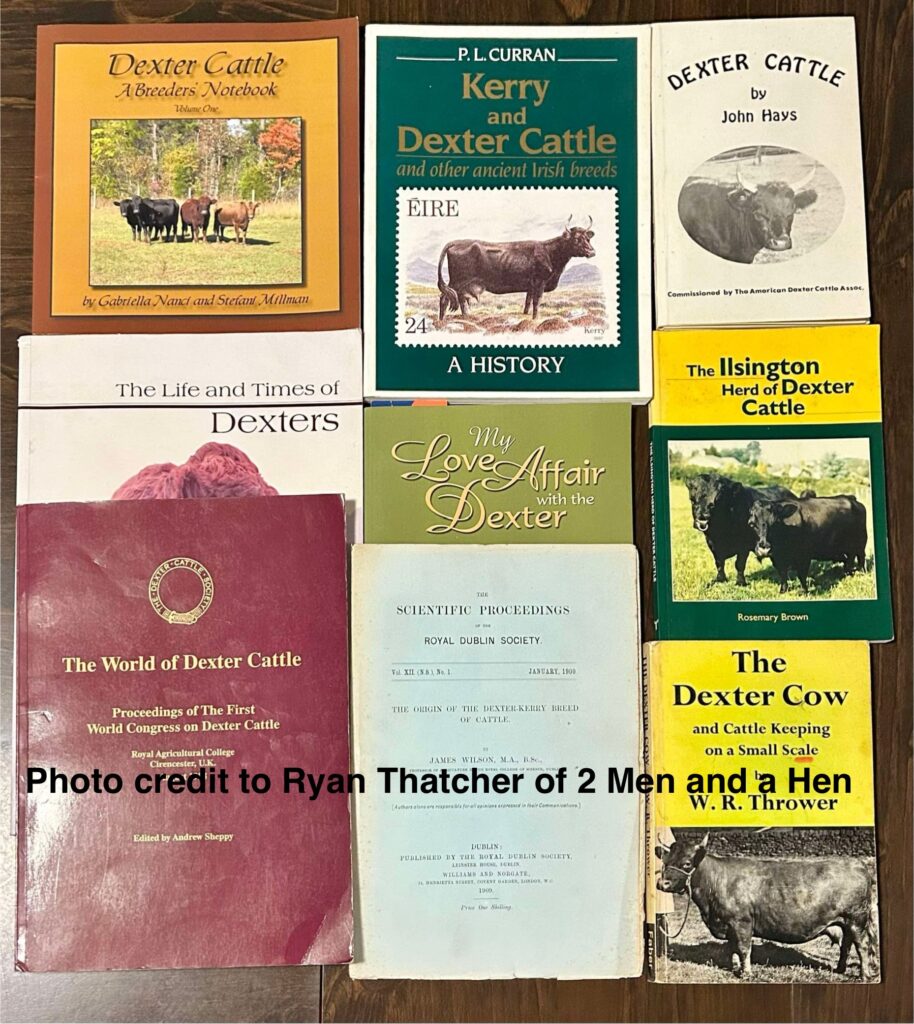
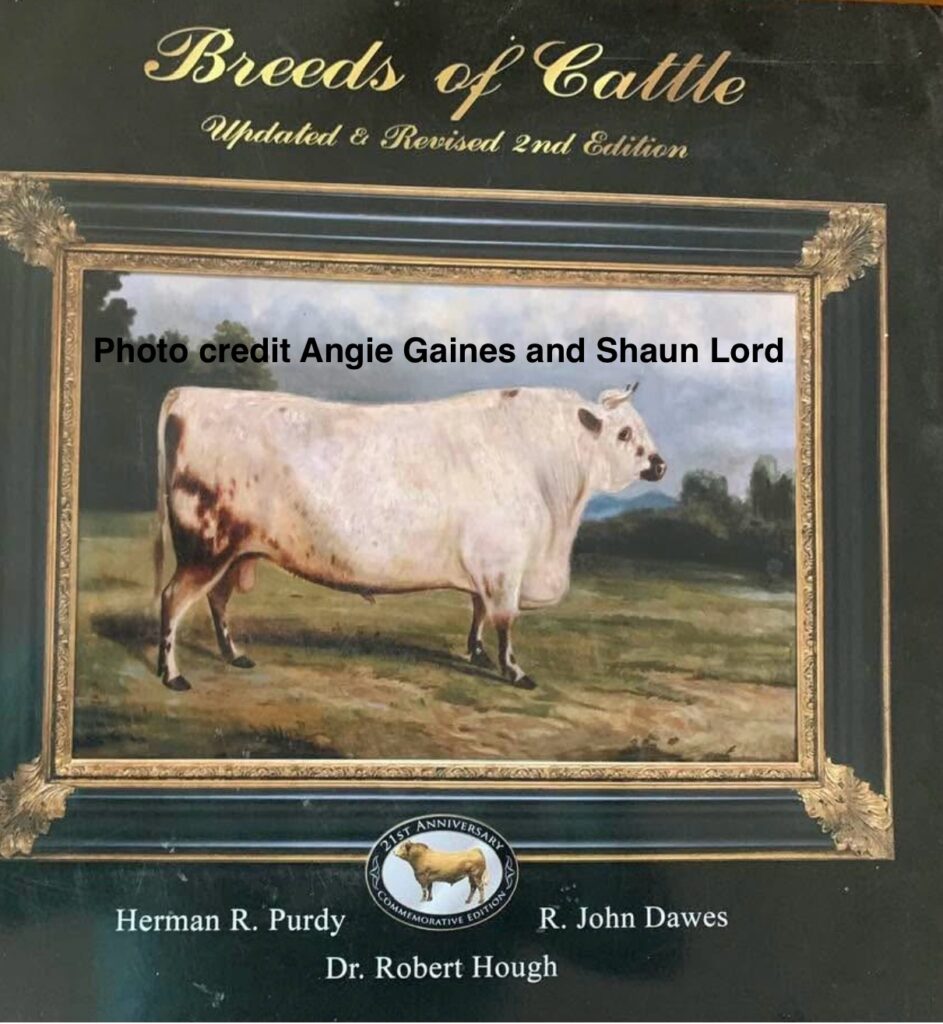
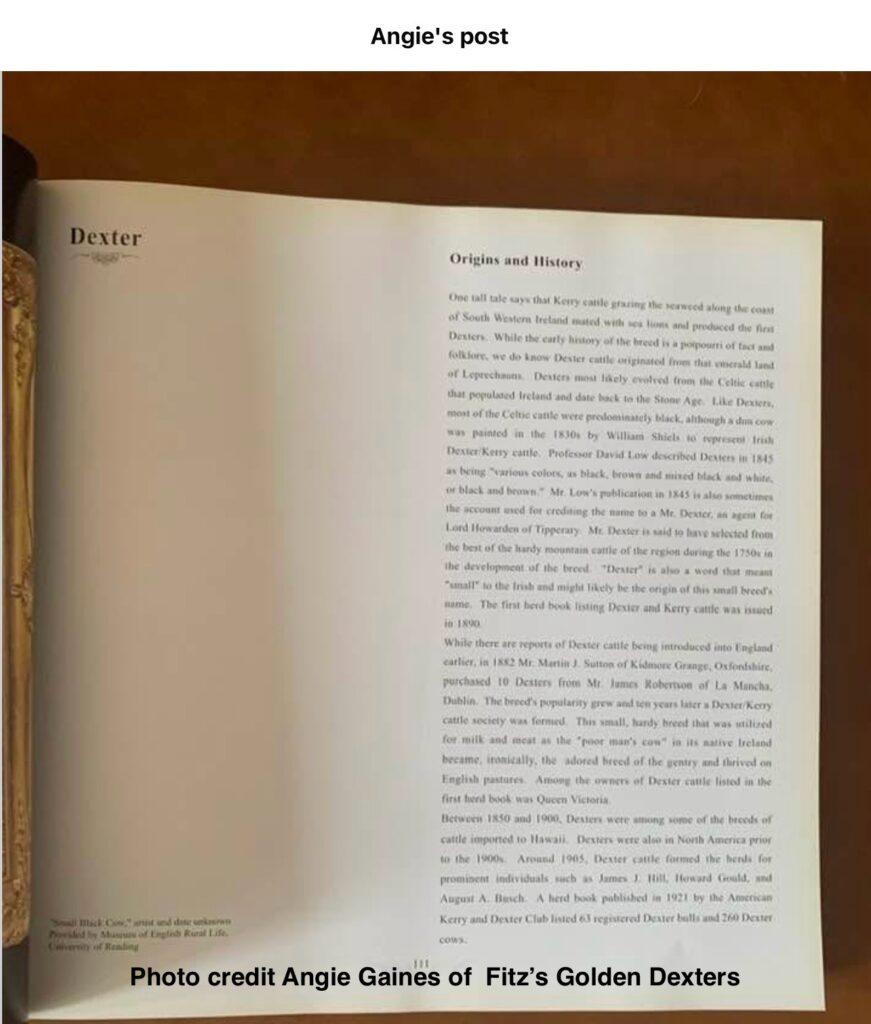
She posted these on a Facebook group she created called the Horned Dexter Cattle and called for Dexter owners and breeders to show what books they had in their libraries. This sparked several breeders to chime in and post on their sites. Dexter owners are very protective of this breed! Below are photos from several Dexter folks with their cherished books. Included are their names and farm names, incase you want to reach out to them. The imposters are the featured image here.
‘But, if you are looking for REAL information on Dexters, the breed and how to care for them, please consider supporting Irish Dexter Cattlemen by subscribing to one of our many membership levels.
Consider spending your money with a team that is working for you, with hundreds of vetted articles, podcasts and videos, stored in an easy to use, farmer designed, Multimedia Relational Database System that you can search thru with just a word or phase. An example: type in “minerals” and 9 different vetted articles show up for you! What’s in this Multimedia Relational Database System which we call the Gazette? ● Links to articles all over the Internet ● Educational, informative videos every farmer should see. ● Agricultural magazines ● Books in an online flip style format you can read on any of your devices. ● Journals produced by your favorite registry in online flip style format. ● Links to interesting podcasts for listening while working or driving. ● Blogs produced by experts in agriculture ● Historical material and Registry Herdbooks. All of it organized by your particular area of interest, like Farm Management, or Herd Health, or Milk & Dairy, or Historical, or Selling & Marketing, or Homesteading, or New to Farming, or Farming Technology. Because it’s a Relational System, it’s also organized by topic, like grazing, milking, organic, regenerative, fencing, irrigation, breeding, and many more. Use the code DEX50for our March special 50% Membership Discount on any membership level! … But you may want to check out our Classified Listing System and all of our levels of membership and find an even better option for you and your farm. At the Breeder level…you can sell anything off your farm…heck even the farm!
The original Gazette, published by the Royal Dublin Society, was a “Register of Pure Kerry Cattle and Dexters” in Ireland and three years later became the Kerry and Dexter Herdbook, with volume 1 appearing in 1890.
This new, updated Irish Dexter Cattlemen Gazette, first published in 2024, is not so much about the Dexter cattle. It is more about Irish Dexter Cattlemen, livestock farmers and ranchers throughout the United States, Canada, Mexico, England, Ireland, South Africa, New Zealand, and Australia.
While Irish Dexters are in some respects superior as a stock, owing to the taste of their meat and milk, the tenderness of their beef, easy calving, mild mannerism, as well as their hardiness. It was stated by His Excellency Lord Eglinton, ‘they are the thoroughbreds of cattle’. That is what we think is true about Irish Dexter Cattlemen farmers and ranchers, they are the thoroughbreds of cattlemen. This is what this Gazette, using modern technology, is all about.
This Gazette is an easy-to-use, multimedia relational database system for members providing a guide for you, the farmer and rancher, using the best technology available to answer to your questions, display information to assist you with your operation, and give you access to a collection of resources not available else-ware. As an online multimedia relational database, the Gazette structures information into areas of interest so that you can focus on topics about which you are most interested. These areas of interest are what we call Community Groups: Farm Management Community, Beef Community, Milking & Dairy Community, Herd Health Community, Historical Community, Selling Community, and Technology Community. These Community Groups are led by Community Directors, experienced farmers and ranchers, who scour the Internet looking for information that is of interest to their specific community group. That information is posted here in the Gazette in the form of:
Original posts from content creators, farmers and ranchers like yourself,
Posts from industry experts,
Online digital magazines,
Irish Dexter Registry publications,
Independent podcasts
Video providers,
Farming and Ranching Guides,
Historical Herdbooks,
Topical books on farming and ranching
This Gazette has taken years to develop by technology experts, who are also farmers and ranchers like you. It takes a lot of time, energy, knowledge, and resources to produce and maintain. If you have a passion for what you do and are looking for ways to make your farm or ranch even better, we would love for you to become a member. Your membership helps use to help you. Join using the links in our free monthly Tips & Tricks Guide, or using the links on our website Home page.
Members automatically gain access to additional functions or tabs of the Gazette:
Communities
Magazines
Guides
Herdbooks
Journals
Cowgirls
Cowboys
All the information on the Irish Dexter Cattlemen website is dynamically formatted to fit any device you might have in your pocket, in your hand, on your tractor, in your car, in the cup holder of your ATV, or on your desktop.