Broken Arrow “A” Livestock

Broken Arrow “A” Livestock is a small farm in Southwest Iowa owned and operated by Aaron and Erica Lantz and their two sons.  Aaron represents the 5th generation of Lantz’s who have produced livestock on the property since 1872.  In 2009, we decided to begin producing our own pork because we were disenchanted with purchased commercial pork.  Aaron’s father and grandfather both raised hogs in a 60 sow farrow to finish program as he was growing up.  In the 1970’s and 1980’s, their program was to buy a non-descript black hog out of Missouri known locally as “Missouri Acorn Hogs”.  They were an old lard-type crossbred hog that could be purchased cheap.  They had excellent mothering abilities and when crossed with Farmer’s Hybrid boars, produced strong litters of hogs that performed well.  These hogs were fatty, but not necessarily fatty enough to be considered a lard style hog.  Beginning in the 1980’s, buyers would dock these hogs as being too fatty in favor of leaner breeds.  For a while, it was worthwhile to take a dock at the buyers and justify the loss as the price paid for ease of management.  Eventually, these hogs were refused at the buyers and we had to stop raising them since there was no way to sell them.  We retained gilts from our program and began introducing leaner breed boars.  We used various breeds to build our program including:  Hampshire, Landrace, Duroc, and Berkshire.  Every two years we would retain new gilts and buy a new breed of boar from a reputable breeder to maximize heterosis.  Eventually, even these hogs did not meet market demands and we were forced to stop raising them.  Eventually, these hogs were sold and the Lantz family purchased Yorks and began raising a true commercial hog.  This endeavor was short lived, since the hog market crashed in the late 1990’s and the family decided to exit hog production entirely. 

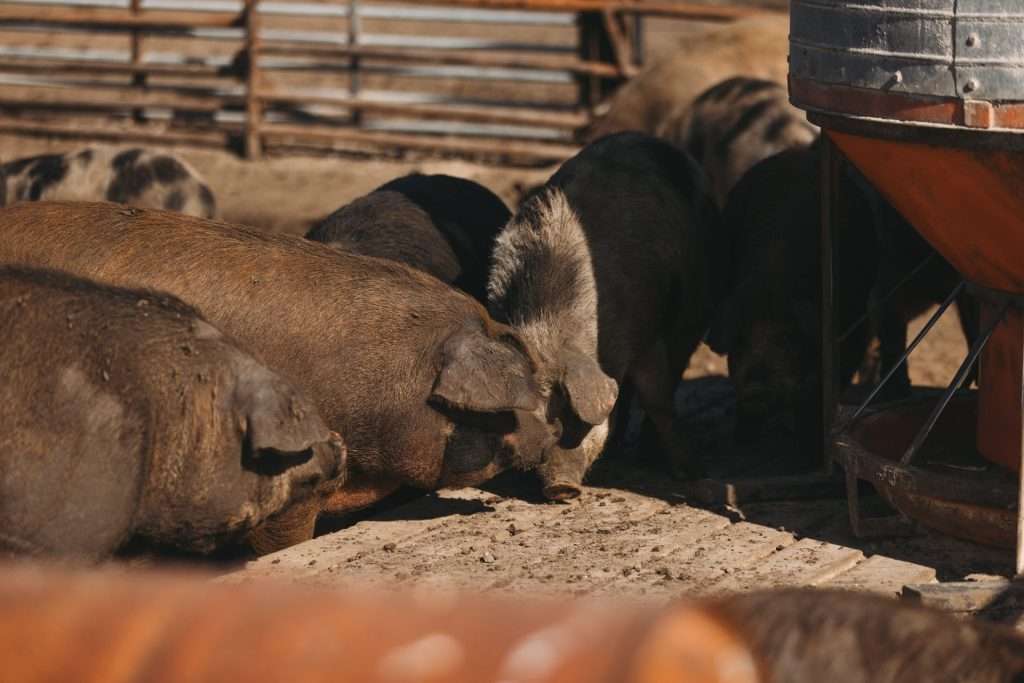
Aaron knew what good pork was supposed to taste like, but it wasn’t possible to replicate the breeding program originating from the Missouri Acorn Hog sows and Farmer’s Hybrid boars.  We had an ideal carcass in mind and began researching which heritage breed would most likely result in the ideal carcass type.  This lead us to purchase our first Red Wattles in 2009.  We learned quickly that Red Wattles are VERY large and between the slow growth curve, small litters, and large feed inputs…we would be challenged to be profitable.  However, we also found that we absolutely loved the carcass.  It is not as deeply red as Berkshire, but has a rich and distinctive flavor with an ideal balance of fat.  We decided that Kune Kune would be a good compliment to the extreme size of the Red Wattle without compromising carcass quality or the docility and easy handling nature of the hogs.  Red Wattles are thought to be a Polynesian breed that made it to New Orleans by way of the French and the breed was resurrected from wild hogs used to homestead Texas.  Kune Kune are also Polynesian and share some attributes like wattling, so it made sense to us to make the cross.  This launched us on a path of dialing in our genetics with the goal of achieving the perfect carcass using a hog ideal to manage.  We have strategically introduced the following breeds:

  • Mangalitsa for carcass attributes including a low collagen fat complex.  This breed can be challenging to raise in the summer heat of Iowa and can be challenging to handle. 
  • Iowa Swabian Hall is a similar composite program to our own and we sought to add the work done by other breeders to consolidate the value.
  • Meishan was introduced for their prolific litters and early maturation in addition to carcass flavor attributes and fat distribution in the carcass.
  • Mulefoot and Ossabaw are Spanish type genetics known for their carcass complex ideal for curing. 
  • Gloucestershire Old Spot and Large Black are old British breeds known for their balance of carcass attributes and management attributes. 
  • A very small amount of Berkshire was used in the program.  To obtain the genetics we sought, we sometimes had to use crossbred animals.  Berkshire is a popular breed to make heritage type crosses and, while we didn’t actively seek to use Berkshire specifically, we were not opposed to these genetics for their carcass color and flavor attributes. 

At first, we had a significant amount of variety in our crossbred animals.  After having obtained the genetics we thought we needed to create the ideal hog, we closed the program.  We didn’t actively make a decision to close the program, but rather ran out of need to obtain animals from outside programs.  To standardize our hogs, we began using a program to select for replacement breeding stock within our own herd and rotating males and females strategically to use linebreeding to concentrate ideal attributes in a consistent “type”.  We’ve maintained this program for approximately the last 10 years.  We still get some variety in the offspring, but we are becoming more consistent for type and performance with each rotation.  The program goes as follows:  We obtain a group of like gilts the same age.  The goal is to start with 40 gilts, but cull over the coarse of 3 litters to the 10 most ideal and productive females.  We retain the boars we were using for the previous breeding that sired the current group of gilts.  We use those boars on the new group of gilts for one breeding.  There is a chance a sire could breed a daughter, but the pairings are left to chance and often times the boar that breeds any given gilt is not that gilt’s sire.  From this first set of litters we select 6-9 boar prospects and begin growing them with the intention that 2-3 of these will be used to propagate more breeding stock.  We get a second set of litters from the aged boars and all of those offspring are terminal.  We will sell breeding stock females from this group that people can use in their own “heritage type” programs.  After the second set of litters we cull the older boars.  The younger boars take over for the third and fourth sets of litters.  This means that the new boars are sons of the females used to breed.  Again, random pairings ensure some genetic diversity and there is no guarantee that a son breeds his dam…though it is possible.  The third set of litters is also terminal.  We don’t save anything from these litters, but we do assess their quality and use this to arrive at our 10 best sows.  It is from these sows bred to the new boars that we save back a new group of 40 females and begin growing them.  We will get a 5th and 6th set of litters from the older sows so that we remain productive while growing the replacement gilt group, but these offspring will all be terminal.  It is at this point we part with all the older female breeding stock and start over with the same boars we’d been using and a new group of gilts to repeat the process again.  Each cycle, we select animals that meet our ideals and the offspring become more consistent in type and performance.  Because random pairings are utilized, this program can be maintained indefinitely with little detriment to the performance of the hogs and over time the risk of recessive disorders cropping up decreases.  We are just very careful to cull any animals that produce issues and only select ideal animals to reproduce.  Eventually, we will have achieved a proprietary “landrace” breed that we could consider recognizing as a true breed.  At this time, creating a new, recognized breed is not part of our plans.  We are just happy to raise a hog that we are proud to feed our family with.

Producers wishing to obtain genetics have lots of options for utilizing those genetics to benefit their personal production goals.  We suggest breeding our seedstock to Hereford, Tamworth, Berkshire, or Idaho Pasture Pigs.  These breeds are complimentary and offer lots of heterosis.  We are very confident in performance and carcass quality.  We expect our hogs to grow to a normal marketable weight at about 300 lbs with a reasonably significant fat layer without being excessive and low in collagen.  Meat should be darker complected (though not as dark as to be comparable to beef or called “red”) and show good marbling with a texture and juiciness more comparable to beef than to commercial pork.  Cuts will be disproportionate in size to comparable commercial breed cuts, because these heritage-type hogs will flesh and grow differently with a different frame structure that impacts cut size and shape.  The flavor should be rich and distinct.  While not technically either “beefy” or “porky”, the flavor should parallel the mouth appeal and richness of beef though it is not the same flavor as beef.  Producers could also choose to breed to any of the genetics used to develop these hogs in an effort to strengthen certain key attributes.  Breeding to Red Wattle, Iowa Swabian Hall, or Mangalitsa are good choices to enhance management attributes while keeping the carcass attributes of the paired breed.  Really, these hogs are very versatile and could be successfully leveraged to add benefit to just about any program with any goals.

Erica Lantz 

Feeders Grain & Farm Supply Inc 

2052 Hunter Trail 

Corning, Iowa 50841

P: 641-322-4011

Leave a Reply

Enable Notifications OK No thanks