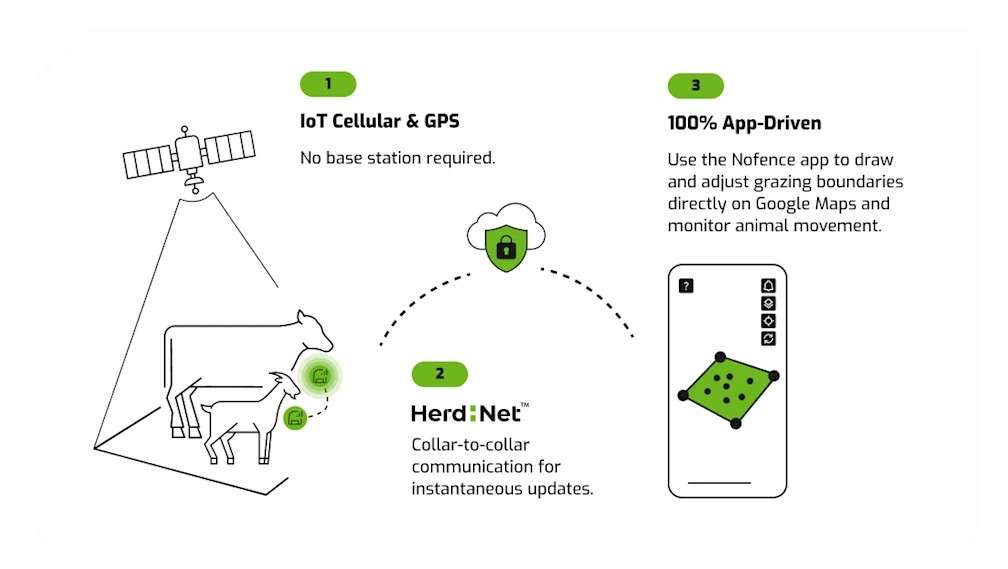
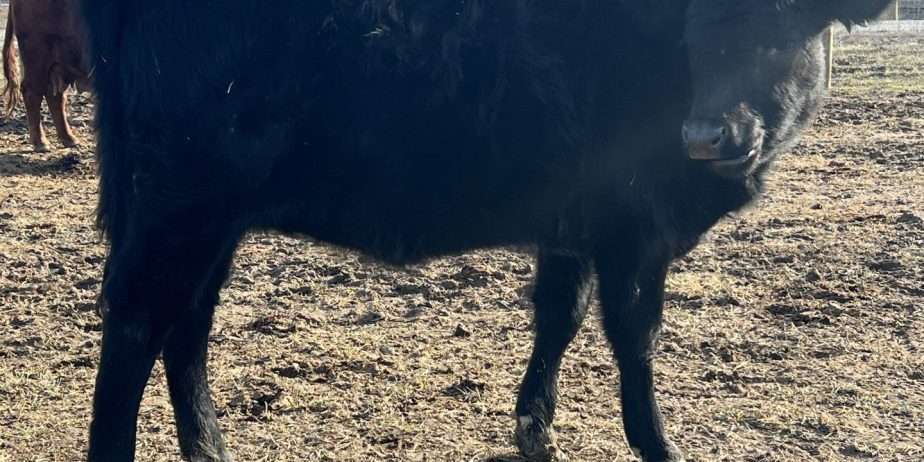
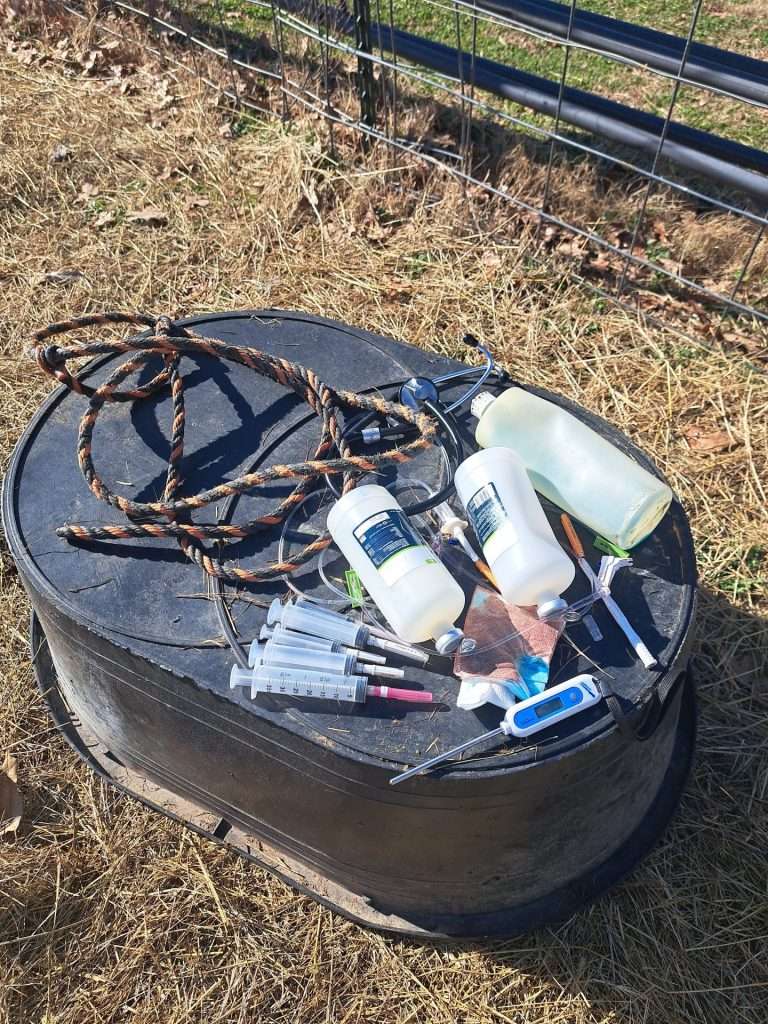
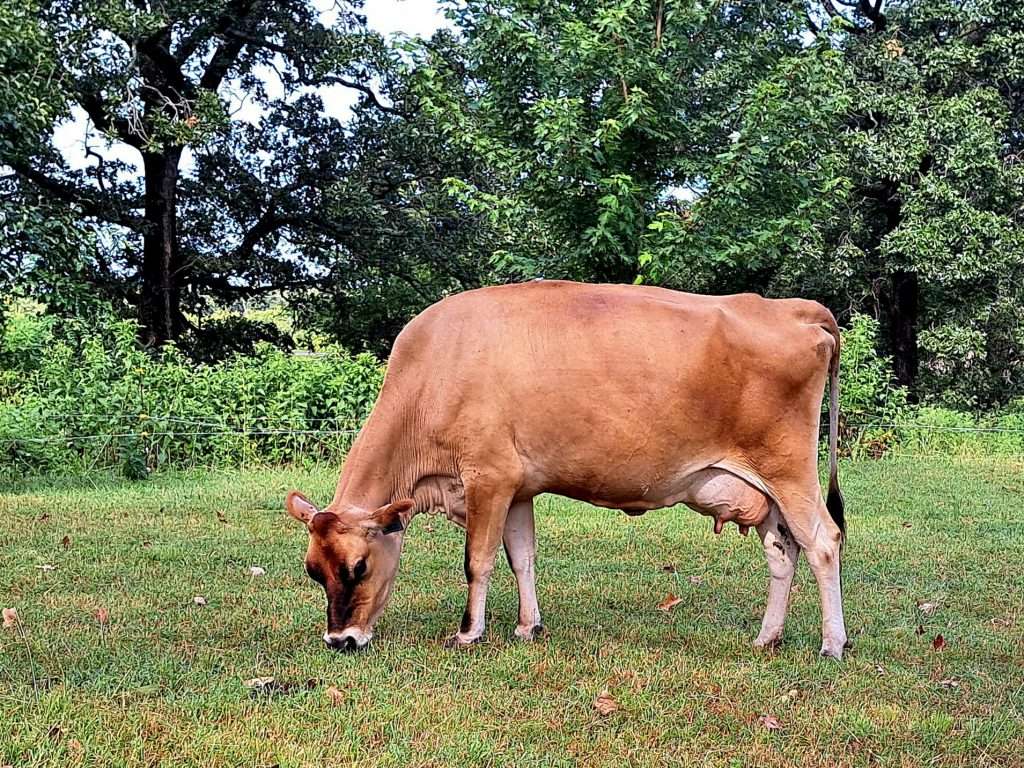
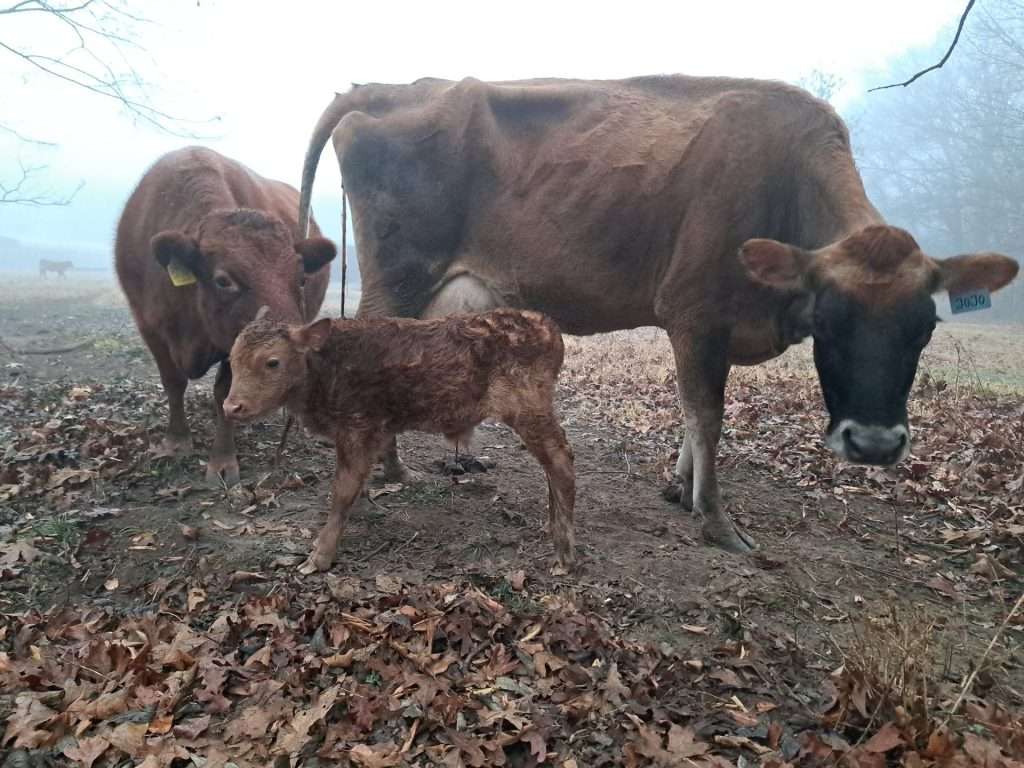
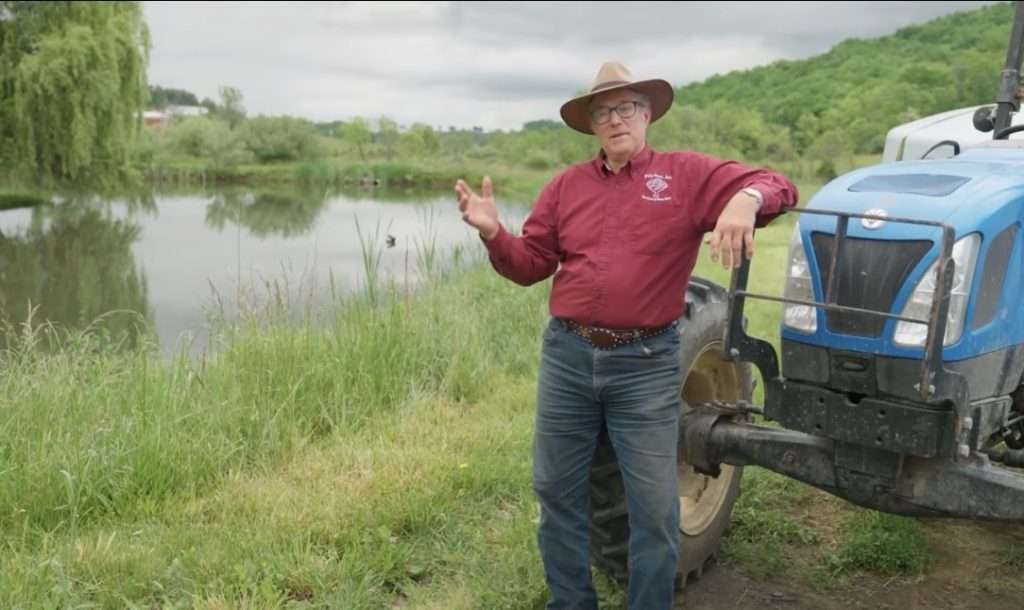
Nofence creates invisible boundaries that safely contain livestock without physical fences. Each mature animal wears a GPS collar that tracks its location and guides it within the virtual pastures you define in the Nofence app. The system combines GPS positioning, cellular connectivity, escalating audio cues, and gentle electric pulses to form a reliable and flexible fencing solution.
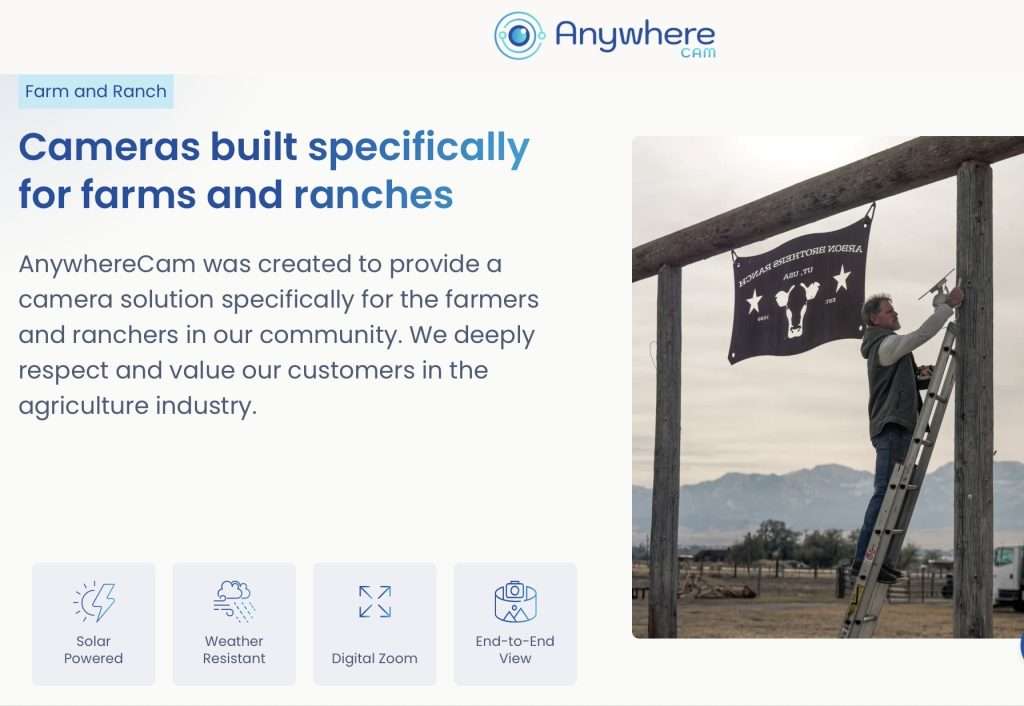
Technology continues to improve the way we can do things on our homesteads, farms and ranches giving us advancements in how we can monitor our precious Dexters. Here is a company that offers a solution.
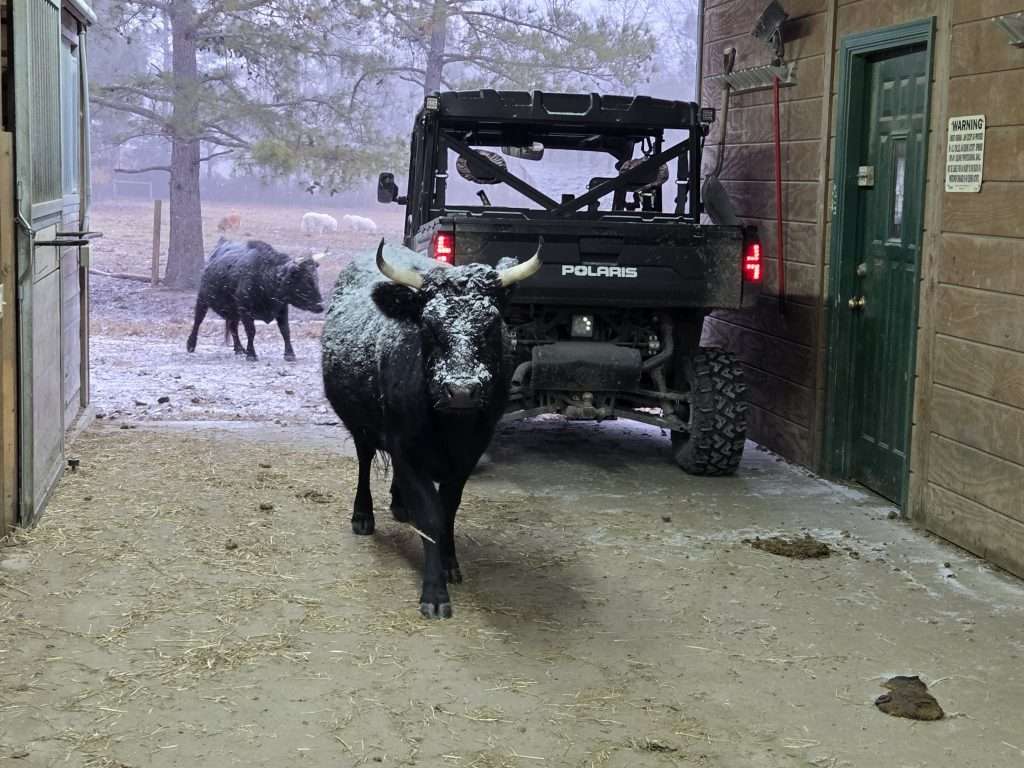
Dexter cattle have a well-earned reputation for being hardy, efficient, and capable of handling conditions that challenge many larger beef breeds. That reputation draws new owners in. It can also quietly set them up for trouble if it leads to the belief that winter preparedness is optional.
It is rarely the Dexter cattle that fail in severe cold. It is systems.
And occasionally, knees, fingers, and judgment before the second cup of coffee.
This article is written as an educational resource for farm organizations, breed associations, and new Dexter owners who want to build operations that function reliably when winter conditions are at their worst. It blends research-based guidance with practical, on-the-ground experience, because winter does not care how things looked on paper in July.
Understanding Dexter Cattle and Cold Stress
Dexter cattle tolerate cold well due to their dense winter coats, efficient metabolism, and generally lower maintenance requirements. Cold tolerance, however, is not immunity.
Research consistently shows that cattle experience cold stress when environmental conditions force them to burn additional energy to maintain normal body temperature. Wind, moisture, inadequate calories, poor body condition, and limited access to water all accelerate this process. Over time, cold stress can lead to weight loss, suppressed immunity, and reproductive impacts.
Dexters can handle winter. Winter still has rules.
Preparedness Starts With Farm Design, Not the Forecast
The most difficult winter situations occur when chores become reactive instead of routine. A well-designed farm reduces emergency labor. A poorly designed one forces risky decisions during storms.
Preparedness begins with infrastructure choices made long before the first weather advisory.
Water Infrastructure: Design for Failure, Not Convenience
Water systems are the most common winter failure point on livestock farms.
Water lines do not fail politely, during daylight, or when conditions are mild.
Water lines
Must be buried below local frost depth, not estimated depth
Long runs to remote pastures increase freeze risk
Fewer reliable water points outperform many marginal ones
Hydrants and valves
Freeze-proof hydrants must be installed correctly with proper drainage
Gravel beds must remain uncompacted
Low areas prone to runoff and drifting snow should be avoided
Heated water troughs
Use livestock-rated heaters only
Protect wiring from moisture and rodents
Always plan for power loss
Solar water systems can work well when designed properly, but winter realities must be considered. Battery capacity must account for short daylight hours, panels must shed snow, and output will be reduced during prolonged storms.
A water system that works flawlessly nine months of the year can still become a liability if it requires wrestling frozen hardware in the dark while livestock observe quietly and reconsider their respect for you.
Power Systems: Assume the Grid Will Fail
Winter storms routinely knock out power for days. Generators should be considered core farm safety equipment, not optional upgrades.
They are rarely purchased because everything is going well.
A generator should be capable of supporting:
Well pumps
Heated water troughs
Essential barn lighting
Minimal equipment needs
Fuel storage should cover multiple days of operation. Electrical layouts should prioritize critical systems and protect wiring and outlets from moisture, snow, and rodents.
Electric Fencing in Winter Conditions
Electric fencing behaves differently in cold weather.
Grid-powered chargers are vulnerable to outages
Frozen ground reduces grounding efficiency
Snow and ice can short fence lines
Solar chargers provide valuable redundancy but must be sized for winter conditions and maintained during snow events.
Frozen ground has very little respect for even the most carefully installed grounding systems.
Redundancy matters more than strength.
Farm Layout and Human Safety
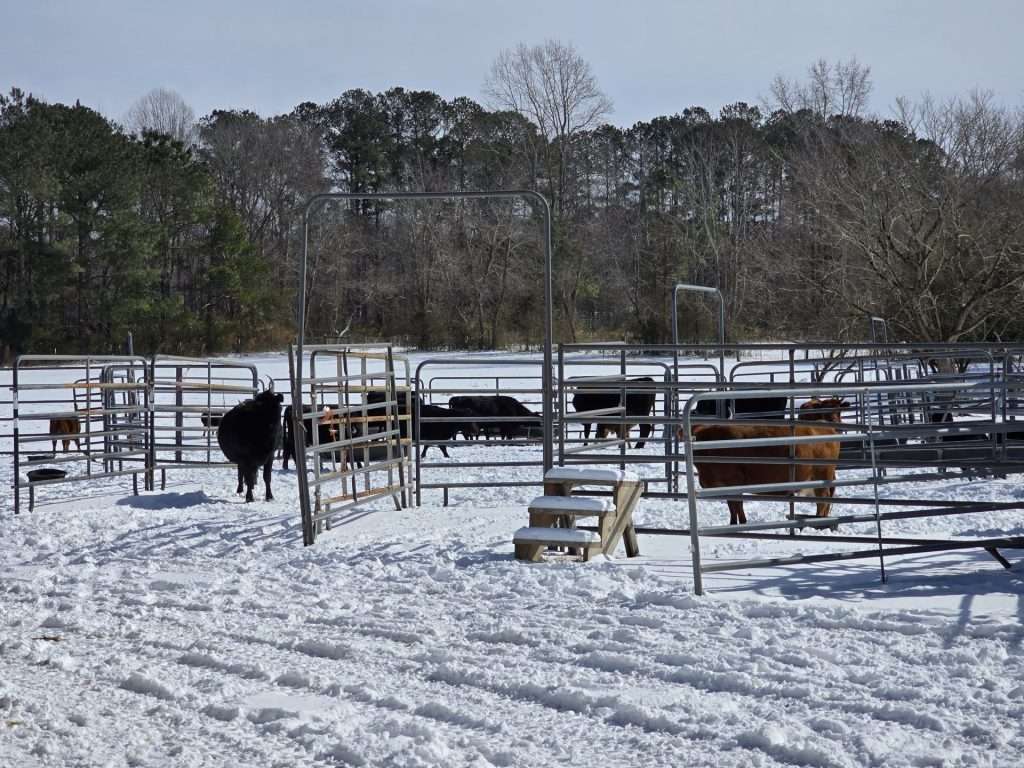
Dexter cattle generally move through snow with impressive confidence. The person carrying feed across ice often does not, even when wearing boots marketed as “winter rated.”
A winter-ready farm layout:
Places water, feed, and shelter within safe walking distance
Avoids slopes and shaded areas that ice over
Uses natural windbreaks around feeding and watering areas
Does not rely on vehicles for daily care
Farm layouts designed on pleasant spring afternoons tend to reveal their weaknesses during January wind events.
Feeding and Watering During Extreme Cold
Cold increases energy requirements. Research indicates cattle may require 7–10% more energy for each degree below their lower critical temperature, particularly when wind and moisture are present.
Preparedness includes:
Staging hay before storms
Reserving higher-quality forage for calves, seniors, and thin animals
Reducing unnecessary cattle movement that increases energy loss
Water intake must be monitored closely. Frozen or inaccessible water leads directly to reduced feed intake and increased cold stress.
Human Safety Is Herd Health
Human safety is often discussed last, despite being the single point of failure that immediately compromises animal care.
Dexter cattle may be perfectly comfortable standing in a snowstorm. The person doing chores is the variable.
Most winter injuries occur due to slips near water sources, fatigue, rushing, or poor visibility. Clothing, lighting, rest, and task consolidation are safety requirements, not luxuries.
Knowing When to Pause
Preparedness includes restraint.
No routine chore improves outcomes when visibility is poor, footing is unsafe, and the operator is one misstep away from becoming the emergency. Calm, consistent care is safer and more effective than heroic effort.
Dexter cattle are resilient. Winter preparedness is not about proving toughness. It is about designing systems that still work when conditions degrade and the person doing the chores is already tired.
Final Perspective
Dexter cattle are resilient. Farms must be designed to match that resilience.
Extreme winter weather does not test commitment. It tests whether systems were built to function when conditions deteriorate. Preparedness is not bravado. It is making sure that when winter does what winter does, both cattle and caretakers come through it intact.
And preferably upright.
Michele DeVinney Schmoll is a Virginia farm owner at DeVine Farms Quality Dexters. She raises Irish Dexter Cattle and writes from firsthand experience, because farms don’t read instruction manuals. http://www.devinefarms.net/
Author’s Note
This article is written from a practical livestock-owner perspective, informed by university extension research and shaped by real-world experience managing animals during prolonged cold, power outages, and severe winter storms. The intent is not to present idealized systems, but to encourage farm designs and management decisions that reduce risk for both cattle and the people responsible for their care. Preparedness is most effective when it reflects what winter actually demands on the ground.
REFERENCE LITERATURE (CLICKABLE LINKS)
Cold stress basics, winter readiness, and management
1) University of Minnesota Extension — Preparing your cattle for severe winter weather
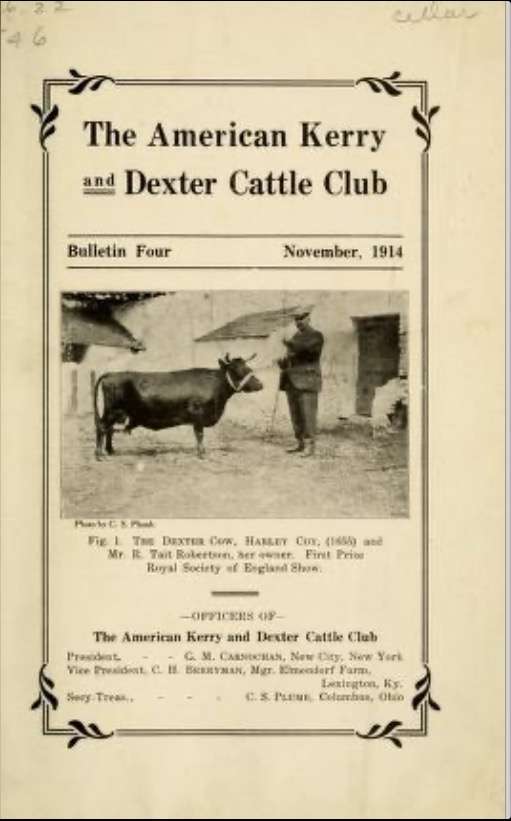
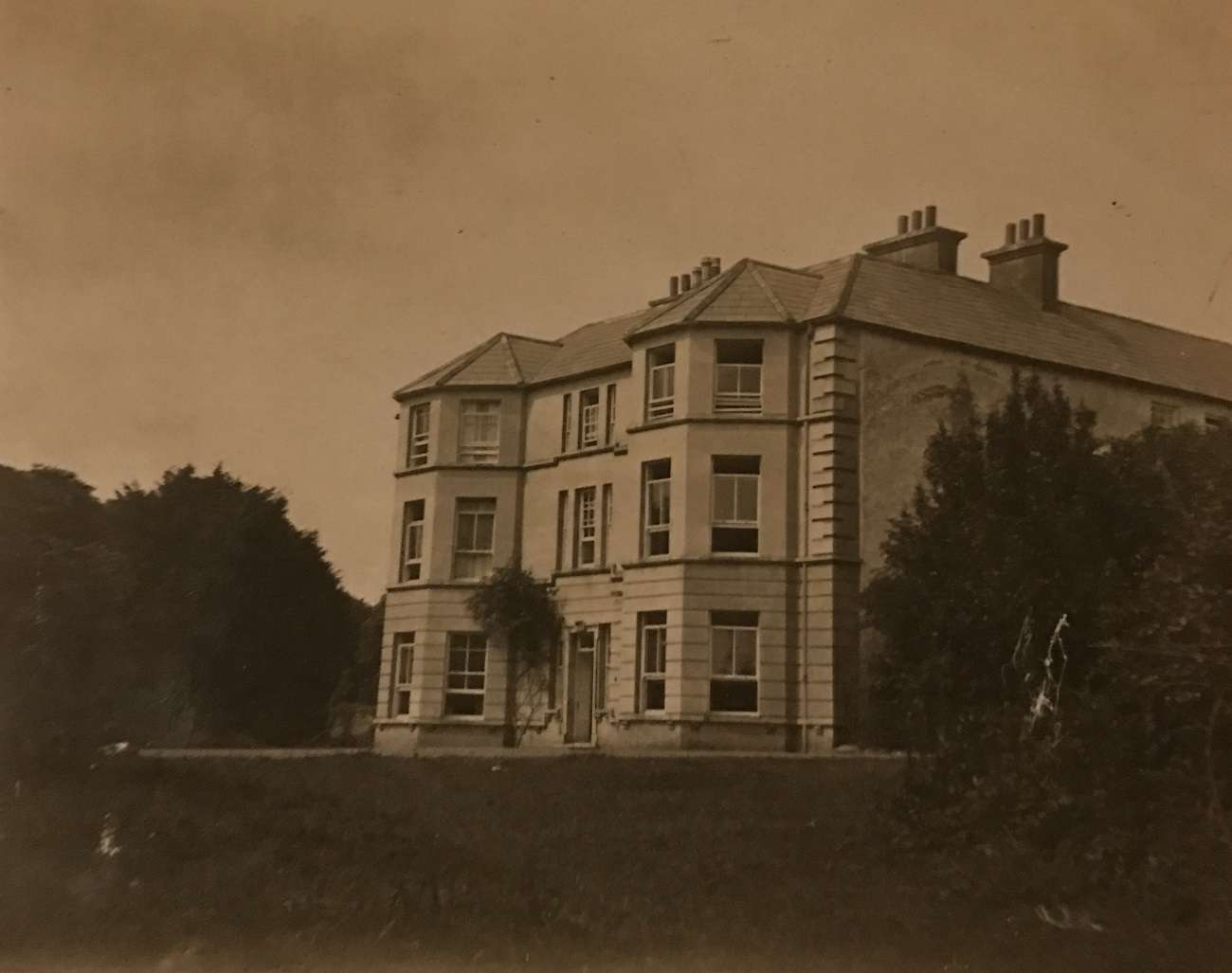
I usually like to start these articles with a picture of a Dexter cow from the past, that will be the focus for the historical adventure, as we travel back in time. But sadly, this time I have no beautiful and memorable cow to set the tone, as one could not be found for a lasting memory. Instead, I will show you a photo of Chute Hall. Chute house was thought to be built in the eighteenth century. In 1906 Chute Hall was documented to be owned by Rowland Chute. Rowland E. Chute owned it along with an additional house by the name of Leebrook House on the same estate. It remained in the family until 1930. Chute Hall was demolished in 1957 and no longer remains, but the memory of Leebrook House lives on in the Ballygarry House Hotel that has come to replace it. You could travel there for a nice stay in the beautiful hotel. Why is Leebrook significant? It was the herd name associated with Rowland E. Chute, who was a landed gentry in country Kerry. He was actually a judge for the Royal Dublin Society allowing Dexters to be entered into the herd books. The lack of history on his herd and the small bit of information that can be found is reveling to why the name of the Leebrook herd never took off.
Just How Hardy are Dexter Cattle?
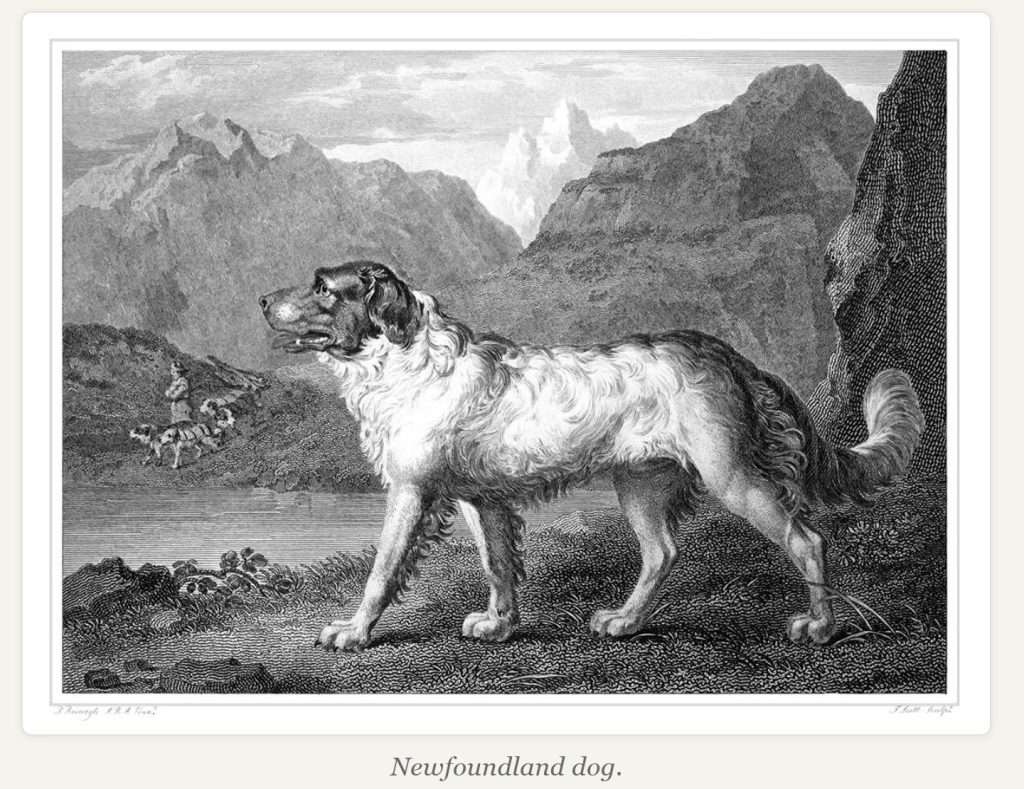
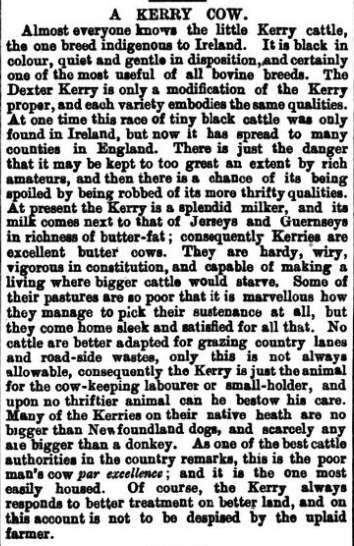
I speak a lot on the hardiness of the Dexter breed. Reminding people that they have been historically known to get by on less, endure hardship and stay productive where other cattle may not. As this above article states “They are hardy, wiry, vigorous in constitution, and capable of making a living where bigger cattle would starve. Some of their pastures are so poor that it is marvelous how they manage to pick their substance at all, but they come home sleek and satisfied for all that.” But, as responsible cattle breeders we must also balance this knowledge with the full responsibility that we must care for the nutritional needs of our animals. So that no new cattle owner may exploit the hardiness of the Dexter to such extremes of nutritionally depriving their hardy livestock, I wrote this article as a historical reminder of where this can go. Dexters in Ireland were naturally small for many reasons, some described as no bigger than a Newfoundland dog. Some of this is genetics while some may actually be due to a lack of proper nutrition in extreme situations. In England on the fertile land where they were pampered by English Aristocrats it was a known fact that the Dexters grew larger and fattened better. Some of this to the benefit of the Dexter, while some may have been a bit more pampered than they may really have needed. Balance over all is good for animals, providing adequate nutrition to be productive while letting them work for their food by grazing and giving them a proper environment to do so. A balance fosters good health while retaining their hardy genetics so that they may best serve their owners with reliable productivity.
What Lesson may we learn from Rowland Chute?
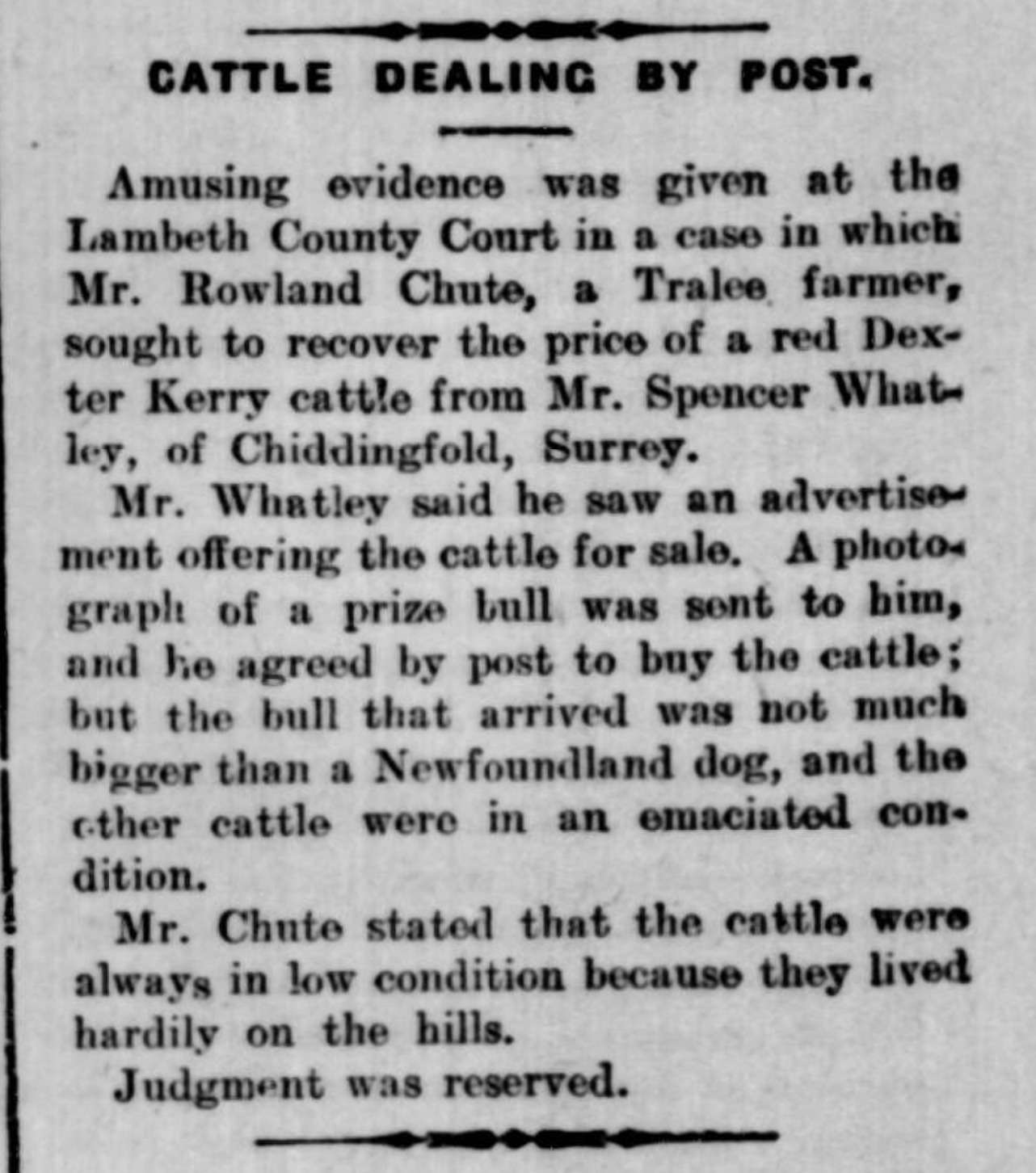
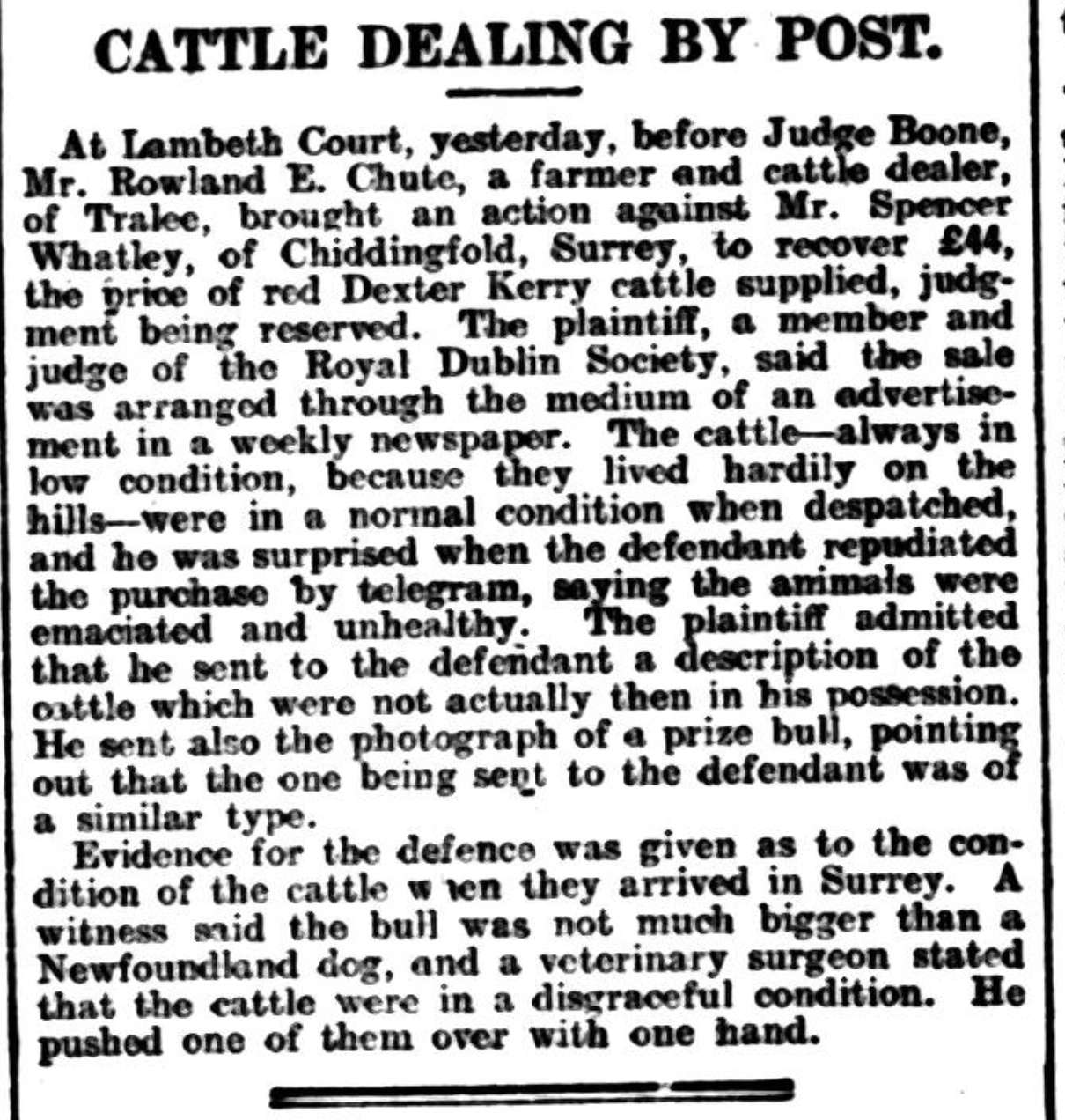
Here we will see the significance of Rowland Chute in my historical wanderings of Dexter cattle. Rowland Chute sent a photograph of a prize-winning bull (I wish had that photograph) to a prospective buyer, Mr. Spencer to help persuade him into buying his cattle. I tried to research and find information on what bull this could have been but turned up no results when looking for a Leebrook (Chute’s herd name) bull, so I must assume that the bull was of a different registered herd name. It sounds as though Chute may have sent a picture of a prize-winning bull and the buyer may have purchased stock thinking they would resemble the bull in the photograph. What the buyer received was in no wise up to his expectations but rather “not much bigger than a Newfoundland dog, and the other cattle were in an emaciated condition”. Chute’s response was “that the cattle were always in low condition because they lived hardily on the hills”.
A Vet Stated the Dexters were in a Disgraceful Condition
Chute claimed his Dexters were in “normal condition” because the cattle were “always in low condition, because they lived hardily on the hills”. Chute was surprised to hear the animals were emaciated and unhealthy but then admitted that he sent a description of cattle that were not actually in his possession. Instead, he sent a photograph of a prize bull! It does cause the mind to wonder where these animals may have been obtained from, just wondering the hills waiting to be snatched at the moment a perspective buyer was found. Witnesses definitely backed up the claim of the poor condition of the Dexters. Most importantly a veterinarian said that they were in disgraceful condition. Those are strong words; he did not just say they were in low condition but disgraceful! The bull was not much bigger than a Newfoundland dog. A male Newfoundland dog may weigh as much as 150 pounds and stand at 28inches tall. To consider the size of a Newfoundland dog see the story here where a Newfoundland Dog and a little Shetland Pony similar in size “have struck up an unlikely friendship”. https://www.chroniclelive.co.uk/news/north-east-news/newfoundland-dog-forms-unlikely-friendship-21682333
The Final Verdict for Rowland Chute
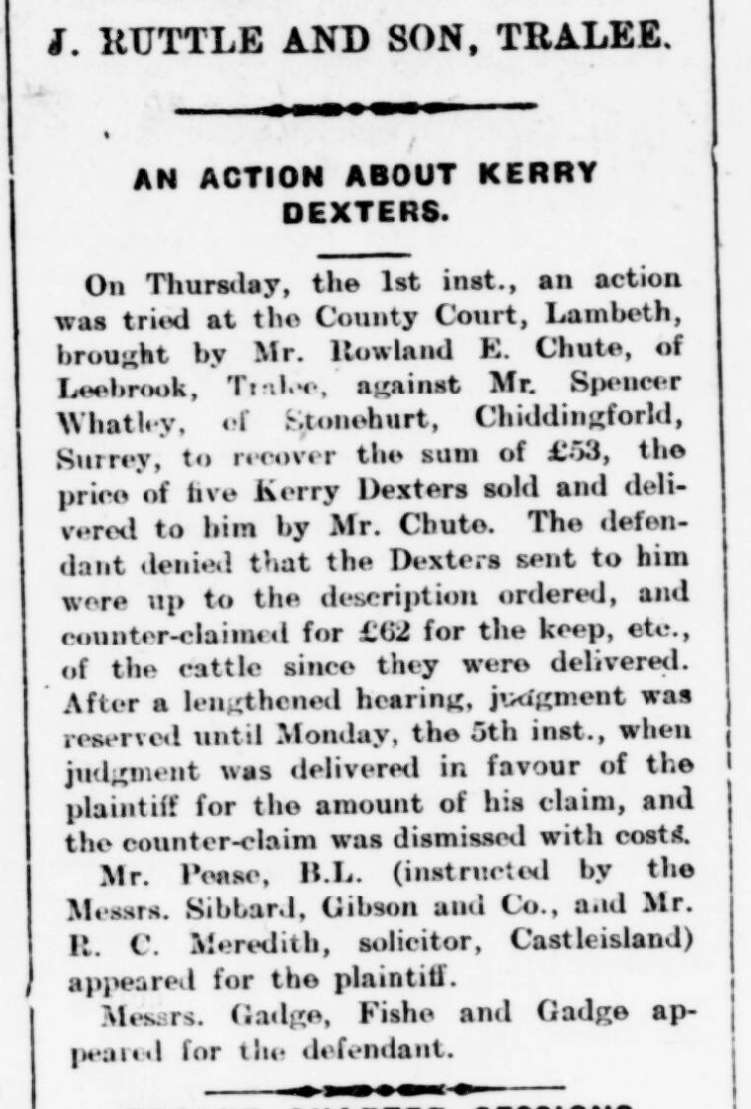
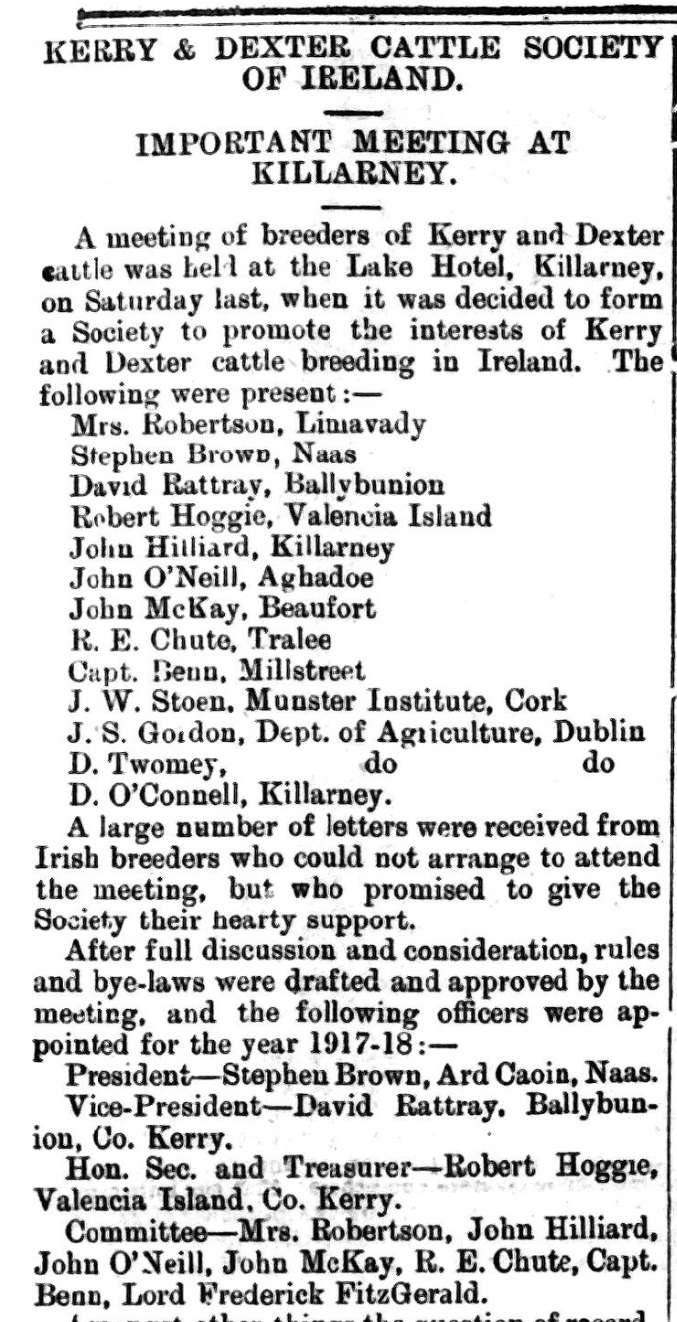
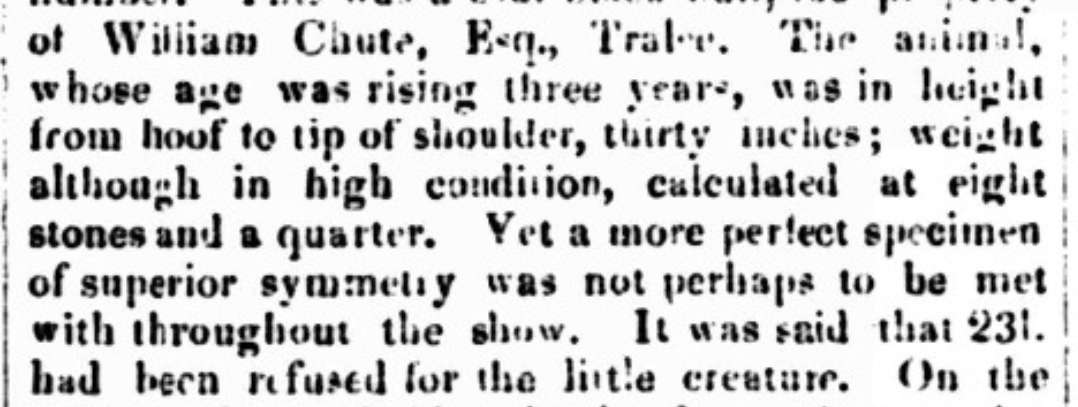
In this article Rowland Chute, the plaintiff was requesting £53 to recover the cost of the Kerry Dexters sold to Mr. Spencer Whatley. Mr. Watley countered that Chute should pay 62 £ for the keep of the unfit cattle upon their arrival since they were delivered. The County Court, Lambeth delivered in favor to Chute awarding him his claim of £53 and dismissing the counter claim from Mr. Watley. Mr. Rowland Chute was vindicated that day of his charges, but a further look into the Herd books shows that Rowland Chute had a very limited future with Dexters. When I searched for records, I found only 3 registered cows with the prefix Leebrook. Leebrook Cush, Leebrook Darkie and Leebrook Stella. All of these three cows were owned and bred by Rowland E. Chute and Qualified by inspection. If I were to guess they were possibly inspected by Mr. Chute himself since he was a judge for the Royal Dublin Society. None of these cows show any offspring that I can find. One cow’s date of birth is listed as 1898, the other listed as Dec 11, 1898 and the last Dec 20 1898. I later found Chute appointed an officer for the “Kerry and Dexter Cattle Society of Ireland” in 1917 written in the Kerry Evening Post. For a man who was so involved with Dexters, appointed a judge and an officer, he has a very small number of Dexters registered to his name and you can’t but wonder if his cattle that were once said to be “in a disgraceful condition” had something to do with why. If a breeder wants to stay long in breeding any form of life one must attend to its needs and we must never give hardiness as an excuse for a true form of neglect. I will not develop any conclusive opinion on Mr. Chute as there were some incredibly small Dexters in Ireland, as I said before partially due to genetics and diet. Chute was said to have had a bull that weighed 8 stones and a quarter (115.5 pounds). The 3-year-old bull measuring at 30 inches from hoof to tip of shoulder was said to be in high condition. The comment was made in reference to this bull, “Yet a more perfect specimen of superior symmetry was not perhaps to be met with throughout the show.” This bull I will wager was the prize bull that was previously mentioned. It is fair to say that most Dexter owners will want a Dexter to fatten out at a larger weight than 115 pounds, live weight and if properly taken care of you may nearly guarantee today, whatever type of Dexter you raise, they will by 3 years old.
Chute Apointed Committee Officer for The Kerry and Dexter Cattle Society
Perfect Specimen of a Dexter Bull weighing 115.5 pounds
My full intent in researching this information was to be thorough, but I also know that the history of Dexter cattle is extensive and recognize that even with every good effort I could possibly be missing information in my research to enlighten us on the situation of Rowland Chute. I will take no hard line in conclusion on the matter of Mr. Chute but rather leave it in the hands of the reader.
-Danielle of Bryn Mawr
Information may not be reproduced without giving credit to the author.
Here is a good video that gives you some food for thought. Interesting history on the price relationship. Are we valuing our Dexters herds like history has valued the cattle market?
Another thing to think about is we produce a dual purpose animal. There’s value in both the milk and the meat!! This video is really speaking only to the meet when you add the milk and it’s value you get a whole different perspective.
Buy the cattle. How often in life do you just do something that you later think, what the heck did I do? Roll the dice and see what comes up. That wasn’t me. I thought it over. I had a plan. When you have a plan, it always works. At least I try to convince myself of that.
I had the land. 40 acres of woods and pasture. My dream come true. A small turnout attached to the horse stables within spitting distance of a 3 acre pasture. The turnout has 4 rail iron fencing and the pasture has 3 strands of electric wire. The perfect place, in my mind, for my new Dexter cattle.
I had read, multiple times, that Dexter cattle are easy on the land. Smaller, lighter, and easy grazers. A cow per acre, I should be golden. Start small and grow.
Electric fencing, for me, was a nonstarter. I get it. The cattle respect it when trained. It is cheaper than other alternatives and easy to install. One small problem. I don’t like getting shocked. If I don’t like it, my cattle sure as heck won’t.
As a teenager, my cousin, Kevin, and I were raccoon hunting in my Pappy’s woods. Let me amend that. We were chasing our coon dogs through the woods who were chasing deer. The raccoons were very safe.
Kevin announced that he had to take a potty break. It was dark and I pointed my head lamp on anything but Kevin. I heard him yell and fall backwards directly into several thorn bushes. Not knowing what to think I shined my light on him seeing laying down with his pants at his ankles. Kevin was yelling, “I got shocked! I got shocked!”
He peed on an electric fence. Lesson learned. I don’t like electric fences.
But it was November. I won’t put the Dexters on the pasture until the spring anyway. I can buy the cattle and keep in my turnout. I can use the stables in the winter to keep them warm. I can remove the electric fence in the spring and install a new fence. It can’t be much more expensive. That should work. Plan was taking shape. Buy the cattle.
As soon I called, I knew. I found a website of a seller that was relatively close to where I lived. Looked genuinely wholesome, and in this day and age, you never know. I gave them a call. I didn’t know it then, but I say it proudly now, that is when I first spoke to very nice people who I will later call my mentors. If you are new, find one. There are people out there who share the same thoughts, and have experienced it before, who are willing to engage and assist. Take calls from you while you are on your cell phone standing in the pasture, staring at a cow saying what the heck just happened and what do I do now.
I, my wife, and Bear, my beloved dog, were invited to their farm. In fairness to my dog, I don’t know who is more attached, the dog or me. Both of us have a lot of sticky velcro on us. I am happy with either description.
It helps seeing the farm and the environment that the cattle are being raised in. I had decided that the cattle I wanted were cattle that were well taken care of, loved, not horned, and docile. All of those, of course, are a personal preference. After leaving, my wife told me that we just bought some cattle, though the check had not been written. She was correct.
My mentors delivered Bitsie, Willow, Jubilee (in calf), and Liberty just a few days later. Our Yellowstone was in the cattle business.
A little bit about the author. I own and operate a small farm called “Our Yellowstone LLC” in Illinois. I couldn’t do it alone, but will keep my wife’s name out of it to protect her innocence.
We’ve only had Dexter cattle for 11 years, and in many ways, for a Dexter breeder, that’s a long time. But in the grand scheme of farming, it’s barely a blip on the radar. And yet, it feels like every possible bad thing that can happen on a farm has happened on ours.
These are the things no one likes to talk about.
Sure, everyone loves cute calf pictures. Short videos of a dam effortlessly delivering a fuzzy little miracle. Smiling farmer selfies with a favorite cow. But what about the bad days? Why don’t we talk about the moments that rip your heart out and leave you feeling like you’ve been sucker-punched in the gut?
Do we stay quiet because we’re afraid of being ridiculed? Judged? Or worse, shunned as a breeder?
I think by not sharing these stories, we unintentionally make fellow breeders feel alone, isolated on an island, convinced that bad things only happen to them.
You are not alone, my friend. Bad things happen all the time. We just don’t like to announce them to the world. But today, I’m sharing my story in the hope that it leaves you feeling a little less alone if and when something bad happens on your farm.
About eight years into our Dexter journey I felt confident in my abilities to take on the challenges faced with the large dairy breeds and I got myself a Jersey who quickly became my favorite cow on the farm. I’m sharing her story because it’s one that isn’t limited to dairy cows, it simply unfolded through her.
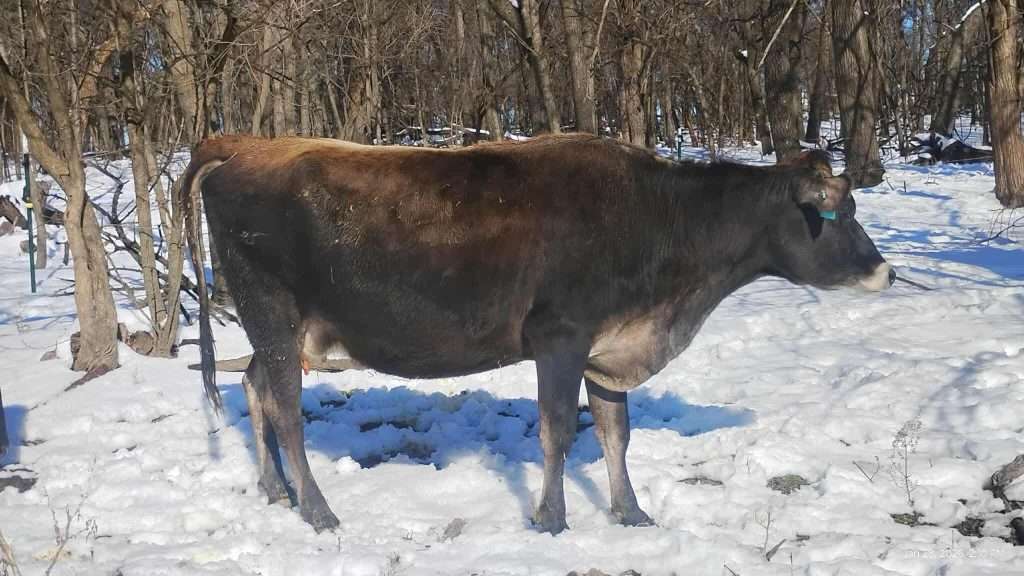
This is Jojo, 8 months into her 2nd lactation. She normally keeps excellent condition on our farm.
On Tuesday, December 23rd, I found my beloved cow, Jojo standing in the field looking like a gopher with her cheeks packed full and drool pouring from her mouth. I walked her to the chute, thinking maybe she had a stick lodged in her mouth or something equally ridiculous. Instead, I found her mouth packed full of her own cud, stuck to the roof of her mouth. I pulled it out, released her, and she immediately went back to eating and acting completely normal.
Two days later on Christmas Day, of course, I found her standing with her head down, green goo pouring from her mouth and nose, making the strangest sound. A sound I recognized instantly.
She was choking.
I had heard that sound so many times watching Dr. Pol, only it usually came from a horse. I was 100% certain that’s what was happening and I knew I had to act fast.
I haltered her and walked her back to the chute while calling my vet. No answer. Then the mobile vet. No answer. I called every vet within a 60-mile radius, nothing. In total desperation, I called my dairy friend who raises Jerseys. She told me to glove up and go in after it but warned me not to push it down, or I could kill her.
No pressure.
With no vet calling back, I had no choice. I pulled on an OB glove and inserted my entire arm into her mouth and down her throat. I could literally feel her nose against my shoulder. Finally, I reached it. I knew immediately what it was, a solid ball of cud. I tried to sweep it out, but couldn’t get around it. So I gently pinched it and started pulling. That’s when she thrashed her head. Instinctively, I yanked my arm out. After a moment, I realized the choking sound was gone. The drooling had stopped. I hadn’t removed the cud but I had dislodged it enough for her to swallow it.
The next day, I hauled her to the vet. Something was clearly wrong. After examining her tongue, he diagnosed her with wooden tongue.
Wooden tongue is caused by Actinobacillus lignieresii, a bacterium normally present in the mouth and rumen of healthy cattle. It enters through small wounds caused by rough feed, thorns, or sharp plant material, triggering inflammation, abscesses, and a tongue that becomes hard and immobile sometimes so severe the animal can’t eat or drink.
In Jojo’s case, she was packing cud in her mouth instead of chewing and swallowing it. We treated with Macrosyn (generic Draxxin) and planned a second round seven days later, adding LA-300 and IV sodium iodide. But here’s where it got complicated, Jojo is a milk cow. The only approved antibiotic for milk cows is Excede. The vet recommended Macrosyn anyway, because time was not on our side. If wooden tongue isn’t controlled within two weeks of symptom onset, the cow is deemed incurable. We were already on day four.
Because sodium iodide isn’t approved for bred cows and Jojo was due to calve in three days I opted not to use it. A decision I would later regret.
Over the next seven days, I pulled cud from her mouth twice a day as she declined rapidly. Despite feeding her expensive chopped hay and every grain imaginable, she kept losing weight at an alarming rate simply because it hurt too much to eat.
Seven days later, I hauled her back to the vet expecting the worst. Instead, he said the antibiotics were working. Her tongue was reactive again. The first week, she hadn’t moved it at all. Now she was aggressively pulling it from his hand. Relief flooded me but progress was painfully slow. We were on day 10 of 14. Time was running out.
We discussed inducing her so we could safely administer sodium iodide, but the vet strongly advised against it due to the risk of calving complications. He admitted iodide wasn’t technically approved for bred cow but he’d used it many times without issue. At that point, I took the risk. In addition to Macrosyn, we administered IV iodide and another round of LA-300. The next day, for the first time in 11 days, I didn’t have to pull cud from her mouth. Victory!
This photo breaks my heart. I’ve never seen her look so skinny.
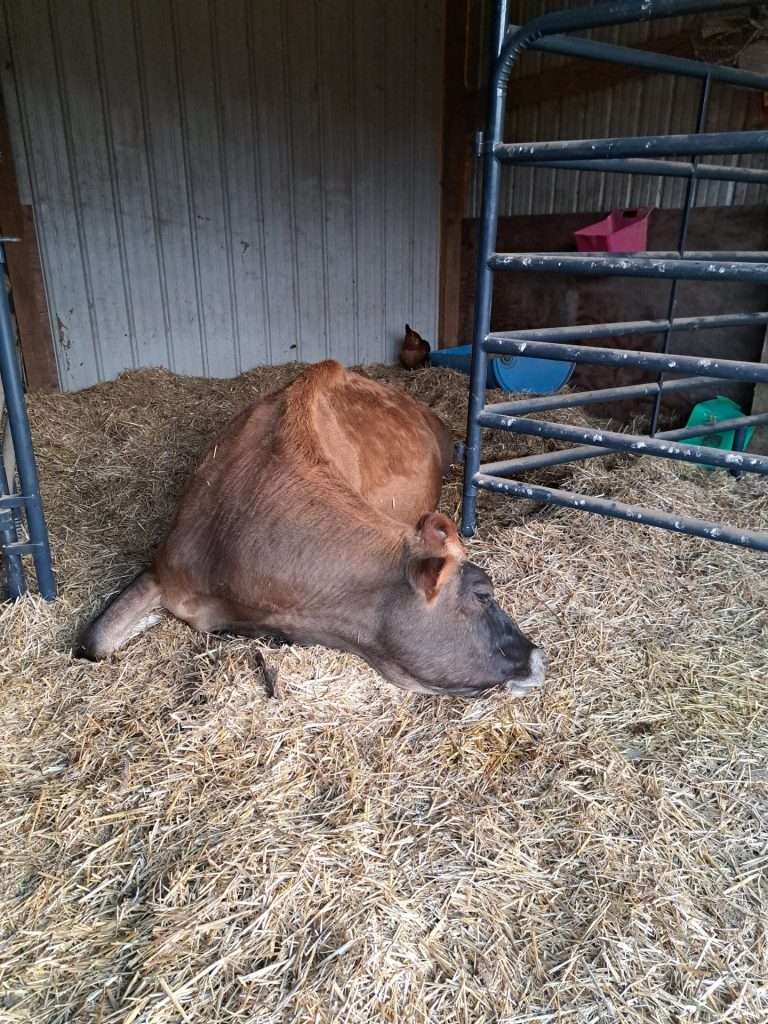
Four days later, Jojo calved a healthy bull calf. She was dangerously thin and still barely eating, but she wasn’t packing cud anymore. I thought the nightmare was finally over. I was wrong. Right after calving, I gave her a Bovikalc bolus (calcium), but forgot to repeat it that night. I woke up in a panic at 6 a.m. and ran to the barn to find her down, legs stretched behind her, head twisted back. I was coming face to face with my biggest fear, milk fever.
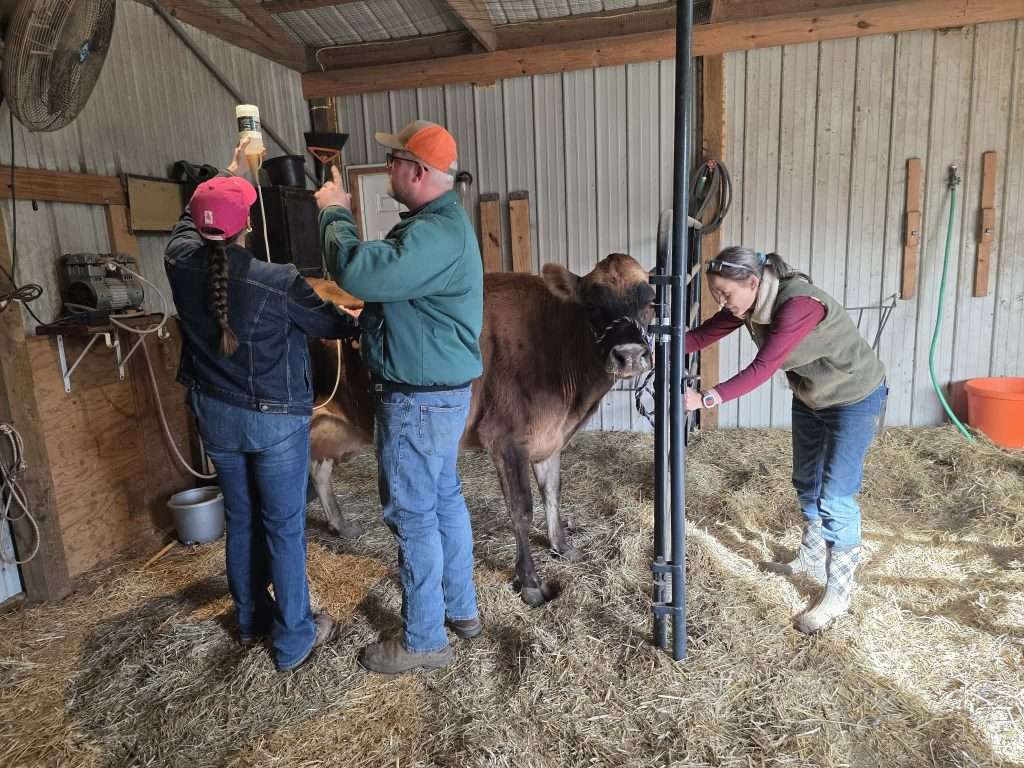
I made call after call while administering another bolus. My vet said he was heading out on a farm call but would try and swing by later in the afternoon. This was a life-or-death emergency. Desperate, I called my dairy friend again. She dropped everything and came. The mobile vet came through for me and followed shortly after.
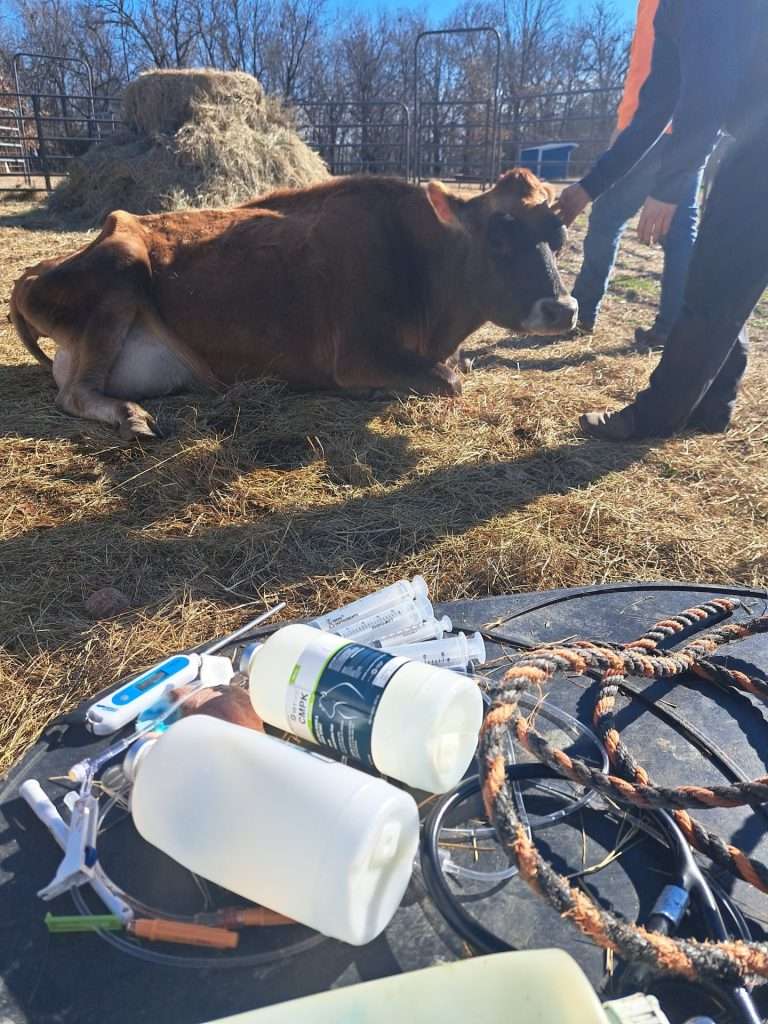
My friend and I got CMPK (Calcium, Magnesium, Phosphorus, Potassium) into her milk vein, enough to help her stand. Later, the vet administered more IV calcium and transdermal CMPK.
Two days later, she went down again, this time barely alive. Her temperature was 90 degrees. Her body was shutting down. After hours of treatment, we had to get aggressive. I pulled on the halter while the vet smacked her rump, anything to get her up. And she stood. Barely. But she stood.
From there came eye ulcers. Pneumonia. A third round of Macrosyn. Multiple CMPK treatments. Sleepless nights. Watching for the smallest signs of improvement, or decline. I checked her every three hours, sitting beside her, stroking her neck, telling her she was a good girl.
One morning, I walked in and found her standing… chewing cud. I cried. Progress came slowly. Then, 23 days in, my heart shattered again, she was packing cud once more. Back to the vet. Excede. More sodium iodide.
That was the last time I ever pulled cud from her mouth.
As I write this:
• 49 days since this nightmare began • 32 days since her second milk fever episode • 26 days since I last pulled cud
Jojo is eating a full dairy ration twice a day, eating hay from the bale, gaining weight, and raising a healthy bull calf.
I don’t know if we’re completely in the clear yet. But if farming has taught me anything, it’s this: survival isn’t always loud or pretty. More often, it’s quiet, stubborn, and earned one hard day at a time. The hardest parts of farming rarely make it to social media because they’re messy, exhausting, and unseen but they don’t mean you’ve failed. Sometimes they simply mean you stayed and fought when it would’ve been easier to walk away. And that counts for something.
Through all of this, I’ve been reminded that farming requires a kind of faith we don’t often talk about, the faith to keep showing up when the outcome is uncertain, to do the next right thing even when you’re exhausted, and to trust that God is still working when nothing looks hopeful.
There were many moments when I felt completely powerless. And maybe that’s the point. Sometimes all we can do is place what we love in God’s hands and take one small step forward, believing He sees what we can’t.
Jojo’s story isn’t just about survival. It’s a reminder that grace often shows up quietly. In a cow that stands when she shouldn’t, in strength that returns one mouthful at a time, and in the peace that comes from knowing we are never carrying these burdens alone.
One day at a time. One chore at a time. And a whole lot of faith in between.
About the Author:
Kimberly Jepsen is the heart behind MooShine Ridge in Vinita, Oklahoma, where she and her husband, Kevin, have been raising dual-purpose Dexter cows since 2015. Their little farm store is a labor of love, offering Dexter beef, raw milk, and artisan cheeses made from their own cows. Kimberly has a deep passion for the Dexter breed and loves nothing more than sharing what she’s learned over the years—whether it’s guiding fellow farmers, helping newcomers discover the joys of small-scale farming, or simply introducing people to the rich, creamy flavors of her handcrafted cheeses. For her, farming isn’t just a business—it’s a way to nurture animals, the land, and the community she cares about. https://mooshineridge.com/
Broken Arrow “A” Livestock is a small farm in Southwest Iowa owned and operated by Aaron and Erica Lantz and their two sons. Aaron represents the 5th generation of Lantz’s who have produced livestock on the property since 1872. In 2009, we decided to begin producing our own pork because we were disenchanted with purchased commercial pork. Aaron’s father and grandfather both raised hogs in a 60 sow farrow to finish program as he was growing up. In the 1970’s and 1980’s, their program was to buy a non-descript black hog out of Missouri known locally as “Missouri Acorn Hogs”. They were an old lard-type crossbred hog that could be purchased cheap. They had excellent mothering abilities and when crossed with Farmer’s Hybrid boars, produced strong litters of hogs that performed well. These hogs were fatty, but not necessarily fatty enough to be considered a lard style hog. Beginning in the 1980’s, buyers would dock these hogs as being too fatty in favor of leaner breeds. For a while, it was worthwhile to take a dock at the buyers and justify the loss as the price paid for ease of management. Eventually, these hogs were refused at the buyers and we had to stop raising them since there was no way to sell them. We retained gilts from our program and began introducing leaner breed boars. We used various breeds to build our program including: Hampshire, Landrace, Duroc, and Berkshire. Every two years we would retain new gilts and buy a new breed of boar from a reputable breeder to maximize heterosis. Eventually, even these hogs did not meet market demands and we were forced to stop raising them. Eventually, these hogs were sold and the Lantz family purchased Yorks and began raising a true commercial hog. This endeavor was short lived, since the hog market crashed in the late 1990’s and the family decided to exit hog production entirely.
Aaron knew what good pork was supposed to taste like, but it wasn’t possible to replicate the breeding program originating from the Missouri Acorn Hog sows and Farmer’s Hybrid boars. We had an ideal carcass in mind and began researching which heritage breed would most likely result in the ideal carcass type. This lead us to purchase our first Red Wattles in 2009. We learned quickly that Red Wattles are VERY large and between the slow growth curve, small litters, and large feed inputs…we would be challenged to be profitable. However, we also found that we absolutely loved the carcass. It is not as deeply red as Berkshire, but has a rich and distinctive flavor with an ideal balance of fat. We decided that Kune Kune would be a good compliment to the extreme size of the Red Wattle without compromising carcass quality or the docility and easy handling nature of the hogs. Red Wattles are thought to be a Polynesian breed that made it to New Orleans by way of the French and the breed was resurrected from wild hogs used to homestead Texas. Kune Kune are also Polynesian and share some attributes like wattling, so it made sense to us to make the cross. This launched us on a path of dialing in our genetics with the goal of achieving the perfect carcass using a hog ideal to manage. We have strategically introduced the following breeds:
Mangalitsa for carcass attributes including a low collagen fat complex. This breed can be challenging to raise in the summer heat of Iowa and can be challenging to handle.
Iowa Swabian Hall is a similar composite program to our own and we sought to add the work done by other breeders to consolidate the value.
Meishan was introduced for their prolific litters and early maturation in addition to carcass flavor attributes and fat distribution in the carcass.
Mulefoot and Ossabaw are Spanish type genetics known for their carcass complex ideal for curing.
Gloucestershire Old Spot and Large Black are old British breeds known for their balance of carcass attributes and management attributes.
A very small amount of Berkshire was used in the program. To obtain the genetics we sought, we sometimes had to use crossbred animals. Berkshire is a popular breed to make heritage type crosses and, while we didn’t actively seek to use Berkshire specifically, we were not opposed to these genetics for their carcass color and flavor attributes.
At first, we had a significant amount of variety in our crossbred animals. After having obtained the genetics we thought we needed to create the ideal hog, we closed the program. We didn’t actively make a decision to close the program, but rather ran out of need to obtain animals from outside programs. To standardize our hogs, we began using a program to select for replacement breeding stock within our own herd and rotating males and females strategically to use linebreeding to concentrate ideal attributes in a consistent “type”. We’ve maintained this program for approximately the last 10 years. We still get some variety in the offspring, but we are becoming more consistent for type and performance with each rotation. The program goes as follows: We obtain a group of like gilts the same age. The goal is to start with 40 gilts, but cull over the coarse of 3 litters to the 10 most ideal and productive females. We retain the boars we were using for the previous breeding that sired the current group of gilts. We use those boars on the new group of gilts for one breeding. There is a chance a sire could breed a daughter, but the pairings are left to chance and often times the boar that breeds any given gilt is not that gilt’s sire. From this first set of litters we select 6-9 boar prospects and begin growing them with the intention that 2-3 of these will be used to propagate more breeding stock. We get a second set of litters from the aged boars and all of those offspring are terminal. We will sell breeding stock females from this group that people can use in their own “heritage type” programs. After the second set of litters we cull the older boars. The younger boars take over for the third and fourth sets of litters. This means that the new boars are sons of the females used to breed. Again, random pairings ensure some genetic diversity and there is no guarantee that a son breeds his dam…though it is possible. The third set of litters is also terminal. We don’t save anything from these litters, but we do assess their quality and use this to arrive at our 10 best sows. It is from these sows bred to the new boars that we save back a new group of 40 females and begin growing them. We will get a 5th and 6th set of litters from the older sows so that we remain productive while growing the replacement gilt group, but these offspring will all be terminal. It is at this point we part with all the older female breeding stock and start over with the same boars we’d been using and a new group of gilts to repeat the process again. Each cycle, we select animals that meet our ideals and the offspring become more consistent in type and performance. Because random pairings are utilized, this program can be maintained indefinitely with little detriment to the performance of the hogs and over time the risk of recessive disorders cropping up decreases. We are just very careful to cull any animals that produce issues and only select ideal animals to reproduce. Eventually, we will have achieved a proprietary “landrace” breed that we could consider recognizing as a true breed. At this time, creating a new, recognized breed is not part of our plans. We are just happy to raise a hog that we are proud to feed our family with.
Producers wishing to obtain genetics have lots of options for utilizing those genetics to benefit their personal production goals. We suggest breeding our seedstock to Hereford, Tamworth, Berkshire, or Idaho Pasture Pigs. These breeds are complimentary and offer lots of heterosis. We are very confident in performance and carcass quality. We expect our hogs to grow to a normal marketable weight at about 300 lbs with a reasonably significant fat layer without being excessive and low in collagen. Meat should be darker complected (though not as dark as to be comparable to beef or called “red”) and show good marbling with a texture and juiciness more comparable to beef than to commercial pork. Cuts will be disproportionate in size to comparable commercial breed cuts, because these heritage-type hogs will flesh and grow differently with a different frame structure that impacts cut size and shape. The flavor should be rich and distinct. While not technically either “beefy” or “porky”, the flavor should parallel the mouth appeal and richness of beef though it is not the same flavor as beef. Producers could also choose to breed to any of the genetics used to develop these hogs in an effort to strengthen certain key attributes. Breeding to Red Wattle, Iowa Swabian Hall, or Mangalitsa are good choices to enhance management attributes while keeping the carcass attributes of the paired breed. Really, these hogs are very versatile and could be successfully leveraged to add benefit to just about any program with any goals.
Do you have the Homesteading/Hobby farming down, and now you’re wondering what’s next? Is making 100% of a living on the farm a dream? Joel Salatin talks about the essentials, an ingredient list if you will, for transitioning from weekend farming to full-time farming.
Spring is right around the corner, but for many you are still dealing with cold and snow. Caring for a dairy cow during the winter can be a challenge, but it doesn’t need to be insurmountable!
Teats chap and freeze when wind-chills are at zero and below. You may choose not to post dip at all, which is fine. You can also use products like Winterset, or Revive (from IBA.)
Treat chapped teats with Udder Balm or similar, and be careful to not over milk your cow.
Providing plenty of hay and water, plus a bedded shelter or tree line for wind protection is all she needs otherwise! She heats up from the inside out, with rumination serving as her furnace. She is very likely much more comfortable than you are in this weather!
Juliette is a monthly contributor to the Irish Dexter Cattlemen Newsletter and the author behind many of the articles on the FB group The Science of Owning. Dairy Cow.
Here is a link to other suggestions for dealing with it. https://www.agproud.com/articles/19093-tips-for-dealing-with-frostbite-and-other-teat-health-issues
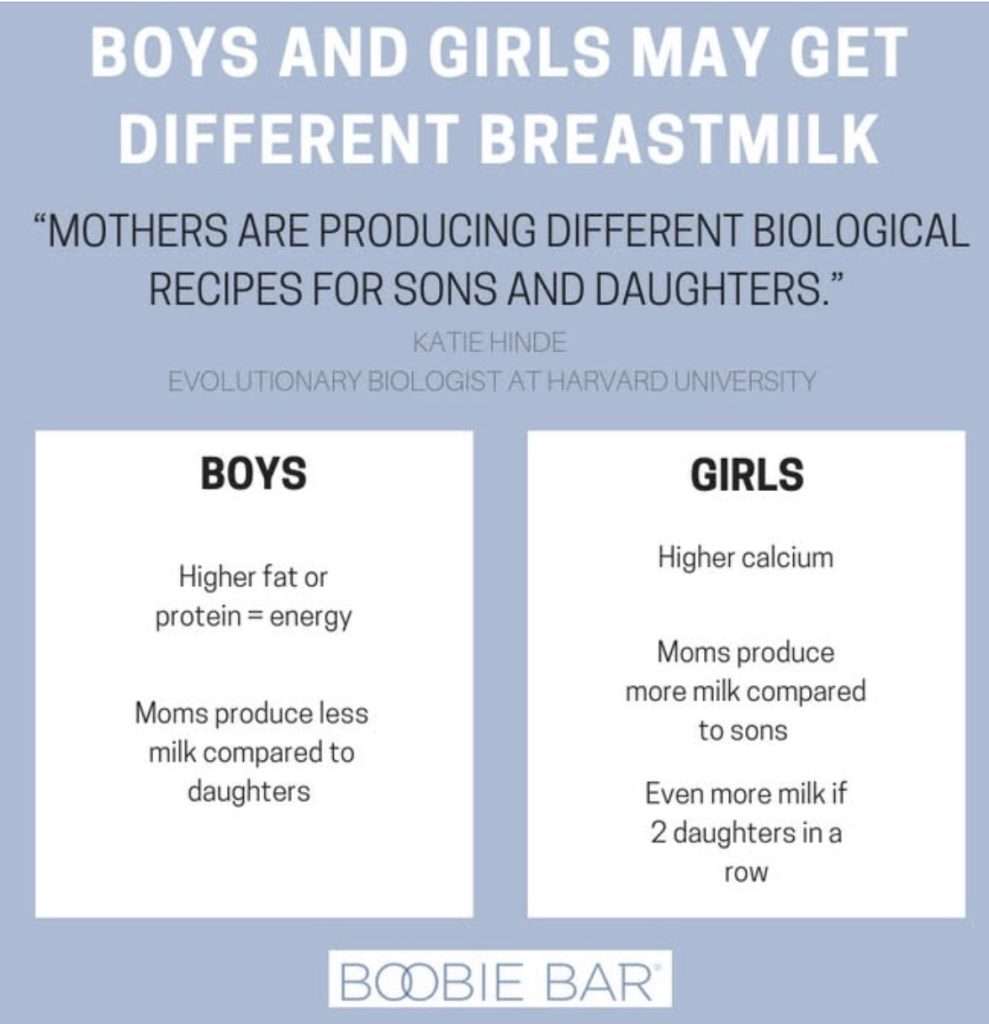
The study below show that there are differences in the milk produced for boys and girls. Could this be true for our Dexters we are miking…and note what it says if there are two girls in a row! This could be very interesting to study.
A Deep Dive Podcast, brought to you by Irish Dexter Cattlemen, on topics of interest to all farmers and ranchers. Subscribe to the free, monthly Irish Dexter Cattlemen Tips & Tricks Guide to get early access.
Brought to You by These Breeders, Affiliates, & Sponsors
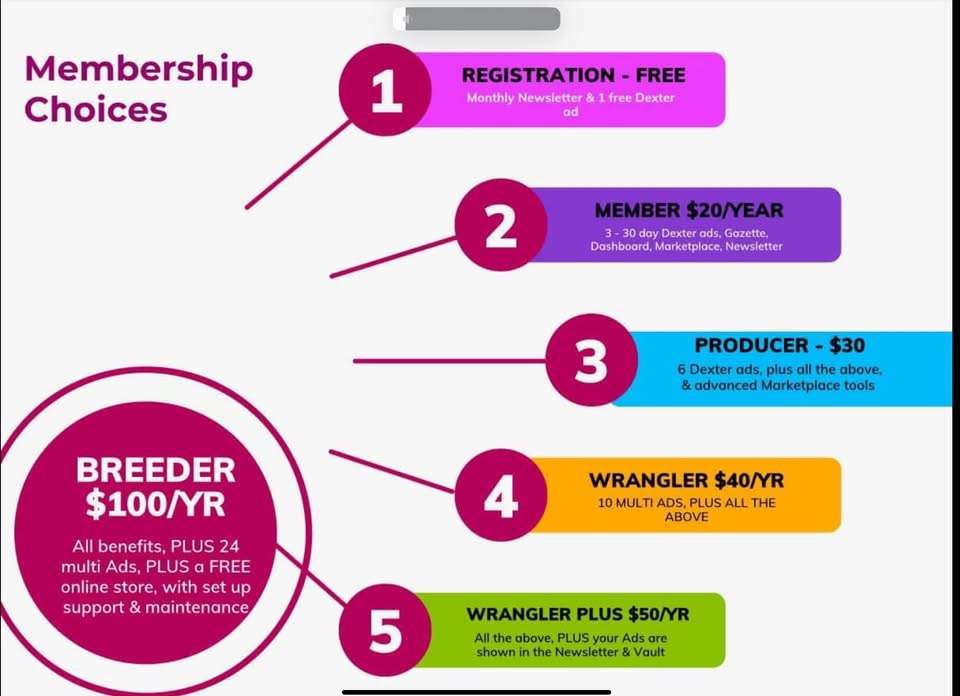
Hello to all our IDC Newsletter subscribers and members. With the February Newsletter release coming up this weekend, we mark two years of providing informative & educational information to our followers. What started with a genuine love for the breed, a desire to help others & their Dexters, plus a goal to bring more breeders together and promote the breed, IDC has grown beyond our expectations. Our small team of Eliena Bodtke, Janelle Soja and myself, along with our website & Newsletter producer Bob Curlee have made it our mission. Not to mention our many contributors who have all committed countless hours to researching, writing and providing valuable information for you. All the while building the Gazette, our huge library that stores all of our past Newsletters. These Newsletters can be accessed & searched at any time by our members.
We often mentor and help others with ideas, advice etc. when contacted. If we hear of a concerning topic or a seasonal issue, we try and address those in the Newsletters. We are grateful that many knowledgeable contributors have chosen to come alongside us in providing valuable informational articles in the Newsletter. Many are Dexter owners from different parts of the Country, with different viewpoints, from different associations, but all coming together for the good of the breed we all love. We cover countless topics like history, health, dairy, beef, farm management, homesteading and more. We often share cheese, soap making or bread making in our homestead section, as well as stories written by new owners. We also have contributors who are not Dexter owners, but they have experience with diary, beef or homesteading. Our team feels that if we can encourage and support new breeders, they stay longer and succeed in the Dexter breed. This not only helps them, it helps the breed. We hope you will join us as a member of the IDC soon. Members get more perks than just the Newsletter. If you belong to one of the associations or an affiliate then you will receive a discount on your membership with IDC. Please contact the affiliates for your discount membership code or reach out to one of us. We can even help you set up your own storefront for whatever you may have to sell from the farm. You are not limited to just Dexters. Thank you for being part of the Irish Dexter Cattlemen community…where we are helping Farmers & Ranchers grow, innovate, build, manage, regenerate, produce and above all promote, market and sell your Dexters.
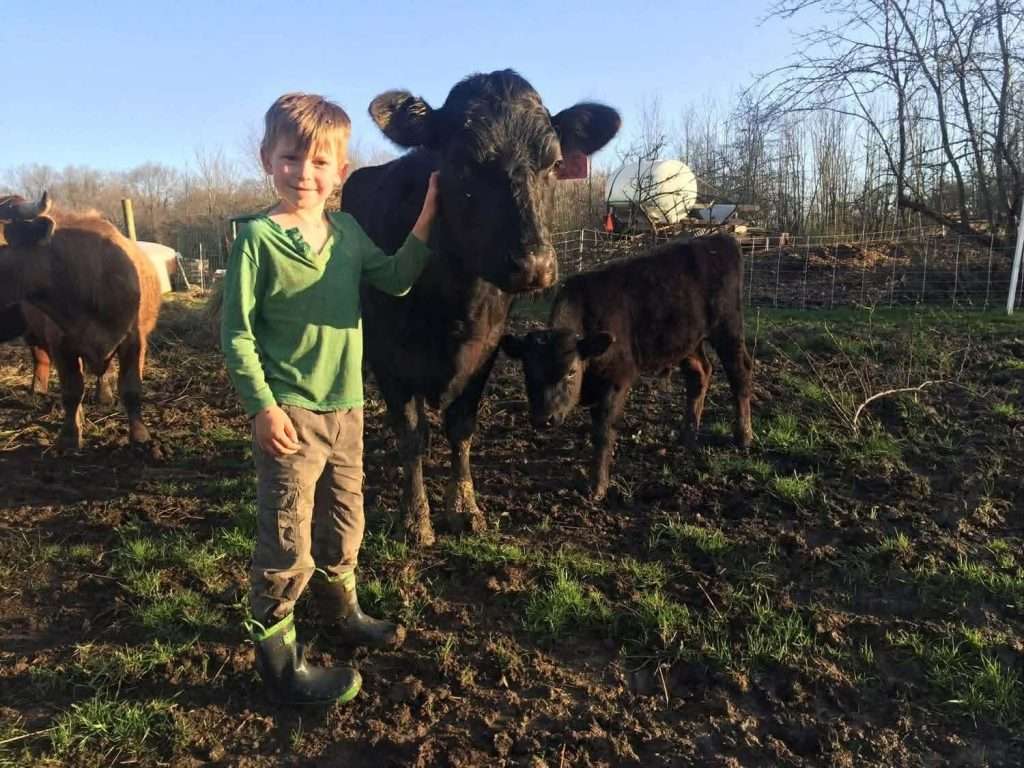
What an idyllic picture kids and animals paint. County fairs are full of animals, including cattle, being lead around the show ring by their young owners.
The homestead dream, complete with family milk cow, gives off major romantic vibes. But what does it actually take for children and cattle to interact safely on the farm or homestead?
Here are a few tips and suggestions from our family farm:
Because children are low to the ground, and their movements tend to be quick, cattle can view them as predators. Talk to kids about how important it is to move slowly/deliberately and to behave calmly and quietly when they’re around cows (especially a cow that is not familiar to them).
When introducing kids to a new cow, be sure the cow is safely restrained. I like to tie our cows on a halter with a slip knot. Kids can approach from the side or front of the cow (not the back), and talk to the cow.
Cows in a herd will groom each other, and mother cows will also bond with their calves by grooming them. A great way for kids to get to know and bond with a cow is to spend time brushing them. Our cows prefer to be brushed on the neck, shoulders and along the back.
If you have children and are purchasing a cow for the first time, it is helpful to look for a cow that has been handled/shown by children and is familiar with them.
And my final tip is to be confident! Fear teaches us to expect the worst. Set yourself up for success by following these tips, and be confident when you and your kids interact with cattle. If you find yourself becoming fearful, remove yourself from the situation, and try again another time.
I hope these tips and suggestions help you build a strong bond with between your cattle, yourself and your children!
Selecting the finest cut of beef is a debate as old as butchery itself. From white-tablecloth steakhouses to backyard grills, opinions are plentiful and fiercely defended. Yet when judged by flavor, tenderness, and overall culinary performance, one cut consistently distinguishes itself from the rest: the ribeye.
⸻
Defining Excellence in Beef
To identify the best cut on a cow, one must first establish the criteria. A truly exceptional cut should offer: • Pronounced, natural beef flavor • A tender but substantial texture • Reliable juiciness • Adaptability across cooking methods
While many cuts excel in one or two of these categories, few succeed in all. The ribeye does.
⸻
The Anatomy of Flavor
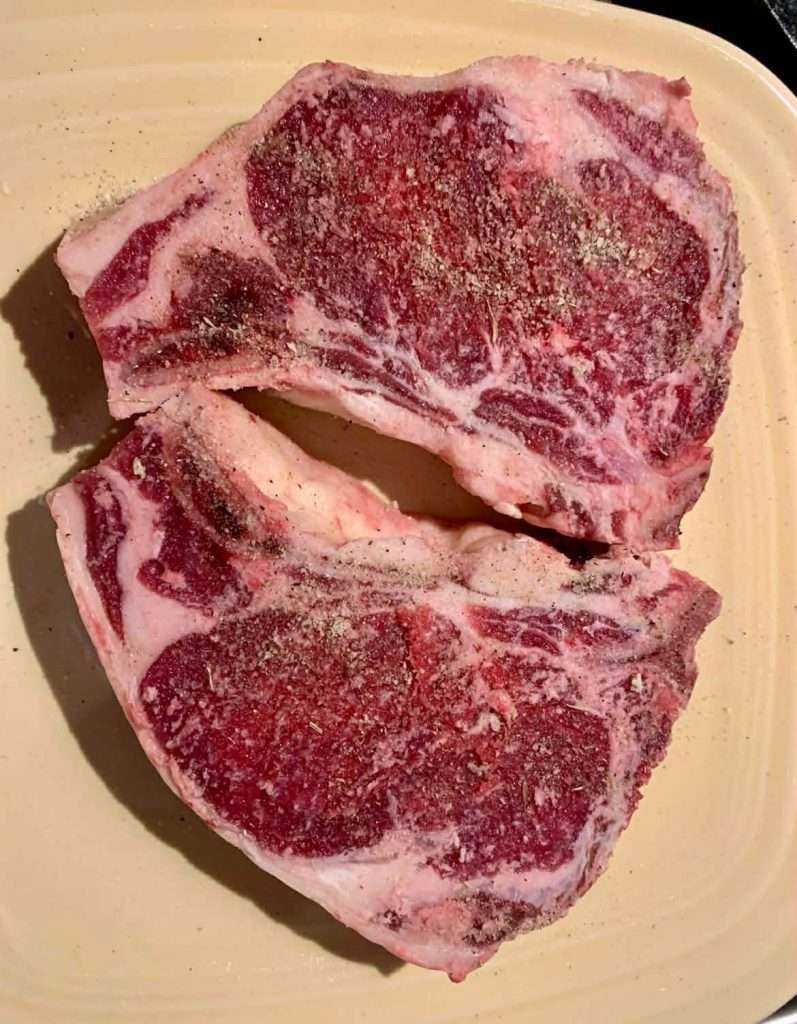
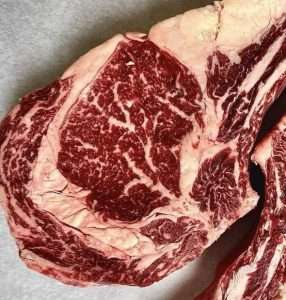
The ribeye is sourced from the rib section of the animal, an area characterized by minimal muscle exertion. This anatomical advantage allows for the development of extensive intramuscular fat, commonly referred to as marbling.
Marbling is widely regarded as the primary driver of flavor in beef. As the steak cooks, the fat slowly renders, permeating the muscle fibers and producing a depth of flavor that is both rich and unmistakably beef-forward.
Fine intramuscular marbling is the hallmark of a high-quality ribeye.
⸻
Tenderness with Substance
Unlike ultra-lean cuts such as filet mignon, which prioritize softness at the expense of flavor, the ribeye achieves a rare balance. It is tender enough to require minimal effort at the table, yet structured enough to provide a satisfying, hearty bite.
This balance makes the ribeye particularly appealing to diners who value both texture and intensity.
⸻
A Cut That Rewards Simplicity
Another defining virtue of the ribeye is its forgiving nature. The generous fat content acts as a natural safeguard during cooking, reducing the risk of dryness and allowing for a wide margin of error.
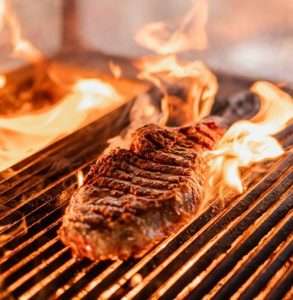
Whether prepared rare or medium, grilled over open flame or seared in cast iron, the ribeye maintains its succulence with minimal intervention. Salt, heat, and time are often all that is required.
High heat and simple seasoning allow the ribeye’s natural qualities to shine.
⸻
Bone-In or Boneless: Two Expressions of Excellence
The ribeye is available in both boneless and bone-in forms, each offering a distinct experience: • Boneless ribeye provides ease of preparation and uniform cooking. • Bone-in ribeye, including cowboy and tomahawk steaks, delivers enhanced flavor and visual impact.
Both versions exemplify the cut’s inherent strengths and remain staples of high-end steakhouses worldwide.
⸻
How It Compares to Other Premium Cuts
Other cuts deserve recognition for their individual merits: • Filet mignon offers unmatched tenderness but limited flavor. • New York strip delivers a firmer texture with less marbling. • T-bone and porterhouse provide variety but require careful cooking to manage uneven thickness. • Brisket, while transformative when slow-cooked, demands time and expertise.
Each excels in specific contexts, yet none match the ribeye’s consistency and immediate gratification.
⸻
Conclusion
The ribeye represents beef at its most complete: deeply flavorful, reliably tender, and remarkably versatile. It requires no elaborate preparation to impress, standing confidently on its own merits.
For those seeking the purest and most satisfying expression of beef, the ribeye remains—decisively—the finest cut on the cow.
The Wranglers at Irish Dexter Cattlemen are pleased to announce that we have a butcher on our team now! The folks at PipeDreams Butchery, located near Memphis TN, will be writing articles, doing videos and more. They are familiar with Dexters, as they used own them, milk them and breed them.
They are active on our Facebook group, so if you have a question about processing and post it…don’t be surprised if they answer you. If you have things that you would covered from a butchers perspective, please let us know and we will try to get it covered for you. All contributions, will first appear in the free monthly newsletter and then be archived in the membership Gazzette.
We personally use them for all our processing and are very happy with our cuts, the feedback on our animals and extra services including sausages, ancestral beef, smoking and curing. Very excited to have them participating in our beef community!
How to Create a Unique Identity for Your Small Farm. A strong brand can set your farm apart from your competition, attract loyal customers, and foster opportunities for growth. Here’s why branding is important for small farms and tips on creating a memorable brand,