January 2026

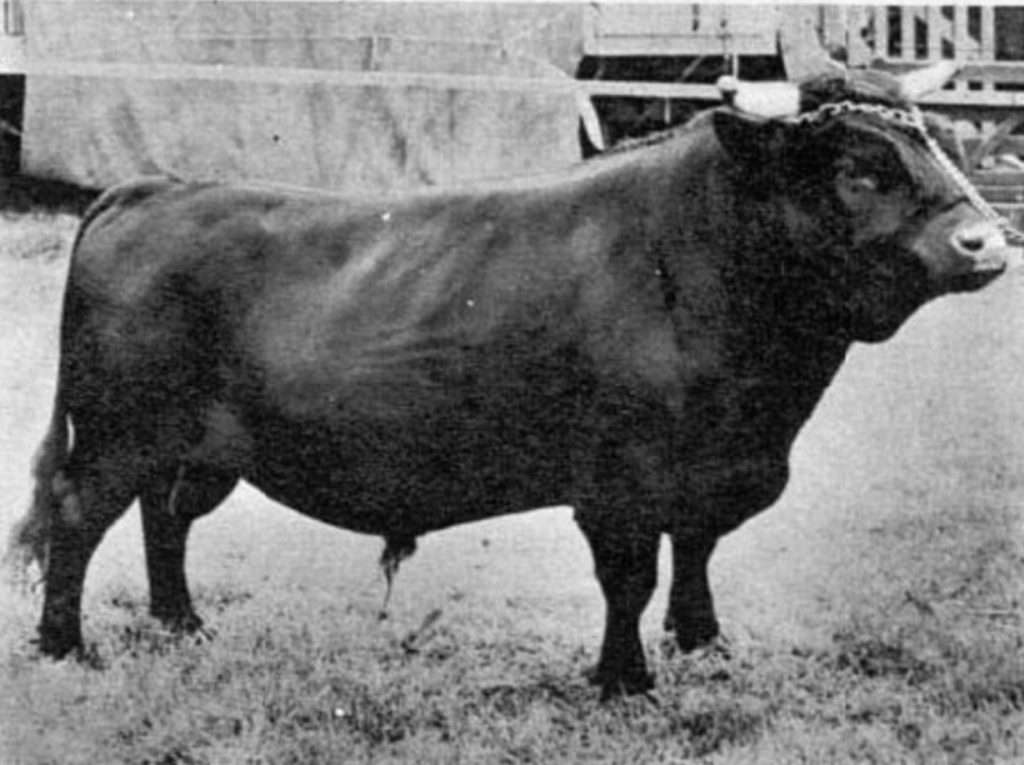
“Dairy Breed” Champion Dexter Bull Atlantic Spratt
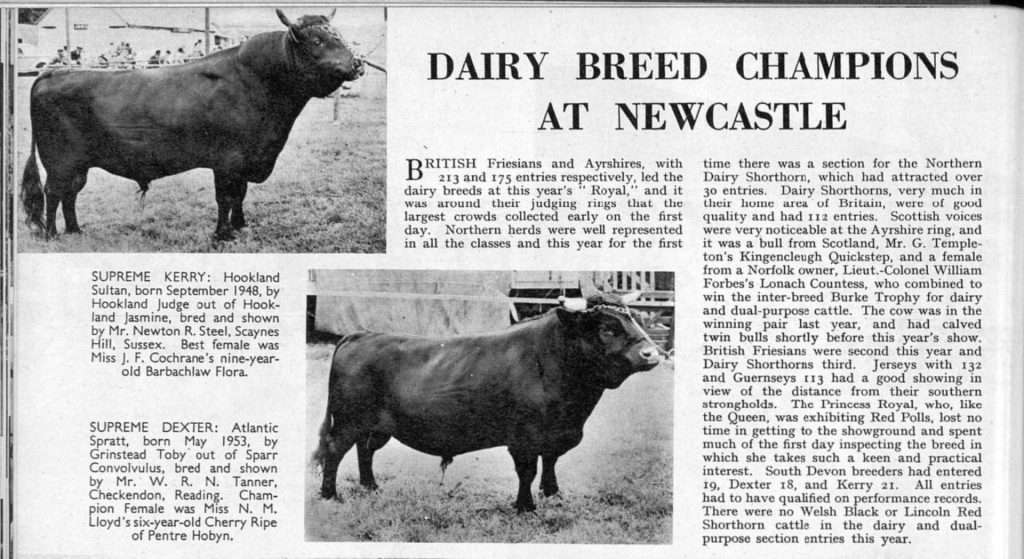
Atlantic Spratt was Shown with these Dairy/ Dual-purpose Breeds in 1956!
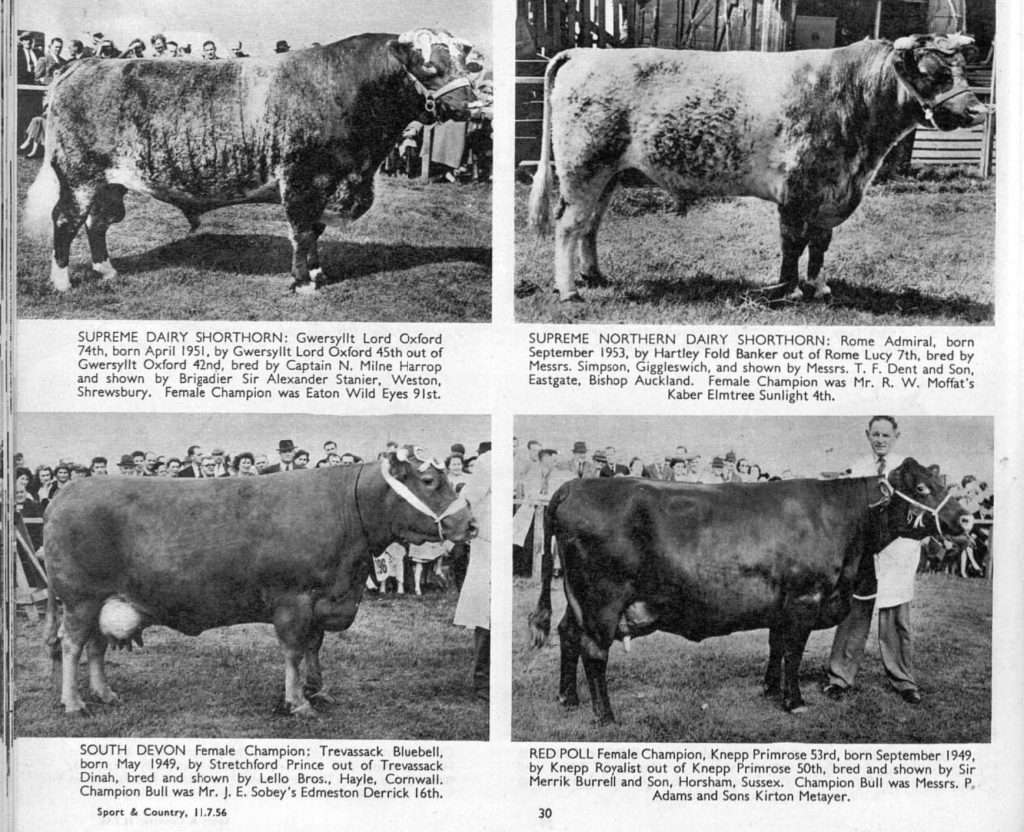
All Breeds entering the show had to have qualified performace records to compete.
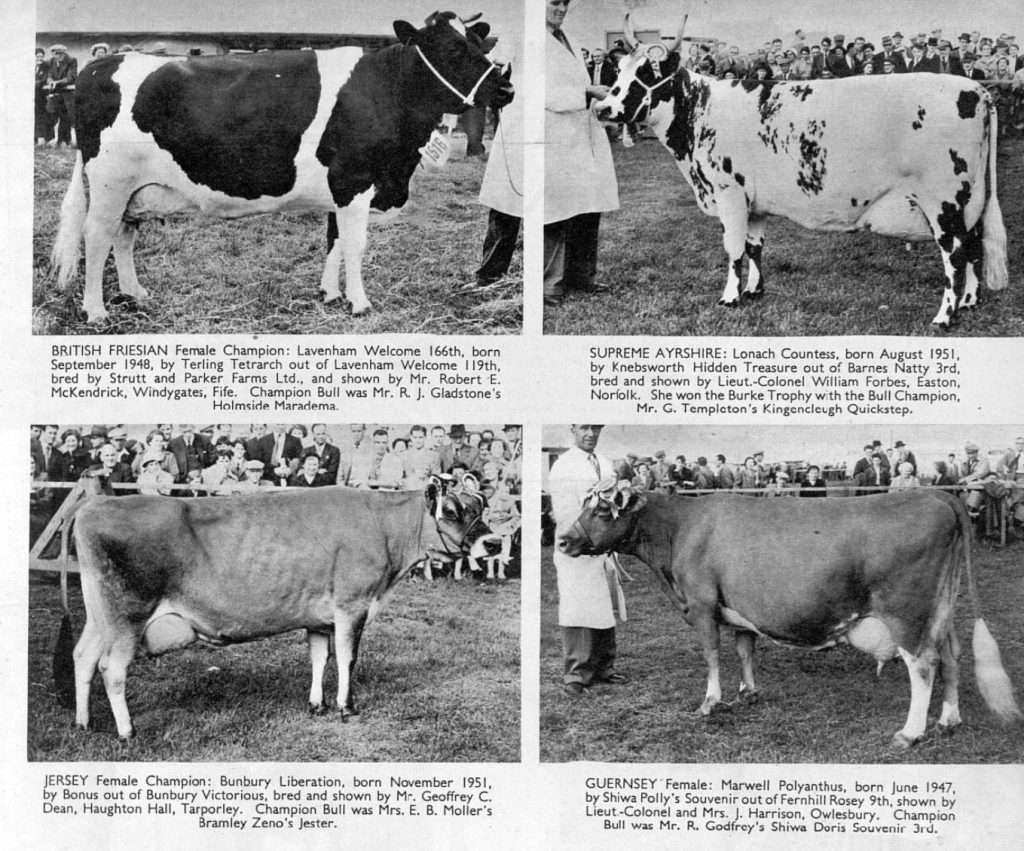
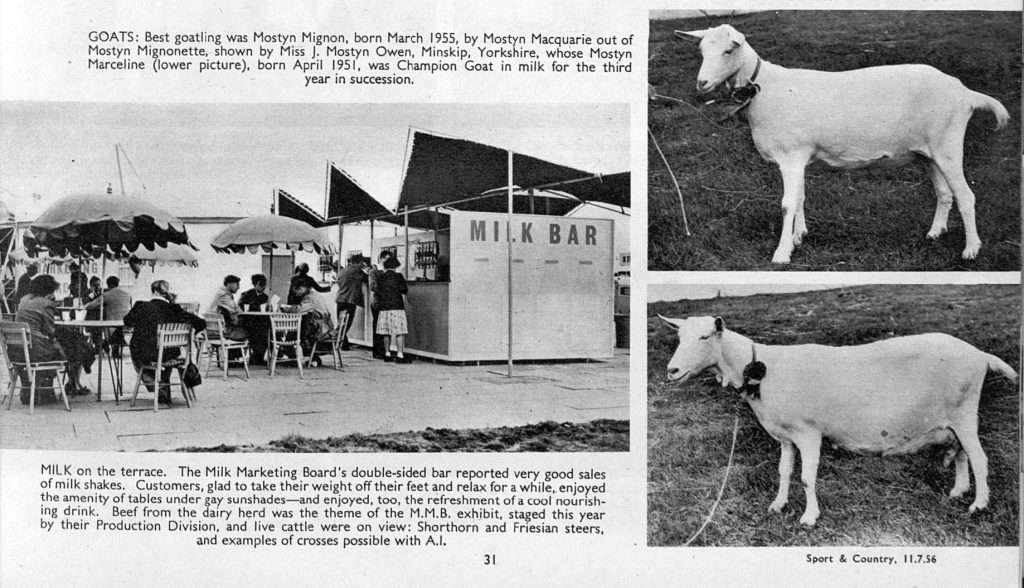
Dexter Cattle put a High Emphasis on Dairy Traits

Dexter Cattle put a high emphasis on dairy traits and beef traits equally. Thoughtful breeders were honing these Irish cattle to excel in both capacities. One of the ways they were doing this, was by selecting bulls from dams with known milk records. Pedigree information is interesting to reflect on when you see repeated names in pedigrees and photos to document what genes might have been passed on from their ancestors. Looking at a bull alone will never tell you anything deeper about his genetics, than what you can evaluate with your eye. A nice-looking bull tells you nothing about what type of milk production his dam might of possessed. Thankfully with photos we can look back on bulls like Atlantic Spratt and see that he had a lot to offer besides just good looks. The fact that Spratt was presented at the show tells us that his dam was qualified by performance records, because it was a requirement to enter the show. Though none of the cows are perfect and much improvements can still be had in generations to come, evaluating them and their records goes to show that they were cows that could surely fill the pail.

Grinstead Toby Sire of Atlantic Spratt
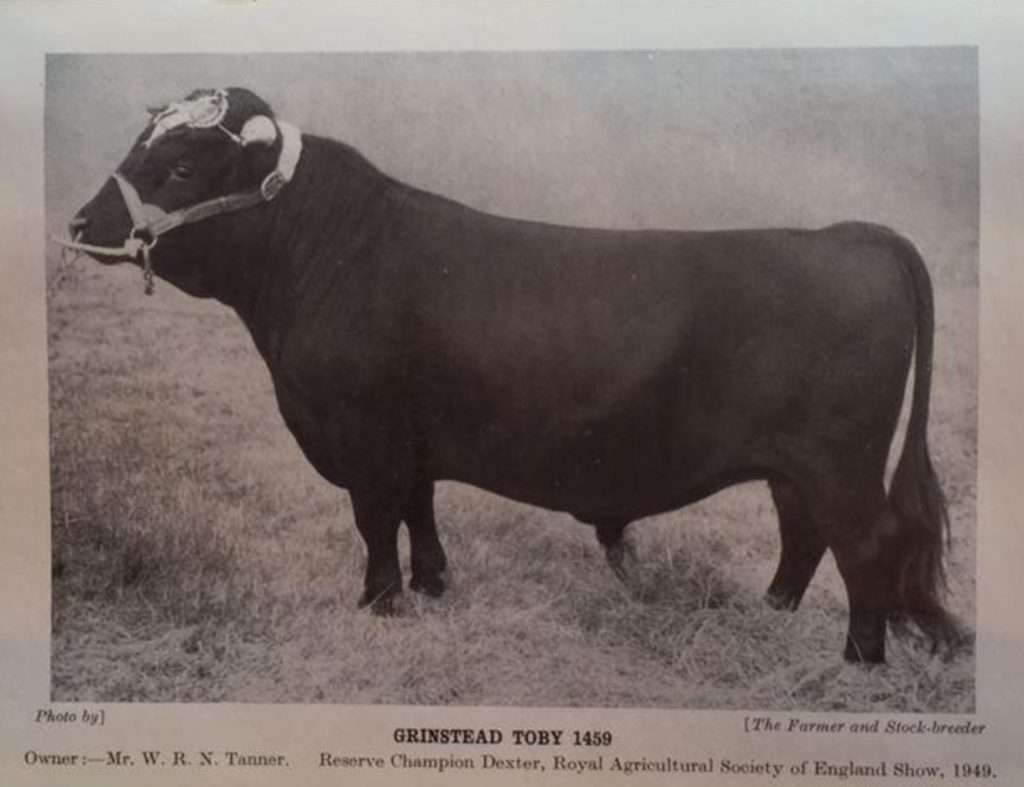
From this photo we can see where Atlantic Spratt got some of his good looks from. His sire was Grinstead Toby, a Reserve Champion Dexter, but to dig deeper I will investigate some of the females in Toby’s pedigree.

Grinstead Trixie the 8th From a Long Line of Doccumented Milkers
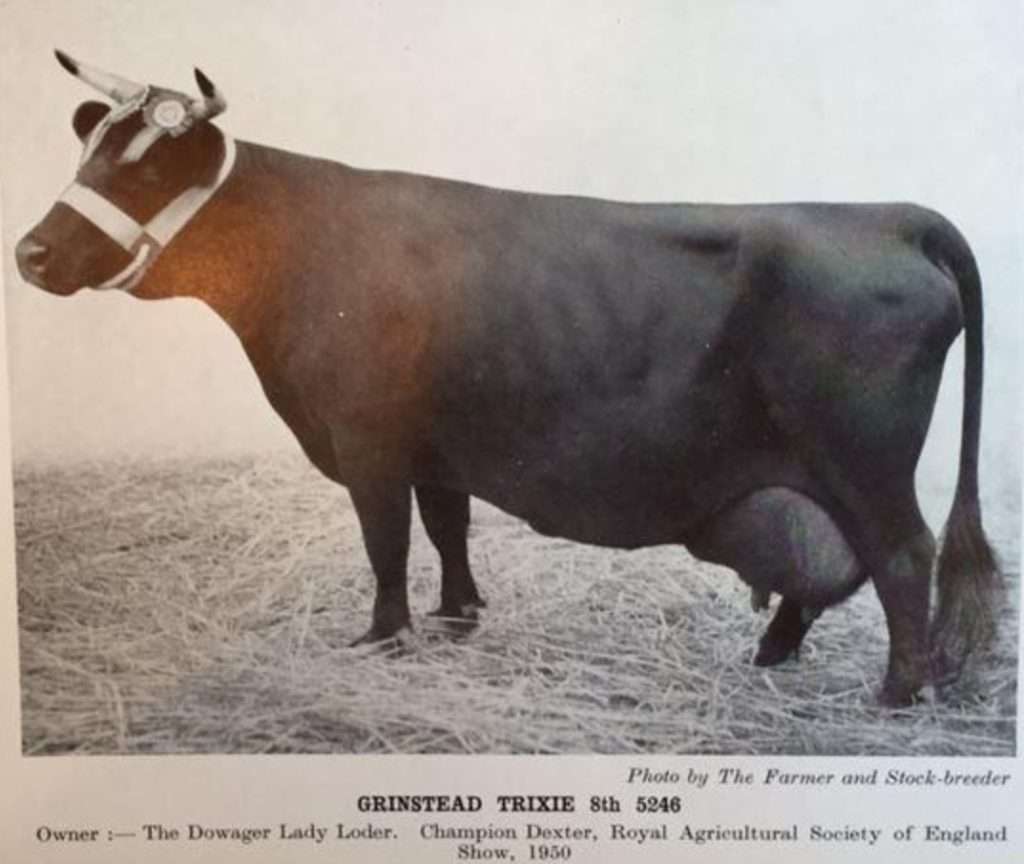
Grinstead Trixie 8th Queen of the Dairy Show
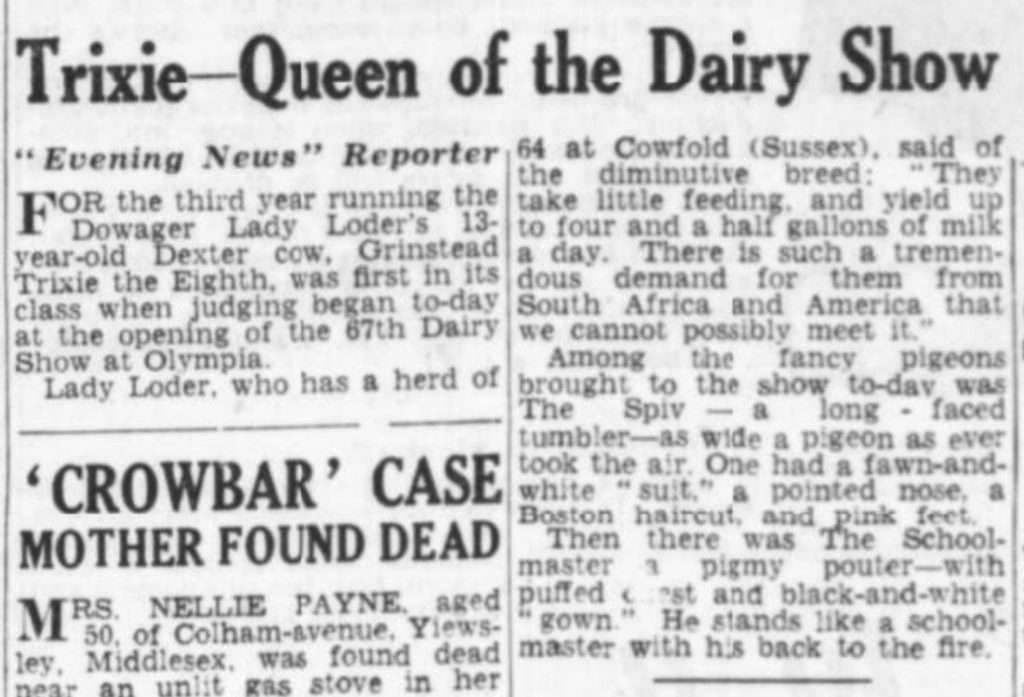
This is Grinstead Trixie the 8th. Lady Loder the breeder, was known for only selecting sires out of cows with proven milking records. Though this cow may seem like she has less than perfect attachment at 10 years old(the age in photo), she looks to have a good amount of volume. You will see in the article above, Trixie is “Queen of the Dairy Show” in October 1953 (then 13 years old and winning first prize for 3 running years). She was a top Dexter cow out of cows that were milking at 4 and a half gallons of milk a day. Lady Loder was known to cull hard and keep to a high standard. Trixie the 8th could have had improved udder attachment, but she definitely filled her part as a solid milk cow. Now I shall dig a bit further back in history to give the reader a greater understanding. Let us next consider Grinstead Trixie the second and likewise the original Trixie herself.

Grinstead Trixie the 2nd
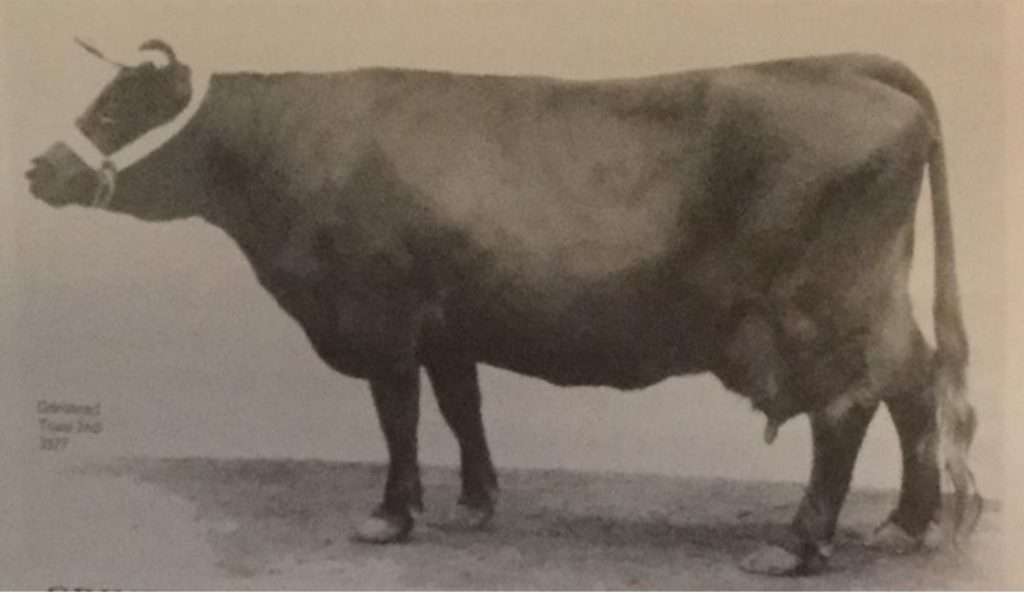
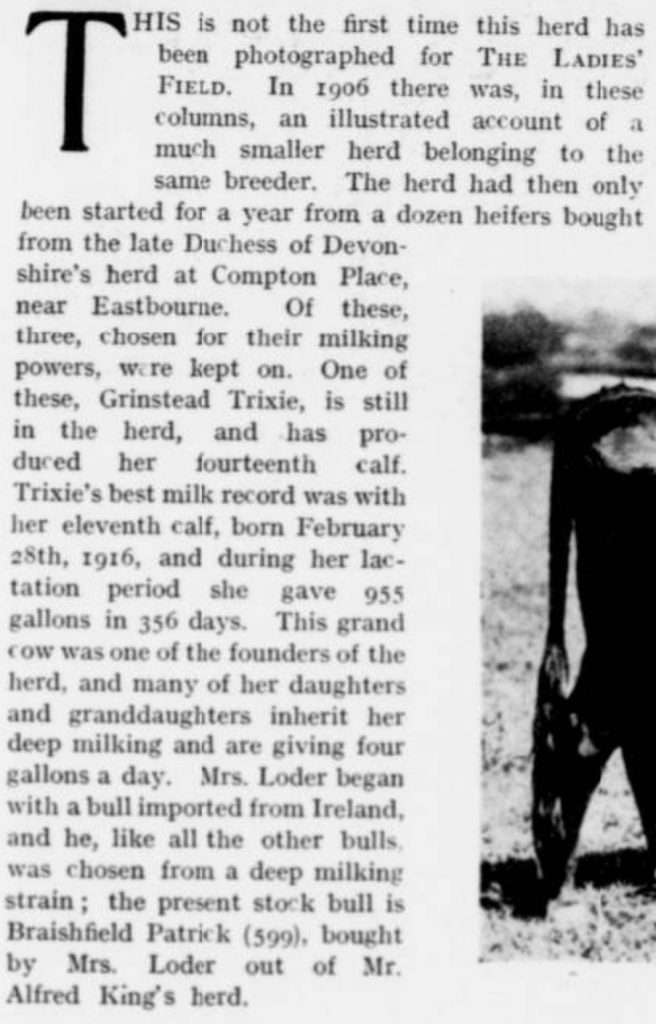
The Original Trixie of 1904 Foundation to Grinstead Herd

Just to give a very interesting historical compass to the full impact of the Grinstead Trixie line, let us delve deep into history, back to November 1919 when the original Trixie was being written about. The original Trixie was one of an original 12 cows that were obtained by Lady Lodger. Of those original cows she only kept three, Trixie being one of three top cows. Those 3 cows were chosen for their milking powers. Trixie was born in 1904 and was a foundation cow for the Royal Dublin Society. By 1919 she had produced her 14th calf, proving to be productive and already fairly long lived. What an exceptional cow to start your herd from. This cow was the foundation of Lady Loders Grinstead herd and imprinted her name on the herd for generations to come. Lady Loder in other statements had complained about some of the low quality Dexters that were being sold. Lady Loder may not have started with the best stock, but she culled down to just three cows to build her herd from and only used proven bulls that possessed dairy traits worth passing on to their offspring. She had a focused eye that considered the breed standard when evaluating and considering her Dexters by. Her legacy is one worth being remembered and replicated, showing you do not need much to start out with, but rather have a quest for quality and be willing to cull to obtain it.
Murrell Peach Blossom: Another cow in Spratts line
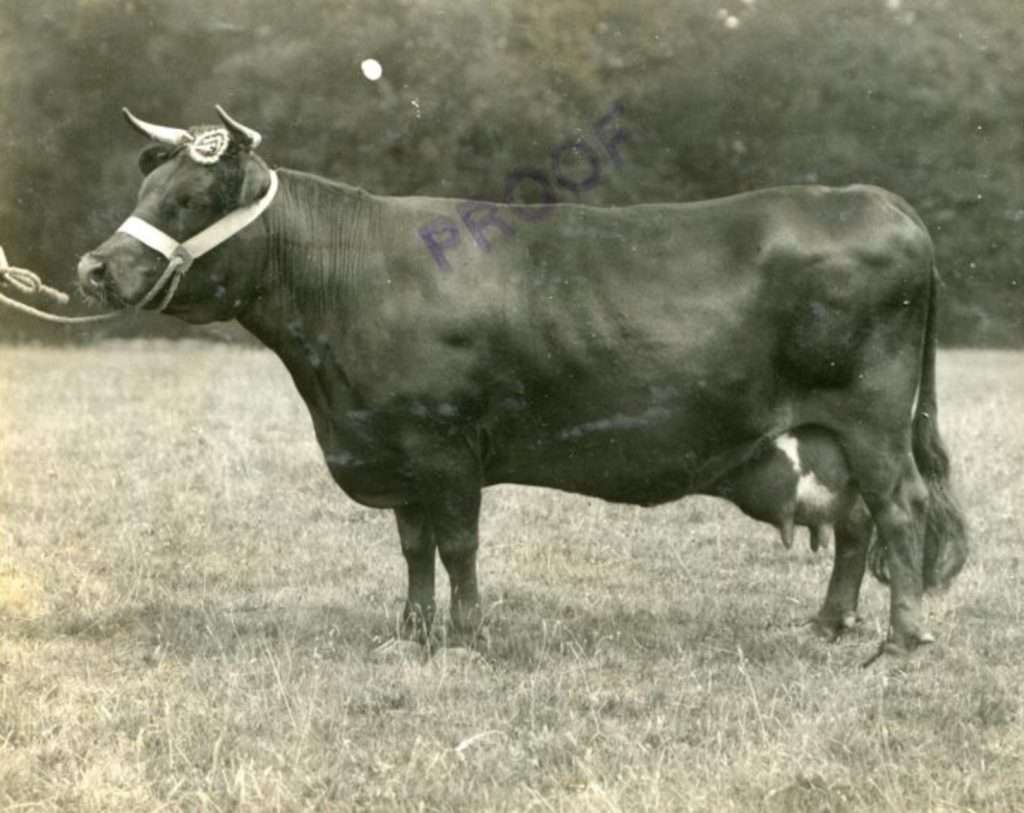
Murrel Peach Blossom who was likewise related to Atlantic Spratt was a challenge cup winner.

Grinstead Hawk 5th: Another cow in Spratts line
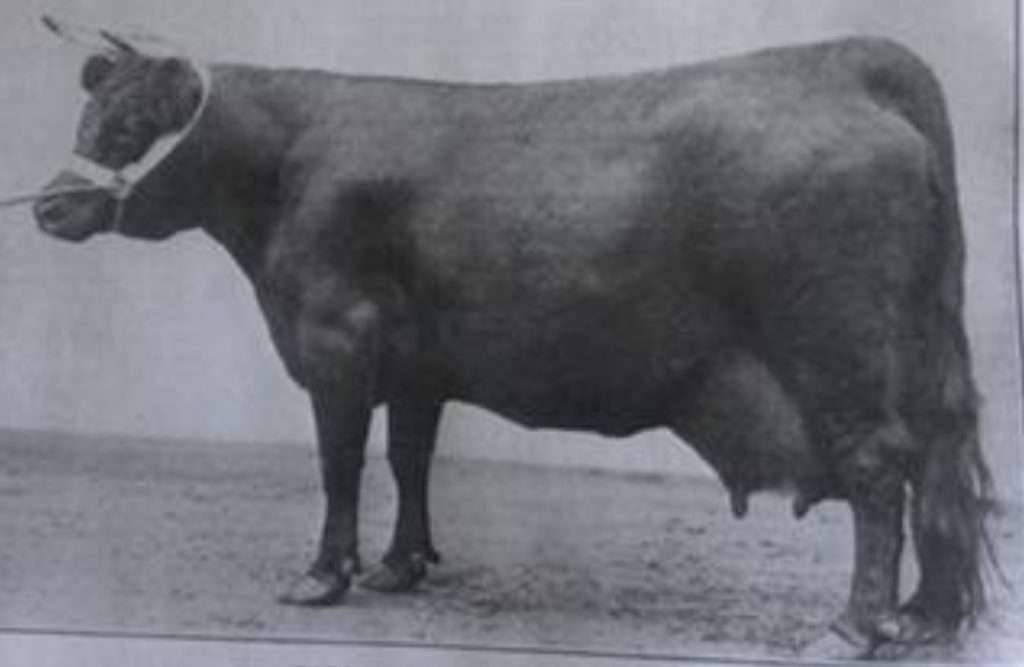
Grinstead Hawk obtained a register of merit for milk production in 1940, won 1st in the milking trails and won the reserve Nutt challenge cup and many more competitions. Though her flat feet and titlted teat may jump out as not quite perfect, there is much to be appriciated in a cow with solid milk production.

Peach Blossom of Claragh : A heifer in Spratts Line
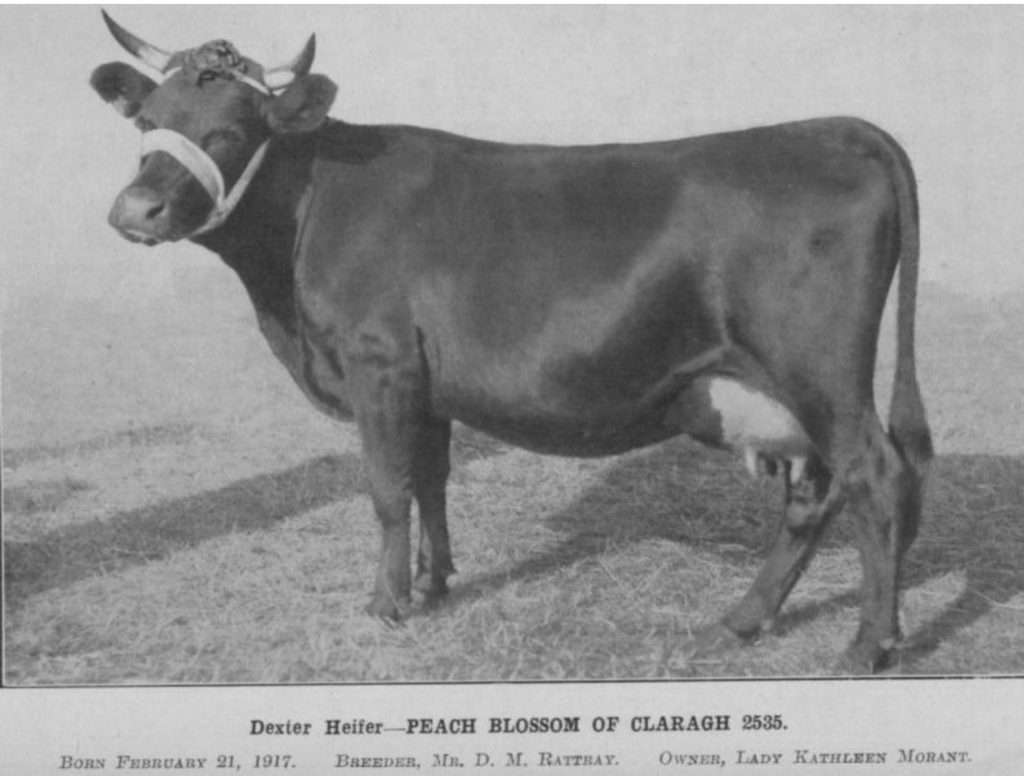
Peach Blossom of Claragh won 2nd place for a cow in milk while competing against mature cows.
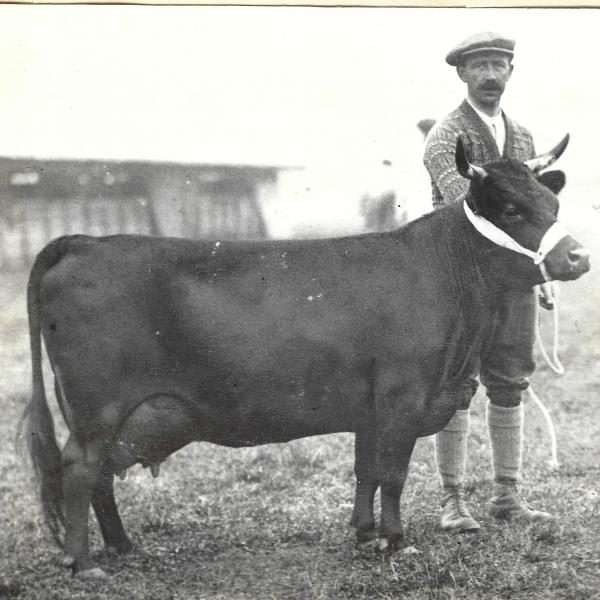
In conclusion to this article, I will leave you with this cow Grinstead Watercress, bred by Lady Loder though not directedly related to Spratt. This cow is graceful and well balanced a testament to her breeding. Some may say that she is not deep enough, but for a cow that I believe to be non chondro born in 1920 I’d say she is quite beautiful indeed. I hope this article inspires people, no matter the size of your herd or no matter how long you have been breeding that their is always room for improvement, no matter the current genetics in your herd. In order to truely preserve the wonderful Dexter traits of yesterday we must also be willing to impove our cattle of today.

“Dairy Breed” Champion Dexter Bull Atlantic Spratt Read More »

Historical
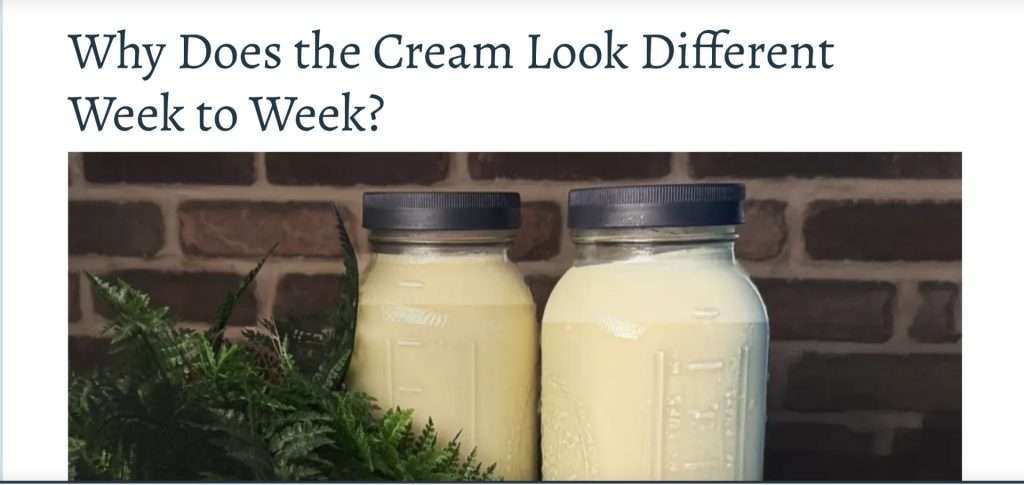
LET’S TALK CREAM AND DEXTERS

Here is an interesting article from a fellow Dexter milker, Michele Parsley. Real facts about how it varies and why. Don’t forget, some of our cream stays behind and never completely separates, making two incredible products, cream and still some pretty creamy milk for drinking or making something else. Celebrate your Dexter milk and cream!

https://www.mountainheritagefarm.com/blog/cream-variation

LET’S TALK CREAM AND DEXTERS Read More »

Milking & Dairy

DEXTER CATTLE – JOY, LAUGHTER, AND HEARTBREAK PART II

COVID.  It sucked.  No matter what aisle of the plane that you sit in, even if  you just want to stand in the middle, it sucked.  There was tragedy, heart ache and despair.  Some are still recovering.  Some never will.  All that said, it was eye opening for me.  An introvert by nature (though very few of those that meet me will agree with that description), COVID was somewhat of a respite.  It forced, for better or worse, solitude.  For me, it brought peace.  It got me thinking about our world and my place in it.  It was time to start questioning old habits and accepting the norm.  It was time to start doing.  

Where do I start?  As my late Dad would say, at the beginning.  I started to look for property in a rural area.  That was my first mistake.  I didn’t have a solid foundation as to what I wanted to do.  I looked at field, woods, and pastures.  Some had homes, and others did not.  About all of the properties were a good distance from where I lived and some were located in other States.  After becoming exhausted and frustrated, I realized that my search was futile. I needed to establish what I wanted to do and with what animals.  

My initial thought was horses.  My thought is I could breed horses, and/or run a boarding business.  It was my wife, ever the cynic, who asked the first pointed question. “Do you know how to ride a horse?”  

Contrary to popular opinion in my household, I was a seasoned equestrian and rodeo champion.  At least in my mind I dreamed I could be.  That said, I scheduled horse back riding lessons.  While I enjoyed the lessons, and riding, I started to think it was going to take a lot of time and experience to take other people’s horses in and provide appropriate care.  But alas, fate had other plans.  My wife quit asking about trivial things such as my ability to take care of horses and we sold our home and bought a home with horse stables and acreage.  For me, it was heaven.  

Then reality set in.  I remembered what the goal was.  The goal was to raise our own food.  Horses would be welcome, but horse meat will never be in our diet.  

The internet, love it or lump it, is a source of a great deal of information.  I play the game.  In that, I mean, I disregard all the “great” comments, and all the “terrible” comments and seek the middle,  I tried to not seek articles that I favored but cast a wide net looking for neutrality.  Just the facts, ma’am.  What I found intrigued me.  Dexter cattle.  Ideal for beef, milk, and smaller areas of land.  Hearty animals and docile in nature.  Not miniature, but smaller in stature.  Less intimidating for the new and not an animal that has to be considered a pet.  

I compared to different breeds.  I was intrigued by grass fed and milk that many argue is better suited to sensitive stomachs.  Not only for feeding my family, but the potential of feeding others.  I was not looking for marketing gimmicks but trying to fit a niche.  My niche.  I was told finding the acreage was the hardest part of raising cattle.  I can say with 100% certainty, that is a lie.  But I am having so much fun living my dreams with our Dexter cattle.

A little bit about the author for those who have read this article or maybe even the first article and scrolled to the bottom of this article just to see if someone had the guts to admit writing this.  I own and operate a small farm called “Our Yellowstone LLC” in Illinois.  I couldn’t do it alone, but will keep my wife’s name out of it to protect her innocence.  

DEXTER CATTLE – JOY, LAUGHTER, AND HEARTBREAK PART II Read More »

Selling

Calving Management

Calving Management: Nutrition, Timing, Profit

A Deep Dive Podcast, brought to you by Irish Dexter Cattlemen, on topics of interest to all farmers and ranchers. Subscribe to the free, monthly Irish Dexter Cattlemen Tips & Tricks Guide to get early access.

Brought to You by These Breeders, Affiliates, & Sponsors

Crest Point Farms Online

Since 2024
6 ads

Stay’N Put Farm Online

Since 2024
3 ads

Ashrons Acres

Since 2024
0 ads

Stumpys Acres

Since 2024
1 ad

Maple Creek Dexters

Since 2024
3 ads

Pipe Dreams Farm Butchery

Since 2025
2 ads

Hayburner Acres

Since 2025
0 ads

Grandma's Dexter Farm

Since 2025
2 ads

DeVine Farms

Since 2025
0 ads

Calving Management Read More »

Podcasts

Embyro Transfers

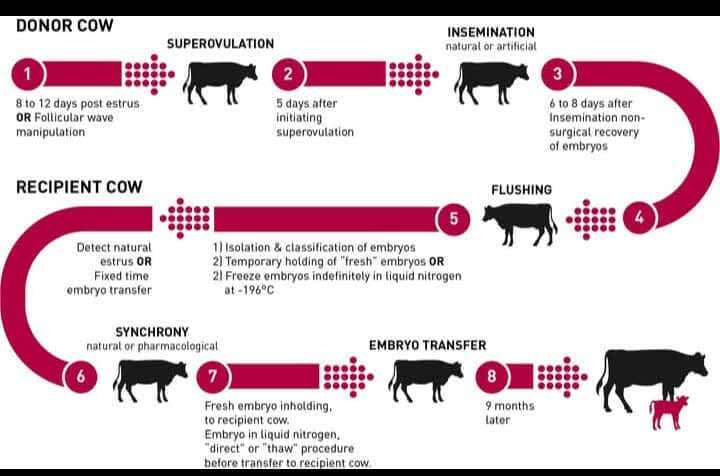
The basics of Embryo Transfer

The “donor dam” is usually a high quality, registered animal.

It begins with FSH (Follitropin) injections, to “super ovulate,” ending in Lutalyse, Estrumate or Estridiol to bring her into heat, followed by insemination and flushing.

Recipients in my world tend to be virgin heifers, but I’ve had older cows successfully carry ETs also. They are synchronized to have the embryos implanted at precisely the right time.

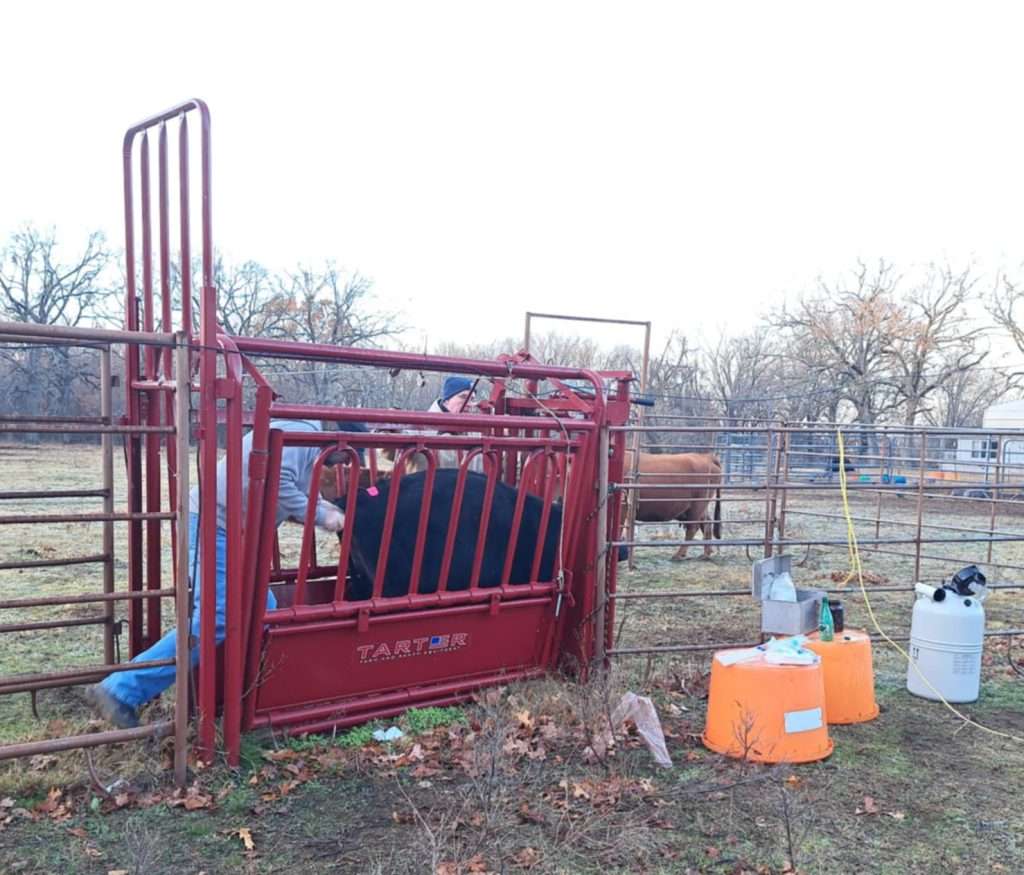
Flushing takes place using a catheter (similar to an AI pipette but longer.) The embryos are then sorted under a microscope, with the ET vet or tech categorizing them 1 (excellent) through 4 (not fertilized.) Grade 1s can be frozen. Grade 2s have a chance but have to be put in immediately.

Success rates vary from 40 to 65 percent. Fresh embryos typically have a higher conception rate then frozen versions.

On a random sidenote it is pretty cool to see a recipient give birth to an ET of a different breed. I’ve had numerous Holsteins carry Swiss calves, and it is an almost surreal experience at the time of delivery.

Embryos offer some the chance to purchase a high type calf with less expense, albeit a bit more risk. They can be a way to get some great genetics into your herd.

Embyro Transfers Read More »

Technology

No Udder, No Cow!

Atlantic Alison Showing off an Exceptional Udder

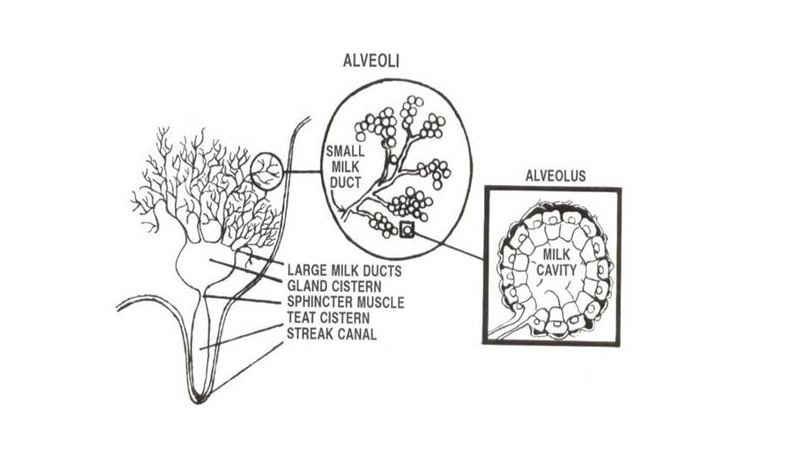
The old saying “No feet, no cow” is a phrase that denotes the importance of a cow’s ability to walk. Without good feet there can be no cow to stand on them, thus causing peril to the health of the cow. No Udder, no cow could be a similar maximum, denoting the importance of the cow’s udder. Without a good functioning udder, a cow cannot fulfill her role to nourish a calf or humans thus degrading her value as a cow. Not every Dexter needs an udder like Atlantic Alison, but the quality of a Dexter cow is tied up in the function and quality of her udder.

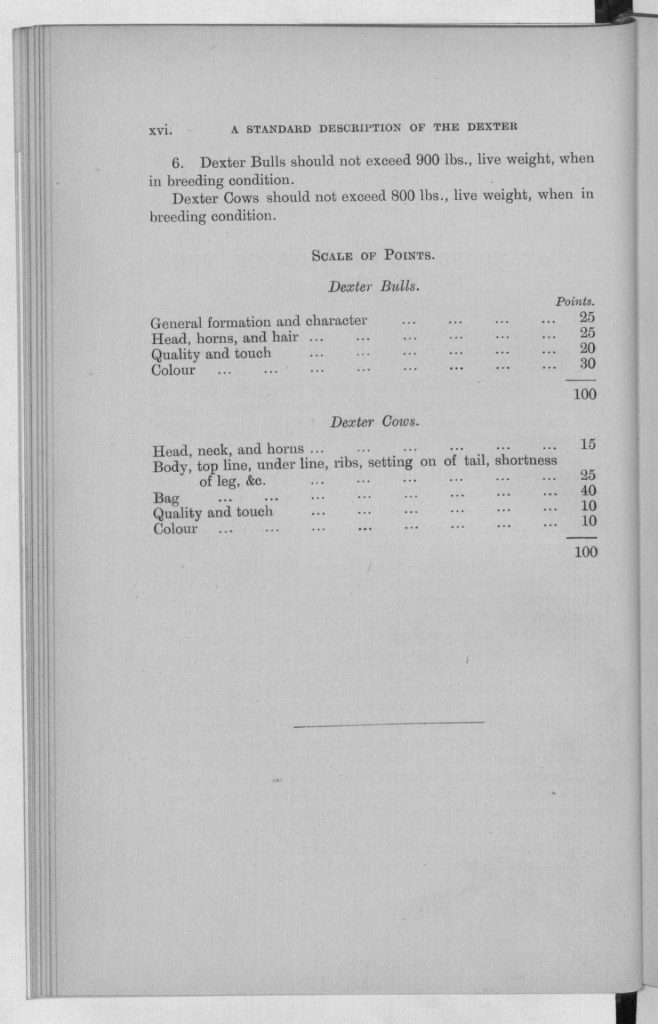
Scale of Points taken from the 1900 English Standard

This scale of points as seen above, is the first scale of points written for Dexter cattle and the most authoritative in breed history. It makes it clear what values can be attributed to a Dexter cow. As you can see udder traits are very important to the Dexter breed. There is no room in the Dexter breed for cows with truly bad udders, as it’s not agreeable to the standard scale of points. So, you see, 40% of a Dexter cows value of points is wrapped up in the quality of her udder, where only 25% goes for her body. That 25% is not just shortness or depth alone but “body, top line, under line, ribs, setting of tail, shortness of leg &c.” The point is cows with good udders are very important to the breed. A cow that lacks valuable udder points would scale very low as a Dexter in general. A cow that is not perfectly short could still score quite high as a Dexter if all other traits were ideal. A short Dexter with a bad udder would easily be beat by a taller Dexter with good conformation and an excellent udder.

No Udder, No Cow! Read More »

Historical
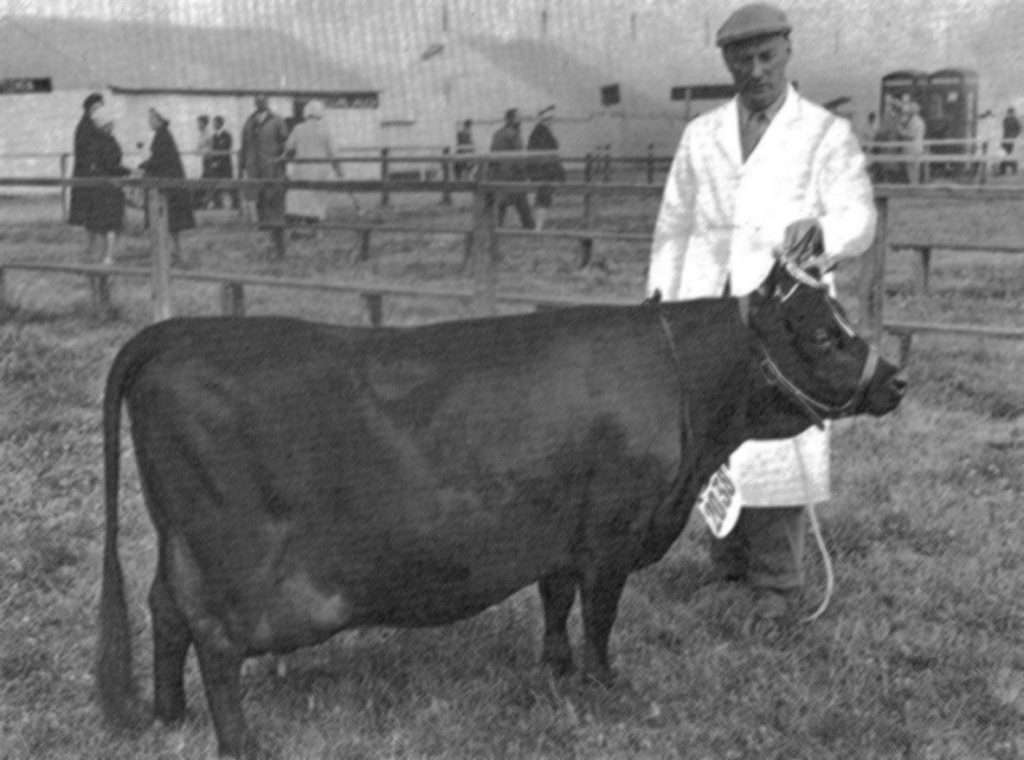
AI Plans vs. Real Life on the Farm

The Naughty Heifer and the Fence That Failed

We had a plan. A good one, too.

Three cows—technically two cows and one heifer—were supposed to be prepped for AI. Schedules were coordinated, semen was purchased (expensive, carefully chosen semen), and optimism was high.

And then… cows happened.

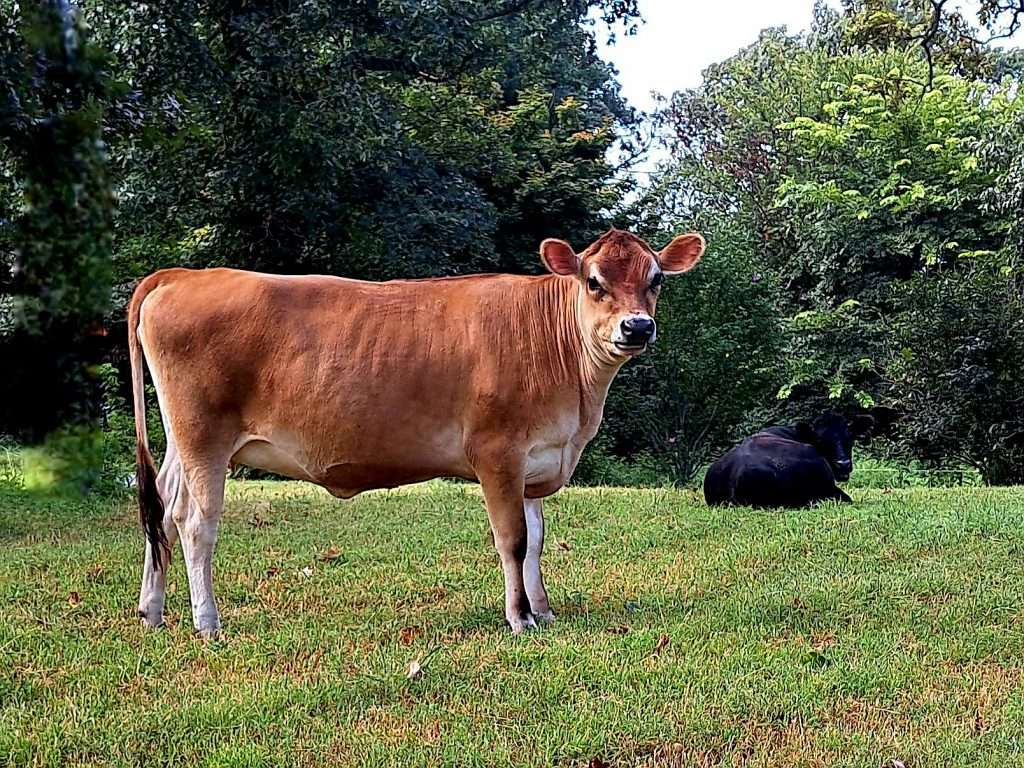
Instead, last night I caught the naughty Jersey heifer giving the Dexter bull a complimentary ride like it was part of a rewards program. No reservation required. Turns out there was the tiniest gap in the fence behind the round pen. The bull, being the logical problem-solver that he is, decided: If my head fits, clearly the rest of me will too. After politely bending the fence to accommodate his shoulders, hips, and audacity, he strutted through like Mr. Joe Cool himself, like he’d planned it all along.

Victorious. Smug. Unbothered.

I saw the whole thing play out with my own two eyes and am convinced that exact thought rolled through his lizard brain.

What followed was a full-blown cattle rodeo.

There I was, holding a gate open, desperately trying to call the heifer into a safe area while simultaneously holding one arm out like a traffic cop to keep the rest of the cows from joining in on the shenanigans. Bless my cows—they listened. This time. Meanwhile, my husband is trying to literally cock block the bull, which is (apparently) far easier to describe in writing than to accomplish in real life.

Round and round the three of them went.

The heifer, absolutely enchanted by the attention, had no intention of listening to me. Foolish wishful thinking on my part, but I had to try. When it became clear she was not coming willingly, I decided to grab a halter and a bucket of treats.

I turned my back and took exactly three steps.

That’s when my husband yelled, “HE GOT IN!”

I won’t lie—I saw red.

This heifer is a full-blood Jersey. I bought special, sexed mini Jersey semen just for her. Two hundred and fifty dollars a straw. In one instant, my carefully laid plans and dreams of a mini were dashed.

Words were said. Loudly. Words I won’t repeat here, but let’s just say I fully earned that shirt that reads, “I’m sorry for what I said while we were working cattle.” The general theme of my rant was questioning why he didn’t put a hand on her lady parts to block the bull.

Listen- if we had traded places, I absolutely would have dove in.

After tempers cooled, my husband informed me that this was clearly a coordinated effort. The heifer and bull had paid off the steer—promising him first choice at the clover.

The steer stepped on my husband’s foot and, in fluent bovinese, declared, “NOW!”—clearly on cue.

The heifer spun.
The bull landed.
The package was delivered.
Mission accomplished and the steer casually stepped off his foot like nothing had happened.

I am not exaggerating when I say it happened in seconds.

Yes, I could give her a lute shot in a few weeks and try again. But my AI tech is coming in less than two weeks, and I hate asking him to come out for just one cow. So… it is what it is. At this point, I’m hoping for a bull calf we can beef. A small victory, but I’ll take it.

And honestly? This is farm life.

You can plan meticulously. You can invest in genetics, schedules, and systems. But animals don’t read calendars, respect budgets, or care about our best intentions. They remind us—sometimes loudly and inconveniently—that we are working with life, not controlling it.

Some days you get exactly what you planned for.
Other days, you get a story you’ll be telling for years.

And if nothing else, this one gave us a good laugh, a lesson in humility, and a reminder that the best laid plans often turn into the best memories.

Plus… it helps that they’re so dang cute.

About the Author:

Kimberly Jepsen is the heart behind MooShine Ridge in Vinita, Oklahoma, where she and her husband, Kevin, have been raising dual-purpose Dexter cows since 2015. Their little farm store is a labor of love, offering Dexter beef, raw milk, and artisan cheeses made from their own cows. Kimberly has a deep passion for the Dexter breed and loves nothing more than sharing what she’s learned over the years—whether it’s guiding fellow farmers, helping newcomers discover the joys of small-scale farming, or simply introducing people to the rich, creamy flavors of her handcrafted cheeses. For her, farming isn’t just a business—it’s a way to nurture animals, the land, and the community she cares about. https://mooshineridge.com/

AI Plans vs. Real Life on the Farm Read More »

Farm Management

Soap Making

Getting Into Soap Making: A Farm-Rooted Approach

by Lexy Schussler

    On the farm, there’s always a project going on.

    Whether it’s fixing fence, feeding animals, or figuring out how to use what we already have, farm life keeps our hands busy and our minds curious. It’s no surprise that so many homesteaders eventually find themselves asking about soap making.

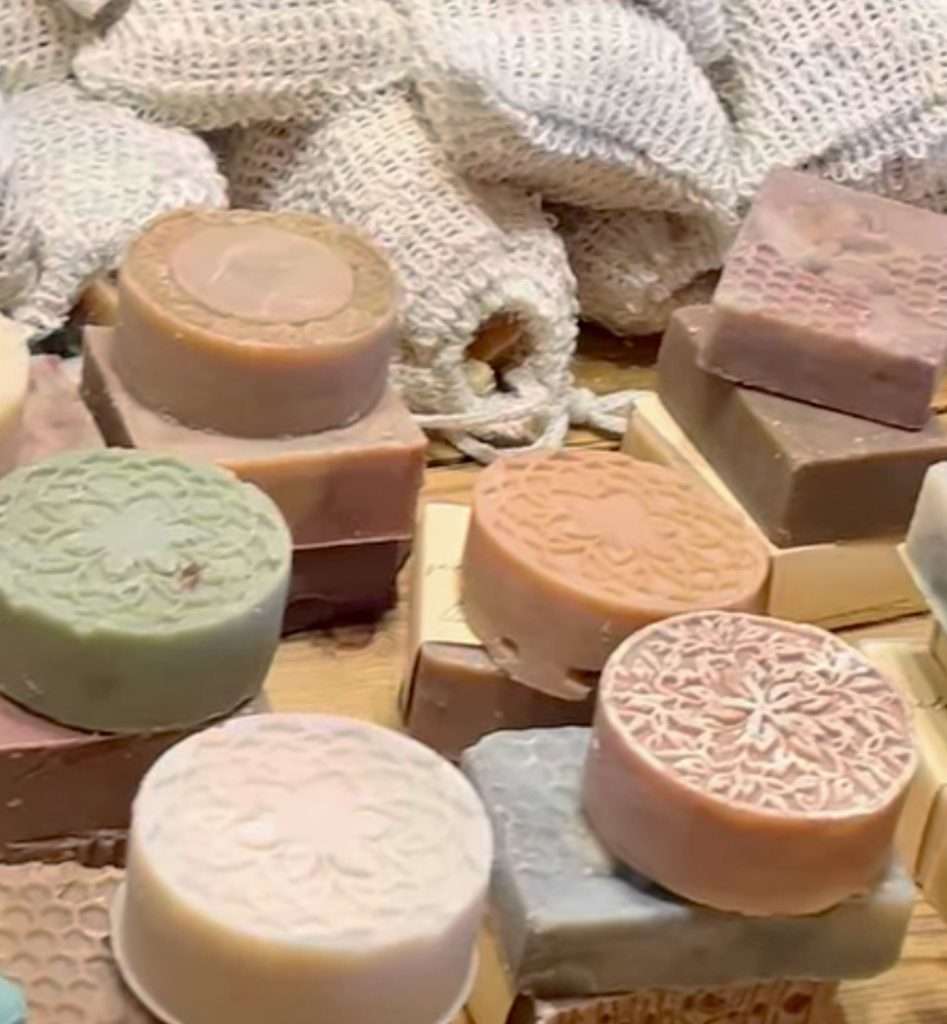
    Soap making fits naturally into farm life. It’s practical, creative, and deeply tied to stewardship. Rendered tallow, lard, fresh milk — these aren’t just byproducts, they’re opportunities. For families, soap making becomes a teachable skill. For kids in 4-H or FFA, it can turn into a fundraiser or small business. For farms, it can quietly support feed bills, hay costs, and seasonal income without adding chaos to daily chores.

    This isn’t about chasing trends or building something overnight. It’s about using what you already have and building a rhythm that works with the farm, not against it.

    The best place to begin isn’t shopping — it’s inventory. What do you have the most of? For many farms, the answer is pork fat or beef fat. Tallow and lard make exceptional soap bases, producing hard, long-lasting bars with a creamy lather. They also connect modern soap making to generations before us who relied on exactly what their land and livestock provided.

    From there, balance becomes the focus. While animal fats form a strong foundation, additional oils help fine-tune how a bar feels and performs. Coconut oil contributes cleansing and bubbles. Olive oil adds gentleness and conditioning. Shea butter and castor oil bring richness and lather, but both are best kept at around five percent or less. Too much of either can leave soap sticky or soft. Thoughtful formulation matters more than complexity.

    That balance extends to structure as well. Hard oils like tallow, lard, coconut oil, and small amounts of shea butter give soap durability and longevity. Soft oils such as olive oil and castor oil improve skin feel and conditioning. Superfat also plays an important role. A superfat range of five to seven percent creates a bar that lasts in the shower, doesn’t melt away quickly, and still treats skin kindly — especially important for hardworking hands.

    Liquid choice offers another place for creativity. Goat’s milk, cow’s milk, and sheep’s milk all produce beautifully gentle soaps, but milk isn’t required. Water, herbal teas, and even regional beer can all be used successfully. Soap making allows room for both tradition and experimentation.

    As recipes take shape, batch size and molds come into focus. Loaf molds are a favorite for good reason — they create consistent bars that are easy to cut, label, and package. Silicone molds can be expressive and fun, but they often complicate packaging, so it helps to think ahead to how the soap will actually be sold.

    Many makers begin with batches in the thirty-six to fifty-four ounce range, which are manageable and forgiving. Larger batches become appealing as confidence grows. Consistency matters, especially when selling, but inspiration matters too. Soap making should feel grounding, not exhausting.

    No matter how carefully batches are measured, there’s almost always a little extra batter. Keeping small molds on hand for overpours is one of those quiet tricks that prevents waste and creates opportunity. Overpours make excellent samples, donation pieces, market giveaways, and gift add-ins.

    Selling soap introduces a new layer of thought: understanding who you’re selling to. Most homesteaders quickly discover they don’t have just one demographic. Many blue-collar households want soap that lasts, doesn’t melt into mush, and doesn’t dry skin out. Clean, familiar scents often outperform trendy blends in rural and family-centered communities, while boutique spaces may invite more experimentation. The goal isn’t to chase every preference — it’s to know your audience.

    Fragrance oils deserve special attention. Reading soap notes is essential. Reputable suppliers document how fragrances behave in cold process soap, including acceleration and discoloration. Vanilla-based scents almost always darken to tan or brown. That doesn’t mean they can’t be beautiful, but it does mean planning ahead. One common technique is reserving a small portion of unscented soap — usually four to ten ounces — to color and swirl for contrast.

    When starting out, slow-moving fragrances are your friend. Acceleration leaves little working time and can overwhelm beginners. Reviews written by other soap makers are just as valuable as official notes, often offering real-world insight that saves time and frustration.

    Many homesteaders source fragrance oils from companies like Midwest Fragrance Company, Aztec Candle & Soap Supply, and Nurture Soap for their balance of performance and price. Higher-priced suppliers such as Bramble Berry also offer standout scents, but every fragrance should be priced per ounce and accounted for in the batch cost.

    When the numbers are done correctly, soap making becomes a powerful fundraising and income tool. Many bars can be produced for under two dollars and sold for five to eight dollars depending on the market. With a four-to-six-week cure time, soap aligns well with typical fundraising timelines — but offers far more education and pride than traditional campaigns. For youth involved in animal projects, soap sales can directly support feed, bedding, and show expenses.

    Seasonal planning makes all the difference. For the first year or two, minimal production throughout the year paired with heavier production starting in August works well. October through December becomes the main selling season, with the goal of covering a full year of hay or grain costs. Once that foundation is built, growth feels steady rather than stressful.

    Valentine’s Day soap is often made in late November or December, allowing plenty of cure time and avoiding post-holiday burnout. Smaller molds, gift sets, and overpours shine during this season. Trying to produce year-round before infrastructure is in place often leads to burnout. Building slowly builds longevity.

    Presentation matters, too. A strong logo and consistent label help people recognize your soap instantly. Tools like OnlineLabels allow makers to experiment with shapes and sizes without large upfront costs. Keeping a variety of labels on hand makes it easier to create gift baskets and seasonal packaging as inspiration strikes.

    Marketing doesn’t always require advertising. Many homesteaders find success through community involvement — donation baskets, raffles, church events, and silent auctions. Handmade items are especially prized at livestock shows and fundraisers, including those hosted by the American Dairy Goat Association, where quilts, soap baskets, and farm goods are both competitive and deeply appreciated.

    What began for me as a way to use farm abundance and offset costs slowly grew into something much bigger. Soap making turned into soap making classes, and those classes opened the door to agritourism — inviting people onto the farm to learn, slow down, and reconnect with where everyday goods come from.

    This past year, our farm was voted top five for best day trip, farm, and soap in the Kansas City area — something I never imagined when I first poured a small batch at the kitchen counter. We’re just 35–45 minutes outside the bustle of the city, yet people are willing to make the drive for something wholesome, hands-on, and real.

    That’s the quiet power of building something intentionally. Soap was never just soap — it became an invitation. An education. A bridge between rural life and curious hands looking to learn.

    And like most good farm projects, it all started small.

    One good bar at a time.

    Soap Making Read More »

    Homesteading

    From Freezer Camp to the Milk Pail: Maggie’s Story

    How “Accidental” Breeding Created a Little Black Cull Heifer that Turned into One of the Best Milk Cows in the World…

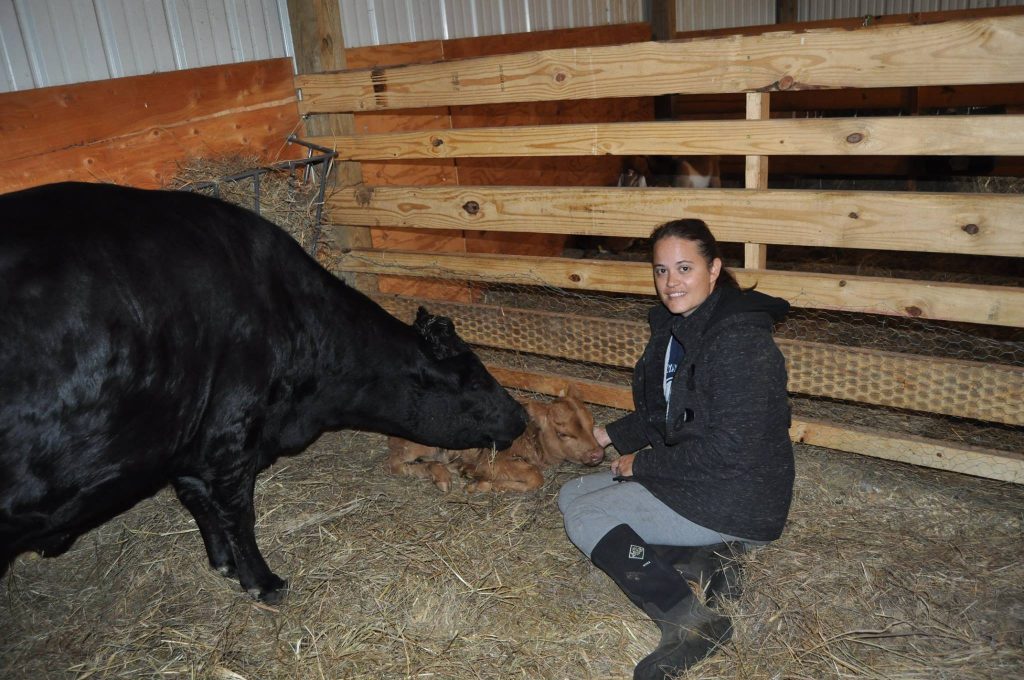
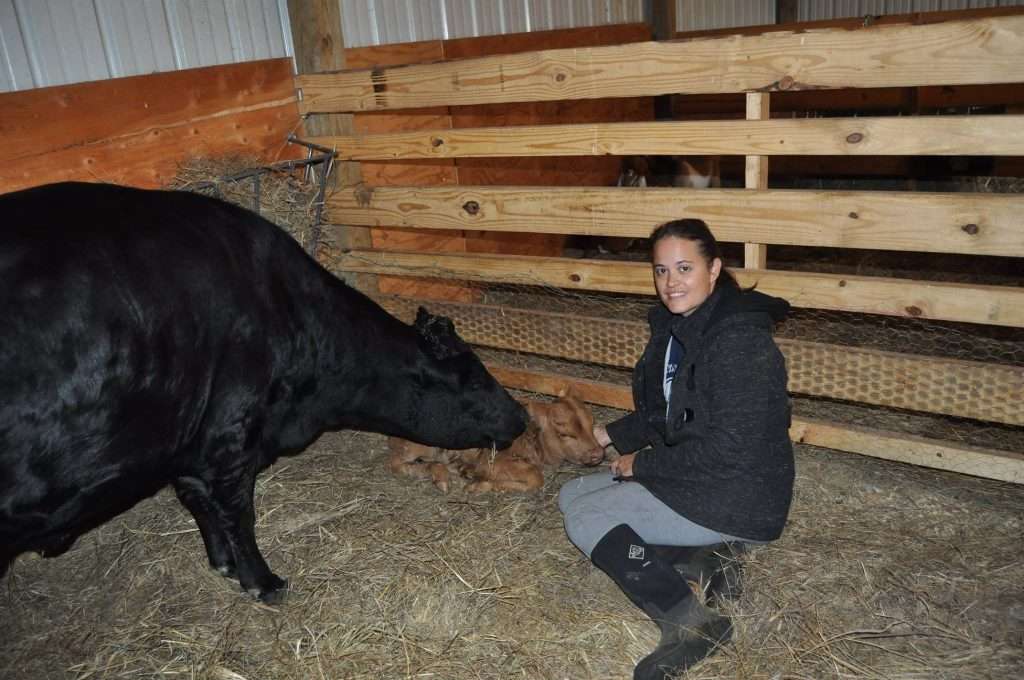
    The year was 2015, and I had never touched a cow before buying one. I had read every book I could find and devoured countless online articles about cattle, but I had absolutely zero real-life cattle experience. Still, I knew one thing for certain: I wanted a milk cow. That single desire was all the motivation I needed to bring home my first Dexter cow, Cassandra, in March of that year.

    Cassandra—quickly nicknamed MooMa—was due to calve soon, and I couldn’t bear the thought of her living alone for three months. Cattle are herd animals, after all, and MooMa needed a companion. Our budget was tight, so I bought a wild little black cull heifer named Maggie She wasn’t registered because her dam had been bred by a “steer” that had retained one testicle when he had been banded. Maggie was also A1A1 milk, which at the time was a big deal for us so we had no intention of keeping her long-term. Her future, as far as we were concerned, involved freezer camp.

    Maggie arrived already overwhelmed. Shortly before coming to our farm, she had been vaccinated, dehorned, weaned, and then hauled to a new home with complete strangers. By the time she stepped off the trailer, she was terrified. Kevin and I stood watching in horror as Maggie calmly stepped between two strands of hot wire as if they didn’t exist—and just like that, she was gone.

    MooMa, older and steadier, began calling for her. Before long, Maggie came trotting back, stepping right between the wires again as though that was perfectly normal. We quickly added a third strand of wire and spent the next week wondering what on earth we had gotten ourselves into.

    Maggie wouldn’t let us within fifty feet of her. Her fear seemed contagious, and soon MooMa didn’t trust us either. Time was ticking. I had just three months to turn MooMa into a milk cow. So every day—sometimes multiple times a day—I went out and simply sat in the pasture with them. Cattle are naturally curious. At first, they’d freeze and stare at me, clearly hoping that if they didn’t move, I wouldn’t notice them. But it didn’t take long for them to learn I wasn’t there to hurt them—and that I usually brought treats. Before long, my pasture visits became something all three of us looked forward to.

    On June 10, 2015, MooMa gave birth to a little red bull calf we named Liberty. Five days later, I began milking her. The next nine months were a steep learning curve for both of us. I’d love to say she milked like a dream, but the truth is… quite the opposite. That story, however, is for another blog post.

    When it came time to rebreed MooMa, my AI technician talked me into breeding Maggie as well. She had grown into a lovely little heifer and could, at the very least, provide us with beef. She was still mostly wild—nearly all my effort had gone into training MooMa—but Maggie didn’t need to be tame to reproduce, so we went ahead and bred her.

    Throughout her pregnancy, Maggie came to the barn every single day. She stood quietly, watching me freequently dodge kicks and often times fight for every drop of milk from MooMa. What I didn’t realize at the time was that Maggie wasn’t just waiting for her “big sister” to finish—she was studying.

    Fast forward several months. MooMa calved her second calf just days before Maggie had her first. Once again, I began milking MooMa, and once again, Maggie watched and waited.

    Four days after Maggie calved, I walked into the barn expecting my usual routine and instead found Maggie standing squarely in the milk stanchion. She refused to leave. Waving my arms, yelling like a crazed person—nothing fazed her. Finally, exasperated, I looked at her and said, “Well, Maggie, I guess you’re going to be a milk cow today.” Fully expecting her to spook and bolt, I slammed my milk bucket loudly beneath her. She didn’t move. I washed her udder. Still nothing. When I finally grabbed a teat and squeezed, Maggie sucked in her gut and stood like a seasoned professional. No treats. No headgate. No kicks. No tantrums. This little black cull heifer wanted to be a milk cow.

    Dexters are notorious for holding back their hind milk unless the calf is nursing. I’ve long accepted this and simply train calves to nurse on one side while I milk the other. But Maggie is different. She gives me everything she makes, trusting me to leave enough for the one thing she loves more than anything—her calf. When it’s time to wean, she handles it herself, yet she still comes to the barn every day, eager to be milked.

    One year, while transitioning Maggie from a fall calving schedule to a spring schedule, I milked her for 380 days straight. In my book, that makes her a Super Cow. Maggie remained a cherished milk cow at MooShine Ridge for many years—a living reminder that sometimes the animals we least expect to keep are the ones who teach us the most.

    About the Author:

    Kimberly Jepsen is the heart behind MooShine Ridge in Vinita, Oklahoma, where she and her husband, Kevin, have been raising dual-purpose Dexter cows since 2015. Their little farm store is a labor of love, offering Dexter beef, raw milk, and artisan cheeses made from their own cows. Kimberly has a deep passion for the Dexter breed and loves nothing more than sharing what she’s learned over the years—whether it’s guiding fellow farmers, helping newcomers discover the joys of small-scale farming, or simply introducing people to the rich, creamy flavors of her handcrafted cheeses. For her, farming isn’t just a business—it’s a way to nurture animals, the land, and the community she cares about. https://mooshineridge.com/

    From Freezer Camp to the Milk Pail: Maggie’s Story Read More »

    Milking & Dairy

    Maggie’s Miracle: A Story of Hope and Survival

    Three years after I started my Dexter journey, it was mid October, 2019 and my farming world felt as though it was collapsing around me. After weeks of fighting an unknown illness and exhausting every option available, I was forced to make the devastating decision to put down my first cow. I was heartbroken. And just when I thought I had reached the lowest point imaginable, things took an even darker turn.

    Only weeks earlier, Maggie—one of my most beloved milk cows—and I had quietly celebrated an extraordinary milestone: one full year in milk. For a Dexter cow, this was no small achievement. Most Dexter lactations last eight to nine months at best, but Maggie loved being a milk cow. By intentionally delaying her breeding to move her from a fall to a spring calving schedule, she was able to continue milking far longer than expected.

    That high didn’t last.

    Branna before she got sick. She was such a sweet little cow.

    Just one week later, Branna—one of my first fresheners—fell ill. I rushed her to the veterinarian at the very first hint that something was wrong, but despite every effort, she spiraled downhill with terrifying speed. After three on-farm veterinary visits, countless treatments, and test after test, I was left with the most painful decision a farmer can face. Two weeks after her first symptoms appeared, I remained by her side, heart aching, as we made the compassionate choice to let her go humanly. My husband loaded her body into our trailer and together we made the long journey to OSU vet school to have a necropsy done.

    Exactly one week after Branna became sick, Maggie followed. The vet confirmed Maggie was pregnant and said, “Maybe we can help her survive long enough to calve.” But she was still five months away from her due date, and given her rapid rate of decline, that hope felt impossibly distant.

    Both cows health deteriorated with terrifying speed. My head was spinning. The veterinarian had no clear answers and no way to stop whatever was happening. He believed Maggie’s illness was unrelated to Branna’s, but after a second physical exam—conducted one week after the first—he unofficially diagnosed Maggie with BLV (Bovine Leukemia Virus), a disease considered incurable and ultimately fatal. That diagnosis was based solely on physical examination; no blood test had yet been performed. And because Maggie was running a high fever, which is of course not impossible but it’s not typically associated with BLV, I questioned it. I had the vet pull blood and send it off for testing.

    Maggie continued to decline at an alarming rate. A cow once described by my veterinarian as “really fat” became a shell of her former self. For ten long weeks, she hid in the woods, barely eating and shivered non stop running a persistent high fever. Twice a day, every day, I hauled food and water to her, desperate for her to take even a few bites. Some days she did. Many days she didn’t. Often, I simply sat beside her and cried.

    I was utterly shattered. To say I was broken feels like an understatement. My animals mean everything to me, and suddenly I was watching not one, but two cows slip away while I stood helpless to stop it. I’m not someone who cries easily—certainly not in front of others—but this season reduced me to sobbing in my husband’s arms more times than I can count. I couldn’t bear the thought of losing them both in the same month.

    There were two moments during those ten weeks when we made the painful decision that it might be time to let her go—made all the harder by the fact that she was pregnant. One of those days fell on my daughter’s birthday. The other was a Saturday night. Both times, Maggie survived the weekend, and then—something would change in her disposition so I postponed the call to the vet, clinging to whatever hope I could find.

    Over time she’d rally just enough to make us pause. Two small steps forward, one giant step back. Her improvement was so slow it was almost imperceptible, leaving me wondering if it was real progress or simply my heart refusing to give up. She had lost more than 300 pounds and was so weak that she stumbled with every step. At one point, she even dropped to her knees, and I thought to myself, This is it—she won’t get up again. But Maggie is a fighter.

    Eventually, Branna’s necropsy results came back. She had suffered from a massive infection affecting every organ in her body—including her heart. The necropsy took a month and cost me nearly $900 and they never could tell us how she got so sick. All tests for communicable diseases were negative. The vet was now certain Maggie had not been battling the same illness. Still, we had no explanation for what had caused either cow to become sick.

    Then, ten weeks to the day after Maggie’s first symptoms appeared, her fever finally broke. That morning I walked into the living room and looked out toward the pasture, convinced I was still dreaming. There, in the open, stood Maggie—no longer hidden in the woods, but calmly eating from the hay bale. My legs gave out. I dropped to my knees and sobbed, overwhelmed by the sight of her standing there, triumphant—her battle finally won. It was the first milestone that brought tears of joy—and it wouldn’t be the last. Her recovery was slow, but steady. Each week, she grew a little stronger. Naturally, I assumed she had miscarried, yet at that moment, I was simply grateful she was alive. For the first time in weeks, I allowed myself to believe that the worst might finally be behind us.

    The veterinarian later retracted the BLV diagnosis, and subsequent testing confirmed Maggie was negative. He admitted these were two of the strangest cases he’d seen in a very long time. We may never know what truly happened.

    Then, a few months later, as I stood loving on Maggie, I saw it—distinct kicks in her belly. She was still pregnant! Or was it just wishful thinking?

    My husband doubted it. After all, Maggie had stood at death’s door more than once. But I was so sure of what I had seen. Even so, I couldn’t help but wonder what condition that calf might be in after ten weeks of illness, high fever, and near starvation.

    On Sunday, March 31st, at 7 p.m., Maggie didn’t come up with the rest of the herd for feeding. Worried, I went searching. I found her deep in the woods, standing over a very wet little red bull calf. Maggie—and her little miracle. I stood there as the sun set, tears streaming down my face, watching them together. When darkness crept in, I congratulated her, told her how much I loved her, and quietly walked away. I looked at my husband, smiled, and said, “Mags is back.”

    For five long months, I cried more than I thought possible, prayed without ceasing, lost countless hours of sleep, and ridden an emotional roller coaster I wouldn’t wish on anyone. But through it all, God never forsook me, and He heard my prayers.

    After everything Maggie had endured, this strong, healthy little bull calf was nothing short of a miracle. He deserved a name that reflected the gift he truly was. We chose Theodore—which means “Gift of God.”

    P.S. As you can see in the photo, Maggie had fully regained the condition she lost. She is a survivor. Thank you, Jesus, for making Dexter cattle so remarkably hardy.

    About the Author:

    Kimberly Jepsen is the heart behind MooShine Ridge in Vinita, Oklahoma, where she and her husband, Kevin, have been raising dual-purpose Dexter cows since 2015. Their little farm store is a labor of love, offering Dexter beef, raw milk, and artisan cheeses made from their own cows. Kimberly has a deep passion for the Dexter breed and loves nothing more than sharing what she’s learned over the years—whether it’s guiding fellow farmers, helping newcomers discover the joys of small-scale farming, or simply introducing people to the rich, creamy flavors of her handcrafted cheeses. For her, farming isn’t just a business—it’s a way to nurture animals, the land, and the community she cares about. https://mooshineridge.com/

    Maggie’s Miracle: A Story of Hope and Survival Read More »

    Herd Health

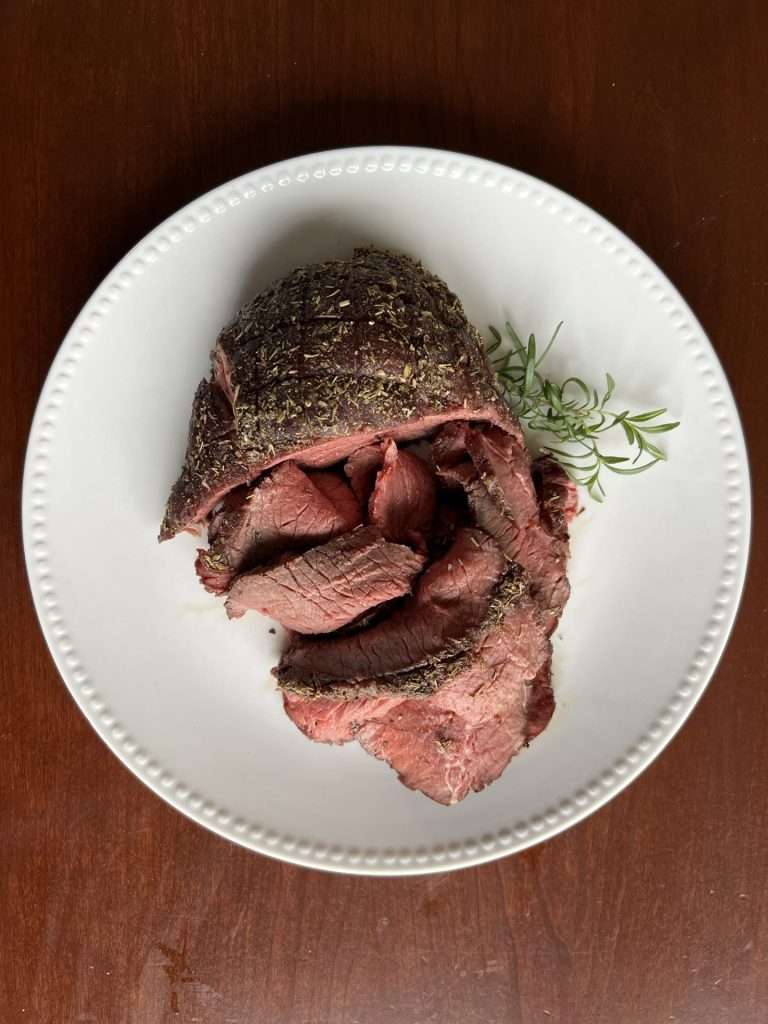
    The BEST Beef

    We’ve been raising our own beef for years. Before that, we raised rabbit and chicken, and hunted deer to fill our freezer. It’s been so long since we had to purchase meat from the store, I forget how lucky we are. Especially now that we raise Dexter cattle.

    I’m always pleasantly surprised when we get feedback from our beef customers. I take for granted that we get to eat beef this flavorful and tender on a regular basis. My all time favorite message from a new customer is this: “Your beef is fantastic. It tastes the way I remember beef tasting in my childhood.” Delicious beef, reminiscent of a slower time.

    A new customer just a few weeks ago texted, “beef is awesome! Color and texture is amazing.” This is really a confirmation of our goal to improve tenderness. The flavor has always been top notch, and we’ve been refining tenderness and marbling with success! Being grass-fed only, this has taken a longer road to accomplish, but what satisfaction!

    Another customer recently wrote, “Thank you!!! It’s literally the ONLY meat I trust eating myself or feeding my kids!!!” We are so grateful to be trusted in this way! Our little Dexter cows really make this possible, with their great foraging skills, and ability to convert that forage into flavorful, tender, and nutritious meat for our community.

    Have you tried Dexter beef? If not, you really don’t know what you’re missing. But, don’t just take my word for it! Find a Dexter beef producer in your area. We can help with that. Head over to the Irish Dexter Cattlemen Marketplace to look for beef in your area. Keep checking back as we add more producers from across the US.

    The BEST Beef Read More »

    Beef
    Irish Dexter Cattlemen

    We’re on TikTok! 🎉 @idc79807

    Come check out our growing TikTok account and join the fun! Our content is a great mix of cute, fun, informative, and everything in between—there’s something for everyone. Be sure to follow us so you don’t miss out.

    Want to see your Dexters or your farm featured? We’d love that! Feel free to send photos and/or videos to
    📧 tiktok@irishdextercattlemen.com

    We’ll also be posting new ads on TikTok. I’m currently catching up on existing ads, and once we’re up to date, your ad will be posted as soon as it goes live on the website.

    Have content ideas or interesting Dexter facts to share? Photos, videos, and suggestions are always welcome, just send them to the email above.

    Let’s show off our Dexter community! 🐄💚

    We’re on TikTok! 🎉 @idc79807 Read More »

    General

    Is Your Dexter Udder Hairy?

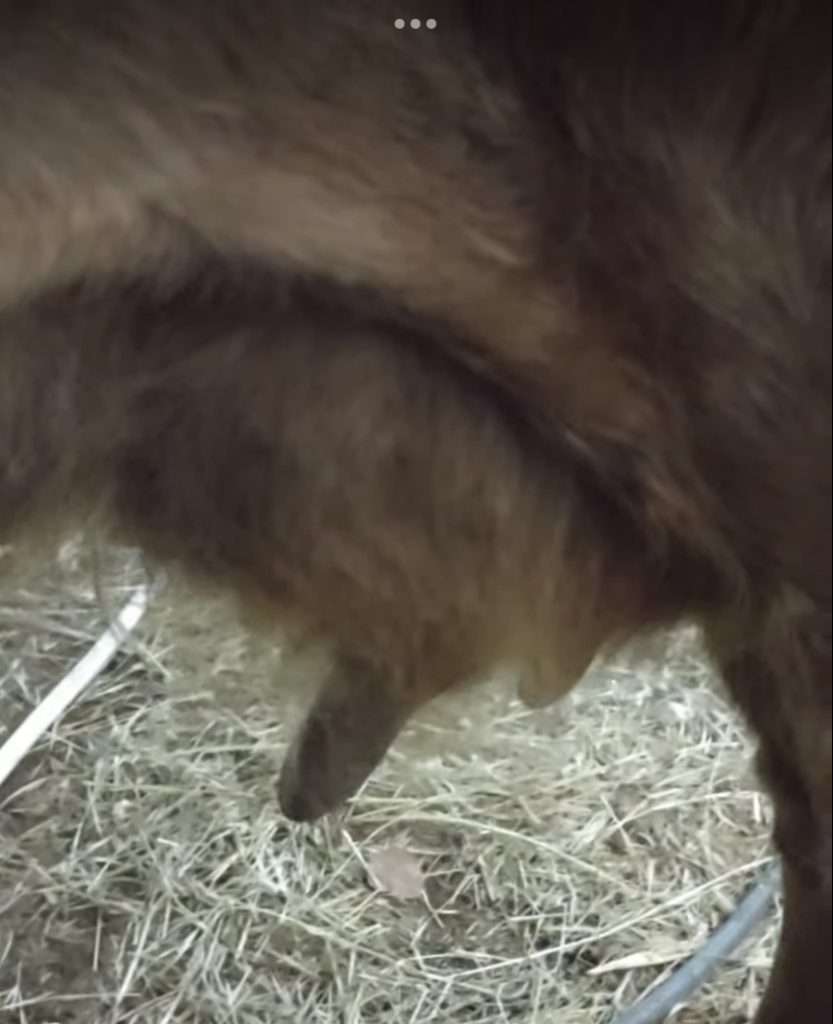
    Let’s face facts. Some of our Dexter gals have some pretty hairy udders. All that hair is not something we want if we are trying to milk them and provide a clean product.
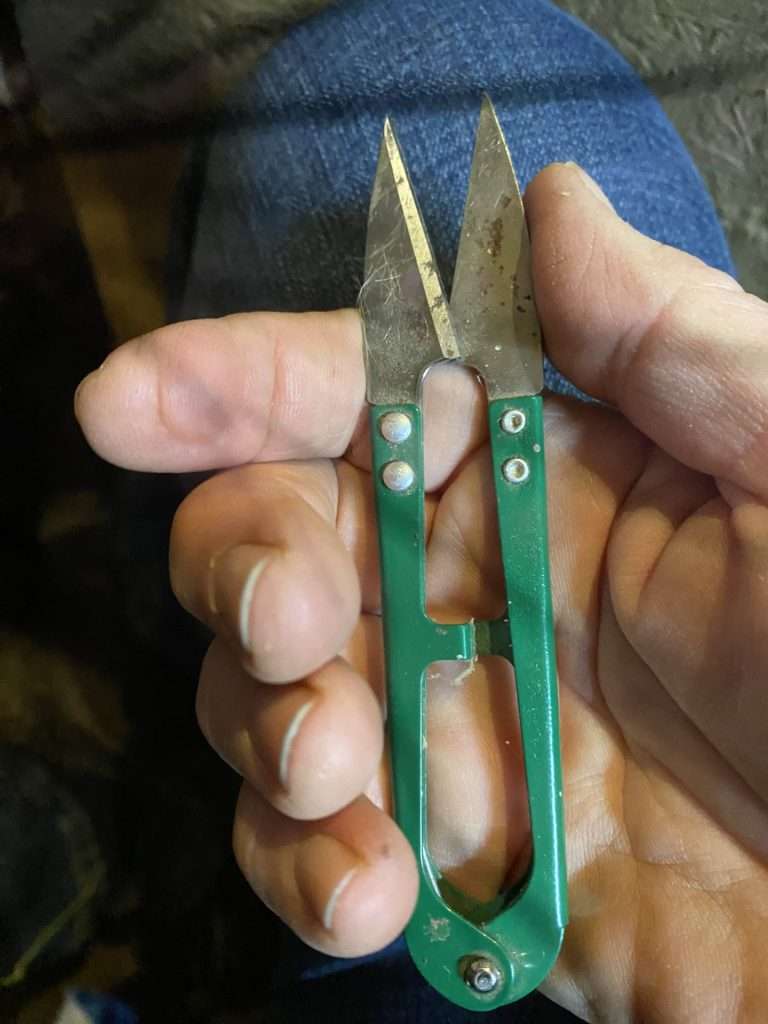
    I use these handy dandy scissors pictured below, but some folks also use electric clippers, as in the short video below.

    What ever method you choose, make sure you do it, it makes cleaning the udder sooo much easier!

    Is Your Dexter Udder Hairy? Read More »

    Milking & Dairy

    A little help from TECHNOLOGY can help with calving…

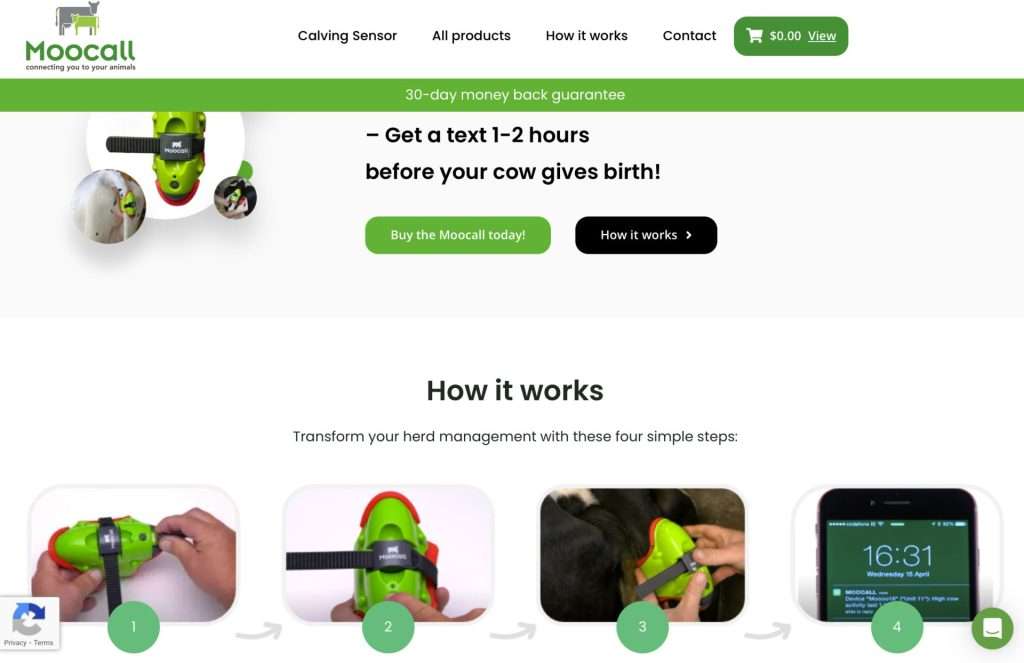
    After many nights of interrupted sleep, due to monitoring a heifer and her first calving, I decided to let technology given it a try. I purchased a Moo Call device. Of course it arrived and she went into labor, but I decided to given it a try on my Dexter due.

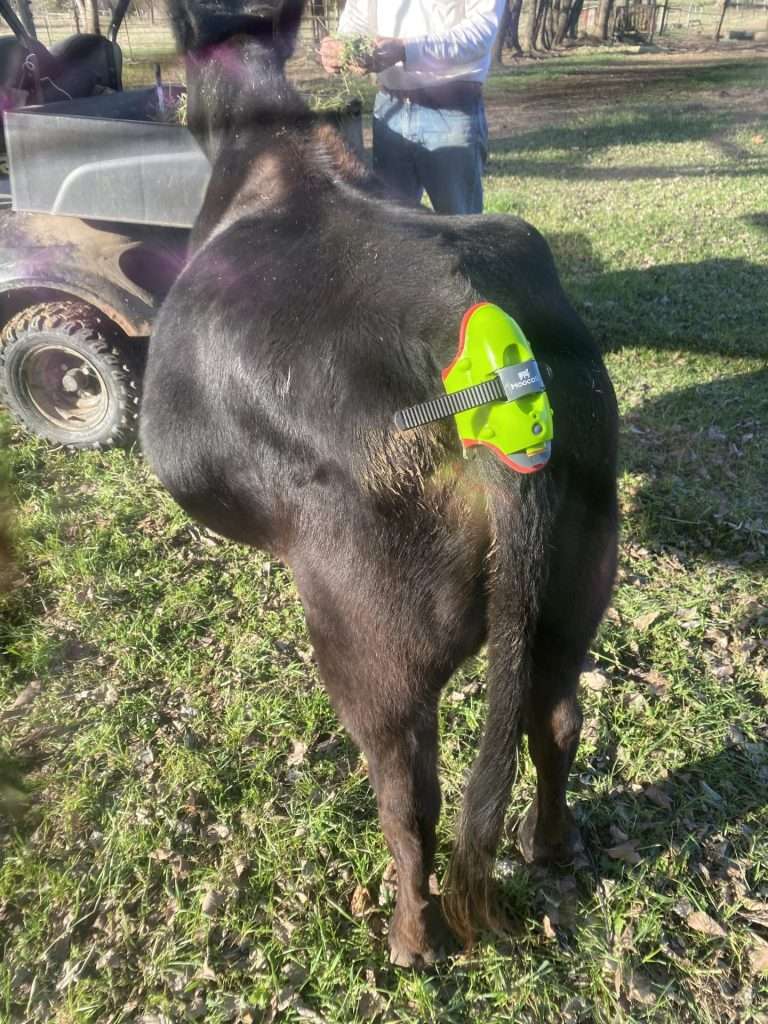
    It was pretty simple. I followed the instructions and had to cut off to sections on the red rubber grip to get a proper fit. After that I attached it to her tail and monitored during the day, like I always have. I figured she was a few days out and mostly used it at night, so I could sleep.

    After a brief phone call with them, to make sure it was working properly, I relaxed and decided to give it a chance. He due date came and went, but all of my experience told me she was not ready and I slept like a baby.

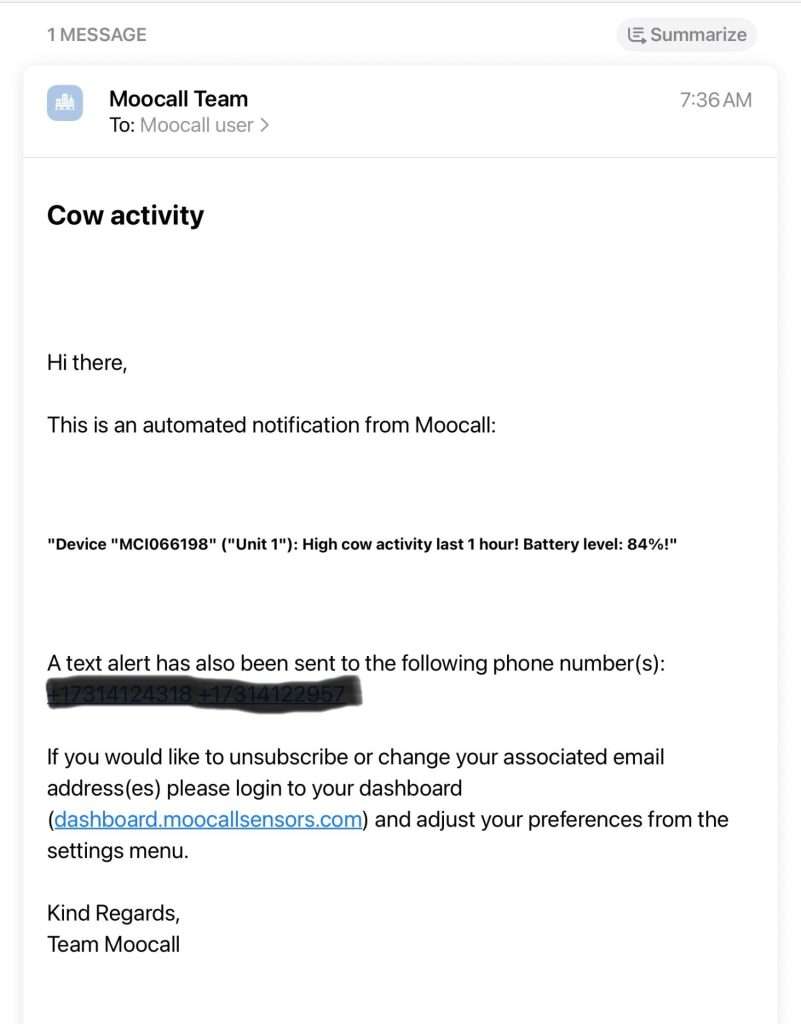
    The next morning while finishing up miking, my husband said…Did you just get an email like this? I grabbed my phone only to have it MOOO at me! I had received the email and text…but now it was mooing at me from the APP I had downloaded.

    We quickly finished up and went to check on her…and yes she was in the beginning stages of labor. The Moo Call said she would calf within the hour…and she did! The alerts started at 7:34 and the calf arrived at 8:18. Here are some visuals of our experience.

    A little help from TECHNOLOGY can help with calving… Read More »

    Technology

    Eat Your Way Through a Cow, Episode 1

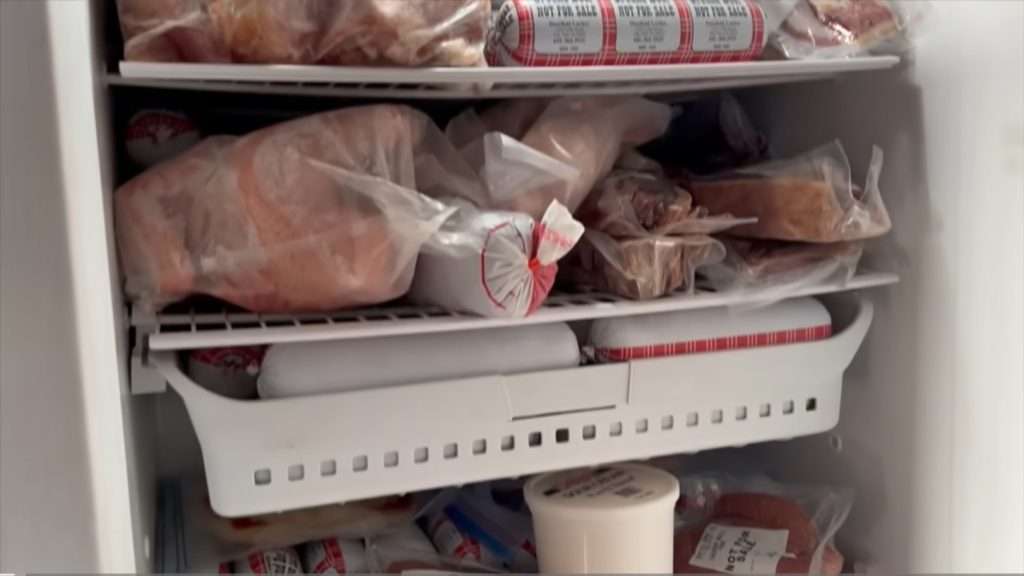
    Here is a really good podcast about what you and your customers should expect when getting a cow processed . It can be intimidating to buy beef in bulk for the first time. Share with your customers to help them fully utilize a whole or half cow, which is a big (and worthwhile) investment.

    Please keep in mind that these numbers are for a standard breed cow. The numbers for the Dexter will be less, but the return will be a higher ratio. Dexter ratios are closer to 60-65% with less inputs, easier on pastures and a whole lot of personality!

    Eat Your Way Through a Cow, Episode 1 Read More »

    Beef

    Sheep Vs Goats

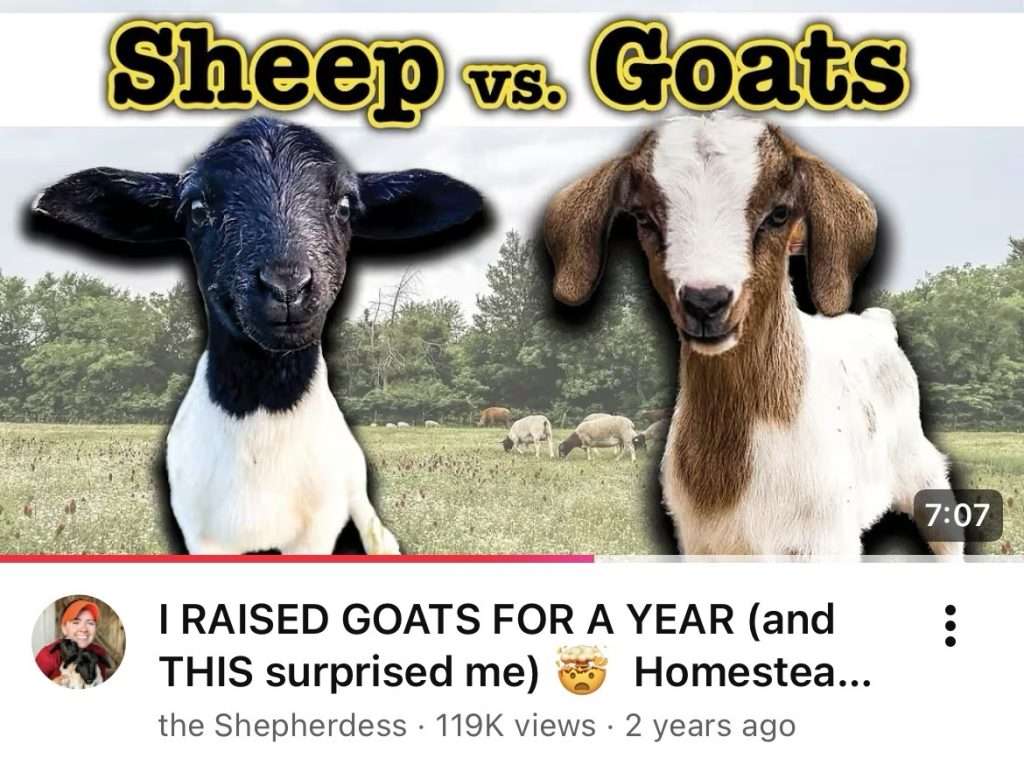
    Which animal is best for YOUR homestead?

    In addition to our wonderful Dexter cows, and our various poultry, we added sheep to our homestead. But, are sheep the right next step for you? Watch this short and informative video to help narrow down which animal would blend best into your system.

    Sheep Vs Goats Read More »

    Homesteading

    Planning Farm Succession

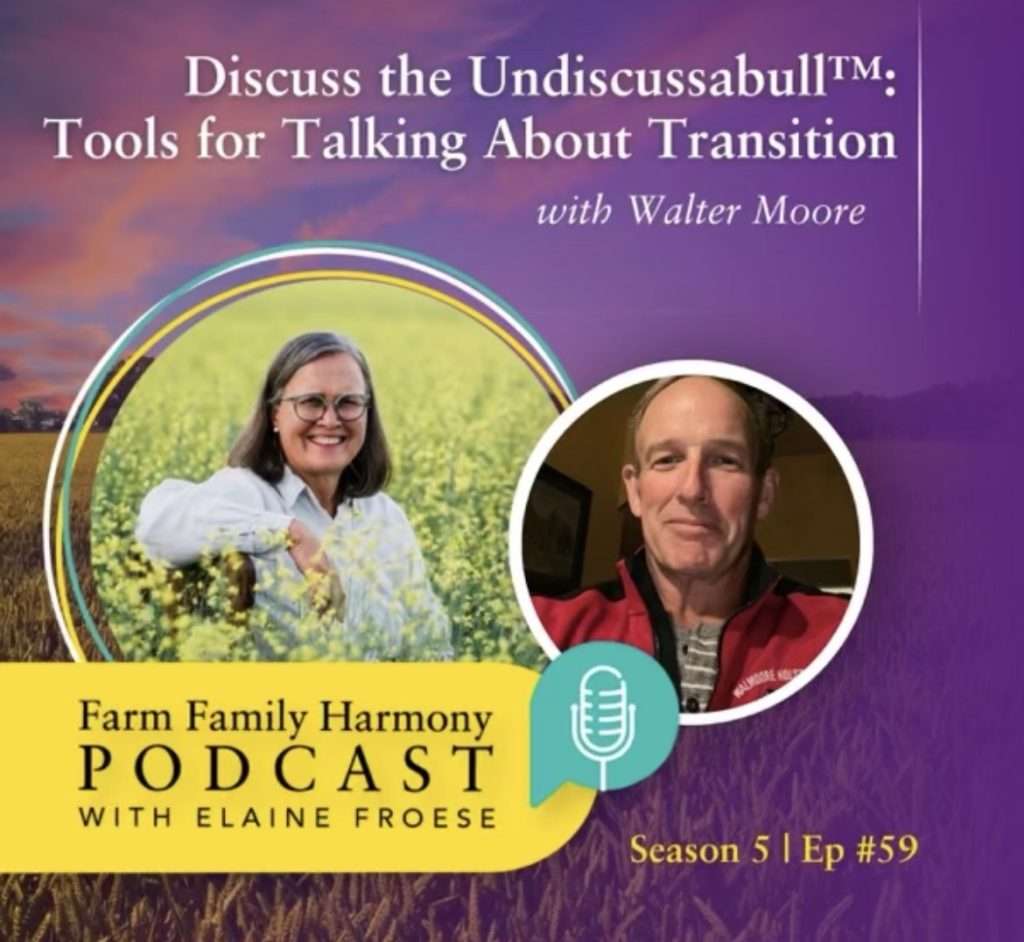
    The hard, but important conversations around family succession on the farm.

    With the price of land and start-up costs at an all time high, it is more difficult than ever to get into farming. In this podcast, Elaine Froese, and her guest, Walt Moore, talk about the key aspects of keeping a farm in the family. They provide such a needed conversation around finances, dreams, and communication so that the farm is around for generations to come.

    Planning Farm Succession Read More »

    Farm Management

    ASK THE BUTCHER! How To Field Dress A Deer!

    Here’s a clear, practical short article on how to properly field dress a deer:

    How to Field Dress a Deer Properly

    Field dressing a deer is an essential skill for any hunter who wants to preserve high-quality meat and ensure safe handling in the field. Done correctly, it cools the carcass quickly, prevents spoilage, and prepares the animal for transport. The process is straightforward but requires care, cleanliness, and attention to safety.

    1. Prepare Your Tools and Area

    Before beginning, ensure you have a sharp knife, gloves, and a stable place to work. Position the deer on its back with the head uphill if possible—this helps control blood flow and keeps the interior clean.

    1. Make the Initial Incision

    Start by cutting a small opening at the base of the sternum or just above the pelvis. Pinch the skin upward as you cut to avoid puncturing internal organs. Continue the incision along the midline up toward the ribcage. Many hunters stop at the sternum, but you can split the ribcage if needed for faster cooling.

    1. Open the Body Cavity

    Carefully separate hide and muscle from the abdominal wall. Use two fingers to lift the skin and guide the knife to prevent piercing the stomach or intestines, which can contaminate the meat.

    1. Remove the Organs

    Begin by freeing the diaphragm—the thin membrane separating the chest cavity from the abdomen. Cut around the esophagus and windpipe, then pull downward to remove the heart, lungs, and other internal organs in one controlled motion. Roll organs away to keep the cavity clean.

    1. Drain and Clean

    Tip or roll the deer to drain excess blood and fluids. Wipe debris from the cavity but avoid rinsing with water unless absolutely necessary, as moisture can encourage bacterial growth.

    1. Cool the Carcass

    Proper cooling is critical. Prop open the chest cavity with a stick or spreader to allow airflow. In warm weather, consider removing the hide more quickly to speed cooling.

    1. Transport Safely

    Once field dressed, move the deer to a clean, shaded location. Use game bags if packing out to keep meat free from dirt and insects.

    Proper field dressing is about efficiency, respect for the animal, and food safety. With practice and patience, the process becomes smoother and results in high-quality venison every time.

    ASK THE BUTCHER! How To Field Dress A Deer! Read More »

    Homesteading PipeDreams

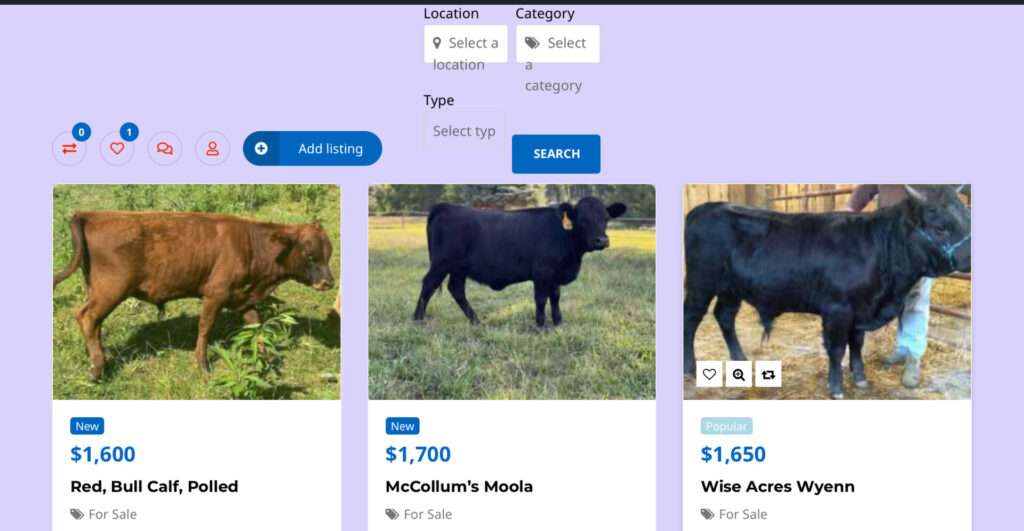
    The Irish Dexter Cattlemen Marketplace..have you tried a free ad?

    Did you know that we have given everyone a free ad to try out the Irish Dexter Cattlemen Marketplace? That’s right! Give it a try!

    I have found it a great place to produce a professional looking ad that can be shared anywhere.

    Recently, we have tweaked some of the features to make it easier to use. The pictures are automatically resized to work with the system. No pre approval process. We can tweak it later if we need to. And also a team behind you that can help you make it what you want it to be.

    Here are some recently posted ads. Check them out!

    The Irish Dexter Cattlemen Marketplace..have you tried a free ad? Read More »

    General

    Announcing The Documents Vault

    Irish Dexter Cattlemen is about farmers & Ranchers. A critical design feature of the website was to connect farmers & ranchers with each other using the latest technology. For example, whenever you list an item for sale in the MarketPlace, you instantly become connected to the buyers interested in your item. Buyers can directly message you and ask questions about the cow you have just listed. As the seller, you begin to collect the names and email addresses of all your potential buyers. This is one way farmers & ranchers become connected to each other..

    Announcing the Documents Vault, a new way farmers & ranchers can share information with other farmers & ranchers, plus a unique way to dramatically simplify the sale and transfer of your Irish Dexter. In fact, you can use the Documents Vault to sell and transfer any item you have on the farm. The key feature is how it can share.

    How Do I Access It?

    Casual users browsing the Irish Dexter Cattlemen website, users who have registered for free on the website, and members who have registered and then have become members, all have access to the Documents Vault in increasingly feature rich ways depending on their chosen level.

    To access the Documents Vault, mouse over Dashboards on the main menubar, then select My Documents Vault. If you are a casual user, this will open the Public Documents Vault containing folders and documents relevant for public viewing. If you are a registered user, this will open your Private Documents Vault where you can create you own personal folders where you can upload files and documents plus you will have acess to folders and files shared with you by other farmers & ranchers. If you are a member, you will have access to the same files and folders as do registered users plus you gain access to significantly more valuable documents that enhance your farming operation.

    What is it? How can I use it?

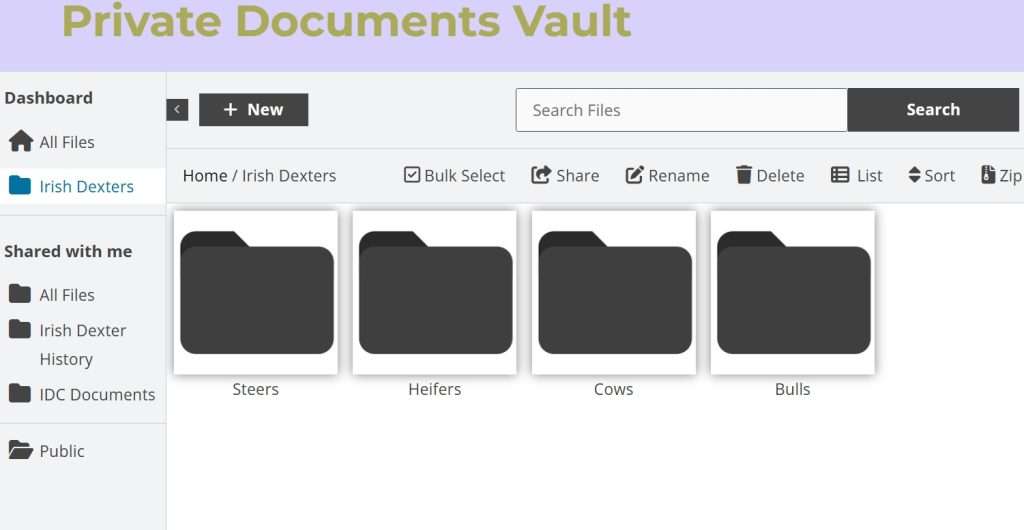
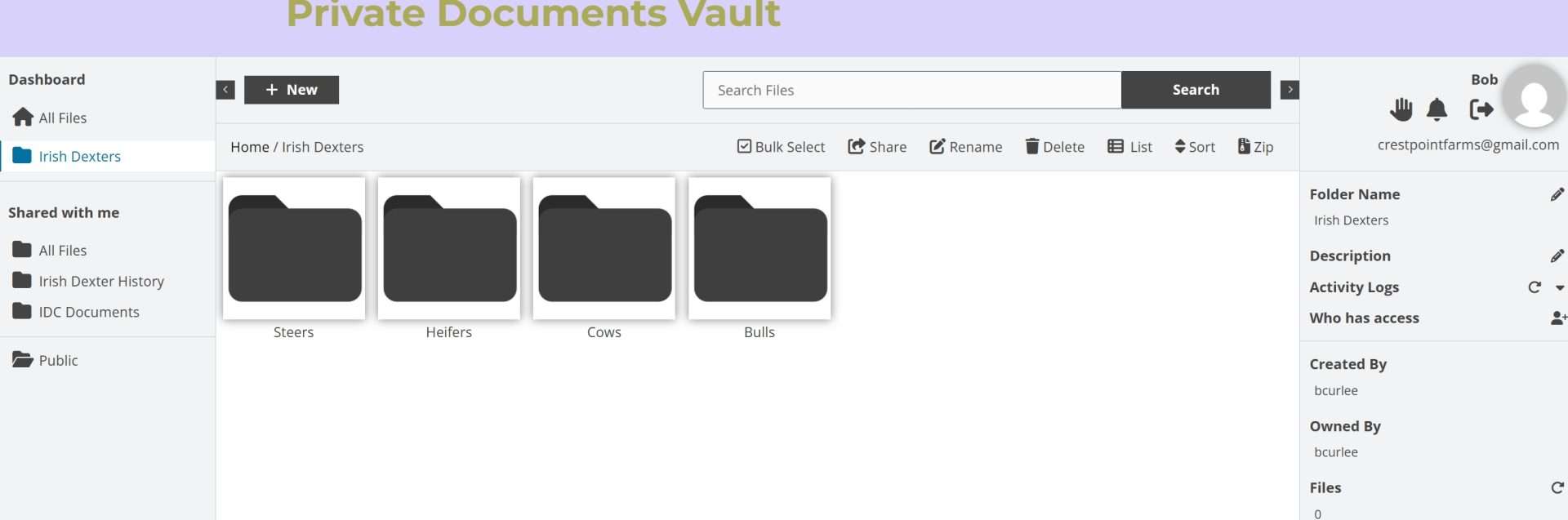
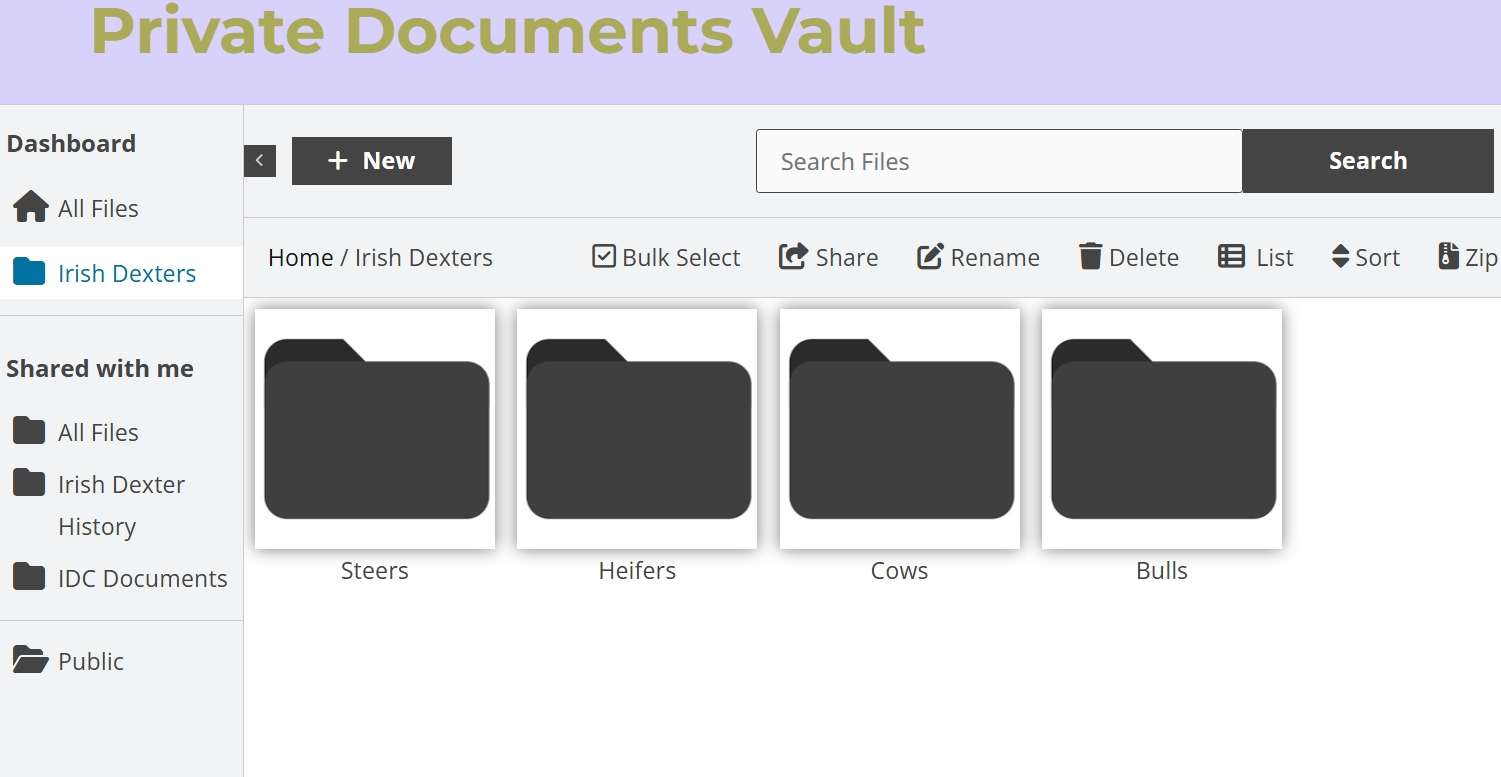
    The Documents Vault is no different than an ordinary file system except in one important way. It provides you with file and documents sharing. To begin, use the New button to create folders or upload files. In this example, a new folder was created and labeled Irish Dexters which you can see on the left under Dashboard. Clicking on this folder allowed for it to be opened and four more folders were created as you see above. Click on the Cows folder and here you can create a separate folder for each of your cows. Click on a specific cow’s folder and you can begin uploading the documents for that cow. What kind of documents? The system accepts Word documents Excel spreadsheets, PowerPoint presentations, text files, pdf documents, images, and photos. This means you can upload a photo of your brucellosis certificate provided to you by your vet. Upload your cow’s registration certificate provided to you by your registrar. Upload the genetic tests provided by your genetics testing lab. Upload your cow’s photos. Collect all the documents as they occur. Use your smartphone to capture your documents. What’s the benefit? When time comes to sell your cow, or heifer, or bull, one simple click of the Share button transfers all your cow’s information to your new buyer. This is how you build value for your farm and your buyer will instantly see that your farm is where they want to buy more cows.

    How do I share?

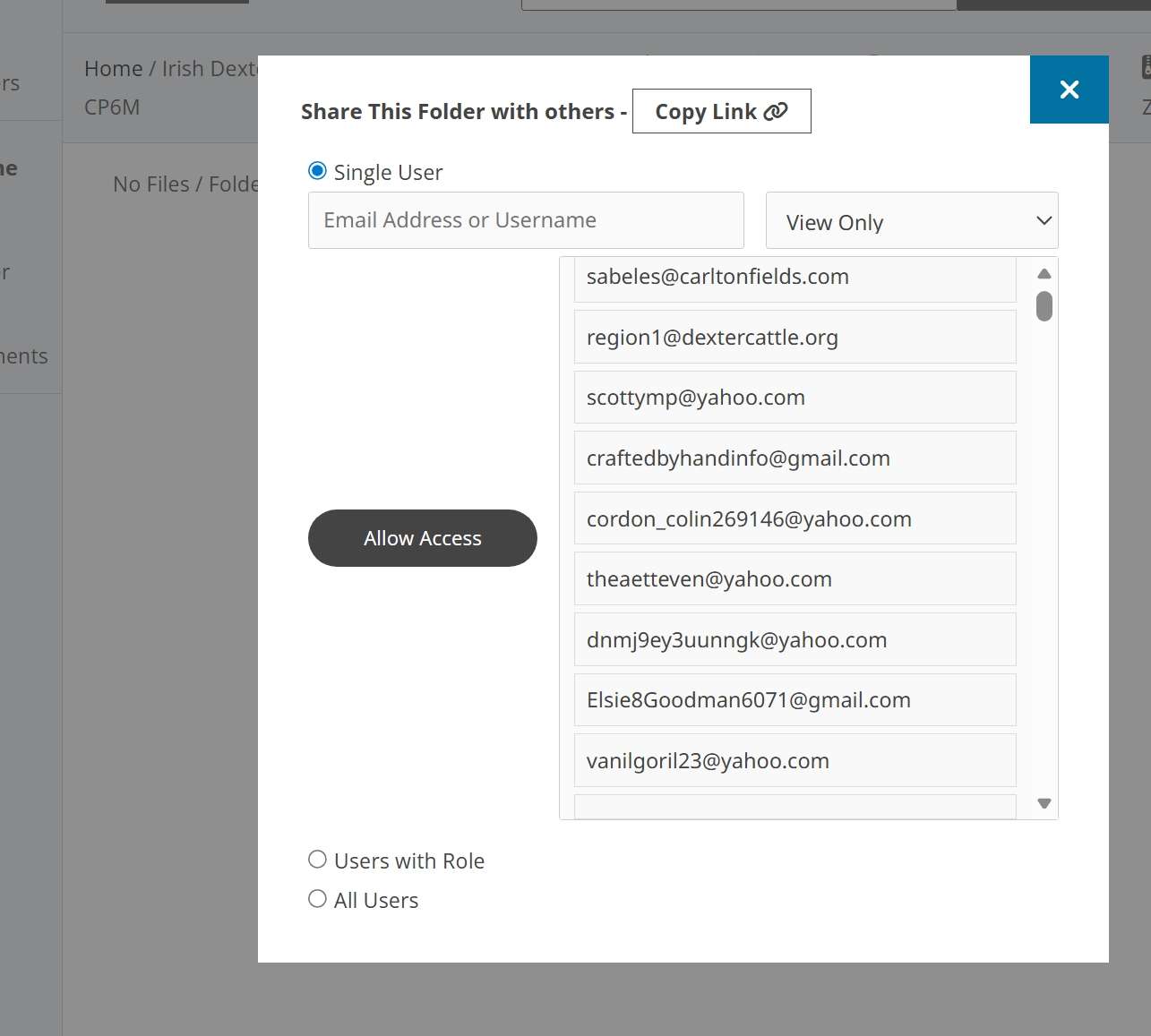
    Click on the folder then click on the Share button. It’s as easy as that. In the Share window (shown above) you can enter the buyer’s email address (they must complete a free registration on the website first) and then choose how you want to share your folder. Your choices are View Only, View and Upload, or Full Access. Any folder or for that matter, any single document can be shared. Sharing does not remove the folder or document. You continue to have full access to it, just as before. This new tools makes it even easier to sell and transfer your Irish Dexters and you have a direct record of who bought your cow. They buyer has a direct record of where they bought each animal. They are sure to buy more from you again.

    Summary

    Your fundamental, underlying goal in the operation of your farm is to build value. The Documents Vault does just that. It keeps you organized and it demonstrates to your buyers a significantly higher degree of trust. They are assured that they get everything they bought. This means that your buyers will be contacting you first for all their future purchases. The example here was for your Irish Dexters, but anything on your farm can be documented and shared in the same way. Also, you can add new information on how you farm and capture information you think is valuable and easily share it with everyone at Irish Dexter Cattlemen by selecting All Users in the Share window. The Documents Vault is how Irish Dexter Cattlemen connects farmers & ranchers.

    Announcing The Documents Vault Read More »

    General

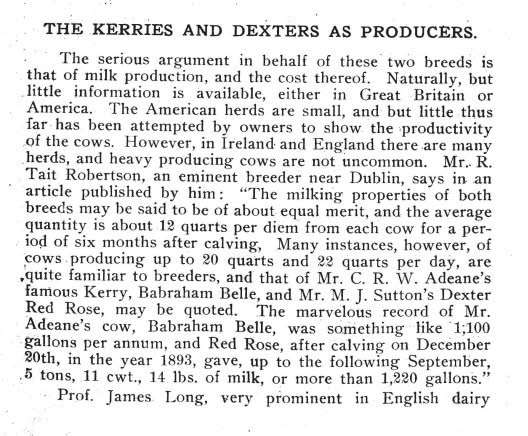
    Historically looking at the Dexter milk properties!

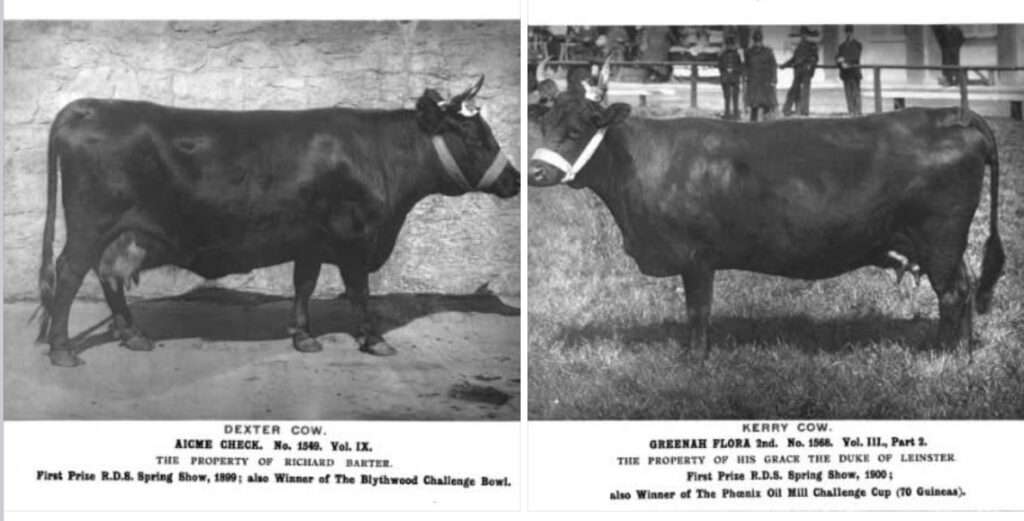
    Many may not know that the Dexter at one time was known to have milking properties of equal merit as the Kerry, a known dairy breed, though they are a dual-purpose breed. Mr. R Tait Robertson was to of said ” The milking properties of both breeds may be said to be of about equal merit”. Who is R. Tait Robertson? He is the son of James Robertson, of whom bred or collected a large portion of the foundation Dexters sold to England and other places. He was an influential breeder. For an interesting photo reference of the amazing similarities of Dexter and Kerry cattle see Aicme Check (Dexter cow) and Greenah Florah 2nd (Kerry cow). I did not have to hunt far and wide to find examples that looked closely related. All I had to do is go to the 1901 Herd book and find the only available photos of an example Kerry and Dexter cow. And by the way note the classic white Dexter udder marking on the Kerry cow as this was a common Kerry trait feature too. Nose to nose as you can see in the photo comparison they do look quite alike.

    Historically looking at the Dexter milk properties! Read More »

    Historical
    Content is for Members Only

    Become a Member of Irish Dexter Cattlemen

    1. Register First for free newsletter
    2. Go to Dashboard/My Account
    3. Then At bottom, Buy a membership
    Enable Notifications OK No thanks